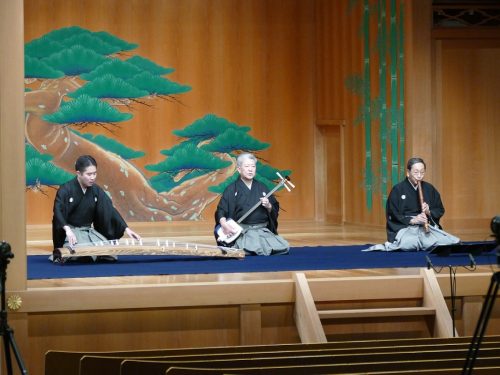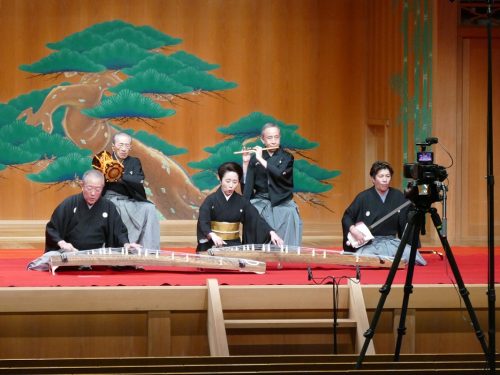

The seventh regular performance of the Japan Sankyoku Association 'Hibiki in Japan': The world of Nohgaku depicted in Sankyoku <II>
*Information at the time of adoption.
- Name of the organization or individual
- Japan Sankyoku Association
- subsidy category
- Creation Grant
- Grant Type
- single year
Reiwa 2 (2020) 1st Term Creation Grant [Single-Year Grant Program]


Business Overview
The Japan Sankyoku Association has held a series of performances centering on works related to Nohgaku at Kanze Noh Theater since 2019 with the cooperation of the head family of Kanze-ryu school. Due to the COVID-19 pandemic, the second performance was recorded at the Noh Theater and distributed online. The distribution is divided into two parts, 'the first part' and 'the second part', and the first part contains three classical pieces including 'Kikujido' performed by Living National Treasure Kisokyu KATATA as a guest performer, and the second part contains three classical pieces including 'Yashima' performed by Living National Treasure Seikinshi TOYAMA, who is the chairperson of our association, and two contemporary pieces as well as a conversation and a performance of Shimai between Noh shite-kata Takashi TAKEDA of Hosho school and Japanese music researcher Mihoko NOGAWA. Each song is preceded by a narration by Mr. Nogawa.
- Period of Activity / Project
- Thursday, February 18, 2021 to Friday, March 5
- Venues
- 25. Kanze Noh Theater Commemorating Sakon KANZE (Chuo Ward, Tokyo)
*Information such as project outlines is provided by organizations and individuals providing subsidies.
Profile
【 Public Interest Incorporated Association Japan Sankyoku Association 】
The Public Interest Incorporated Association Japan Sankyoku Association is an organization of professors and performers of sankyoku (A form of ensemble accompanied by singing, with koto, sangen, and shakuhachi) with a history of more than 50 years, and has more than 5000 members nationwide. With the aim of "To contribute to the promotion of Japanese traditional arts and the development of Japanese music culture by promoting the spread of koto, sangen and shakuhachi and promoting exchanges among schools of sankyoku." they hold five sponsored performances a year, and actively train young musicians and send lecturers to schools and experience classes.