
On July 14, 2023, the fourth activity debriefing session was held as a place to re-examine the significance and effects of "Social Grant" and widely share its results and future challenges. Chupki, LLC, which operates the cinema "Cinema Chupki Tabata" in Higashi-Tabata, Kita-ku, Tokyo, which operates universal screenings of movies that allow anyone to enjoy movies regardless of disability, and Chupki, LLC, While focusing on the screening of Kenji Miyazawa's recitation plays, the "Monogatari Group ☆ Polan no Kai", which is engaged in the dissemination of audio guides for the visually impaired and expressive activities with artists with various personalities such as visual and hearing impairments, reported on its activities. He talked about the significance of promoting barrier-free viewing and the possibilities of new creations that arise from it. In the first part, we will deliver the state of the roundtable with Chupki LLC, and in the second part, we will deliver the state of the roundtable with "Monogatari Group ☆ Polan no Kai".
- Date & Time
- Friday, July 14, 2023 18:30~21:00
- Venue
- Arts Council Tokyo 5th floor conference room
- Reporting organizations and speakers
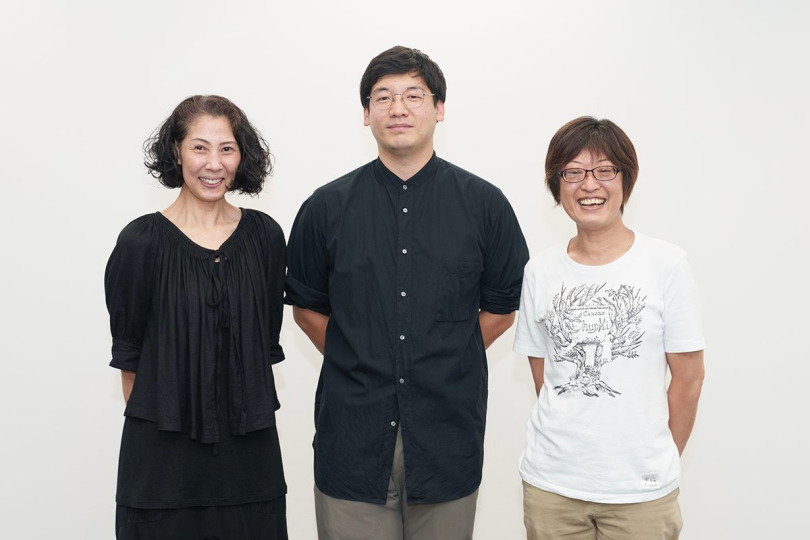
- Godo Kaisha Chupki Chihoko Hiratsuka
Monogatari Group ☆ Polan no Kai Sairi, Tetsuro Ishigami - facilitator
- Tomoki Ogawa
- graphic facilitator
- Mihoko Seki
- sign language interpreter
- Yuko Kato, Yuko Setoguchi

Credit: Chupki LLC

Photo by Kazuyuki Matsumoto

(Image enlargement: JPEG version)
Produces audio guides for classic foreign movies that can be enjoyed with the visually impaired
日本で唯一のユニバーサルシアター「シネマ・チュプキ・タバタ」を運営する合同会社Chupki。代表の平塚千穂子さんから「芸術文化による社会支援助成」に採択されたふたつの事業を中心に活動が紹介された。
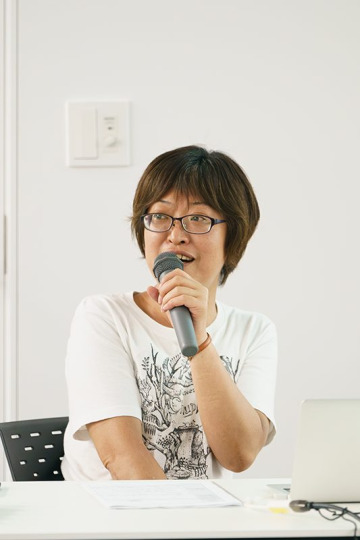
Photo by Kazuyuki Matsumoto
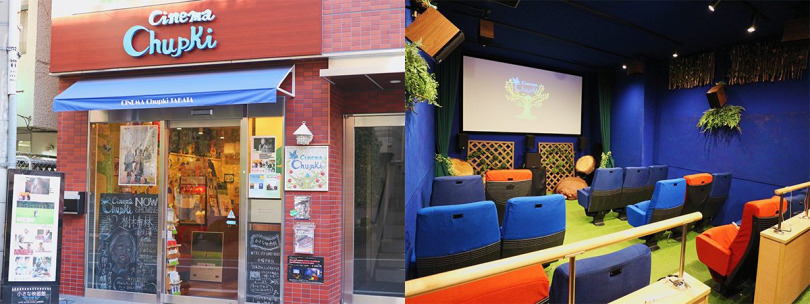
Cinema Chupki Tabata (Hereinafter, Chupki) is a small 20 seat cinema where anyone, including the visually and hearing impaired, those in wheelchairs and those raising children, can enjoy movies without worry. City Lights, a volunteer organization that has been working since 2001 to create a movie-viewing environment for the visually impaired, raised funds through crowdfunding and other means, and in September 2016 it opened in a shopping district about a 5 minute walk from JR Tabata Station. All selected movies are screened universally. Universal screening is a screening style in which any person can enjoy a movie. For the visually impaired, audio guidance with earphones is provided, and for the hearing-impaired, viewing support tools such as screenings with Japanese subtitles are provided at every screening. There is also a wheelchair space and a parent-child viewing room.

Courtesy of Chupki Limited Liability Company
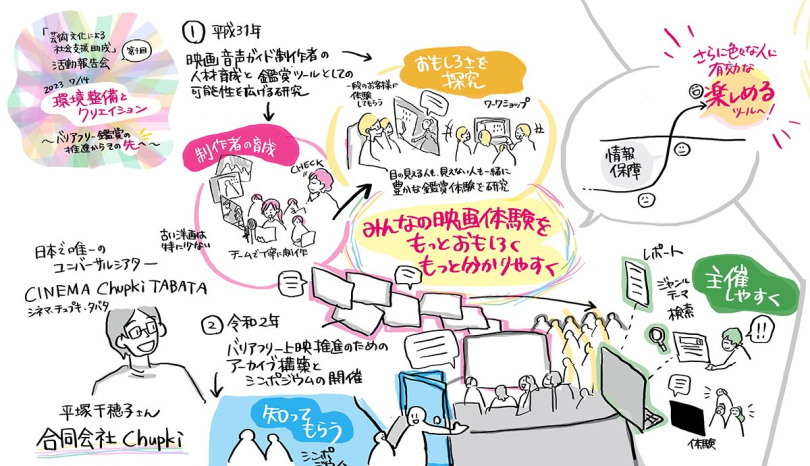
"I received a grant from 'Social Grant' for a project I planned to solve problems in running a movie theater on a daily basis," says Mr. Hiratsuka. First, in the first term of 2019, "Research on human resource development for movie audio guide producers and expanding their possibilities as viewing tools" was adopted.
"Listening to the voices of visitors, we realized that there was more potential for audio guidance, and we received a request from a visually impaired person who said, "I would like to revisit old foreign movies that I used to watch when I could see." On the other hand, many elderly people and young people have stopped watching foreign movies with subtitles because the general public has become less interested in subtitles. In recent years, movie distributors have started to provide their own audio guides, and an increasing number of movies can be listened to through and "HELLO! MOVIE" apps. However, only about 10% of movies have audio guides, and most of them are Japanese movies. Therefore, while producing audio guides for classic foreign films, I wanted to develop human resources and improve the skills of audio guide producers."
"We want to promote not only information security for the visually impaired, but also the enrichment of the viewing experience by watching movies with various people with audio guides. One of our goals was to make foreign films barrier-free more popular and standard."
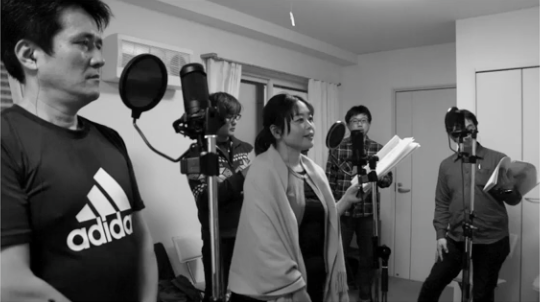
The project is divided into three main categories: upgrading the skills of audio guide producers, barrier-free screenings and questionnaire surveys, and holding workshops. First, in the "Skill Improvement for Audio Guide Producers," we created audio guides based on three classic foreign films of different genres: "Stagecoach," "Miracle on Thirty-fourth Street," and "Casablanca." "Many old foreign movies are not dubbed, and people with visual impairments cannot see the subtitles, so the audio guide includes the reading of the subtitles. Subtitles are almost entirely dialogue, so it's a dubbing process called voice over. A casting director was assigned to create scripts and cast audio guides, while at the same time training casting directors. We cast 10 ~ 15 voice actors for 1 foreign film, but in the case of a film with many minor roles, 1 voice actor sometimes played 5 ~ 6 roles to avoid overlapping dialogue."
原音のトーンや芝居とズレないように声優たちがセリフを録音する様子は、スタジオ収録を記録した動画で見ることができる。シネマ・チュプキ・タバタ公式ウェブサイトの「事業報告」に掲載されているのでぜひ見てほしい。
Source: Chupki LLC
In consideration of the training of the producers, we made a plan to produce one audio guide in two months. Instead of making 1 film by 1 person, each person divided the time into about 20 to 30 minutes, and 1 film was made by a team of 4 or 5 people.
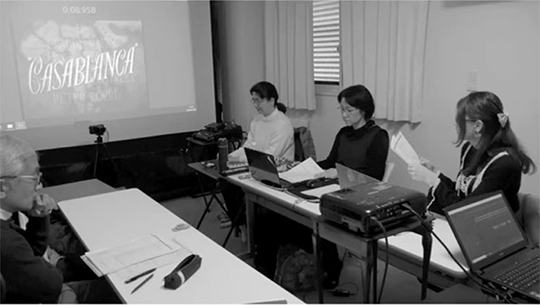
"After each member wrote their first draft, they had to coordinate with each other, for example, to unify the names. They communicated closely between their parts and other people's parts to see if they could describe the same place in the same scene with the same words, and how to call names. Also, the rewritten manuscript should be checked by the members. A visually impaired monitor will check the completed script. Based on these considerations, we will revise the expressions that need to be rewritten and record the narration in the final script. The flow is to edit the recorded material and complete the audio guide."
音声ガイドモニター検討会の記録動画を紹介しながら、視覚障害者モニターの方から「リズムが悪い」という指摘を受けた例を解説した。「ガイド制作者が長い文章を書いてしまって、それを短くポンポンと切ってもらえると情景がイメージしやすいなどの意見をいただいているところです」。この動画も公式ウェブサイトの「事業報告」に掲載されており、時代背景、人物の特徴、シーンのつながりや意味など、非常に丁寧に読み込んで制作される過程が垣間見える。
Courtesy of Chupki LLC
The second project is a barrier-free screening and questionnaire survey. Can we expand the possibilities of using audio guides? A questionnaire survey was conducted by Chupuki audiences with and without visual impairments.
"When asked what impression they had after listening to the audio guide with earphones, 85% replied that it was good. More specifically, "It was easy not to follow the subtitles with my eyes." On the other hand, some said, 'I felt uncomfortable because the subtitles and the dialogue were different,' and 'I couldn't concentrate on the movie.'"
When asked if they would like to listen to audio guides again, 47% said they would like to and 33% said it depends on the work. "It's not just the audio of the subtitles, so the audio guide of the situation that supplements the visual information feels unnecessary because it is understood by those who can see it, and I think it is because I feel a little uncomfortable that I don't see it that way. There was also a comment that "I would like to use it for the second and subsequent viewings.""
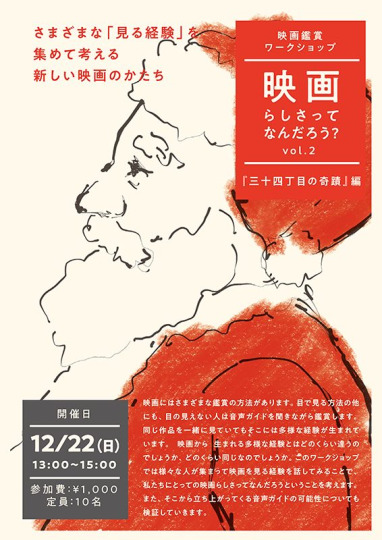
In the third project, "holding workshops," with the cooperation of Mr. Kenta Hayashi of the "Art Appreciation Workshop with the Visually Impaired," audio guides were used to create a place for people to share their experiences and discuss the theme, "What is the essence of cinema?". It was around March 2020 when the COVID-19 pandemic began to make it difficult to hold events. Seven or eight people participated, including those who had not seen the films at Chupki but had seen them on DVD, video or in other theaters. "I think people who saw it a long time ago have vague memories, so I asked the participants to come up with a scene that left a lasting impression on them, and everyone, whether they could see it or not, watched the scene repeatedly with an audio guide, and then we asked them to describe what they saw and what they felt."
"Different people have different values, different knowledge, and different ways of feeling, so there are differences in the viewing experience. However, there are surprisingly few places where people can express their misplaced experiences with peace of mind. Mr. Hayashi facilitated the dialogue, and he felt that by creating different impressions and incongruity, the uniqueness of the movie and the fun of the movie are enhanced."
"I was particularly impressed by the scene in "Stagecoach" in which a visually impaired participant said, "It was like watching a baseball game in a stadium." Those who can see it are watching/being shown what is shown by the camera operation in the movie, but those who can't see it have a bird's-eye view of the whole chase, and according to the action description of the audio guide, focus on the main character who is running away and the Apache tribe who is chasing."
Also, in "Miracle on Thirty-fourth Street," there is a long deliberation in the courtroom scene at the end. In response to the audio guide, "How do you see the passage of time?". "The viewer senses that time has passed by watching two different courtroom scenes overlap in a cinematic technique called overlap. Watching it with a variety of people made me realize once again that only movies can express themselves. Through the film watching workshop, I was able to experience breaking down the structure and how films are made, and it was interesting to talk about how well films are made."

Credit: Chupki LLC
At Cinema Chupki Tabata, earphones for listening to the audio guide are available at the reception, and people with or without visual impairments who want to listen to the audio guide can borrow them. "Recently, the audio guide has become a hot topic on social media, and people from movie companies have asked us to include the audio guide when they make DVDs. Some people are interested in the audio guide and come to watch it after reading the comments of the people sending it. This tool was originally developed to provide information security for the visually impaired, but it is effective for a wide range of people, and I think I was able to convey how much fun it is to use it to share your thoughts with others."
Creating a website for people who want to hold universal screenings
In the second term of FY 2020, "Building an Archive and Holding a Symposium to Promote Barrier-Free Screenings" was adopted.
"Although many films have been made that are barrier-free, there have been several problems, such as not being able to fully utilize these tools as archives. It was not easy to find out which films were barrier-free, who to contact if they wanted to screen them, and how to handle viewing support tools. Since know-how is not shared, people thought it would be difficult to implement, and the hurdle was raised. The need for audio guides and subtitles is spreading among the elderly and young, and they can be used effectively as viewing tools to enjoy movies, but they are not widely recognized."
"For this reason, we wanted to make it easier for people who wanted to hold universal screenings to research, share know-how, and hold them casually. There was also a sense of crisis that screenings themselves might decline due to the COVID-19 pandemic, and I thought it was important to protect the venue for screenings, especially for things like universal screenings, which might be difficult to hold."
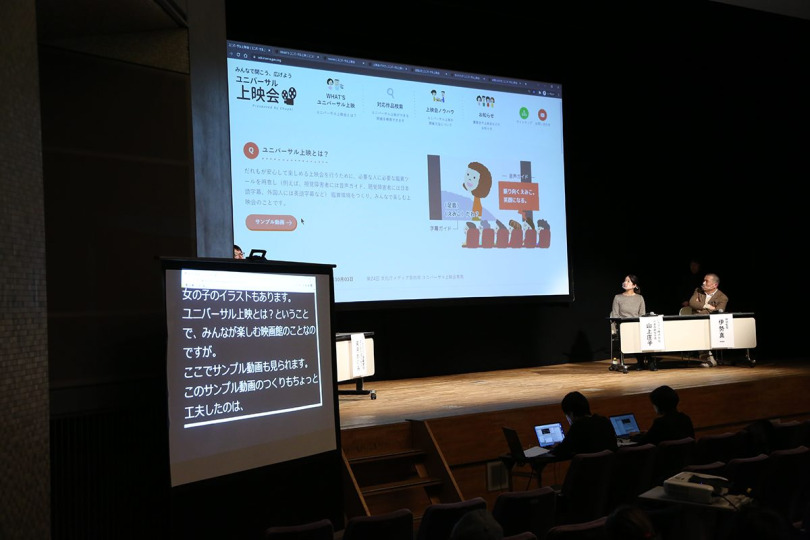
そこで、ユニバーサル上映会を主催する人に役立つ情報を集め、アーカイブ検索機能のついたウェブサイトを作成することにした。サイト名は「みんなで開こう、広げよう、ユニバーサル上映会」。まず、ユニバーサル上映とは何かを紹介するサンプル動画を作成した。
"In this video, you can experience how movies feel when you are blind, how movies look with audio guides, how important subtitles are when you are deaf, and what a universal screening with audio guides and subtitles is like. In the section about 'what it would feel like to be blind,' the screen is completely dark without any video, and in the section with audio guide, the screen is completely dark but you can hear the audio guide, so you can watch the movie while imagining it. "How much subtitles are needed?" is a video that allows people who can't hear a movie without subtitles to experience what it's like to watch a movie with subtitles. And at the end, it's all attached. Universal screening is based on the concept of universal design, which aims to enrich the possibilities of the viewing experience for everyone who shares the venue by providing the necessary viewing tools to the people who need them and watching movies together with various people. Universal screenings are not only about adding Japanese subtitles and audio guides, but also about adding English for foreigners. It's a website that says that movies belong to everyone, so the richer the venue, the more possibilities there are to experience them."
The main focus of the website is to search for supported titles. Most of the movies in the database that are officially produced by studios support UDCast or "HELLO! MOVIE" and can be identified by an icon on the app. What's not marked is Chupki's production, which isn't compatible with the app but has subtitles and audio guides. The information is divided into genres and categories and takes you to the movie information site Movies .com. Among the huge number of barrier-free movies, it is easy to find what kind of movies organizers can screen universally, and you can also search by theme such as diversity-related movies. As for how to hold a screening, he explained the process of planning and advertising about three months in advance and renting a venue. Dozens of cases have resulted in actual screenings. "In the future, we would like to increase the number of reports from people who actually held universal screenings. I would like to introduce examples and increase the number of people who want to try it."
Symposium and Screening of the Film "Interpreters of the Heart"
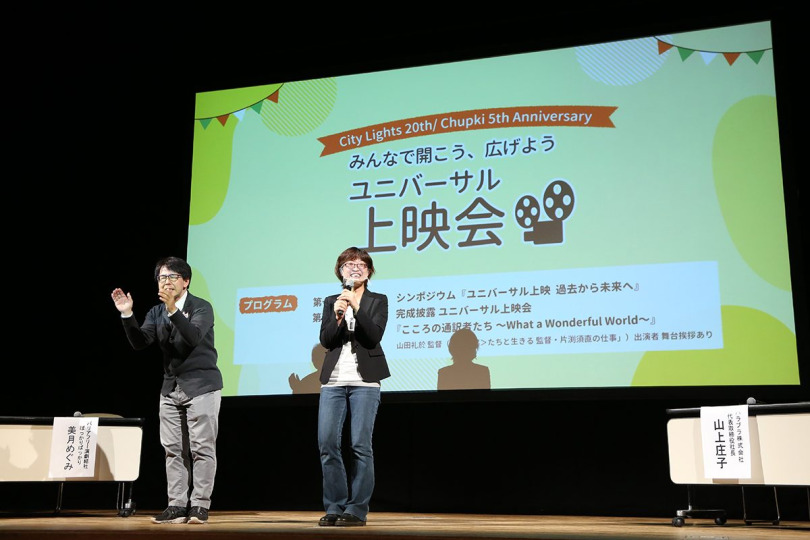
Furthermore, in order to promote the archiving of these films and the utilization of viewing tools, a notice was sent to about 1200 places, including public halls, cultural promotion offices, social welfare councils, facilities for the disabled, and public libraries in each municipality that may hold future screenings, and participants were invited. On December 22, 2021, a symposium entitled "Universal Screenings: From the Past to the Future" was held at Kitatopia Tsutsuji Hall (Kita Ward, Tokyo). Guests included Megumi Mitsuki, a visually impaired person who is the vice president of City Lights and an actor in the "Barrier Free Drama Association"; Shoko Yamagami, president of Palabra Co., Ltd., who developed the "UDCast" app; and Shinichi Ise, director of Ise Film, a film production and distribution company that has been producing documentaries about the disabled for many years.
"Mitsuki is a disabled person who enjoys watching movies. Director Ise worked with Chupuki to produce audio guides and subtitles. At first, he was skeptical about the use of viewing tools, but when he was actually involved in the production, he began to say that he wanted to make all of his works barrier-free, going back to the old works, and he made about 11 of them barrier-free. We had such a director come and talk about how the experience can be utilized by the producer, the viewer, and the person who connects them by making viewing tools and showing them universally."
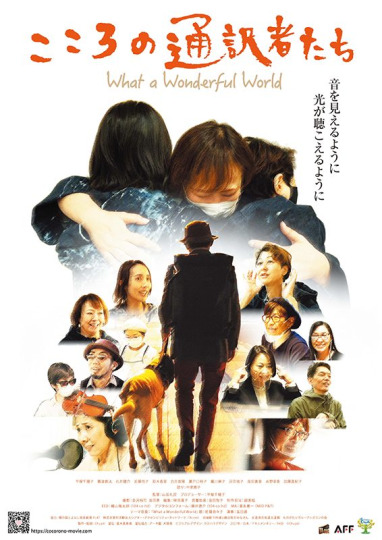
In conjunction with the symposium, a preview of the completion of Chupki's first documentary film (Hereinafter, "Interpreters of the Heart") was shown.

Courtesy of Chupki GK
"Through these projects, the goal is not to equalize movie-viewing opportunities for the disabled, but rather to hold universal screenings in order to make everyone's movie-viewing experience richer and more interesting. So I hope I've told you that everyone should be active."
"Interpreters of the Heart" has since been shown in various theaters, and now independent screenings are held in various places. "After the symposium, we will meet people at each screening venue and tell them that they saw it. The number of people who want to hold a universal screening is increasing, and some people want to show Interpreters of the Heart. I would like to continue to expand the significance and value of universal screening by accompanying them." he said at the end of the presentation.

Courtesy of Chupki LLC
There were some questions from the facilitator, Mr. Ogawa.
- Ogawa
- Although UDCast and "HELLO! MOVIE" are becoming more popular, they say that only about 10% of games have the audio guide, but looking at search sites for games that support it, we don't see Roman Holiday, for example.
- Hiratsuka
- Right. When UDCast or "HELLO! MOVIE" are used, the production committee decides to add audio guides and subtitles for new releases, and they spend the budget to create them. The reason why there are so many Japanese films is that they are always checked by the producers. I think it's because it's difficult to check old works.
- Ogawa
- I see. That's why Chupuki is used.
- Hiratsuka
- If you don't have it, you have to make it.
- Ogawa
- Hiratsuka-san's activities are structured in several layers, such as forming an organization called City Lights, building a long-awaited movie theater, building various platforms, and producing a film called Kokoro no Interpreters to expand the platform. I want to check what kind of cinema Cinema Chupki Tabata is. What is showing now (as of July 2023)?
- Hiratsuka
- This year marks its seventh anniversary. Right now, we are showing "Blue Giant," a coming-of-age movie about three young men who are fascinated by jazz. It wasn't barrier-free, so I attached an audio guide with our building's original. Chupki has only 20 seats, so there is a waiting list, so the show will be extended.
- Ogawa
- What language is Chupki?
- Hiratsuka
- In the Ainu language, it means "the light of nature." Natural light, the sun, the moon, and stars can all be represented by chupuki. The light of nature falls on everyone equally.
- Ogawa
- It seems to embody that movies belong to everyone. It's okay to bring children even if they have disabilities.
- Hiratsuka
- Yes. There is also a small room called the parent and child viewing room, which is completely soundproof, and even if the baby cries, you can continue viewing from that room without worry.
Mr. Hiratsuka of Chupki, a limited liability company, is trying to promote barrier-free viewing tools and universal screenings by voluntarily creating audio guides for classic Western movies that are not produced by movie companies. This was not only to support the viewing of films for people with disabilities, but also to shed light on the "viewing" aspect of films and to enrich the relationship between films and people. It was also a proposal that I hope various movie theaters will refer to.
(Reporting and writing by Yuri Shirasaka)
Chupki LLC
2001年より視覚障害者の映画鑑賞環境づくりを続けているバリアフリー映画鑑賞推進団体City Lightsが2016年に募金を集めて設立した映画館。視覚障害者のみならず、聴覚障害者、発達障害者、車椅子利用者、小さなお子様連れのお客様など、様々な障害を持つ人が安心して映画を鑑賞できる環境を提供する日本初のユニバーサルシアター。映画の音声ガイドや日本語字幕を制作し、毎日ユニバーサル上映を実施。
https://chupki.jpn.org/
Social Grant Grant results
- FY 31 (2019) 1st Term "Human Resource Development for Movie Audio Guide Producers and Research to Expand Possibilities as a Viewing Tool"
- FY 2020 (2nd Term) "Building an Archive and Holding a Symposium to Promote Barrier-Free Screenings"
Monogatari Group ☆ Polan no Kai
2004年創立。「生きる」をテーマに宮澤賢治作品のみを上演。 2021年イーハトーブ賞奨励賞受賞。 舞台の音声ガイド制作、鑑賞サポートに携わる。 2020年より字幕映像制作や手話パフォーマーとともに創り上げる公演を行っている。
https://polan1010.com/
Social Grant Grant results
Social Grant
A program to support "Activities that allow people who have limited opportunities to experience and participate in art due to their social environment to engage in art experiences, such as appreciation and creation, and to exercise their creativity and enrich their imagination." and "An artistic activity that sets social issues based on one's own awareness of problems and works to solve them through cooperation and collaboration with various people and organizations" for organizations working in Tokyo. It was started in fiscal year 27 (2015), and since fiscal year 28 (2016), public applications have been held twice a year. It has supported more than 120 projects. It is not just "art for art's sake" or "art that is useful to society," but it is trying to support activities that propose and materialize a new way of art in which society and creative activities are inseparable in a way that has never been done before, so to speak, "the third art."