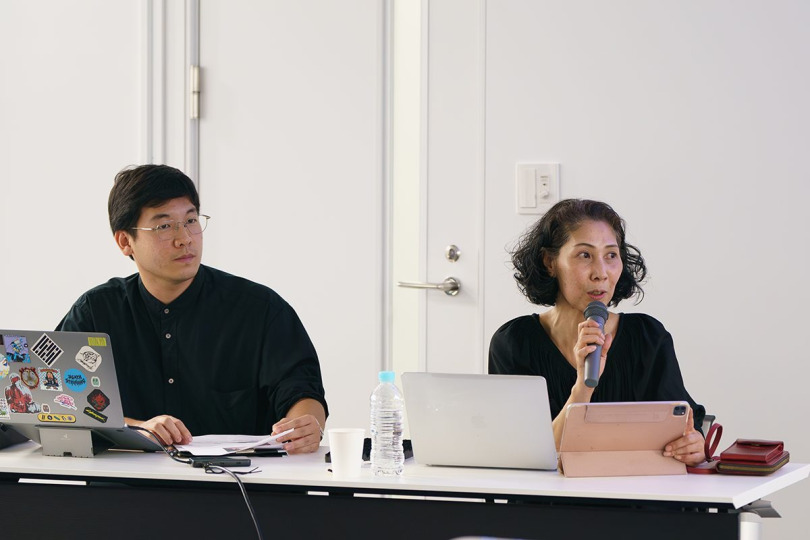

On July 14, 2023, the fourth activity debriefing session was held as a place to re-examine the significance and effects of "Social Grant" and widely share its results and future challenges. In the first part, we introduce the activities of Chupki LLC, which operates Cinema Chupki Tabata, a movie theater in Higashi-Tabata, Kita-ku, Tokyo, which provides universal screenings of movies that anyone can enjoy regardless of disability. In the second part, we will report on the "Monogatari Group ☆ Polan no Kai", which focuses on the screening of reading plays by Kenji Miyazawa, disseminates audio guides for the visually impaired, and engages in expressive activities with artists with various personalities such as visual and hearing impairments. After that, we will also deliver a roundtable with the participants.
- Date & Time
- Friday, July 14, 2023 18:30~21:00
- Venue
- Arts Council Tokyo 5th floor conference room
- Reporting organizations and speakers
- Godo Kaisha Chupki Chihoko Hiratsuka
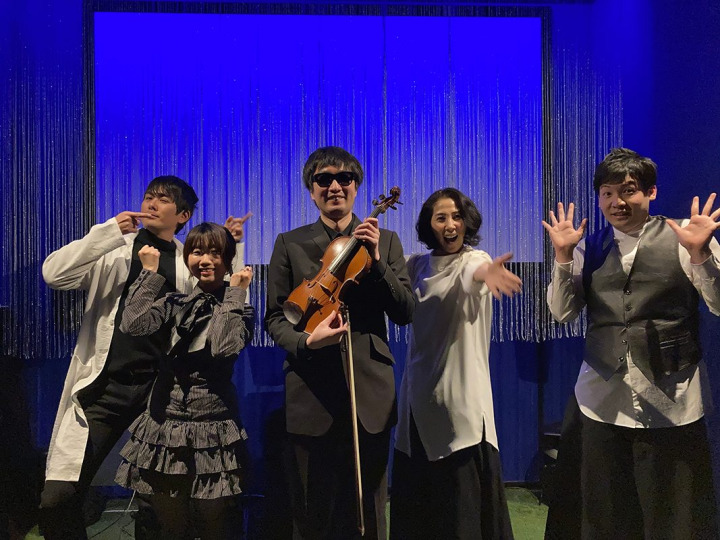
Monogatari Group ☆ Polan no Kai Sairi, Tetsuro Ishigami - facilitator
- Tomoki Ogawa
- graphic facilitator
- Mihoko Seki
- sign language interpreter
- Yuko Kato, Yuko Setoguchi

Courtesy of Monogatari Group ☆ Polan no Kai

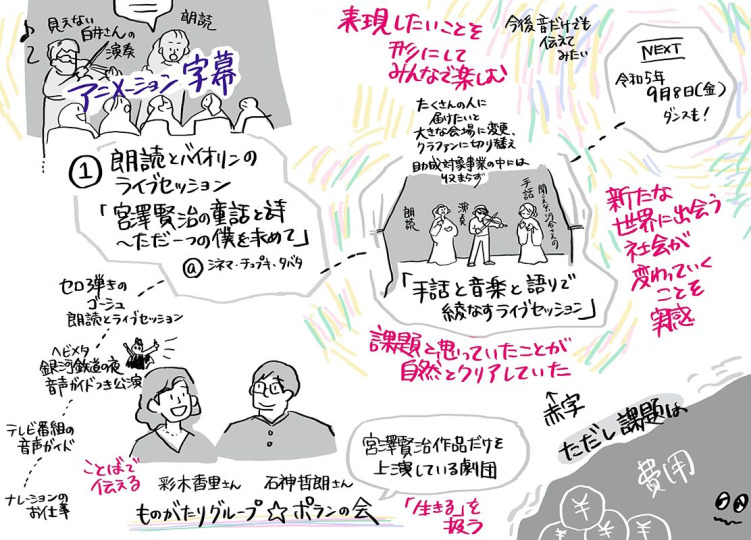
(Image enlargement: JPEG version)
Encounter with Cinema Chupki Tabata and the Opportunity to Support Viewing
「ものがたりグループ☆ポランの会」(以下、ポランの会)は、「生きる」をテーマに宮澤賢治作品のみを上演している劇団だ。代表の彩木香里さんと劇団員の石神哲朗さんが登壇。令和3(2021)年度 第1期「芸術文化による社会支援助成」に採択された「朗読とバイオリンのライブセッション」を中心に、視覚障害や聴覚障害のあるアーティストとの共同制作、字幕映像制作と表現活動について紹介した。
The troupe was founded in Tokyo in 2004 and has also performed in Miyazawa Kenji's hometown of Hanamaki, Iwate Prefecture, since 2016. "Reading Miyazawa Kenji's works makes me think about what it is to live." says Ayaki. "The poem describes Kenji's own struggles, and I think those of us who live today can relate to it. Also, children's stories are written in such a way that children can enjoy reading them, but when you read them again as an adult, you realize that they also depict human beings who are stupid." It is said that they were formed with the idea that "If only one or two people on earth could be kind, wouldn't the world be kinder?" through Miyazawa's works. "It's based on the idea of performing Kenji's works, so we don't really want to put on a big show in a big theater, but we want to tell people if they see one or two people."
Ayaki, who usually works as a voice-over narrator, began to see the interest in supporting viewers when she worked as an audio guide for a TV program in 2013. I immediately wanted to add audio guides to my troupe's performances, so I took a barrier-free course at JVTA (Japan Academy of Video Translation). In 2015, the theater company's 10 year anniversary performance "Night on the Galactic Railroad - Heavy Metal Version" was scheduled to be held at Nogata Ward Hall, so 5 of the performers attended the course. The five are still working on audio guides, subtitles, and other support services.
"It was our first performance with an audio guide, and we felt our way through it, but it was fun to create our own performance even when we didn't know what to do. Usually, an audio guide is added to a completed play later, but we were able to create an audio guide while discussing what we wanted to convey and what we wanted people to see from the beginning of the play."
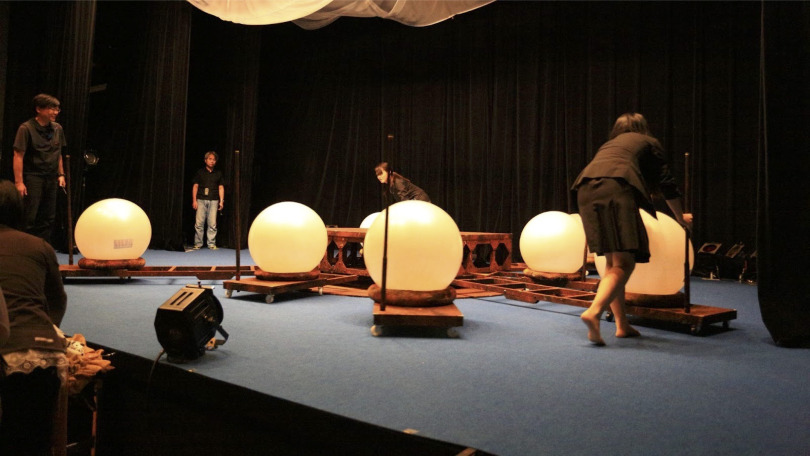
The stage set consisted of a three-meter-square platform at the center of the stage, seven railway-like tracks radiating from it, and a balance ball placed at the end. In some cases, the actors sat on the balance ball, which also rotated when the set was pushed with their hands. "In addition to the audio guide, the visually impaired were asked to stand on a platform, sit on a balance ball, and spin the set with several actors in what was called a guided tour before the show started. As for the actual costumes worn by the actors, the costume staff accompanied them and explained the material and shape of the costumes."

Source: Monogatari Group ☆ Polan no Kai
"For this performance, we borrowed the FM radio equipment from Mr. Hiratsuka of Chupki LLC so that the audience could listen to the audio guide, and we have known each other since then. After a while, in 2019, we decided to do some kind of reading in Chupki."
From now on, there will be a need for theatrical support, not just for movies, so Ayaki wanted to try what she could do on her own, even as a small theater company. With Hiratsuka's advice, they tried their hand at creating barrier-free subtitles and audio guides, and collaborated with Cinema Chupki Tabata for a screening and reading of the film Gauche the Cellophile.
Blind Biolist With Deaf Actor
Soon after, the next concert was scheduled, and Hiratsuka introduced Shirai Takaaki, a completely blind violinist. "When I said, "Yes, yes." it happened that Mr. Shirai, who is blind, introduced me to the violin. It was the first time for me to perform with an invisible person, so at first I wondered how I should practice, but when I actually met him, he was able to adjust the volume and operate the equipment, and he taught us a lot of things, so we got along well."
In this way, the plan for the "Reading and Violin Live Session" in which the Polan Association will perform with Takayo Shirai was born, and it was applied for and adopted for the first term of "Social Grant" in Reiwa 3 (2021).
"The original plan was to perform readings of Kenji Miyazawa's children's stories and poems and violin sessions with barrier-free subtitles in July and December 2021. But then a state of emergency was declared, and it was postponed to February and June 2022."
Just as she was making plans for the performance after the postponement, the stage performance for which Ayaki was an audio guide was accompanied by a stage sign language interpreter. Ayaki was attracted to sign language expressions and thought, "I want to do it in my own performance!" so she consulted Shirai and Hiratsuka. The February performance will be performed by Shirai and Ayaki as originally planned, and the June performance will be accompanied by stage sign language interpreters. While meeting with TA-net (Theater Accessibility Network), a non-profit organization that trains and dispatches stage sign language interpreters, to realize this, Asako Hirokawa, the president of TA-net, advised him that it would be more interesting to perform with a Deaf actor, and he was introduced to Deaf actor Yumiko Kawai. In June, Shirai, Ayaki, and Kawai will join together to hold a performance that combines sign language with reading and music. "We began by groping what was necessary and what should be done for Mr. Shirai, who could not see, and Mr. Kawai, who could not hear, to express a work together on the same stage. I had to change my practice and budget a lot, but I still wanted to do it."
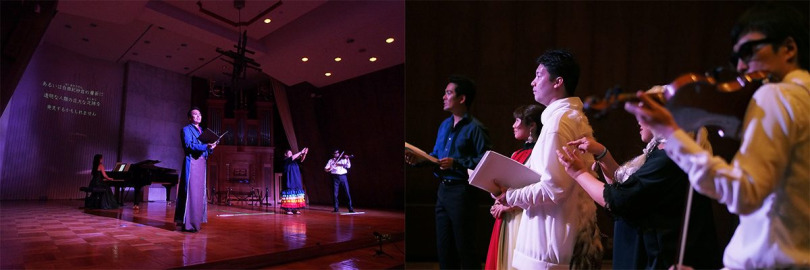
First of all, at the "Reading and Violin Live Session: Children's Stories and Poems by Kenji Miyazawa - In Search of the Only Me" held in February, there was a live session with Polan no Kai and Ms. Shirai's violin. It was held at the same museum as a special event for the theme of the Chupuki movie that month, "Living." For Nighthawk no Hoshi, Shirai wrote new music, and for the four poems from Haru to Shura (Spring and Shura), Shirai's original music was arranged for the performance.

Courtesy: Monogatari Group ☆ Polan no Kai
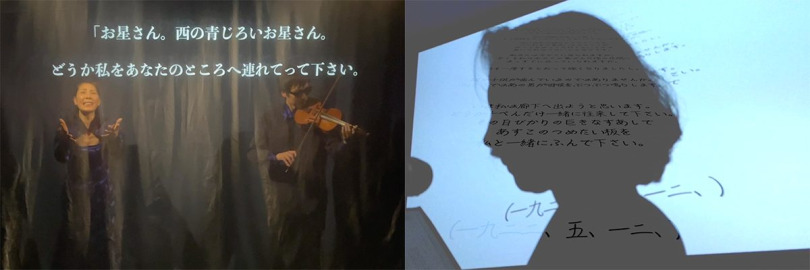
In addition, the costumes and stage sets were explained in advance so that the visually impaired audience could enjoy them more, and there was also an open explanation during the intermission. The atmosphere is cozy and close to the audience. "Subtitles were projected on a screen hanging between the audience and the stage so that people in the audience could watch the subtitles while watching the recitation and performance. It's a small theater, but we love Chupki and we all thought about what we could do best with this place. The first film, Nighthawk no Hoshi, had regular subtitles, and for the four poems Ishigami tried to add animated subtitles. Due to the COVID-19 pandemic, we projected subtitles with vinyl curtains hanging down to prevent infection, so there were reflections and it was a little difficult to hear the sound inside the curtain, but we were able to do it safely."
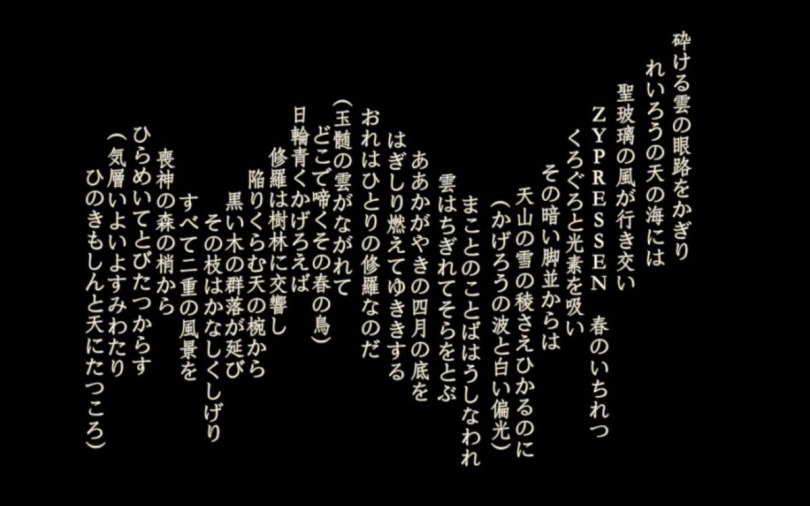
Ishigami Tetsuro, an actor and filmmaker, explains that he used the layout of the first edition of his poetry collection as a reference for the animated subtitles for his mental image sketch “Haru to Shura ”. "It is said to represent Kenji's emotional ups and downs," says Ayaki.

Photo by Kazuyuki Matsumoto
While some audience members said it was fun, others said, "It's hard to read and understand, so I want normal subtitles." Mr. Ishigami said, "When I just listen to Kenji Miyazawa's words, I sometimes find it difficult to use different expressions, so I thought that if there were some things I could express in writing, I would be able to understand his work a little more. In this performance, we thought that we could make the letters look bigger by making use of projectors and screens in movie theaters. I think it is a bit gray whether it is information security or not, but I would like to show subtitles as usual for "Nighthawk no Hoshi" and move the subtitles dramatically for the poems. The mental image sketch is a collection of Kenji's poems. I thought that if I linked the movement of the mind to the letters, I could communicate more to the customers."
Recently, Ishigami has been thinking about ways to convey Kenji's world through hearing and sound alone, such as concentrating on listening in complete darkness with only sound. "We don't make them because we have to support them, but we try to create something that we want to express and ultimately enjoy together." Ayaki said.

Source: Monogatari Group ☆ Polan no Kai
For the June performance that followed, there were many opinions that "since Mr. Kawai will also join, it would be better to have more people see it in a larger venue," but Mr. Ayaki continued to say that he wanted to do it in Chupki. Finally, without being able to decide to change the date, time and location, I had to explain the situation to the person in charge of Arts Council Tokyo. If the venue is changed to a large hall, the budget will change significantly, and the amount of subsidies will not be able to cover it. As a result of consultation, rather than performing halfway, we decided to return the June performance to Ayaki's reading and Shirai's violin session as originally planned, and to deliver it to the audience who could not see the February performance.
"The person in charge of Arts Council Tokyo proposed to apply for a new grant for a performance in a large hall, but the application deadline was approaching, and I didn't have time to write an application. However, when the final change procedure for the business plan was completed, Lutheran Ichigaya was suddenly able to be used as a venue on June 29th, and the motivation of the performers increased, and it was decided to hold a separate project from Arts Council Tokyo 's subsidized project, "Live Session with Sign Language, Music, and Storytelling ~The Phenomenon of Me~". We switched to crowdfunding and worked hard together, but it fell far short of the target amount of 2 million yen and ended up in a big loss. But I'm glad I did it."

Photo by Arata Ikeda Courtesy Monogatari Group ☆ Polan no Kai
"Polan no Kai was not established from the beginning with the intention of actively working on solving social problems and issues, but by chance we were able to perform together with artists with visual and hearing impairments. I was surprised to find that the tasks I had listed when I applied for the grant were naturally cleared when I finished the performance, such as creating a performance with sign language performers and producing a video with subtitles."
One of the goals of the Polan Society is to perform in Iwate, Kenji's hometown, and to expand support for the viewing to the Tohoku region. "We wanted Mr. Shirai and Mr. Kawai to feel the atmosphere of Hanamaki and express Kenji Miyazawa, so in September 2022 we held a performance in Hanamaki titled "A Live Session Intertwined with Sign Language, Music and Narration - The Phenomenon of Watashi." Some people in the Tohoku region are becoming interested in audio guides."
"The members of the troupe were supported by many people during a difficult time, and after the performance, we were given a lot of energy to live and feel like we should do our best. As a result of choosing what I wanted to do and what I thought would be fun, various people introduced me to various people, and I went in a completely different direction than I had originally imagined. Even so, the fundamental theme that I want to express Kenji remains the same, and through this performance I was able to naturally feel what Kenji wanted to convey."
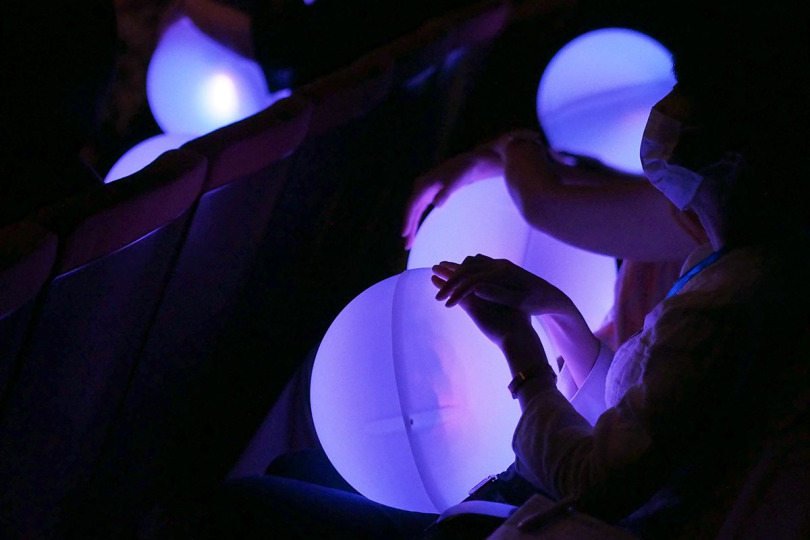
A device called "SOUND HUG" was used for the Lutheran Ichigaya performance so that people with hearing impairments could enjoy music and sound. It is a spherical music device that can be held and enjoyed with light and touch, and the color changes depending on the pitch of the sound.

Equipment provided by Pixie Dust Technologies Co., Ltd.
Ayaki recalls how she met Kawai. "At first, we didn't know what to do because we hadn't had much contact with people who couldn't hear, but as we practiced together, the anxiety disappeared, and I realized that this is society. They think about the other person, and they try to receive what the other person is saying or trying to convey. I realized that if I could change and become more kind through direct contact like this, the world as a whole would change."
"I want to tell many people how it is because it is fun, and I want to continue it, but the big problem is the budget. It's a discussion every time. Due to the timing of the September 2023 performance, "Live Session Intertwined with Sign Language, Music, and Narration - Sukita Honorary Food -" we applied for another grant, but unfortunately it was not accepted. We thought about downsizing, but we decided to go for it."
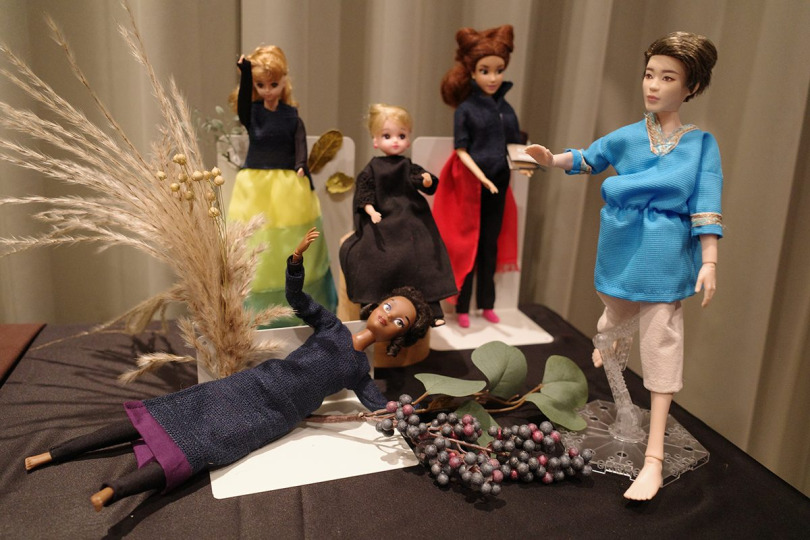
Promotional video for the September 2023 performance of "Live Session Intertwined with Sign Language, Music and Narration - Sukisutta Honorary Food" (Lutheran Ichigaya) is shown. It will consist of programs that have been performed at Cinema Chupki Tabata, but the hall will be bigger, more sign language performers will be added, and the costumes will be completely different. In order for the visually impaired to be able to feel the texture and shape of the costumes by touching them, the costumed Barbie dolls were created by the costumers themselves.

Courtesy: Monogatari Group ☆ Polan no Kai
Mr. Ogawa, the facilitator, joined the discussion by saying, "Sounds good. There are a lot of people on the stage today who are not asked to do it, but it's OK."
- Ogawa
- For example, Ms. Ayaki used to narrate TV anime and tabloid shows. Delivering and communicating with words itself seems to be your life's work, but what do you think?
- Saiki
- Right. I think we will continue to do that. It is also connected to audio guidance.
- Ogawa
- Ishigami-san, what attracted you to become involved in Polan no Kai?
- Ishigami
- I became involved with the film in 2014. At the voice actor training school I was in at the time, a senior asked me if I could help out at a place called Polan no Kai, and before I knew it I was on stage. The theme is "living," and although all the members of the troupe are gloomy (laughs), they have a strong energy to survive somehow. Mr. Saiki is a representative who wants to do various things, and before I know it, he comes with a plan, so we have no choice but to do it too (laughs). I myself used to work in the care industry, work with mentally challenged children, and for some reason have a connection to welfare, but if I hadn't been involved with Polan, I probably wouldn't have heard of audio guides and accessibility. I am impressed by the "energy to live" that comes from Ms. Saiki, and I have been involved with her for almost 10 years.
- Ogawa
- It is the source of energy to live.
On the other hand, Ayaki said, "Hiratsuka has had a great influence on me." Rather than being barrier-free, it conveys the atmosphere of having fun together as an expression. It was supposed to be eventful, but it was a peaceful report from start to finish.
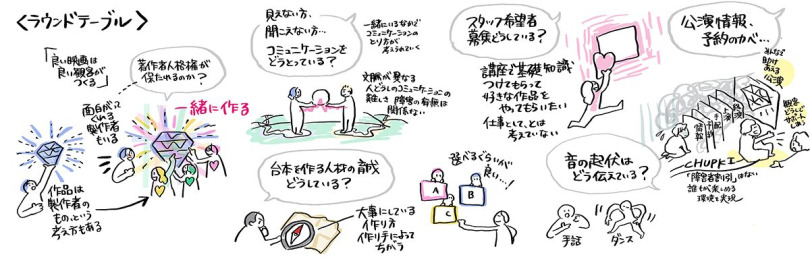
Roundtable: Enriching Works through a Diverse Audience

(Image enlargement: JPEG version)
Then a round table was held with all the speakers present.
- Ogawa
- In your book (Yomoku Kobo, 2019), Ms. Hiratsuka talked with Masako Tanaka, a visually impaired person. "There are quite a few people who make audio guides and leave everything up to the [visually impaired] monitor and think that because the monitor said this, they have to correct it. But I think that's a little bit different from being a member of the group who makes things together." he said.
- Hiratsuka
- Right. First of all, the creator is very important in creating audio guides. If the director is present, we can work together, but if the director is not present, the producer has to understand the author's intention. In response to the script, we ask them to express what they notice because they are invisible to the monitor.
- Ogawa
- How to think about a work of art. There is an idea that people should not touch it because it was made by a genius artist. Since only the artist can understand the intention of the work, it is necessary to convey it as it is. In other words, the works of Kenji Miyazawa should not be turned into heavy metal. (Laughter) Some people think that there is a way to enjoy them. Are there people in movies who wonder what the director was thinking when he put in this scene, but want to make it sound guide as much as possible?
- Hiratsuka
- More than subtitles, audio guides are creative and have long been criticized for violating moral rights. Moral rights of authors are exactly about whether the work you created will be transmitted as it is. On the other hand, there is a big element that movies reach the audience and are made from the audience. Director Yoji Yamada once said, "Good movies are made by good audiences." "Films are made by the audience, not by the director." It's true that when we produced the film Interpreters of the Heart, we felt the possibility of the film expanding from the audience, and that production is not complete. As an extension of the filmmaking process, if the director is present at the audio guide monitor review meeting, he or she may be stimulated by unexpected and sharp comments from the visually impaired monitor. Making audio guides is a creative process, and I think the director enjoys it because he thinks it expands the possibilities of his work.
- Ogawa
- Are there directors and distributors who don't like unexpected points or expressions from guides?
- Hiratsuka
- Times are changing, so we don't hear about moral rights anymore. However, I sometimes wonder if people will be convinced by the subtitles that describe mountain scenery shot with great care by a master of the Japanese film industry with words such as "lush green mountains."
- Ogawa
- As you experiment with various forms of support and expression, do you sometimes receive criticism?
- Saiki
- I think it's natural to have various opinions, so even if someone says, "That's not right," I don't think I have to change it based on one person's opinion. But it's important to see how things go while trying them out, and we want to change the form little by little as we search for a better way, not only to support the audience, but also to promote what we want to express.
He also introduced questions from the audience.
- Ogawa
- This is a question for Mr. Saiki. "What kind of communication rules have you established with people who have created communication in different contexts?"
- Saiki
- We haven't made any rules. I didn't really know how to communicate with people with visual or hearing impairments, but during our time together, they gave me their opinions about what they wanted me to do. It's strange, but I feel something other than words. On the spot, we thought of ways to communicate by ourselves, such as communicating by writing. Of course, there were times when the practice would not progress without a sign language interpreter, but as we worked together, the rules were naturally formed. For example, when Mr. Kawai and the sign language interpreter were talking in sign language, Mr. Shirai had no idea what was going on, so we decided to attach a bell to his wrist, and Mr. Kawai and the sign language interpreter all attached different bells. I found something new every time I practiced, and gradually became able to communicate.
- Ogawa
- Now, I have a question for Hiratsuka-san. "Training human resources to create scripts for audio guides. What kind of people took the course? You said that you divided the work for 20 to 30 minutes each, but what was the final result?"
- Hiratsuka
- There are many kinds of participants. It's difficult to say in a word, but many people like movies after all. Audio guides are not qualified, and it's still unclear what the correct answer is. For those who have studied audio guides in other places, the basics are the same as the audio guides made by Chupuki, but there may be some differences in where to put your attention. I mentioned earlier that a monitor for the visually impaired pointed out that they wanted long sentences to be shortened, but some people are taught that it is good to write about three sentences. At Chupki, we try to match the time progression of the movie and give hints to visually impaired viewers to imagine what sounds they hear in real time. It's hard to get people to understand that audio guides tend to be based on the rhythm of the person who makes them, not the rhythm of the movie.
- Ogawa
- Does it mean that the way of thinking is different from the secondary sound that comes in TV dramas?
- Hiratsuka
- Yes, probably. I think audio guides are unique depending on who makes them. That's why I hope it will be so rich that you can choose multiple audio guides for one game. I think listeners have their own preferences. Some people prefer a bland, less inflected audio guide. When we say visually impaired people in one word, the amount of information they want is different between those who are congenital and those who have lost their sight. Moreover, the amount of information they want is different between those who have lost their sight for a short time and those who have become accustomed to life without their sight.
- Ogawa
- Indeed, it would be nice to be able to choose. How do you recruit audio guide production staff?
- Hiratsuka
- After all, we want people to learn the basics, so we allocate the production to people who are taking audio guide courses held at Chupuki or who have basic knowledge of audio guides after taking courses outside the company. We have people on our mailing list who want to be involved in making audio guides, and there was a time when we asked people if they wanted to do it, but that would have resulted in too many people. Also, I don't think of audio guide production as a job, so I think it's best to have someone in charge of a work that they really like. I think that if there is no love in the work, what can be conveyed cannot be conveyed. That's why I want people to write audio guides that they can work on like a fish out of water.
- Ogawa
- I think there are probably some people who want to do it as a profession, but among various possibilities and ways of thinking, I understood Mr. Hiratsuka's policy of proceeding well. Next, I have a question for Ms. Saiki. "Did you try to show the ups and downs of the sound and the change of tone in the recitation and the music visually, or convey it by wind or smell? Do you have any ideas on how to make poetry more meaningful?"
- Saiki
- For the performance in September 2023, I am thinking of expressing sound and music through dance performance instead of "sound hug" (as of July 2023). Also this time, I will pair up with a Deaf artist and express the same sentence in both reading and sign language. The ups and downs of the sound and the changes in tone will surely be expressed by deaf artists through facial expressions and sign language. I would like to challenge the performers who can hear it to express it in harmony with each other.
ここで、小川さんから、City Lightsの副代表、美月めぐみさんが2018年に視覚障害者のサポートについて執筆した特定非営利活動法人シアター・アクセシビリティ・ネットワーク発行の『観劇サポートブック』(2020年改訂)のテキストが紹介された。サポートに必要なことが視覚障害の当事者の立場から書かれており、ウェブサイトでも読める。
- Ogawa
- Here's an excerpt. First of all, even if I wanted to get information about performances, I couldn't see it. Even if the performance information is released, it is very close to the performance date, so I cannot arrange a guide helper in time. I want to make a reservation by phone, but I can only do it online. If a character authentication password is displayed, you cannot enter it. You also have to buy tickets for the guide helpers. Even after arriving at the venue, it is hard to identify the building and find the entrance, reception and restroom. I don't know when we're going to take a break. I can't confirm my reserved seat number. I don't know where the unreserved seats are. Even while watching the movie, if it is difficult to grasp the content or if you don't understand the situation, you are left behind by the story ... etc. These are mainly for the visually impaired, but they suggest that there are various issues not only in the content of viewing support but also in the surrounding areas. What do you think of this proposal?
- Hiratsuka
- I have been active for more than 20 years, and I am working with the intention of creating a movie theater that solves all of the things that I have always felt would be nice if there were such support, or that would be a problem if there were not, so Chupuki has cleared all of them.
- Ogawa
- Wow!
- Hiratsuka
- We aim to be a movie theater without handicapped people, so there is no discount system for handicapped people. On the other hand, guide helpers are free of charge, and we provide viewing support for disabled people, so we set up a fee category according to age. However, there is a discount system for people who have difficulty in working due to their disabilities or who are financially burdened. If you want to go see a movie on your own, but you have to book a guide helper before you can go, it's hard to make movies a part of your life. So, the staff will pick you up at Tabata station so that people with disabilities can come to see the movie by themselves. You can also make a reservation by phone. Sometimes people say, "Please tell me this month's works, I can't see the flyer." and I spend about 30 minutes telling them about the work.
- Ogawa
- It's great. Thank you.
- Saiki
- Since we started working with Chupuki-san, we aim to support the audience as much as possible, although we cannot do all of our performances. I want to create performances that people with visual impairments and hearing impairments can enjoy together, so I think the most important thing now is to create a space where the audience helps and cares. There are a lot of things that you don't notice, but you try each performance. It would be best if we could all help each other.
- Hiratsuka
- Because it is a small space with 20 seats, we can pay attention to it. But recently, I've come to think that it doesn't necessarily mean that the facility side has to cover the situation of each person when it's not possible to pay attention to a movie with greetings on stage when it's full. Chupuki is a permanent building, so there are disabled customers frequently and regular customers get used to it. Some customers help us when they feel that the staff is already full.
Both groups value the works first and aim to enrich them with diverse viewers. As Hiratsuka said, once I decided to do it anyway, someone would naturally help me, and I made it happen. I think the reason for this movement is that he believes in the power of the works themselves and in viewers. There is no one right way to interpret a work of art, and different interpretations are created by each viewer, which can be shared with others. In a place where we share appreciation and expression, our view of "disability" also changes. We will continue to pay attention to the creativity in the viewing support itself and the new discoveries and creations that come out of the place where anyone can participate.
(Reporting and writing by Yuri Shirasaka)
Chupki LLC
2001年より視覚障害者の映画鑑賞環境づくりを続けているバリアフリー映画鑑賞推進団体City Lightsが2016年に募金を集めて設立した映画館。視覚障害者のみならず、聴覚障害者、発達障害者、車椅子利用者、小さなお子様連れのお客様など、様々な障害を持つ人が安心して映画を鑑賞できる環境を提供する日本初のユニバーサルシアター。映画の音声ガイドや日本語字幕を制作し、毎日ユニバーサル上映を実施。
https://chupki.jpn.org/
Social Grant Grant results
- FY 31 (2019) 1st Term "Human Resource Development for Movie Audio Guide Producers and Research to Expand Possibilities as a Viewing Tool"
- FY 2020 (2nd Term) "Building an Archive and Holding a Symposium to Promote Barrier-Free Screenings"
Monogatari Group ☆ Polan no Kai
2004年創立。「生きる」をテーマに宮澤賢治作品のみを上演。 2021年イーハトーブ賞奨励賞受賞。 舞台の音声ガイド制作、鑑賞サポートに携わる。 2020年より字幕映像制作や手話パフォーマーとともに創り上げる公演を行っている。
https://polan1010.com/
Social Grant Grant results
Social Grant
A program to support "Activities that allow people who have limited opportunities to experience and participate in art due to their social environment to engage in art experiences, such as appreciation and creation, and to exercise their creativity and enrich their imagination." and "An artistic activity that sets social issues based on one's own awareness of problems and works to solve them through cooperation and collaboration with various people and organizations" for organizations working in Tokyo. It was started in fiscal year 27 (2015), and since fiscal year 28 (2016), public applications have been held twice a year. It has supported more than 120 projects. It is not just "art for art's sake" or "art that is useful to society," but it is trying to support activities that propose and materialize a new way of art in which society and creative activities are inseparable in a way that has never been done before, so to speak, "the third art."