
This website uses cookies to improve your experience. You can also change the cookie function by setting your browser. You must agree to the use of cookies when browsing the site.

  • x
  • Instagram
  • facebook
  • Line
  • Youtube

Report on "Social Support through Arts and Culture"

Since fiscal year 27 (2015), Arts Council Tokyo has been implementing the "Social Support through Arts and Culture" program to support artistic activities in which people from various social environments can participate together and demonstrate their creativity while respecting each other's individuality, as well as activities that address various social issues by utilizing the characteristics of arts and culture and the abilities of artists.
Here you will find videos and reports of debriefing sessions by organizations that have completed their subsidized activities.

The 5th "Song, Language, and Body: Possibilities of Creating a Place for Diverse People to Meet" (Part II) Round Table

On February 9, 2024, a debriefing session was held to share with the participants the achievements and challenges of projects selected as "Social Support through Arts and Culture Subsidies." The theme of the fifth session is "Song, Language, and Body: The Possibility of Creating a Place for Diverse People to Meet". In the first part, we introduced the activities of the "Expression Club Gayayaya" in Hikarigaoka, Nerima Ward, which has been creating a place where people with intellectual disabilities and others can enjoy music and dance workshops for nearly 20 years. In this second part, we will introduce the activities of Monten, a general incorporated association that has been developing a variety of projects at Ryogoku Monten Hall, a local hall/art space open to anyone in Ryogoku, Sumida Ward. In the second part, we will also report on the roundtable.

> Click here for the 5th "Song, Language, and Body - Possibility of creating a place for diverse people to meet" (Part 1) Expression Club Gayayaya
> Click here for the 5th "Song, Language, and Body - Possibility of creating a place for diverse people to meet" (Part 2) General Incorporated Association Monten


Time of the event
Friday, February 9, 2024 18:30 ~ 21:00
Venue
Arts Council Tokyo 5th Floor Conference Room
Reporting organizations and speakers
EXPRESSION CLUB GAYAGAYA Miri Kojima, Tamami Yamada
MONTEN Yaeko Kurosaki, Miki Akaba
facilitator
Tomoki Ogawa
graphic facilitator
Mihoko Seki
sign language interpreter
Yuko Kato, Yuko Setoguchi

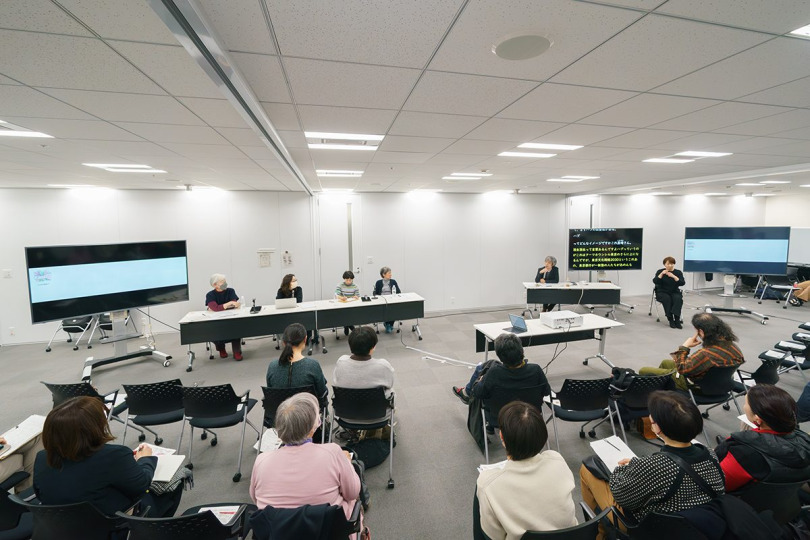
Scene of Round Table
Photo by Kazuyuki Matsumoto

The need for continued support and hubs for community music

Finally, everyone took the stage and the round table began under Ogawa's direction. Monten's Kurosaki-san raised four questions for the Arts Council Tokyo.

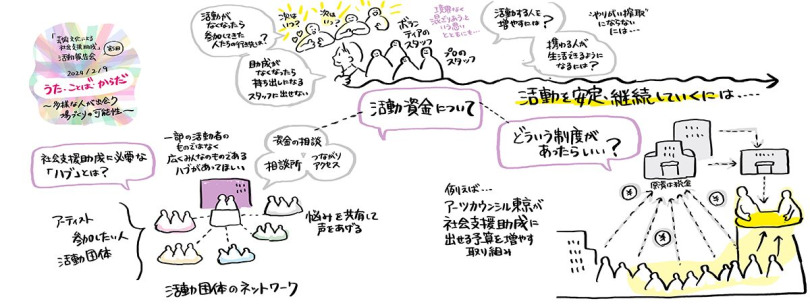
Graphic Recording (Production: Mihoko Seki)
(Image enlargement: JPEG version)
Ogawa
"As for what social support through arts and culture should be, he mentioned that it is necessary to obtain funds for continuous activities, to establish a network of various organizations and a hub to bring them together, and to share information with support organizations. First of all, what kind of image is hub? "Tokyo Culture Strategy 2030" also mentions the term "Art Hub." What kind of hub do you want, Kurosaki-san?"
Kurosaki
"I want to create a network because everyone who is doing community music has the same problem. For example, activity funds. If you get a grant, get people together, do something fun, and then it's over, people will be left behind. It also makes me feel guilty, wondering if it was good to do it. While sharing such concerns, we would like to think again about how to break through the problems, how to convey everyone's voices, and where to deliver them. We need a network. It's also a hub for people who want to participate and engage."
Ogawa
"What exactly is missing?"
Akabane
"First, a list of organizations. From the user's point of view, there may be times when they want to ask what kind of organization or artist can hold a workshop, and from the artist's side, it is like a consultation center where they can ask how they can be involved in such activities. It's the center of the network. In addition, it may be necessary to coordinate the management of funds and activities for culture, such as what organizations to distribute funds to, where and who to send to conduct projects. I think there are some things that the Arts Council Tokyo has already done. Furthermore, in order to make policy recommendations on the results, issues, and requests of these activities, we are gathering the voices of businesses involved in these activities."
Ogawa
"For example, is it a place where people with disabilities or without disabilities can concretely discuss where they can participate when they say they like music?"
Kojima
"I heard earlier that an art hub will be established, but I think it is meaningless if a hub is established to create a diverse society, but it becomes a hub only for those who are trained in high art."
Ogawa

"Right. We have to speak up about what kind of hub we want to be."

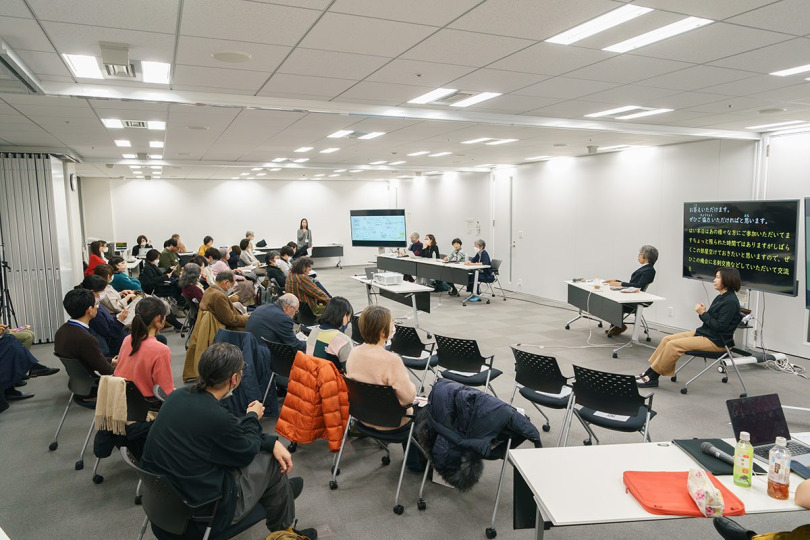
Scene of Round Table
Photo by Kazuyuki Matsumoto
Ogawa
"Shall we talk about money next?"
Kurosaki
"I feel that we, who are engaged in activities, have made it into a myth that grants have a term of several years and that we cannot continue to receive them. I think we have to appeal that this is an activity that should be supported forever."
Akabane
"When we artists try to carry out an activity, we do it for free if we can't get a grant, and sometimes we pay the staff's fee out of our own pocket. When I get a call from a participant saying, "When is the next workshop?" and they are looking forward to it for a long time, after 2 or 3 years pass, I think, "I am not playing with their minds." If we don't do the activities, the participants will have nowhere to go. We need money to continue to exist, but without subsidies, we have to rely on volunteers."
Kojima
"If you have money, you can do many things, and the participants were wondering where they could do their art activities if we didn't do it. I don't think there are many other places to go, and I think it's a serious problem."
Yamada
"I live in Kyoto, so Kojima-san always provides me with a round trip transportation fee to Tokyo and a reward. However, Kojima-san is not preparing any reward for himself, and he is doing it with his energy. I myself have been able to work in a privileged environment, and my perspective has been broadened and I have been supported, so I am starting to think that I would like to do this in my own area. But I have to work to make a living, and it's difficult to balance working as a volunteer. But just recently, I passed by a facility where I thought I could volunteer in this area. If it's four times a year, I wonder if I can do something like dance or sing from scratch regardless of the remuneration.
There is never enough space for people who need such activities, so money is not enough, but if more people create such spaces regardless of money, I think we can make up for it. It's a tough one."
Ogawa
"Kurosaki-san, how much subsidy do you need to be stable?"
Kurosaki
"I think it depends on what kind of project you create and what kind of people you interact with. However, people in this field are on a shoestring. As a musician, I'd like to pay the same amount as the performance fee for concerts. There are various preparations other than the day itself, and I don't think community music will spread unless people who are involved in community music activities can make a living. There was a movement for a while that the sound and lighting staff, who used to be close to volunteers in general theater and movie performances, should receive a proper staff fee, and now the staff is also receiving a reward. I think that needs to happen in community music. Even in a workshop, there is a difference between what can be produced by amateurs and what can be produced by community music professionals. The experience and learning that a specialist has gained is the same as a performer learning music by practicing an instrument. In any art world, I would like to create a project that ensures that performers and staff can make a living."
Kojima
"I didn't expect this to happen (laughs). As Yamada-san said earlier, I think it is dangerous to say, "It would be good if the number of volunteers increased." It's not just about paying artists, it's about money. So you have to have a certain amount of money to do it."
Ogawa
"In the subsidy system, if the number of organizations subject to the subsidy increases more and more, it will cost an endless amount of money. But it's also true that there are many people who don't know what to do if they can't plan because they don't have money. What kind of system would you like to have next in order to continue your activities?"
Kurosaki
"I think the Arts Council Tokyo itself must have a place to make a presentation for obtaining funds. When the current budget of the Arts Council Tokyo is not enough to share with you, I think it would be good to send our voice to the top in our activities to obtain new funds."
Ogawa

"Unfortunately, the budget and environment for stable continuation of activities have not been established in the field. Perhaps a part of a long activity was subsidized, and we were able to implement it with more powerful content than usual, but it was really necessary beyond that."

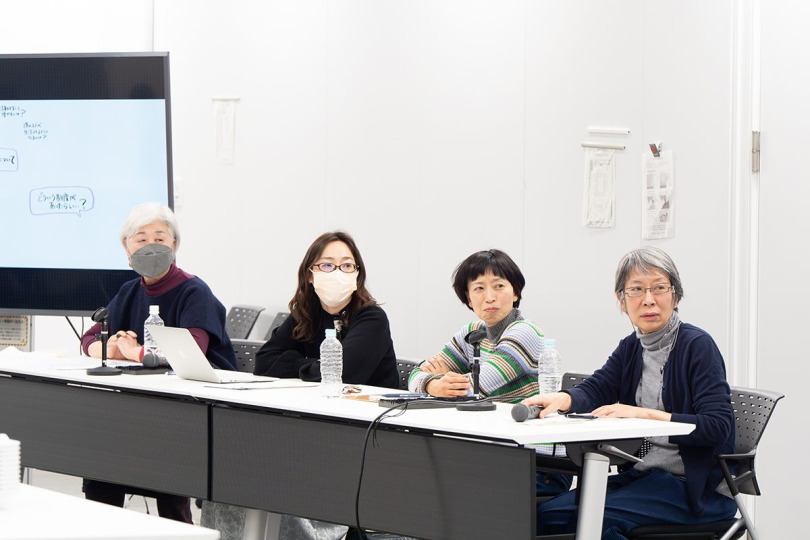
Photo by Kazuyuki Matsumoto

The round table ended with Mr. Ogawa's request, "In the 10 years since the Arts Council Tokyo was established, various aspects of the council have matured and various opinions have been expressed. In addition, I believe that today's debriefing session brought up issues that we need to consider next, including the design of the system, and I would like everyone at the Arts Council Tokyo to consider them as homework."

Ms. Tomoko Matsuoka, a senior program officer at the Arts Council Tokyo, said, "Thank you very much for cutting into the limitations of the subsidy system," and gave us an answer that we can give now.

Matsuoka

"There are few cases in which a single organization or project can be subsidized for a long time, and in the case of the Arts Council Tokyo's subsidy system, it is also rare for the same organization or project to be subsidized continuously. Social support grants for arts and culture are unique in that there is no set period for the continuation of the grant. However, if a grant is to be continued for the same project, appropriate reasons and explanations are required. Budgets are limited, and the purpose of the grant system is not only to continue supporting one community, but also to spread the results to society as a whole.
I think it is important to step up to the next plan so that we can see the need to continue the subsidies, and to continue dialogue with businesses through subsidized projects.

The first question from Mr. Monten was, "What did you think about this initiative when you shared it?" I myself and my colleagues have observed it several times together, and I thought that the issues of community music are common to the initiatives and issues that have been raised in the field of other subsidized organizations.

What left an impression on me when I observed the online course was what Ms. Rii Numata said, "We need to both close communities and open them up.".
Closure has an image of being closed, but I think it is sometimes necessary to create a safe place where participants feel they belong. However, if this is all there is to it, there will be a mismatch between what is stated in the Guidelines for Public Offering: "Efforts that are returned only to a specific person or organization are not eligible." Since the source of the grant is tax money, the results of the grant must be widely returned to society as a whole. In some cases, it is difficult to grant aid to projects that maintain a single place.
Therefore, it is also necessary to "open" the community, and I thought that after establishing the community where the participants belong, it would be good if the grant money was actively used for the "open" project.

Also, regarding the question of whether the Arts Council Tokyo itself can be a hub, I thought that it would be necessary to have a place to share information with those who have used social support grants through arts and culture and those who have an interest in them, and that was the reason for launching this debriefing session. Of course, the number of people who gather for this briefing is limited, so I think we need a bigger hub. In addition to the support section, the Arts Council Tokyo has also established a new section to provide support in a more accomodating manner, and in fiscal 2023, the Tokyo Arts and Culture Consultation and Support Center "Art Note." We still don't know the concrete image of a big hub, but I think we need real advice and cooperation from private businesses to realize it, so I look forward to working with you in the future. "

The words that stood out to me throughout the session were: "If the business is gone, the people who were looking forward to it have nowhere to go." Expression leads to living. It has become an irreplaceable place not only for the victims but also for their families and other people around them. After listening to the reports of both organizations, I thought that "community music" is a way for individuals to put their own words to music and listen to the voices of others. I think that the public is not for the majority, but for the benefit of even one person, which will change society and eventually benefit many people. As mentioned in the report of the first debriefing session, I hope that the metropolitan government and national administration will be reformed so that the subsidy system works for daily artistic activities. I felt the need for a hub as a first step.

(Reporting and writing by Yuri Shirasaka)


EXPRESSION CLUB GAYAYA

It was established in 2003 by participants of a course held by the Kasuga-cho Youth Center in Nerima Ward. Mainly people with intellectual disabilities who live in the ward, music lovers and dance lovers gather once or twice a month to sing, dance and play. The songs and dances created there are made into works, and once a year they perform as "Gayayaya Live."

Social Support through Arts and Culture

General Incorporated Association Monten

Since its opening in 1989, Monnaka Ceiling Hall has actively performed a wide variety of music and performances with the aim of providing a high-quality art experience and fostering a wide audience. In 2013, it moved to Ryogoku and was renamed "Ryogoku Menten Hall" as a new art space. It is operated in partnership with various artists and local communities. It creates a new culture through experimental events.

Social Support through Arts and Culture


Social support through arts and culture

A program to support "Activities that allow people who have limited opportunities to experience and participate in art due to their social environment to engage in art experiences, such as appreciation and creation, and to exercise their creativity and enrich their imagination." and "An artistic activity that sets social issues based on one's own awareness of problems and works to solve them through cooperation and collaboration with various people and organizations" for organizations working in Tokyo. It was started in fiscal year 27 (2015), and since fiscal year 28 (2016), public applications have been held twice a year. It has supported about 150 projects so far. It is not just "art for art's sake" or "art that is useful to society," but it is trying to support activities that propose and materialize a new way of art in which society and creative activities are inseparable in a way that has never been done before, so to speak, "the third art."