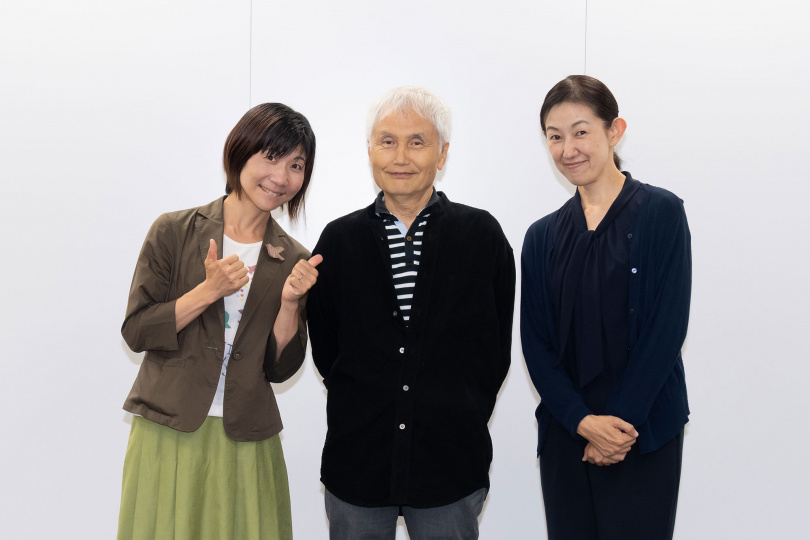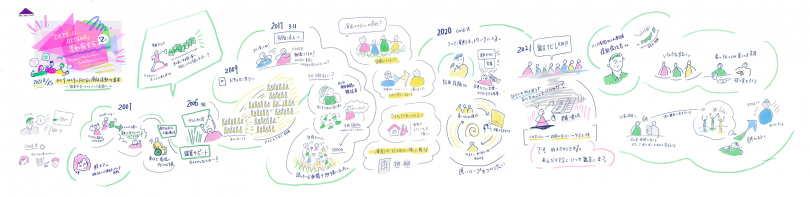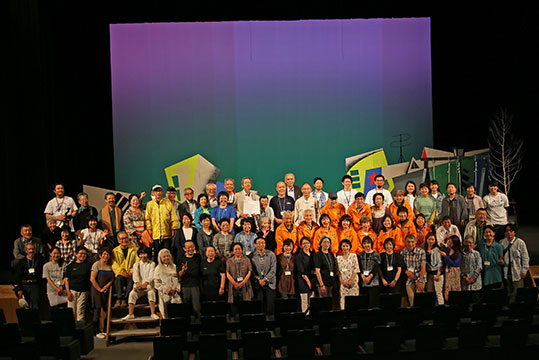

On August 25, 2022, the second activity debriefing session was held face-to-face for the first time as a place to verify the effects of "Social Grant" and widely share future issues and visions. In the first part, the "Senior Theater Network of Non-Profit Organizations (NPOs)" reported on its activities, and in the second part, a roundtable was held with the audience. We will deliver the situation in the first part and the second part.
- Date & Time
- Thursday, August 25, 2022 18:00~20:00
- Venue
- Arts Council Tokyo 5th Floor Large Conference Room
- Name of reporting organization
- NPO Senior Theater Network
- speaker
- Emma Kujira, Ema Matsuda, Toshihiko Watanabe
- facilitator
- Tomoki Ogawa
- graphic facilitator
- Junko Shimizu
- sign language interpreter
- Yuko Setoguchi, Yuko Kato

Courtesy: NPO Senior Theater Network

Photo by Kazuyuki Matsumoto

(Image enlargement: JPEG version)
I started working part-time as a helper. Efforts to Support Viewing
The "Senior Theater Network" is an organization that connects senior theater companies across the country and spreads exchanges and activities. It has continued to carry out two activities: the "Performing Arts Appreciation Support Human Resources Development Project" to support the appreciation of theater by people in various environments such as the elderly and the disabled, and the "Performances of Works by Senior Theater Troupe" composed of elderly actors, and has been adopted for a total of six terms since the start of "Social Grant" in 2015.
今回は、シニア演劇ネットワーク理事長で、60歳以上のメンバーによるシニア劇団「かんじゅく座」主宰の鯨エマさん、副理事長で姉妹劇団「ベニクラゲproject」代表の松田絵麻さん、かんじゅく座劇団員の渡部俊比古さんが登壇。これまでの活動や今後の課題について発表した。
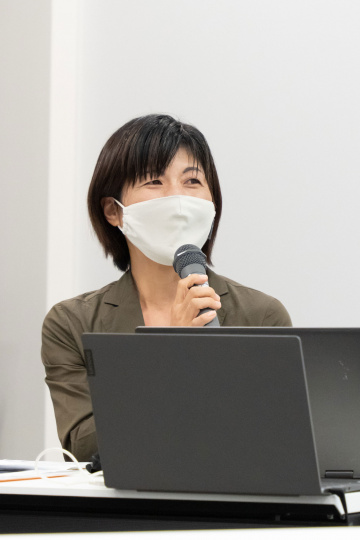
Photo by Kazuyuki Matsumoto
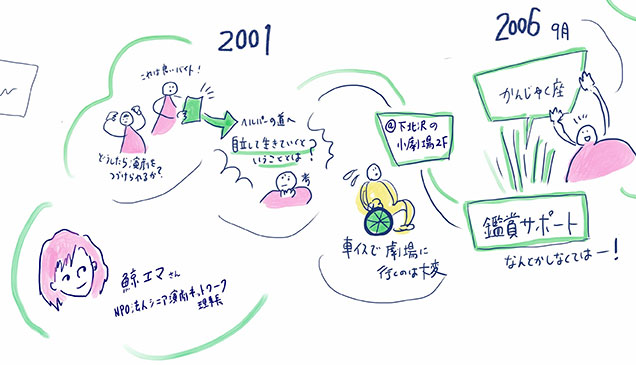
Ema Kujira has found things lacking in the theater world, such as support for viewing and theater groups for the elderly, and has created them without passing them by. They are not merely actors, playwrights, or directors, but also “theatergoers. ”.
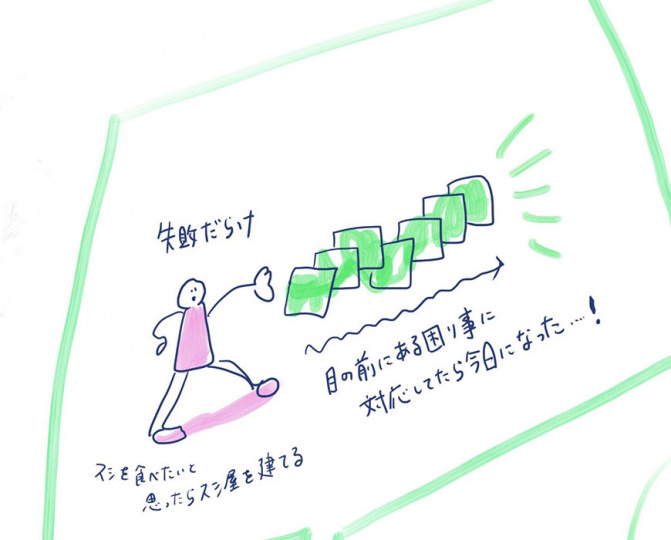
"When I look back, I was dealing with the problems that were in front of me, making mistakes and working hard until today. I wanted to do all of them, but if you ask me what I want to do the most, I wanted to be an actor, so I wanted to be an actor. Someone who looked at me said that if you want to eat sushi, you must be the type of person who starts from a sushi restaurant. (Laughter)"

(Image enlargement: JPEG version)
First, she started supporting people with disabilities as a side job in her theater activities. After graduating from high school, he entered an actor training school and joined a long-established theater company, but he couldn't find a role and left after six years. He started a theater troupe called "Umisenyamasen," but he continues to lose money despite working part-time.
"One day, in the basket of my bicycle parked in Okubo (Shinjuku Ward, Tokyo), there was a flyer for a helper for the disabled in Yono City, Saitama Prefecture. I was assigned to take care of two people with intractable diseases who were confined to wheelchairs, and for about five years, I saw firsthand what it means for a disabled person to live independently in the community."
One day while he was working as a helper for the disabled, a woman in a wheelchair came to see Kujira's play. "The entrance of the small theater which is the venue was on the second floor after going up the narrow stairs, so it was hard to enter first. She switched from an electric wheelchair to a hand-pushed wheelchair, and the staff held her, folded her wheelchair, brought her up to the second floor, and seated her in the wheelchair again." he said.
"There are women of my generation who cannot go to see plays easily. I thought I had to do something about this, and that was the beginning of the viewing support."

(Image enlargement: JPEG version)
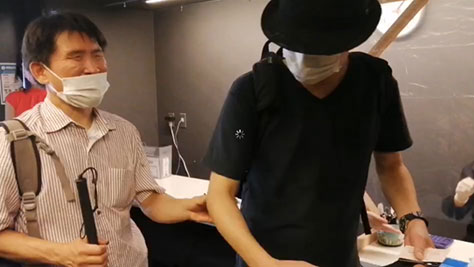
She also appealed to her acquaintances to support the theater and asked them if they would like to join her. Starting with a performance by Gekidan Dogo (Footnote 1), the only theatrical troupe that volunteered at that time, Kujira personally began providing directions to the theater and creating audio guides for plays for the visually impaired. However, it will be several years before it becomes a project of the NPO Senior Theater Network.
Footnote 1: The official name is Gekidan Dogo. It was founded in 1972 mainly by former Mingei Theater Company members. Based in Itabashi Ward, they perform mainly creative plays throughout Japan and overseas. After that, the appreciation support business became established within the troupe, and now services for the visually and hearing impaired are provided at sponsored performances.
Forming the Kanjukuza Theater to Develop a Nationwide Network of Senior Theater Companies
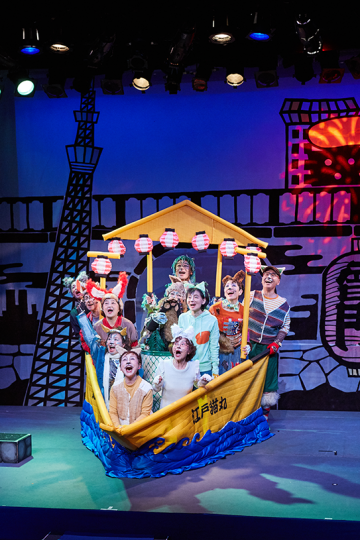
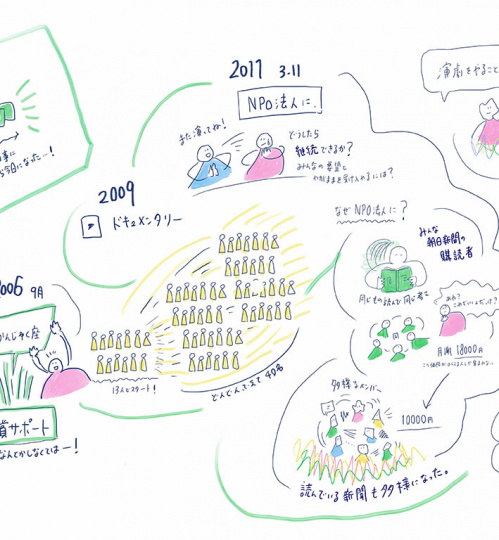
On the other hand, he said he started the Senior Theater Company in response to the "Year 2007 Problem," when baby boomers will reach 60. With a large number of retirees expected and people talking about what to do with their second lives, Kujira recruited troupe members over the age of 60. In June 2006, 13 members formed the Kanjukuza, and in March of the following year, they gave their first performance. Kanjukuza was introduced in the news in 2009, and when a documentary film Kujira was filming was shown at Polepole Higashinakano, more and more members wanted to join the troupe.

Courtesy of NPO Senior Theater Network
After that, he asked senior troupes around the country for joint performances, and 16 of them agreed. In September 2011, they rented the Theater Green in Ikebukuro and held their first National Senior Theater Competition.
"After the Great East Japan Earthquake in March, I approached the welfare troupe Tsurukame in Miyagi Prefecture, which was about to give up going to Tokyo, and asked them if they would like to come as a guest, since I would pay all the transportation and accommodation expenses. They practiced hard and joined us. After the performance, she said, "How having a goal helped me live" I was very happy. and what we've done since then."
Many of the participants said, "Let's do it again," and in order to continue the National Senior Theater Competition, the Senior Theater Network was established as an NPO. Currently, the Senior Theater Network has 12 senior theater companies from all over the country as supporting member organizations.
National Senior Theater Competition

Courtesy of NPO Senior Theater Network
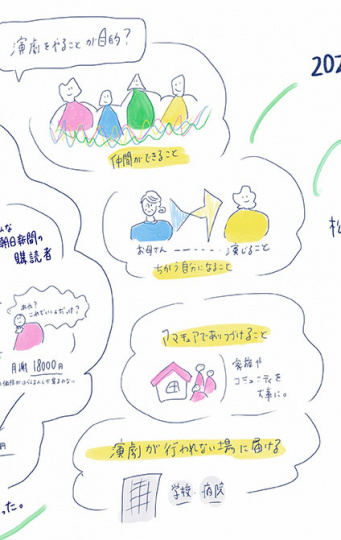
There is another reason for the NPO. The 13 members of the troupe at the time of its formation were all Asahi Shimbun subscribers. "Because they read the same newspaper and have similar values and ideas, there is no lively discussion about the script, and it is necessary to include people with various ideas and positions." he said.
"So we lowered the monthly fee from 18000 yen to 5000 yen for people in their 80s, and a variety of people came in. But we were in the red last year, so we made it a flat rate of 10,000 yen for everyone. Another reason is that we made it an NPO because if we collect money by a voluntary organization, the family would be suspicious. Right now, there are all kinds of people from Akahata to Yomiuri (laughs). I heard various opinions and knowledge about the script, and it became interesting as a creative scene."

(Image enlargement: JPEG version)
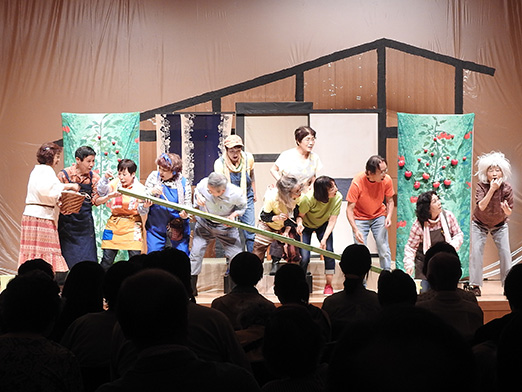
The Kanjukuza currently holds regular performances in spring, delivery performances in autumn, national senior theater competitions, and occasional delivery performances to the islands. There are several things I discovered through that activity.
"I felt that if you have friends, you can share your worries about your personal life and become a place where you can escape. A lot of people said it was fun to be able to play a different role for someone who had always been a mother, or to be friends from scratch with people who didn't know their previous titles. Elderly people also lose their physical strength and memory, their friends and partners die, and they fall ill. I hope that you will be able to spend quality time in the practice room, overcoming such worries about health, love, and finances, and that you will be able to work together with people with different values toward the same goal."
There is a reason to call it an 'amateur theater group.'.
"When a family is in trouble, they don't put their family on the stage. We practice the same act as two teams so that families can come to support us and take care of their personal lives, so that if someone has a strained back or if someone has a funeral, we can work together without making a hole."
"In the play, I want to portray the feelings and messages of seniors who have lived for many years. We also go to schools, hospitals, orphanages, school children, and other places where we don't usually see plays."

(Image enlargement: JPEG version)
"Appreciation Support" for Senior Theater Network
In addition, the Senior Theater Network has incorporated "barrier-free activities for theater" that Mr. Whale has been doing individually since 2015 into its business. In "Social Grant", the "Audio Guide Producer Training Course for the Visually Impaired" was adopted Reiwa in 2015 (Heisei 27), and the "Barrier-free Course for Theater Professionals 'Theater Support for the Visually Impaired'" was adopted in FY2020. In the latter, we learned a variety of things from the social background that needs viewing support and the stories of the visually impaired, and held a total of five lectures, including adding an audio guide to the performance "BONOBO Tatsu" produced by the theater company NLT at Theater X (Kai) as theater practice. In Reiwa 3 (2021), the "Barrier-free Continuous Course for Theater Professionals 2021" was adopted, and a total of 10 consecutive lectures were held to expand the range of support for the deaf, wheelchair users, the elderly, the visually impaired, and the intellectually disabled.

Courtesy of NPO Senior Theater Network
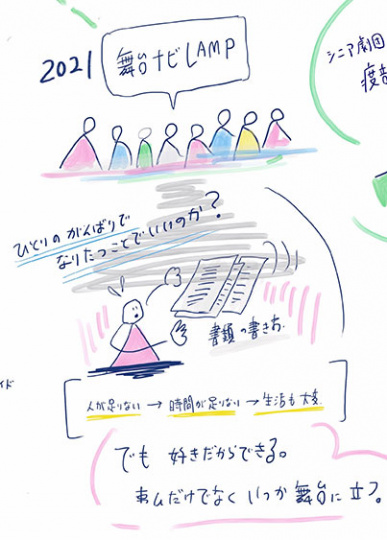
これらの修了生も交えて、2021年末には、シニア演劇ネットワーク内の新たな鑑賞サポートチーム「舞台ナビLAMP」が結成された。舞台ナビLAMPでは、作品の背景やスタッフ・キャストの紹介、制作裏話を盛り込み、誰もが聴きたくなるような音声ガイドの作成を目指している。聴覚障害のある方や日本語に不慣れな方向けの字幕作成、高齢者・車椅子ユーザー・知的障害のある方への鑑賞サポート、演劇公演情報の提供。また、劇団や演劇制作者への鑑賞サポートのノウハウやサポートの提案、レクチャー、機材の貸し出しも行っている。
"The Konnyakuza Opera Theatre asked, "We don't want audio guides in the main story because we want people to enjoy live performances without wearing earphones. But how can we get people with visual impairments to come and see it?" and we proposed to enhance the explanation beforehand and to provide pick-up and drop-off services from the station. The music director put it into his own words based on the preliminary explanation I made, and made a substantial preliminary explanation for the visually impaired monitors to experience. I was happy that the reputation of the performance spread through social media of the visually impaired."

(Image enlargement: JPEG version)
Despite the spread of these activities, labor shortages are a problem.
"I myself am busy with raising two children. But I manage to do it because I love theater. I want to return to the stage as an actor as soon as possible, reminding myself that it won't end in office work." he said.
Create a cycle in which various people can enjoy theater and it also provides sustenance for life
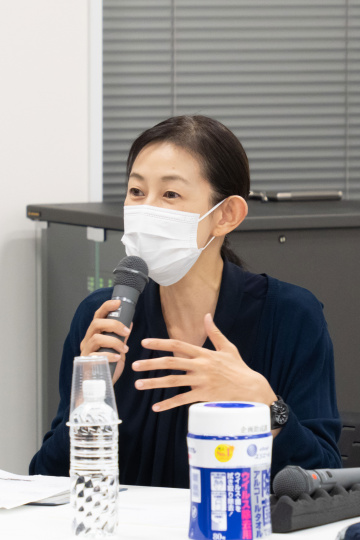
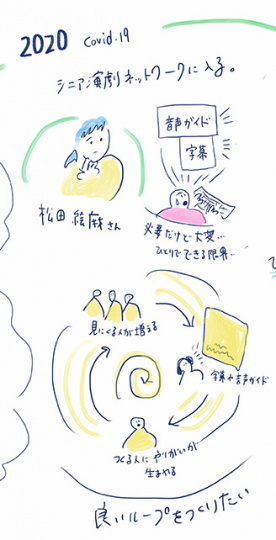
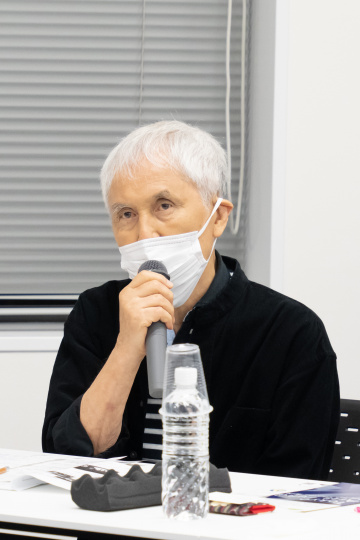
Matsuda Ema, vice president of the Senior Theater Network, then made a presentation. He is also the representative of the "Beni Jellyfish Project," a group affiliated with the Senior Theater Network that recruits members for each project and challenges them to express themselves through theater and video. Until 2019, he worked at the long-established Meijiza theater, and the story began with the first time he introduced support services.
"My predecessor, who was in charge of planning, was transferred, and I was in charge of viewing support instead. So I consulted with Kujira and TA-net (theater accessibility network) (footnote 2), and they gave me guidance at the reception desk and held a lecture to create an audio guide, and I actually tried it. I was hoping that the number of customers would increase by introducing the system, but the number of customers that Kujira-san brought remained. After that, I'm sorry, but I didn't think about the support of the theater as a for-profit organization."
Footnote 2: The Theater Accessibility Network (commonly known as TA-net) is a non-profit organization that supports theater-going with the slogan "Let's all enjoy the stage together." It was established as a voluntary organization in December 2012, and was certified under the Specified Non-Profit Activities Law in July 2013.

Photo by Kazuyuki Matsumoto
However, after leaving the Meijiza in 2019, Matsuda launched the Beni Jellyfish Project the following year and joined the Senior Theater Network. Watching Kujira's work, he said, "In the theater world, things that are good for society or that have aspirations are often based on the efforts of one person, but that is not good. If we don't increase the number of friends and create a system for customers to come to watch, I don't think any support for viewing will last long."
"We can't recommend expensive viewing support to organizers without subsidies. On the other hand, if disabled customers do not come, what should we do? For this reason, I think the challenge for the future is to create a good spiral in which more people go to see plays and the people who make them feel motivated. There were many visually impaired people and people in wheelchairs at the Kanjukuza performance the other day. Looking at the audience seats from the reception desk, I was impressed by how many people were enjoying one play. This is what whales want to do. I hope we can share it with a lot of people so that we can get a little bit more success and spread it."

(Image enlargement: JPEG version)
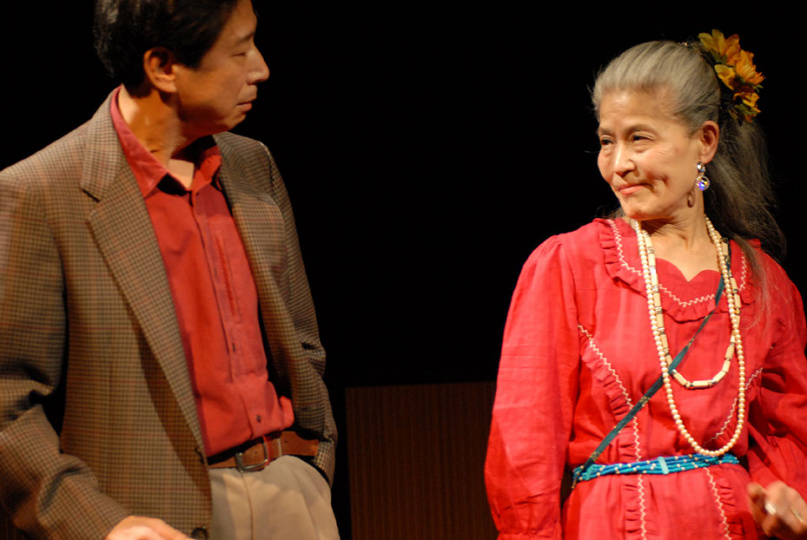
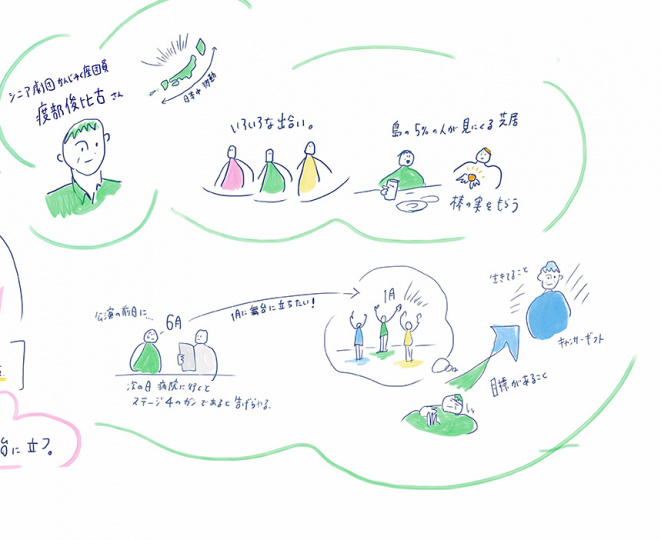
Next, Watanabe Toshihiko, who has been a member of the Kanjukuza theater company for a long time, talks. He joined the Junju-za immediately after retiring at the age of 65 and is now 79. "The regular performance every spring is usually a new work with social elements, written by Emma Kujira, and challenges it. We receive training on vocalization, chanting and dancing from professional Kyogen performers, and we also receive training on music and physical expression from professionals."

Photo by Kazuyuki Matsumoto
The National Senior Theater Competition has been held five times. "I was able to participate in all five meetings, and various connections and things have been born. Our visit to Izu Oshima, where we performed on the island, was one of the inspirations that led to the formation of a theater group called "Expression Group White Moss," which is still active today. In Miyakejima, about 110 people came to see 1 performance, which is 5% of the total 2400 islanders, and it was very popular. When we were having a meal at a restaurant after the performance, children from kindergarten came here and there and gave me camellia seeds as presents. I'm still taking care of it. You can experience a different atmosphere from the performance on the mainland."

Courtesy of NPO Senior Theater Network
However, on May 2019, the day of the Kanjukuza's main performance,. "I had a lot of melena in the morning, but somehow I was able to perform on stage. The performance ended without any problems, and when I was examined the next day, I was diagnosed with stage 4 rectal cancer. Even so, I asked the doctor, "I would like to start practicing for Kanjyukuza from January next year. I will start practicing for the regular performance from January, so could you give me treatment in time for that?". With the understanding of his doctor, he said, "Well, let's decide on a treatment plan so that you can go back to play in January." It metastasized to the liver after surgery in June, and I received anticancer drugs in August and September. I think I was able to endure the painful treatment because I had a goal."
"If I interpret the word "cancer gift," I think God gave it to a patient who had cancer. I'm not exaggerating. When I wake up in the morning, I honestly feel like I'm alive again. I'm really happy when I feel the wind. Well, it's nice to be alive." Watabe's earnest words seemed to prove the raison d'etre of the constellation, where expression and life come together.

(Image enlargement: JPEG version)
(Reporting and writing by Yuri Shirasaka)
Senior Theater Network
高齢者の演劇活動の支援と、障害者の観劇支援を主な活動とする。2006年任意団体として設立し、2012年に法人化した。現在は全国シニア演劇大会の企画運営や、シニア劇団の運営組織として活動するほか、さまざまな劇団、劇場の演劇公演でバリアフリーサポートを施している。
https://s-engeki.net/
Social Grant Grant results
- FY 27 (2015) "Audio Guide Producer Training Course for the Visually Impaired"
- Heisei 28 (2016) fiscal year (2) 'The 11 th performance of Senior Theater Company Kanjukuza "Neko! 2017"
- Heisei 29 (2017) fiscal year (2) "Senior Theater Company Kanjukuza: The 12 th Performance" Minori no Hata ""
- FY Reiwa 2 (2018) 1st Term "Barrier-free Lecture for Theater Professionals" Support for the Visually Impaired "
- FY 2021 (Phase 1) "Barrier-free Continuous Seminar for Theater Professionals 2021 (Year 1 of 3-year Project)"
- FY 2022 Phase 1 "Support Course for Appreciation of Performing Arts" (2nd year of 3-year project)
Social Grant
A program to support "Activities that allow people who have limited opportunities to experience and participate in art due to their social environment to engage in art experiences, such as appreciation and creation, and to exercise their creativity and enrich their imagination." and "An artistic activity that sets social issues based on one's own awareness of issues and works to solve them with a long-term perspective while collaborating with various people and organizations" for organizations working in Tokyo.
The system was launched in FY 27 (2015), and since FY 28 (2016), applications have been made twice a year. It has supported more than 100 projects. It is not just "art for art's sake" or "art that is useful to society," but it is trying to support activities that propose and materialize a new way of art in which society and creative activities are inseparable in a way that has never been done before, so to speak, "the third art."