
Part 2: Fukahori Interview
Creating Together and Evolving Together
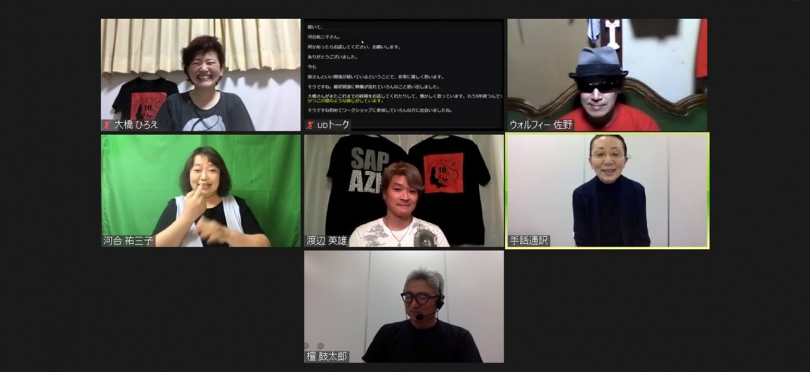
The second part is hosted by Arts Council Tokyo 's program officer, Ryoko Umemuro, and interviews with Hiroe Ohashi and the actors who appeared in "A Midsummer Night's Dream". The exchange, which included questions from viewers, was not limited to the results and challenges of the project, but also expanded to education in the era of multicultural coexistence.
> Click here for Part 11: "Realizing Diversity Theatre" (Part 1)

-In the first session, Mr. Ohashi said that this long-term grant was very effective in developing human resources. This time, we have provided support for two years. Looking back on this project, could you tell us if there was anything that you felt had an effect or influence on the work because it was a long-term project?
- Ohashi
- Without the long-term subsidy, it would have been difficult to develop human resources to this extent. However, now that I think about it, I wish I had focused more on the quality of human resources. I wanted to deepen the content of the workshop and take more time for that. In addition, there was a lot of confusion about the placement of access coordinators due to the turnover of members. It would have been better if we could decide fixed members beforehand. In order to do that, we need to have time for discussion. Because I know so much about theater professionals, I would have liked to have spent more time with the Access Coordinator team, working slowly and fully.
- This project was carried out for 2 years from 2016 to 17. In 2017, the "Basic Law for the Promotion of Culture and the Arts" was revised to become the "Basic Law for Culture and the Arts." Since then, more and more efforts have been made to engage diverse people in the arts. However, on the other hand, as Mr. Dan pointed out earlier, I think there are still areas that are lacking, such as the training of audio guides.
We also have a question from our audience. "Are the access coordinators and theater sign language interpreters who were active in this project still working?" he said. How about this?
- Ohashi
- The grant for the past two years has enabled us to create an access coordinator and a team of interpreters specializing in sign language. Some of them are still active. Some are sign language interpreters, and some are involved in the Paralympics. More and more people are doing this. But I wonder what will happen after the Paralympics. That's the problem. If it's true, I think it's OK to have more performers with disabilities. On top of that, we also want to increase access coordinators and sign language teams. That would be ideal.
Human resource development is limited at the individual level. So maybe we should get more help from people in the theater world. It would be great if the programs for aspiring actors at theaters and drama schools could include the study of voice guidance and sign language interpretation.
- This is another question we received. "Mr. Kawai said earlier that he could follow the leader because he was deaf. I think there is also an urgent need to train leaders with planning skills. Mr. Ohashi, how did you feel about the meaning of being a leader, the importance of being a leader, and the difficulties?"
- Ohashi
- I don't think it's special that people involved in creating plays. Some directors who can hear may find it difficult to relate to people who cannot hear. The opposite is also true. Some deaf people find it difficult to relate to hearing people. Therefore, I think that the good side of being able to understand each other and understand each other will be born when the parties concerned are involved. However, there are various people with disabilities. I will tell you about my experience when I performed The Tempest in June of this year (2021). People from three countries, England, Bangladesh and Japan, performed Shakespeare's famous works together. Since we were both handicapped, I thought we would be able to understand each other, but surprisingly, that wasn't the case and some difficult things happened. I realized that no matter what kind of members you are, if you don't communicate with them carefully and keep things moving, you can't produce a good film. In other words, there are things that can be done because the person concerned is the leader, but there are also things that are difficult.
- Thank you. I would like to ask you to answer one more question. "I think it is difficult for people with disabilities, especially the deaf and visually impaired, to attend drama workshops and drama schools. What should I do?". Mr. Wolfie, Mr. Kawai, how about you?
- Wolfie
- What should I do? Not only theater, but people with disabilities have a history of acquiring educational opportunities through their own efforts. For example, there was a time when it was very difficult for visually impaired people to take general entrance exams for universities. The reason this has changed is because of the enthusiasm of the people involved and the efforts of their supporters. Therefore, I think that the current situation will not change unless there is an increase in the number of people with disabilities who want to become actors and who want to compete with ordinary people.
- Kawai
- There are some things that have changed. For example, before, people who couldn't hear couldn't go to see plays by people who could hear. But now I have a lot of things to go out and learn. Information security for communication has also advanced. Regarding the problem that there are few or no places to take care of it, for example, even if you are a deaf person, there may be someone who can talk to you a little. Instead of saying, "It's hard to communicate because you can't hear." try it first. Therefore, I think that there are more and more places to create an environment such as "Is this the difficult part? Well, let's put in some sign language." First, try, meet, deal with. It's important to start there. Of course, I think that the current situation is still far from satisfactory. Even if it is good at the beginning, problems may occur in the middle. Both those who participate and those who accept it must overcome these challenges. I don't want to be told to do my best because I'm disabled. It is natural to think "I can't hear this, so what shall I do?" and I think it is important to have such an environment from childhood. If there is proper education about what it means to be deaf and what a disability is, I think children will grow up like that.
Mr. Ohashi, you have experience studying abroad. What do you think about the current situation that it is difficult for people involved in artistic activities to get into workshops or schools?
- Ohashi
- The environment has changed a lot since I studied in America. In my case, I was able to start preparing for my artistic activities, but the problem is after that. After graduating from school, it takes too much time to figure out what to do and how to respond. In such a case, I think it will make things smoother if the parties themselves go in, interact and experience. By doing so, you can learn how you and others can respond. I think it is important that people with disabilities and those without disabilities work together to solve problems.
-Thank you very much. We received a report on a very informative and interesting activity. This long-term grant activity report meeting is a series and introduces activities in various fields. For the next and subsequent times, we will announce more details on the Arts Council Tokyo website, so be sure to check it out. In addition, if you want to take on a new challenge like Mr. Ohashi and want support for long-term subsidies, we set up an open call once a year. We will also publish information on our website, so please check it out.
(Composition and text: Rieko Suzuki)
Profile
Hiroe Ohashi
After graduating from high school, she began sign language drama, dance and independent film production. In 1999, she won the Seventh Yomiuri Engeki Taisho (Yomiuri Engeki Grand Prize) for "Chiisai Kami no Tsukurishiko ra" (Little God's Creation) produced by the Haiyuza Theater. She later studied theater and dance in the United States. In 2006, sign art project. He composed and directed "Call Me Hero!" his first Asian film. After that, he continued to work as an actor and director.
Yumiko Kawai
In addition to acting, he also teaches sign language, physical expression, and theater workshops for children. Since 2018, she has been active as a member of the Denchu-gumi, a unit that loosely connects with sign poetry, voice recitation, and dance.
Wolfie Sano
In addition to working as a jazz vocalist and saxophonist, he is an executive committee member of the Mei Asaka Center's "Everyone Gathering Concert." He also served as a lecturer at the Department of Music at the University of Tsukuba School for Special Needs Visuals, and as a chief lecturer at the Lifetime Music Department at the Kawasaki Fun Spring School of Music. In 2017, he made his acting debut in the rock musical A Summer Night's Dream.
Hideo Watanabe
In addition to acting mainly on stage, he also works as a voice actor and narrator. Sign Art Project. He has been involved in Asian films since 2015 -1945. He played Oberon in the rock musical A Summer Night's Dream.
Kotaro Dan
As a barrier-free live commentary specialist, he provides live audio guides in various fields such as movies, plays, professional wrestling, video streaming and year-end parties.
Sign Art Project. Asian (Sign Art Project. AZN)
It was established in 2005 by Hiroe Ohashi with the aim of developing sign language as an artistic performance. After that, he created performing arts that fused music, dance, drama and sign language. In addition to popularizing sign language as a means of communication that transcends ethnic and national borders and creates a new culture, he continued his activities in order to break down the "mental barriers" that everyone has and open themselves up to become closer to the hearts of others around the world. In 2020, 15 years of activities ended to move on to the next stage.