
Part 2 Interviews
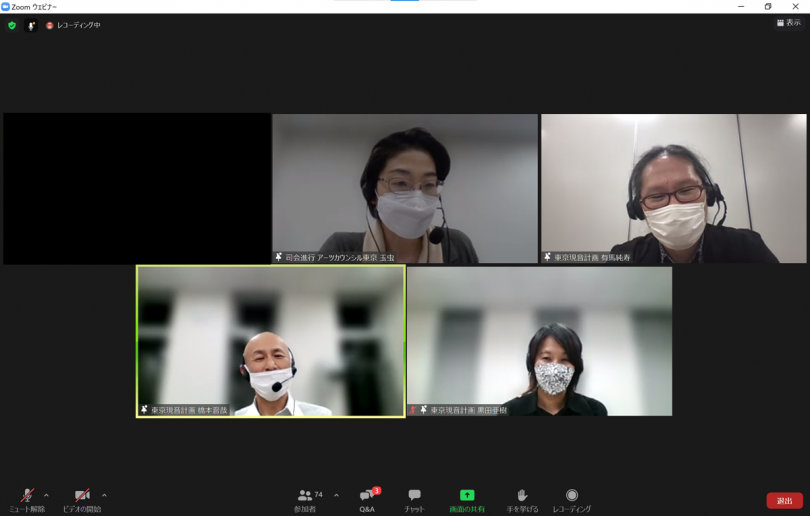
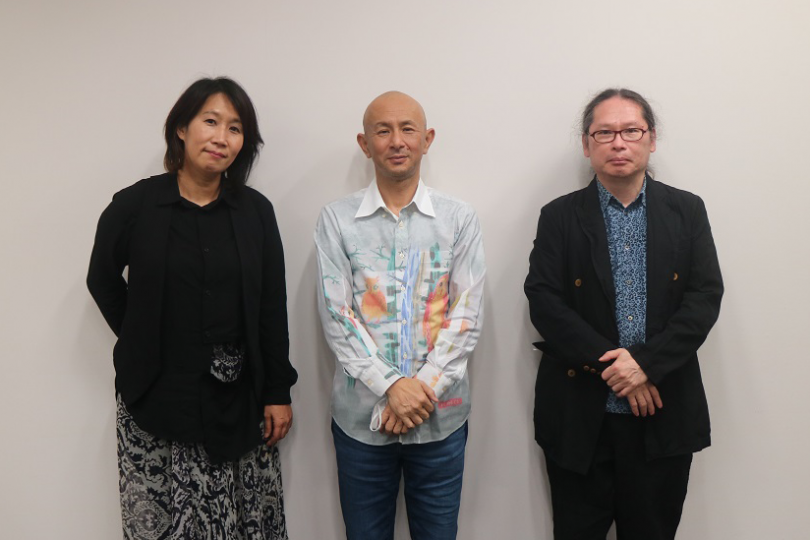
In the second session, under the chairpersonship of Mikako Tamamushi, Director of the Planning and Support Division of Arts Council Tokyo, the participants discussed the scope of the Tokyo Genken Project's activities, the ideal teams that make it possible, and future developments, with questions from the audience.

This is how the Tokyo Genken Project was born.
- Arts Council Tokyo has been providing a single year grant for the Tokyo Arts and Culture Creation and Dissemination Program since the first performance of the Tokyo Real Sound Program. When I first heard about the launch of the Tokyo Genken Project, I had a hunch that something interesting had started, and at the same time, I thought, "How will we continue our activities with this organization?". I think it's really amazing that this has continued for 10 years.
Today, I'd like to take this opportunity to discuss the origins of the Tokyo Genken Project and why it was named this way in the first place. Why is the name "Tokyo"? Is "Genon" an abbreviation for modern music or does it have another meaning, such as "sound appears"? The name "plan" implies that you are going to proceed in a certain way and procedure toward some intention. Could you tell us about your intention in this regard?
- Hashimoto
- Mr. Arima finally called it "How about this one?". In the first place, I was the one who initiated the formation of this ensemble, and I brought the idea to Mr. Oishi. This is because quite a large ensemble often includes saxophone, percussion, tuba and electronics. But as the size gets smaller, instruments other than the piano are removed. In fact, we often play as extras rather than as full members. Then, when we want to do something independently, there is no ensemble that can do it. I was very unhappy about this, and I thought, "Then why don't we get together with those people?". That was the first time, and later I begged Mr. Kuroda to join the piano.
So, from here, we had to use our wisdom and start activities, so when we decided on the name of the organization, we decided to "I don't want to do ensembles or anything like that because it happens a lot." Then I thought, "Japanese with four or five kanji characters is good." like Mujirushi Ryohin. We are based in Tokyo, in the Kanto region, so we were aware from the beginning that we would start from Tokyo. I want to show the uniqueness of the ensemble of the city. - Arima
- Then, when we thought about what to do, we were talking about not just an organization that holds concerts, but an organization that plans something new. So I came up with a plan. I was kind of aware of the name of a science fiction writer. I was thinking about how to express that it's not just about playing music, so the name was a perfect fit. I remember talking to Mr. Hashimoto on the phone in the evening and instantly deciding, "This is it."
Plans to expand
- In addition to the selections of composers, musicians, and cliques that were made through long-term grants, you have been developing activities that can be said to be proliferation, such as producer's selections, best selections, and à la carte series. Each of the five members is busy working solo or as a separate unit. He has also published a database of his repertoire on the web, a YouTube channel for the Tokyo Gentone Project, and recently published a book titled Live Electronics Music in Japan. Rather than "expanding" activities, how did you develop this style of "expansion," in which branches increase and expand more and more? Did it happen naturally or was it planned?
- Hashimoto
- I think half of it is a matter of course. At first, there were two selections, one for composers and the other for performers, but I started to think about how critics and musicologists view music, and if I could create an opportunity for those people to actually throw something into the music scene, then the selection of critics and producers increased. Also, this is related to the that was mentioned earlier, but we are not just going to perform, but we are going to propose something like, "You can do something like this, why don't you try it?" and by doing that, we hope to make the whole contemporary music scene more interesting. That's why we do it for fun, and we do it a little unprincipled. There may be some areas that haven't developed yet because they haven't been organized properly.
- Arima
- If I had to add something, it might be more me than all of the members' consciousness, but I never do the same thing twice. If we do contemporary music, we have to do something different every time. As a result, the situation that you just mentioned is developing. Also, I think each member has a completely different background. As for the development of books, the first job I got when I became a member of society was as an editor, and I didn't think that making books and doing music were so far apart. For example, I think that Mr. Kuroda is thinking of continuing to do what he does at a live house and do contemporary music at a concert hall, so that his background will not be drawn to contemporary music, but will be invaded as it is.
- Kuroda
- When I was in charge of the musicians selection, I was glad I was a group that did this. I started out as a classical pianist, but I go back and forth between genres. Everyone feels like they can use the Tokyo Gentone Project and the box of modern music as they like, come back when they like, and play their favorite songs.
the strength of a team that's not just musicians
-Now I'm going to read some questions from the audience. I have a question for Mr. Hashimoto. Please tell us about the future of Tuba.
- Hashimoto
- Tuba is a musical instrument with a relatively short history, but compared to orchestral instruments, the technique of each generation is greatly improved. In 10 years, the range seems to expand about 1 octave. So, there are many talented young people today, and this is not limited to Tuba, but more and more people are doing interesting activities on YouTube and so on, and they are coming out. So I think it's becoming an interesting situation not only for contemporary music. If the person who asked the question is a tuba player, please do it with hope, and even if not, please listen with interest.
- Thank you. Next question. There are no vocalists or stringers among the members of the Tokyo Genon Project. Please tell us your thoughts on whether you will invite them as guests each time, whether you have a designated advisor, or whether you will recruit new members in the future.
- Arima
- Of course, there is the idea of increasing the number of part-time workers, and we sometimes talk about it, but Hashimoto-san and I often say that it would be difficult just to adjust the schedules of the current five people, and it would be quite difficult to add another person. When we invite outsiders, we don't have an advisor in particular, but we discuss and decide. If I do this song, I want that person to join. The selection of the performer is different depending on the song.
- Hashimoto
- The current five members share the work of the Tokyo Genken Project while carrying out their own activities. If the number of members increases beyond a certain level, I think the weight of activities may change drastically depending on the person. For example, if you have 10 people, chances are high that you will be separated into core members and non-core members. On the other hand, I think five people is just the right number of people in the sense that each of them has to share their responsibilities because there are times when one person can't manage by themselves and someone has to help.
- Arima
- If you trace the history of Japanese contemporary music ensembles, it may be a coincidence, but there are quite a lot of 5 members. Tokyo Quintet or Sound Space Ark. Maybe this number of people is the secret to keep a good balance and work for a long time.
- You mentioned about the members, but I would like to ask about other staff members. For example, in the case of Genon Keikaku, the production was done by Ayako Fukunaga of Naya Collective, the stage director was Hideo Suzuki of Kanon Kobo, and the photographs and logo were done by Hiroyuki Matsukage. I have the impression that they worked with a certain team from the beginning. Do you have any idea about this area?
- Arima
- When I first heard about the plans for this ensemble from Mr. Hashimoto, the first thing he told me was that in order for the group to continue, not only do we need musicians, but we also need productions. I think the fact that everything is packaged, including the stage staff and design, is related to the fact that I am a bit involved in the field of contemporary art. In the contemporary art scene, we pay a lot of attention to that aspect, but there is a tendency for music to be done only by musicians, so I proposed to change that.
- Hashimoto
- I hope that the importance of holding concerts with the support of such staff members will become more widely known in the contemporary music scene. For example, Mr. Fukunaga of Naya Collective is very involved in the production, and he gives us a realistic perspective on what we want to do. The division of administrative tasks tends to lead to fights, and it can lead to someone saying, “I ’ m sick of this. ”. But sharing it with professionals is what keeps us going. In the case of modern music, there are many cases where the receptionist and the stage director are taken care of, but sometimes this goes well as the flow of the whole concert, and sometimes it doesn't. If a specialist takes care of that, the level of concentration for the performance will be different. In addition, I have a feeling that if we are going to have a concert, everyone should be happy. I also think that it is important to manage various areas as a job.
- Kuroda
- They don't always perform with 5 people. It could be a duo or a trio or a guest. Also, as you saw in the video earlier, some programs include gestures and physical expressions, and sometimes lighting and staging are added. In such a case, the stage cannot be made if the stage director takes his own lunch. Therefore, I think that the fact that various staff members participate as associate members matches the color of the Tokyo Genken Plan and has a very good effect.
- Arima
- Mr. Shoin, who I am asking for the photos, is actually a member of an artist group called "Showa 40 nenkai," in which I also participate. We have been working on installations at our recent concerts, so it has been very helpful for us to have a visual representation person as a partner at such times, and we have been planning to do so intentionally. Probably, but I don't think you take a picture every time with an ensemble like this. But of course, we have the conviction and belief that keeping records will lead to the next.
Key points of planning for Grant Programs
- I have a question about subsidies. When you applied for this grant, what kind of appeal did you make and what kind of vision did you have in your proposal? Could you tell me some of the contents?
- Arima
- As for the concert, we made a proposal in which the theme of each concert was clear and the purpose of each concert could be stated briefly. The fact that we work on an equal footing with the production team is effective in applying for grants.
- moderator
- I would like to add to this from our side, which is providing subsidies. In addition to music, this long-term subsidy program allows applications from a wide variety of genres, including theater, dance, art and video, traditional performing arts, and other genre-complex activities. However, the number of long-term grants for music is very small, with only 3 from FY 2013 to the present, which is about 8% of the total, so we look forward to receiving applications from those who are engaged in music. In this context, the database project of the Tokyo Genken Project was an effort to make the recorded videos of our concerts available to the public for free, something that is not normally possible. I think it was a unique project in that we had the perspective of what we could do for the music scene through our activities and how we could change it, and we tried to do that. As for the planning of concerts, it is not a regular performance that is repeated in the same way every time, but the content asks what it means to plan, and the planning method itself is a proposal. I thought it would be very helpful for other organizations and people who are planning to start activities. Critics Selection, for example, was unique in that it tackled the problem of how to create a place where research and criticism can be involved in the actual music scene in a practical way.
How to stay active for a long time?
- The next question is, what kind of contemporary music performance organization would be sustainable in the future? Can you give us some advice?
- Hashimoto
- It's modern music, so I don't think you should ask your elders these things. Young people are more sensitive, so I don't think we need to refer to old people's opinions. I think there is a fairly clear answer to the question of how to establish and maintain such an organization for a long time, not only in contemporary music. It probably means doing it with people you get along with, people you can stick with for a long time. That's the most important thing, and organization and skill are secondary. It's hard to get along with people for a long time if you have skills but don't get along with them, so it's quite important to have a long relationship. In our case, it doesn't look like we can play more than one concert, but we've been able to manage it with our wits.
- Arima
- If I could say anything, it would be that you shouldn't think only in music. For example, there are a lot of things that are common in theater that have not yet been done in contemporary music. That's why I often refer to what other groups in other genres are doing and what methods they are taking to keep them going, including applying for grants, and I try to keep my eyes open. This is not just a question of sustainability and subsidies, but also what's in season, and I think that's something that you don't know if you just look at music.
- Hashimoto
- Then, there is the staff that was mentioned earlier. It is important to properly create staff who can think and grow together outside of production and performance.
- Arima
- In music, the presence of curators is rare. I think we need to develop that. It is the same for production, but I think it is necessary to have important members who are not directly performing but who are important for organizing concerts and projects.
Until the song is decided
-The "selection" part of the Tokyo Gensei Project takes the form of outsiders being commissioned to select music. At that time, will the present sound planning side make any requests? Also, what if the selected song is difficult to achieve?
- Arima
- If it's not limited by the length of the song or the cost, I'll manage somehow. The know-how is a trade secret. (Laughter)
- Hashimoto
- This is case by case. Professor Kondo's lecture, which I mentioned earlier, is an example in which a piece was decided "this" without much consultation and it was decided to go on as it was, but there are also cases in which it is rejected due to the budget, composition, and rental fees for the sheet music being very expensive. Of course, we want to do as much as possible what he has proposed to do. However, we have discussions over quite a long period of time, about several years. There are various patterns of selection. In Noriaki Mori's show, I was surprised how many songs he researched, and I think I can do it three more times. Atami Inamori did a lot of research. Mr. Numano once told me, "It was really hard because there was a tuba." Of course, Mr. Numano is joking.
- Arima
- So, depending on the concert, there are nearly 100 candidate songs, and sometimes we narrow down the candidates. The people we are working with have done a lot of research, and the amount of information there will be the key to our success. There aren't many cases like that, but if you're offered a relatively soft plan, you might say, "Let's work a little harder," or "Let's do more research."
- Hashimoto
- There are people like the one you just mentioned who have great research skills, and there are also people who have a clear vision and ask, "I want a song like this in this composition. Do you have anything?" In that case, we do our best to find them. For example, I know the most about tuba music, so I sometimes suggest something like this. Of course, there are also people who bring me Tuba songs that I don't know at all, so it's really fun to interact with them.
- Kuroda
- Whether it's after a concert or before, it's always a topic of meeting.
- Arima
- We are going to list a lot of candidates, so at that point, we have a lot of information, and from there, it will be the time to make the battle I mentioned earlier.
- Thank you. Among the questions we have received, I would like to ask you about the part related to finance. How are profitability and the scale of the performance hall determined? Also, if it is a long-term subsidy, it will cover half of the total expenses. Will the rest be covered by admission fees?
- Arima
- I think there is a way to use multiple grants. As for the size of the venue, in our case, it is rather simple. First of all, the conditions and restrictions are that it is easy to do electronics. So, a hall that doesn't have any equipment is not eligible. In our case, we usually use Suginami Public Hall, and the main reasons are that they have all the sound equipment, can use it freely, and respond to unreasonable requests. However, when choosing a venue, it has to be available, so we have to worry about where we can reconcile our wishes with the availability.
- Hashimoto
- As for profitability, as I mentioned earlier, Mr. Fukunaga of Naya Collective has the greatest influence. When Mr. Fukunaga negotiates with me to perform, he makes judgments such as, "This is the only vacant place on this day, so I will go here." and in the case of the hall, he says, "Please pay this price." By managing not only for each concert but also for multiple years, you will understand where you can spend money and where you need to save money. Therefore, I think that it is very difficult to manage an ensemble for a long time only by musicians.
- Arima
- Also, I think the key to managing an ensemble is how to utilize the benefits of long-term subsidies.
Future of the Tokyo Genken Project
- Thank you. Finally, I would like to ask Mr. Arima about the future Tokyo Genon Plan.
- Arima
-
Basically, the concert itself is a new challenge every time. One of our plans is to strengthen collaboration with overseas companies. Mr. Kuroda's selection was truly "from Tokyo," but we need to think beyond that. Also, as I mentioned earlier about age, how do we pass on our know-how to the next generation? The electronics part I'm in charge of is a matter of life and death, and not so long ago there was almost no successor. I think we need to think about how to communicate the performance as well as the management know-how. The third is a wide range of collaborations that go beyond contemporary music. We already started this in the à la carte series in 2021, and I think there are many discoveries in this kind of approach, and it will be a great stimulus to our main activities. Personally, I am interested in the concert that Mr. Kuroda held at a live house last year, and there is talk that there are some songs that should be performed at a live house. I am also interested in the old music that Mr. Hashimoto performed, and how there is continuity when the same person who performs modern music performs. As for myself, I don't improvise as much as I once did, so I'd like to do that soon.
As an ensemble, we plan to increase our activities naturally rather than consciously expanding them. This is just a preview, but we are currently doing a remote ensemble-in-residence program at the graduate school of the University of Virginia in the United States. This is a project that was made possible due to the COVID-19 pandemic. We are conducting research with professors and doctoral and master's students over there to see how Zoom can be used as a tool to create music, with the help of the University of Tokyo. The results will be announced next fiscal year. At the end of the year, we will present it in concert format, and we are also thinking of doing it online. We are always thinking about these things in our activities. Now, if you two could add something.
- Hashimoto
- This briefing session has also been held in a webinar due to the coronavirus pandemic. I hope this turmoil will end soon, but by that time, I think the music scene will be completely different from 2019. How will contemporary music change in line with that? Of course, I think it will have to change. What can we do? I think there will be many more things that we think would be interesting to do, rather than "we have to do this," so I hope we can catch them well and use them in our activities.
- Kuroda
- We've done a good job of archiving and communicating online. When working with the University of Virginia on a new project, the historical data in the archive is very helpful. 10 years later, I can now say, "I am a piano of the Tokyo Symphony Project," without any explanation. Therefore, I think that there are many things that can be challenged by the Tokyo Genken Plan.
- Hashimoto
- Speaking of something dreamy, recently in the field of contemporary music, there have been an increasing number of young people working energetically and small ensembles, so I would like to hold a festival. I would love to have your help with that project.
- Arima
- It's a two-day modern music festival.
- Hashimoto
- That's my dream.
-Since you are a member of the Tokyo Genon Project, you may be imagining something different from previous festivals. Could you tell me more about it?
- Hashimoto
- This is really the first time for me to talk about this, but when I go to listen to various ensembles and concerts of contemporary music, I have the impression that the audience is very divided, like this audience at the place where this performer is playing. It is often said that contemporary music should be more open to the public, but before that, audiences are divided into those who like Boulez but not Reich, or who like Tan Dun but not Xenakis. However, we don't have the opportunity to see what kind of organizations are doing what kind of activities in Japan, so it would be nice if there is a place where we can mingle and see that there are various kinds of music and various people are coming when we go. In that sense, I think the Bonkuri Festival that Mr. Dai Fujikura is currently holding at the Tokyo Metropolitan Art Theater is an interesting initiative, but I think we can do something a little different.
- Arima
-
As a group, when I hear ideas like this, I feel free to say things like, "Well, let's put someone from a different genre." or, "Let's add a contemporary music DJ," and the project expands. I think that is also unique to the present sound plan. Today, each of us is speaking carefully in turn (laughs), but normally our style is that we have a lot of things to say and it's hard to keep things under control, and we want to value the interaction that is created.

(Composition and text: Rieko Suzuki)
Profile
Tokyo Gen'On Project
Formed in 2012 as an ensemble of musicians at the forefront of contemporary music. A new perspective is proposed from the performer side, such as a program focusing on Japanese premieres, commissioning unique compositions, and workshops for young performers, composers, and staff. The current members are Sumitoshi Arima (electronics), Masanori Oishi (saxophone), Yoshiko Kanda (percussion instruments), Aki Kuroda (piano) and Shinya Hashimoto (tuba). He received the 13 Keizo SAJI Prize (2013).
Arima Junju (Electronics)
Focusing on sound expression using electronics and computers, he develops activities that cross genres such as contemporary music and improvisation. He has participated in major contemporary music festivals in Japan and abroad, and has been highly praised for his sound technology and performances at numerous concerts. The Minister of Education, Culture, Sports, Science and Technology Award for New Artists. He received the Keizo SAJI Award from the Suntory Arts Foundation as a member of the Tokyo Sinfonietta and Tokyo Genon Project, and as a soloist at Persepolis in the Akiyoshidai International Art Village. Associate Professor, Department of Liberal Arts, Tezukayama Gakuin University; Adjunct Professor, Graduate School, Tokyo University of Music; Adjunct Lecturer, Kyoto City University of Arts.
Aki Kuroda
東京芸術大学卒業、伊ペスカーラ音楽院高等課程を最高位修了。フランス音楽コンクール第1位。ジローナ20世紀音楽コンクール現代作品特別賞。現代音楽演奏コンクール優勝、朝日現代音楽賞。 ビクター『タンゴ2000』『タルカス&展覧会の絵』、伊LIMENレーベル『ブルグミュラーエチュード全曲集』DVDなど録音多数。サルデーニャのSpazio Musica現代音楽祭、シチリアのエトネ音楽祭などイタリアを中心に活動。作曲家の指名により録音した『Piano Collections FINAL FANTASY』等によっても親しまれている。2014年『火の鳥〜20世紀ピアノ編曲集』を伊オドラデクよりリリース、英BBC ミュージックマガジンにて五つ星、レコード芸術誌にて特選盤。
http://www.kuroaki.net/
Shinya Hashimoto (Tuba)
チューバ、セルパン(16世紀フランス由来の古楽器)奏者。サントリー芸術財団サマーフェスティバル(2008、2010)、コンポージアム(2009)、ヒロシマハッピーニューイヤー(2015)、「秋吉台の夏」現代音楽セミナー、東京オペラシティ文化財団「B→C」、NHK-FM「名曲リサイタル」などにソリストとして出演。洗足学園音楽大学講師。「東京現音計画」「低音デュオ」「東京セルパン・トリオ」のユニットで活動。
http://shinyahashimoto.net/