
- target business
- Fukushima Trilogy (adopted in FY 2017: 2 years)
- Speaker (Reporter)
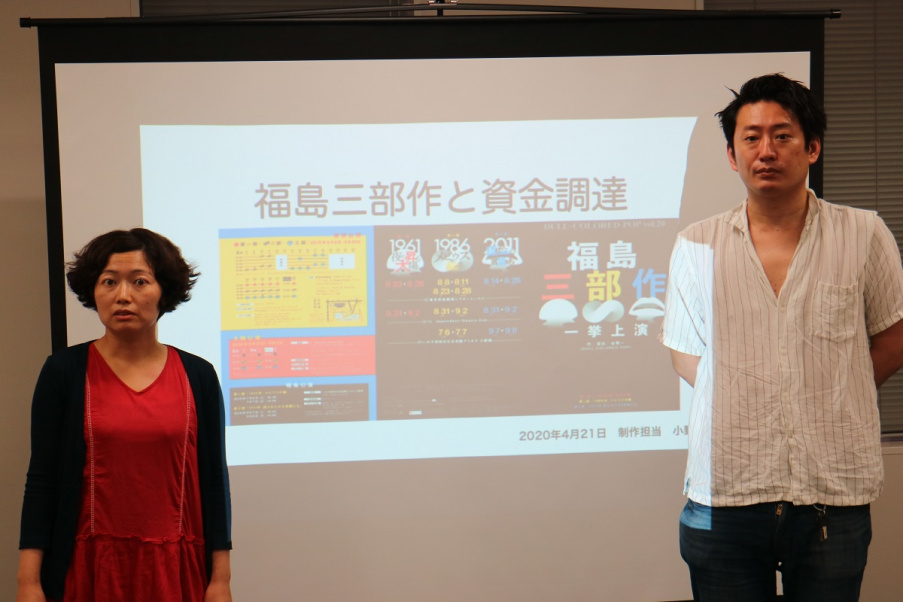
- Kenichi TANI (Writer, director, translator, director of the theater company DULL-COLORED POP), Hiroshi ONOZUKA (produced by the Fukushima trilogy)
Part I Report
The series depicts the history of Fukushima and the nuclear power plant through the stories of three generations and three families over a period of 2 years, attracting a total audience of 10,000 people. In addition, his plays won the Kishida Kunio Drama Prize and the Tsuruya Nanboku Drama Prize (the second part, "1986: The Ring of Mobius"). The Fukushima Trilogy by the theater troupe DULL-COLLORED POP was undoubtedly the news of the Japanese theater world in 2019. How did this challenging project start and reach this ideal success? In this briefing session, the backstage of creation and production was clarified from the viewpoint of "funding."
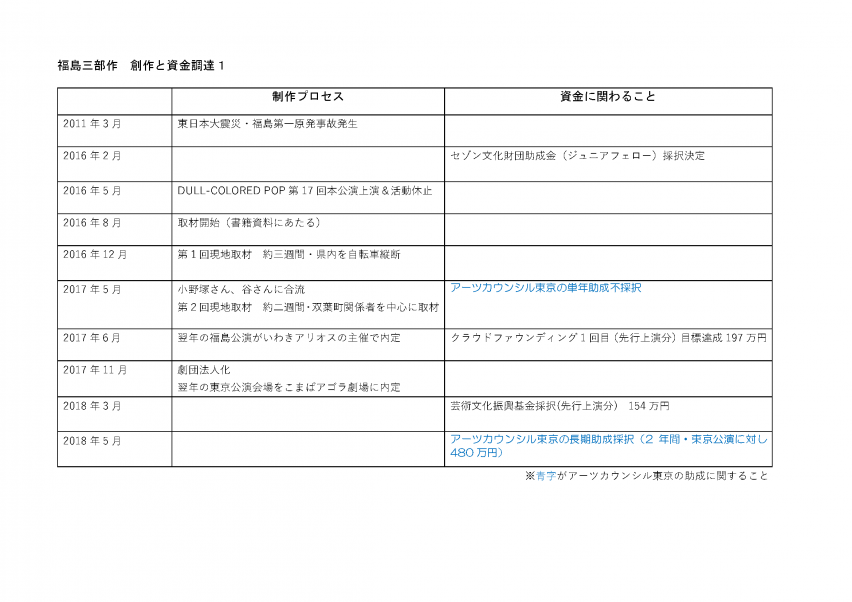
It started on March 11, 2011.
The first date on the handout describing the progress of the project was March 11, 2011. DULL-COLLORED POP producer and director Tani Kenichi was born in Fukushima and has a deep connection to nuclear power. "I was born and raised in Fukushima Prefecture, and my father was a nuclear engineer who also went to and from the Fukushima Daiichi Nuclear Power Plant. In that sense, the date on this print might be May 11, 1980, the day I was born. It was only after the JOC accident when I was a high school student that I became aware of the relationship between myself and nuclear power plants. After that, I personally researched nuclear power plant issues, but I had never spoken out or communicated about them. Then, in March 2011, a major accident occurred. I felt a sense of crisis and fear that my hometown would become a place where no one could enter. Since then, I have always wanted to express something about Fukushima and the nuclear power plant."
It was in 2016 that these thoughts became the impetus to start a concrete project. He was selected as a junior fellow of the Saison Cultural Foundation and had an idea of how much money he would need to cover the story. "There are restrictions on the use of ordinary grants, such as the project must be completed within the fiscal year or it can only be used to cover the deficit, but Saison's grant does not have such restrictions. When I told them that I would like to take time to work on Fukushima, and that it might take one or two years ...... three years, they said that they would like us to use it for such things." Since it coincided with the time when the troupe was going to be on hiatus, I began my preliminary research that summer, and in December I conducted the first interview for three weeks. They will visit the prefecture by bicycle and meet people involved in the project. Although neither the framework of the performance nor the production system was fixed, the outline of the vision of the work, "take a few years" was clear. "There is no point in making plays that say nuclear power is scary and that radiation is dangerous. Everyone already knows that, and that's not the essence. The question is why local governments have allowed such a dangerous thing to exist and why residents have accepted it. I thought that the true darkness could not be depicted unless I wrote about the process of political and economic inclusion.I myself went to school after my father bought me a school bag with the money he received from the nuclear power plant. However, in that case, we would have to at least start talking about the period in the 1960s, when nuclear power plants were invited, and then draw up the history of the Chernobyl accident in the 1980s and the Fukushima Daiichi nuclear accident in 2011. I knew at this point that this was going to be a fairly long trilogy. "

From "support" to "co-creation". Start of crowdfunding
In May of the following year, he decided to set the story in Futaba and visited the town for the second time. Around this time, it was decided that Onozuka Hiroshi, who was involved in the production, would participate, and a crowdfunding campaign was launched to realize the performance. Onozuka, who also works as a producer for the garden theater troupe Penino, was also involved in the production of "Theatre de Annard," a project in which Tani teamed up with Masayuki Nomura of Drama Turku. "I also belong to the production company, Gouch Brothers, and among the company's future projects, there was only one title, Fukushima Trilogy. The creative process at the Théâtre de Anard was very interesting, and when I raised my hand to see if there was something meaningful about Fukushima, the president said "FIRST, IF YOU GO TO SEE TANI-KUN..."" said Onozuka. It was a big step forward that a one-man project became a two-man team. "It was the time when the production of the theater group had disappeared, and there was no theater that would raise their hand. That's why Onozuka-san, who I know very well about her abilities and her work, told me that she wanted to do it, so I thought I could do it in the theater company." Tani said.
The crowdfunding campaign raised 1,975,000 yen against the goal of 1.5 million yen. Of course, the money was enough to make the performance a reality, but more than anything, Tani recalls, "I was encouraged" by the large number of people who supported the project, which was started by the two of them alone. "Actually, I don't really like crowdfunding. I think that theater people should make a living with Kidosen. However, with regard to this trilogy, I was able to move forward with confidence because it has social significance and I had a vision of moving forward with the people who support it. Onozuka-san joined us and organized the crowdfunding, but at that point, we were the only two people in the world who wanted to do the Fukushima trilogy. As soon as we started recruiting, many people said they wanted to support us. Six or seven years have passed since the disaster, and I felt that people might have forgotten about Fukushima, so I was very encouraged by the fact that people were taking such an interest in Fukushima."
Crowdfunding sites that still exist on the Internet have the concept of "moving from 'support' to 'participation,' 'experience,' and 'co-creation.'". Along with credits in publicity materials and DVDs (not for sale), returns include sharing the creative process through e-mail newsletters, pre-events, and training tours, such as reporting on interviews and disclosing plans. Showing backers the gradual materialization of an idea would have been a guide for creators to confirm their response and direction from time to time.
To the opening of the first part. Incorporation and Theater Company Power
Along with crowdfunding, they applied for a grant from the Arts Council Tokyo (single year, not accepted), applied for a grant from the Arts and Culture Promotion Fund (1.54 million yen), and procured funds using public grants. In November 2017, he established a limited liability company, DULL-COLORED POP. The decision was made not only to facilitate contracts and payments, but also to take into account the disadvantages of not being able to apply for subsidies as a voluntary organization and withholding tax when contracting. "Since our theater company had not been very active in applying for subsidies, we had postponed the incorporation. However, when it was decided to do a trilogy and it was possible to perform in Fukushima, there was a problem with the contract with the theater if it was a voluntary organization. It is quite difficult, but we have decided to do it as a company." said Tani.

It's 2018. In May, prior to the performance of the first part, the Arts Council Tokyo decided to provide a long-term subsidy (4.8 million yen for 2 years), and the project is expected to run until the following year. The budget for the first part, 1961: The Sun Rising at Night, which opened at the Komaba Agora Theater in July, was about 8 million yen, including 500,000 yen from a grant from the Arts Council Tokyo. "We thought that the second year would be more expensive, so we kept the subsidy from the Arts Council as low as possible in the first year, so the members of the troupe collected costumes and Mr. Tani ran the operations, so we ran a fairly tight operation." said Onozuka. "When you want to cut your budget, this is a common trick at Dull-Colored Pop. The next year, for the trilogy, I left everything up to the operators, but this time I was the one who taught me how to do the sound, and I was the one in the booth banging out the triggers and making the mistakes." Tani said.
The audience for the first part premiere was 1,972 for 20 stages. Including the performance at Fukushima (Iwaki Arios), it is attracting a lot of attention, and advance tickets are sold out. The audience was filled with enthusiasm, and reviews and interviews were published one after another. In addition, around the time of this performance, the Tokyo Metropolitan Art Theater was selected as the venue for the next year's second, third, and three-part series, which was also good news for the future of the project.
Having experienced the first part, however, there were some concerns and challenges. "In the first part, the troupe members were given a lot of staff work. Still, it was hard to make ends meet, and with so much to do, I thought I had to manage it very well." said Onozuka. "Our theater company doesn't really use outsourced staff. Our policy is to give the troupe members what they can, and pay them the extra money. In this case, the puppets were used as props, and the members of the troupe did part of the puppet making and production work. However, looking back now, I think it was good that I was working hard to increase my salary at that time, but it took a lot of time for non-professionals to touch it, and there were many things that went wrong, so I think it was hard." (Tani)
Trilogy performed at once! Success including "miscalculation"
In November, after the performance of the first part, he applied for a subsidy from the Japan Art and Culture Promotion Fund for the 'simultaneous performance of the trilogy,' and was unofficially offered 4,571,000 yen. In addition to the concerts held in Tokyo and Fukushima, they also tried crowdfunding to hold a concert in Osaka and raised 1,041,000 yen against their goal of 700,000 yen. However, after the success of the first part of the show, they were prepared as much as they could financially, but the beginning of the project began with anxiety.
"When the second part (1986: The Ring of Mobius) opened in Iwaki on July 6, 2019, only 30% of the tickets sold for the Tokyo performance starting in August. There was a fear that Darkara might collapse. Even at the time of entering the hut in Tokyo on August 5, it was about 50%. We did a campaign on SNS and sold repeat tickets. The third part ("2011: Words to Be Spoken") started on the 14th, and reservations were gradually increasing, but seats in the back were still unsold." (Onozuka)
The situation changed drastically after August 23, when the trilogy began to be performed. Due to the rapid increase in the number of reservations, it was decided to increase the number of supplementary seats and standing room seats. Some people lined up several hours in advance to get tickets on the day, and fans shared information and comments on social media. In the end, a total of 8,502 people (with a budget of about 40 million yen) were invited to perform in Fukushima, Tokyo and Osaka in the summer of 2019. This means that more than 10,000 people have been exposed to the Fukushima trilogy, including the first edition of the previous year. Considering that the Komaba Agora Theater, where the premiere of the first part was held, has a capacity of less than 100 people, and that most small theaters have performances lasting from a few days to a week, this figure is quite large.
In terms of funding, there was a final miscalculation. Because of the unexpected sales at the end of the year and the increase in total revenue, the Arts Council Tokyo's subsidy, which should have been 4.3 million yen, ended up being 2,355,555 yen. As a result, the theater company refunded 844,445 yen out of 3.2 million yen it had received in advance as theater expenses.
"The Arts Council Tokyo's subsidy is only for the Tokyo performance, so the budget should be divided proportionally with the local budget, but I put everything on the Tokyo budget, and as a result, I received a rough estimate payment based on a budget with a large expenditure. Also, depending on the progress of the creation, the costs for the cast and crew change, and the procedures for changing them didn't go well. Changes can be made up to the day before the first day, so I think it was necessary to keep track of the cost and revise the budget even during the busy period before moving into the cabin. We also needed the prospect of not being too bearish in relation to ticket sales. Ideally, you should prepare a budget a month in advance that is close to reality, assuming all possibilities. Also, as a theater company, I felt this time that we need to think about the balance of income and expenditure of the whole company, not just that one performance is profitable." (Onozuka)
Fukushima Trilogy is a representative work of Tani and DULL-COLLORED POP, combining strong motivation and writing skills with the power of the theater company and production. Of course, the theme of this report, "fund-raising," served as the foundation for this effort, but looking back, we can also see the relationship between creation and funding, which is not just about steadily accumulating amounts of money. How do we understand and combine support and funds that have different meanings and sometimes restrictions, such as funds for developing ideas freely without being bound by a schedule (Saison Cultural Foundation), crowdfunding as a place to share the creative process that is not limited to “support/being supported, ” and funds to cover expenses for more specific performance preparation and implementation (Arts Council Tokyo, Arts and Culture Promotion Fund)? The behind-the-scenes work of The Fukushima Trilogy will be of great reference to artists, companies, and producers who are venturing into new creative endeavors.

(Reporting and composition by Rieko Suzuki)
> Continued from the 9th "Fukushima Trilogy and Fundraising" (Part II)
Project Description: https://www.artscouncil-tokyo.jp/grants/program/16445/