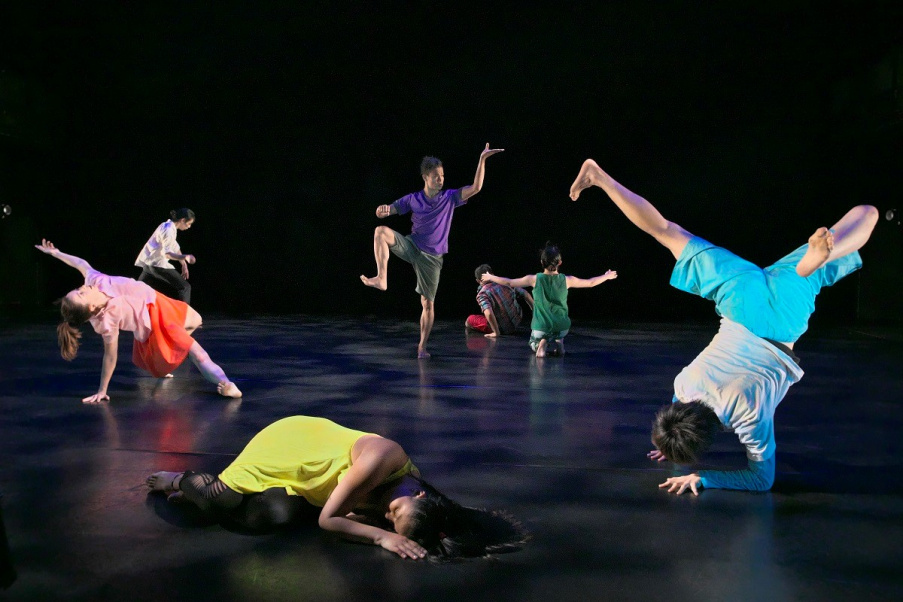

"RE/PLAY Dance Edit" creates one of the representative works of Tokyo Death Rock, led by director Tada Junnosuke, with dancers with different backgrounds in each performance location. Following on from the first part, in which the audience listened to their experiences of the creation, which began with the first performance in Kyoto in 2012, and continued in Yokohama, Singapore, Phnom Penh (Cambodia), Kyoto, and Manila (Philippines), the second part looked back on the progress of the project, including the culmination of the performance at the Kichijoji Theater in Tokyo and the period during which the project was selected for long-term funding.
Click here for Part 8 "RE/PLAY Dance Edit shows cross-country dance collaboration"
Seven Years in Progress: Building a Team that Generates Meaning
-The performance at the Kichijoji Theater in February 2019 was the culmination of all the dancers from all the countries you have created. I have seen this performance, the Cambodian performance, and the repeat performance in Kyoto, and what impressed me the most was the Cambodian traditional dance dancers. My body, which had only known classical dances, changed into a completely different body by repeating the same things and listening to Ms. Tada's talk. So, I'd like to ask Tada-san and Kitamari-san what kind of experience RE/PLAY Dance Edit has been for them. Can you tell us how dancers in each country have changed from your perspective?
- Tada
- The performance at Kichijoji Theater was a performance with all versions of the performers except for the first performance in Kyoto.
- Kitamari
- Seven years have passed since the first performance, so the situation of each dancer has changed. Half of the eight performers at the premiere were absent. That's why the members of the first performance are not in it.
- Tada
- I am a director, so my job is characterized by creating works with various people. So I have actually created a stage with children, citizens and actors. "RE/PLAY Dance Edit" gave me an opportunity to think about how to create works with dancers and people who dance for a living, and I think it broadened my range as an artist. When I went to Asia, I really felt the difference in my body and energy. Of course, there are many things that Japanese can do on their own. However, in trying to portray the world and people, it was a great experience for me to become aware of the physical diversity of Asian people through dance.
- Kitamari
- I wrote a report as an archive 1 month after "We dance Kyoto 2012". At that time, I mentioned that there was a sense of stagnation in dance as a problem that had been a premise for launching this project. I was thinking about how I could convey the fact that the body is a medium with rich possibilities and how I could share it with various dancers.
What I felt through this project was that no matter where you go, you are bound to dance. Everywhere, people start from the learning culture, and dance is something you learn and dance. In the dance community, I think it would be nice to learn to look at "dance" from a bird's eye view and to have a perspective to think about it. For RE/PLAY Dance Edit, Tada is not a choreographer. I felt that creating a work with such a person itself is quite a big challenge. The theme of "dance/not dance" is a question about dance. Questions are essential to continuing dance and making it a theater-going culture. By asking questions and continuing to ask questions, we must convey the meaning of doing the most primitive physical expression in this age and why it is worth seeing. This is not only through words, but also through the body, as a work, and by sharing it with the performers and the audience, we can draw a new future. I think this was such a challenge. There are dancers who have only performed once, and there are dancers who have performed two or three times, so the relationship is different for each dancer, but I still feel that we were able to share an awareness of a problem. In dance, you can do activities by dancing, so you can do what you learned, which is a little scary. So, of course, there are parts that are refined in that way, but I enjoy making it while asking about other things. I felt that this is something that can be done across generations and countries.
-I don't think there are many projects in contemporary dance that last this long. I don't think it's easy to go around Asian countries, select local dancers through auditions, and work with them on productions. What achievements and challenges do you feel once again after continuing this project?
- Okazaki
- No one thought it would go this far. But it was interesting every time, and we all thought about what to do next and what we could do. I think it was because of the strength of the work itself that I was able to have that kind of energy. Since it is an international co-production, it costs money. So I don't think it would have lasted this far if the funds had not been secured. After all, I was able to envision the future thanks to the three-year continuous grant from the Japan Foundation Asia Center, and I think it was important that we were able to create an environment by combining with the Arts Council Tokyo long-term grant from the following year.
- Ong Kensen's Theatreworks in Singapore, Amrita Performing Arts in Cambodia and Sipat Rawin Ensemble in Manila. How did you find local partners?
- Okazaki
- On Kensen is an old acquaintance who understood the meaning of the work and provided the space and funding. Because of the ability of Theatreworks to raise money, but outside of Singapore, there are very few domestic grant systems. Then, the question is whether we can have a common understanding of contemporary. This work is very challenging, and even in Japan, it is not something that will be accepted by everyone. That's why it's so important to see how committed you are.
In Manila, there were two options. I was a little older generation, but there was also an organizer of festivals such as a young dance showcase. On the other hand, the Sipat Rawin Ensemble is in their 20s, and they organize radical festivals with diverse genres. They seem to go beyond the theater, and I think they are a better fit for our project. I decided after doing a lot of research there.
In addition to the local dancers I mentioned earlier, there are also Japanese interpreters living in the area who are essential partners in the creation process. I was not a professional interpreter, but a Japanese person with some kind of involvement in the arts, who helped me in the creative field, where different languages and values fly around. In Phnom Penh, a Japanese team called Social Compass, which solves social problems through art and design, was in charge of interpreting and recording images. This is especially important for short term creations, so we collect information on the site through various routes.
- Lastly, I would like to hear what you could have done because of the long-term grant, and what you would like to see if there were more mechanisms.
- Kitamari
- It can be said about subsidies in general, but to tell the truth, 3 years is not a long term. Of course, there will be some "results" up to that point, but if you want to take it one step further, it will take five years. If it's about three years, you have problems in the first year, and then you have two or three years to clear them up. So if there's a fourth year beyond that. Three years is when babies start talking. I have a strong feeling that if I want to communicate with my child as a human being a little more properly, I want him to be around 5 years old. Therefore, if there is a medium-term or long-term setting such as 5 years, 8 years, or 10 years, I think we can think more about the future.
- Tada
- I don't think 10 years is going to be a big deal, but I think we can think of a system where we can continue for up to 10 years with an option like "continuation."
- Okazaki
- In the first place, projects cannot be created or continue without the motivation of artists. RE/PLAY Dance Edit was like three producers.

Q & A
- Questioner 1
- This work contains improvisation, but at the same time, it also has a coercive nature that is on the other end of the spectrum, and I think it is bound to evoke violence. Among the materials I received, there was a comment from a Filipino who touched on the relationship between the "repetition" that appears in the work and the problems of violence and poverty. Mr. Tada, you have been working together with Japan and South Korea, but to what extent did you take into account the history, the nature and intensity of violence in each region when creating the film? You explained the concept to people from the three regions. Did they share the violence of their culture?
- Tada
- There are quite a few differences between creating works in Japan and South Korea and in Southeast Asia. It is very meaningful for members of both countries to think about the history of Japan and South Korea together, but I had the impression that if we go in the direction of looking for a common history in Southeast Asia, where nationalities are mixed (especially after Cambodia), the scale will become rather small. Rather than that, I wanted to draw something that could be created in a multi-national and multi-cultural way.
In terms of repetition, it's important to me that the characters look human at times and physical at other times. In theater, we try to make the "bodies" on the stage look like "human beings," but in the case of dancers, when they dance, they become "bodies" rather than "human beings." You're a human until the seventh of 10 iterations, and then you're a body. However, how and what the people who are repeating this look like depends on the viewer. It depends on the members, whether it's only Westerners or Asians. Cambodia, for example, has a very difficult history in the near past. Of course, violence is an inseparable issue in relations between Asia and Japan. I am very aware of that image, but I think it is up to the audience to decide what they receive. - Questioner 2
- Can you tell us specifically about your encounters with people like Kitamari in Cambodia and the Philippines? Also, if you can continue this project for a long time, I would like to ask you if there is a specific place you would like to do it.
- Kitamari
- It means a person who understands the local situation and is an active dancer. Katiya (Chey Chanketoya) of Cambodia is the artistic director of Amrita Performing Arts. She is like a big sister to the dancers. She is the same generation as me and close in age, and she also emcees various projects. She is also very fluent in English, and if I had any questions, she would ask and interpret for me, so I had no choice but to ask Katya. In the case of the Philippines, the Sipat Rawin Ensemble was close to Issa. Isa has had a lot of experience dancing abroad and is everyone's dream dancer. She also knows a lot about the Philippines. It's really like a connection. In Singapore, it was the first time for me and I had no idea what was going on, so I couldn't find a partner like that, but in Cambodia and the Philippines, things happened that way.
As for the future outlook, I think that if we make the practice time two weeks, for example, we can take it to the next development. I'm only doing choreography that can be done in 6 days including the actual performance. The idea of "dancing/not dancing" would be totally different if we had twice as much time. It's partly because I ordered for that number of days in the first place, and it's good that it's compact, but I wonder if it can be increased a little more.
Also, I think we could do it with eight people all from different countries. The frequency of people dancing varies from country to country. For example, Japanese people actually dance, but they don't show it. I'm worried that Filipinos dance like crazy. And speaking of places, I want to do it in India now. But this kind of thing is not only a matter of place, but also a matter of connection. - Okazaki
- I am doing research in Seoul and Jakarta, so I hope to realize the project someday.
- Questioner 3
- Will this project end when the grant period ends? Please tell us about future developments and prospects.
- Tada
- Each of them has a piece called RE/PLAY Dance Edit, and I have a hunch that there will be a time when they can use it in their activities.
- Questioner 4
- He said that all three of them were like producers. I think it was also a challenge to raise money and to find understanding collaborators and organizers, but what were your conversations during that process? In particular, for example, in order to raise funds, did you verbalize the problems you felt about art and culture so that you could communicate them to the public?
- Okazaki
- 「3人がプロデューサー」というのは、3人でビジョンをつくりあげたという意味です。多田さんやきたまりさんと語り合ったことは本当にたくさんあって、彼らのメッセージを伝えるようにしていました(リーフレットやウェブサイトのアーカイブ参照)。日本において、国際交流プロジェクトに対する資金助成は本当に少ないんです。だから国際交流基金アジアセンターとアーツカウンシル東京の資金助成がなければこの企画はできなかったと思います。本当は日本のお金だけではなく、両国で資金を持ち寄って実現できたらいいのですが、シンガポール以外は難しいというのが現実です。
- Questioner 5
- I think Southeast Asia was the main place of activity in connection with the Asian Center grant. Also, in the future, you are interested in Indonesia, India, and other Asian countries. For example, if you find the possibility of raising funds and developing your work, would you consider doing it in Eastern Europe or Western countries?
- Okazaki
- I thought there was a possibility of developing in Europe and America, and I had made a proposal. But both of them gave a rude answer (laughs).
- Kitamari
- It's not that I don't want to do it. Everywhere in the world there is dance, there is potential. Even in Asia, some dance methods are westernized. But maybe that's why we have a strong desire to encounter more unimaginable situations, and we try things that seem a bit difficult.
- Tada
- Not only in dance, but also in the performing arts, I feel that Asian countries share a certain degree of concern about the arts. First of all, culture and history are different from those of the West. That's why I'm interested in working in Asia. Of course, it's not that we don't want to do it in the West, and we won't know until we try.
(Composed by Rieko Suzuki)
RE/PLAY Dance Edit
オリジナルは、多田淳之介率いる東京デスロックが2011年に発表した『再/生』。反復する身体を通して、再生に向かっていこうとする人間を描き出した演劇作品を、本作では、俳優を振付家・ダンサーに置き換えて、リ・クリエーションする。
ダンスバーションは、きたまりがプログラムディレクターを務めた「We dance 京都2012」にて初演。2015年にはシンガポールのシアターワークスをパートナーに初の国際コラボレーションとして始動。翌年同プロジェクトを推進する「RE/PLAY Dance Edit実行委員会」を発足し、アジア各国にて活動を展開。
http://www.wedance.jp/replay/
Junnosuke Tada
Born in 1976. A director. He presides over Tokyo Death Rock. From classics to modern dramas, novels, poems, and online texts, he focuses on the actors' bodies and the audience's presence to create works that are actually relevant to people living today. He has collaborated with dancers and musicians, held workshops at schools and cultural institutions across the country, created creative works, and trained human resources. He has also collaborated with South Korea and Southeast Asia in many international productions. In 2014, he became the first foreigner to win the Best Director Award at the 50 Dong-A Theater Awards in Korea. Director of APAF (Asia Performing Arts Farm) and member of Tokyo Arts Festival planning team. He is a part-time lecturer at Shikoku Gakuin University and Joshibi University of Art and Design. From 2010 to 2019, Kirari Fujimi Artistic Director of Fujimi City Cultural Center. He has also served as a judge of Yokohama Dance Collection Competition I since 2015.
Kitamari
Choreographer and dancer, living in Kyoto City. At the age of 17, she began dancing under the guidance of the dancer Masami Yurabe, and since 2003 has run her own dance company, KIKIKIKIKIKIKI. 2006: Graduated from Kyoto University of Art and Design, Department of Video and Performing Arts. In recent years, he has started a project to choreograph all the symphonies of Mahler, and won the New Artist Award (2016) at the Japan Arts Festival for his second work, Night Song. He also creates works based on traditional Japanese performing arts such as Kinoshita Kabuki "Musume Dojoji" where he performs a 60 minute solo using a nagauta, and "Atago" where he performs together with the music of Saga Dainenbutsu Kyogen, which is a nationally designated Important Intangible Cultural Property. He also works in a wide range of genres such as "We dance Kyoto 2012" and "Dance Fanfare Kyoto" program director.
Matsue Okazaki
舞台芸術プロデューサー。STスポット(1987-2004)、BankART 1929(2004-2006)の館長を経て、2008年NPO法人Offsite Dance Projectを設立。横浜を拠点に、国内外の都市空間でアクセシビリティの高いパフォーマンスプロジェクトを企画・制作。主な活動に、アーティストランのダンス・コミュニティ・フォーラム「We dance」、借景の概念を用いた「Borrowed Landscape Project」、トラックを用いたモバイルの「DANCE TRUCK」等がある。
http://offsite-dance.jp/