
This website uses cookies to improve your experience. You can also change the cookie function by setting your browser. You must agree to the use of cookies when browsing the site.

  • x
  • Instagram
  • facebook
  • Line
  • Youtube

Creation Grant: Creative Aactivities [Long Term] grant Activity report

Arts Council Tokyo has been implementing a program called "Creation Grant [long-term subsidy]" that subsidizes long-term activities for up to 3 years since FY25. Here, we will report on the activity report meeting by organizations that have completed subsidized activities.

Part 8 "RE/PLAY Dance Edit shows cross-country dance collaboration"

target business
RE/PLAY Dance Edit Executive Committee "RE/PLAY Dance Edit" (adopted in FY 2016: 3 years)
Speaker (Reporter)
Junnosuke TADA (director), Kitamari (choreographer and dancer), Matsue OKAZAKI (producer)

"RE/PLAY Dance Edit" was adopted in a long-term Grant Programs of three years from Heisei 28 (2016). The project, which creates one of Tokyo Death Rock's masterpieces "Rebirth" led by director Junnosuke Tada with dancers with different backgrounds in each performance location, began in Kyoto in 2012 and has continued to travel to Yokohama, Singapore, Phnom Penh (Cambodia), Kyoto, Manila (Philippines), and Tokyo. What are the challenges, diversity of the body, and possibilities of "dance" that have been seen through extremely simple (but physically demanding) works that depict people moving towards "rebirth" through repeated choreography? We will deliver a roundtable discussion with director Tada, choreographer and dancer Kitamari Kitamari, who initiated this project, and producer Matsue Okazaki, which also served as a report.

listener
Yoko Kitagawa (Arts Council Tokyo Senior Program Officer)
Handouts
International co-production "RE/PLAY Dance Edit" leaflet

http://www.wedance.jp/replay/img/replay2017.pdf
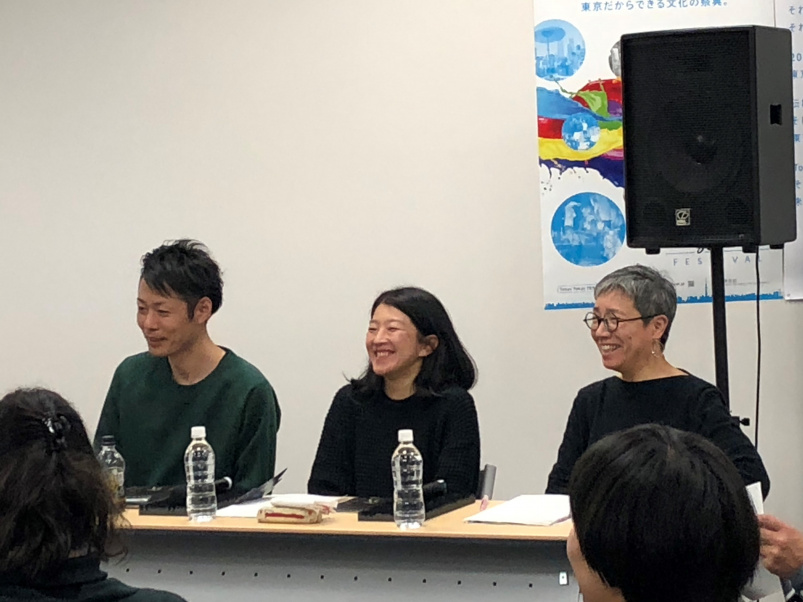
Speakers of the debriefing session

-This project started with "RE/PLAY," a dance version of Tokyo Death Rock's play "Re/Nama," directed by Tada Junnosuke. First of all, could you tell us about the reason for launching this project?

Tada
At "We dance Kyoto 2012" *, where Kitamari was the program director, there was a framework for dancers and theater directors to create works together, and RE/PLAY was born. It's a little complicated, but the original play was called "Re/Sei" in 2011, and it was based on a 2006 play called "Regen," which repeats the scene of a 30 minute banquet and mass suicide 3 times. The 2006 version has more lines and has more theatrical elements, but in fact, at first I was asked to do that with dancers.

※「We dance 京都 2012」:NPO法人Offsite Dance Projectがコンテンポラリーダンスの活性化を目指し、2008年度から5年間にわたり開催したダンス・コミュニティ・フォーラム「We dance」の4回目。
http://www.wedance.jp/2012_kyoto/

Kitamari
I joined "We dance" that Okazaki-san did in Yokohama from the first year. After the third year, Mr. Okazaki told me that he wanted to do it in Kyoto next time. However, it is difficult to know what kind of program is planned unless you are an artist in Kyoto. So they said, "Kitamari, as the program director, make a program." Just before that, two versions of Re/Namu were being performed at a theater called KAIKA in Kyoto. When I saw this performance, I wondered what would happen if it were performed by dancers. I think it would be good to play with dancers who have a different body language from the actors. Then, I contacted Mr. Tada and asked him when he would be able to come to Kyoto. "If only for one week in February," the dance version of "RE/PLAY" was realized.
Tada
So, the practice ...... how long did I do it?
Kitamari
Five days. They came on Mondays and performed on Saturdays.
Tada
Well done (laughs). But if you make it for 30 minutes, it will be ready for 90 minutes. It was the first time for me to make a piece with a dancer, so I started the workshop by asking and talking, "What is dancing?" or "Why is everyone dancing?" rather than meeting the members for the first time. As a result, we decided that a dance version of the new version of "Re/Shou" would be better than the original "Rebirth" of 2006, which is what we've been working on.

-Mr. Tada, could you explain a little more about the work "Rebirth"?

Tada
“Rebirth, ” released in 2006, repeats 30 minutes of banquet until death, making it seem as if he died or came back to life. However, the amount of exercise in 30 minutes was so intense that the living body continued to change over 90 minutes. The new "Re/Shou" was greatly affected by the Great East Japan Earthquake, and the themes of "discontinuity" and "time without return" have been added. I created it with an interest in what can be seen from bodies that are not related to each other. For example, the mere presence of one's body on the stage represents something, and when it moves or music is played, it looks even more like something. In this way, it destroys the landscape that has risen, rises again, and destroys again. I wanted to convey through physical performance that the same movement of the same song does not result in the same moment, and that time cannot be stopped by repeating it.

-How was the first performance?

Kitamari
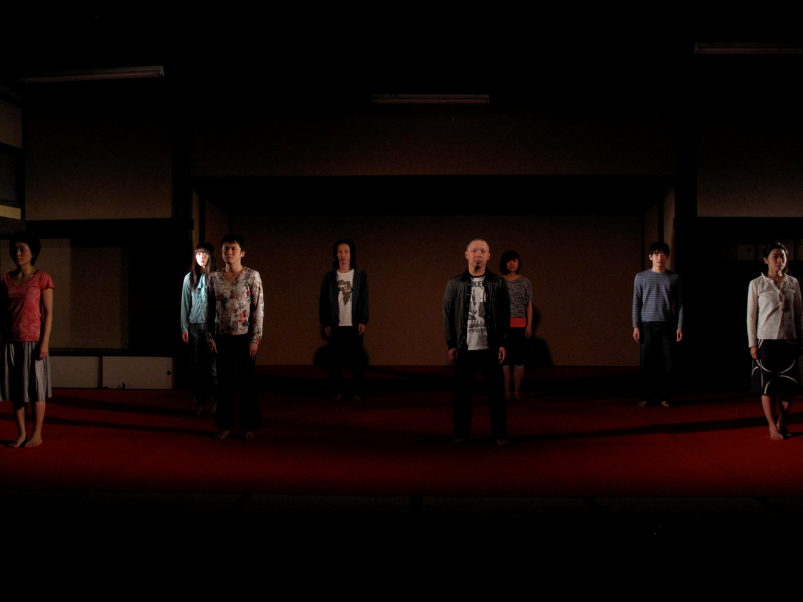
It was very good. The venue was a large hall with an alcove in an abandoned elementary school. In Kyoto, old elementary schools built in Meiji and Taisho periods have large halls of 3 to 40 tatami mats. If you dance like that, the tatami will hurt, so spread a red punch (carpet). There wasn't much space to move, but we were able to perform in a place like a banquet hall.
Tada
It was the first dancer version to include a scene where she dances "Oblady Oblada" 10 times. In the case of actors, as they repeat the same scene, something like the pain of living comes out, but in the case of dancers, by repeating the same dance in the same song, the dance becomes embodied, or the body itself tends to become visible through the dance. Actors can only move, but dancers have two kinds of actions, dancing and moving. So in the dancer version of the performance, we started to give instructions such as "In this scene, you can just move" and "In this scene, you can dance." It's based on the actor's version, but I think the theme of the work has been strengthened by the dancer's version.
2012 Kyoto performance/Venue: Former Rikusei Elementary School Jikyo Room (Photo: Yushiro SAGAMI)

-What was Kitamari's reaction to the decision to create a work based on Rebirth in 2011 instead of Rebirth in 2006?

Kitamari
Among the 7 works of "We dance Kyoto 2012," Tada was the only artist invited from Kanto. Of the eight performers, only two knew Mr. Tada's name and one had seen his work, so I was there on the first day of practice. But I also felt that we could build a good relationship there, and after that I decided to leave it to you. So when I went on Wednesday night, it was already the 2011 version (laughs). When I looked in during the day on the same day, they were practicing "Rebirth" in 2006.
The reason I asked for the 2006 banquet version was because I thought it would be difficult for the dancers. As a choreographer myself, I want to set a higher bar for dancers. When I saw the first performance of the 2011 version, I thought that dancers could do it. But if Ms. Tada had chosen that version in her interactions with the dancers, I felt like I would leave that up to her. Also, the dance version of RE/PLAY had more Oblady Oblada, which raised the bar.

Yokohama/Singapore Edition: In Search of a Variety of Bodies

-After that, it was performed in Yokohama in 2014 with a different cast.

Okazaki
"We dance" is originally a program based on issues for artists, and "We dance Kyoto 2012" directed by Kitamari was wonderful. I was particularly shocked by RE/PLAY. I was aware that while I was exploring new forms of dance, I wasn't able to create dance pieces that really moved my heart, and I realized that it was a special experience for the performers, so I definitely wanted to see dancers from the Kanto region do this. So for the performance in Yokohama, I co-produced with Kitamari, and the two of us started by arranging the performance environment, such as raising funds. This is also when I started auditioning. Therefore, the structure of the international co-production "RE/PLAY Dance Edit" was very compact, with auditions first, and then from creation to the actual performance. In terms of the number of days, it was 5 days of practice + performance days, and in case of overseas, it was 1 day + about 1 week.

-This performance was timed to coincide with the TPAM (Performing Arts Fair).

Okazaki
In this production, the eight performers are together but exist individually. The more diverse the dancers, the more the piece stands out. So I decided to participate in the TPAM fringe (which was then a showcase). At the same time that the Japan Foundation Asia Center launched a grant program called the "Asian Cultural Creation Cooperation Grant," which is perfect for international collaboration, I began to think about expanding the program in Asia with this in mind.

-I see. From there, it will be implemented in Singapore.

Okazaki
Yes. Ong Kensen from Theatreworks came to see the program and said that if he could get a grant from the Asia Center, he would join us. Fortunately, we received a three-year grant from the Asia Center, which allowed us to start RE/PLAY Dance Edit in Asia.

- At that time, had it been decided that other Asian countries would implement it?

Okazaki
I hadn't decided yet, so I went to Kuala Lumpur and Phnom Penh for research during the audition in Singapore. I didn't have plans to go to Cambodia, but I was recommended by a producer at Theatreworks.
Kitamari
In Phnom Penh, Amrita Performing Arts, our partner in Cambodia, held a showcase for choreographer development, and it was great, including the atmosphere of the audience. I was so impressed that I said, "Let's do it in Cambodia, the dancers are amazing". After that, I was planning to go to Bangkok, but Piché Krantchen, who was visiting from Thailand as a mentor, suggested that Cambodia be a good place to go.
Okazaki
It was like, You guys should be here. In Cambodia, quite a few dancers perform traditional dances as public servants. In such an environment, there was a situation in which the momentum for creating was born, and it was very similar to the atmosphere of contemporary dance that I experienced when I was in ST Spot. Through discussion with the choreographer, Piche's workshop made me think about what dance is, and I sympathized with Amrita's activities.

- Are the works you saw at the Cambodian showcase contemporary rather than classical?

Kitamari
They were all creating contemporary works based on classical movements. For example, if I just use a flash on the light, the customers say "Wow." Classics rarely use strobes. When I saw how the audience responded directly to those little changes in lighting and movement, we said, "I definitely want to do it here."

- Going back a little bit, Singapore was your first overseas country. Did the dancers who attended the audition understand the concept?

Tada
Looking back, I think they figured it out pretty quickly. But I went to Asia because I wanted to see a variety of dances, so the people who came were from different backgrounds. Some contemporary dancers studied ballet or traditional arts, some were aerobics teachers, some were actors who had ballet experience, and some were Australians living in Singapore. So I think the way they understood it was different. Even if they did the same dance 10 times, they would give instructions like or "Here, use your base dance." or "Show me your dance in the future." However, the choreography itself is something that the individual thinks about, and I think how they react to instructions is also different.

Cambodia/Philippines: Can There Be Dancing Without Dancing?

-Our Arts Council Tokyo subsidy started in FY2016. The first year will be in Cambodia, the second year will be in the Philippines, and the third year will be in Tokyo.

Okazaki
As we prepared for our 2015 performance in Singapore, we set up the RE/PLAY Dance Edit Executive Committee to lay the groundwork for the next year's performance.
Tada
The concept of the project was to mix the performers from the previous tour with those from the next tour. So, we were going to bring a dancer from Singapore to the performance in Cambodia, but we had a schedule conflict, so we had another Japanese person join us.
Kitamari
All Cambodian dancers have done classical dance. At the audition, there was a dancer from the circus who had Western techniques, but in the end, we chose a classical dancer.
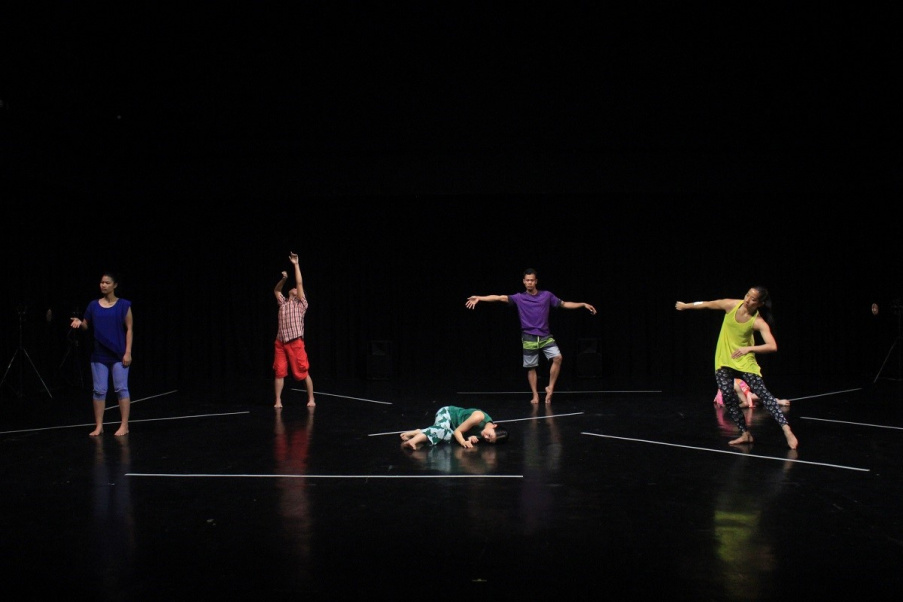
Phnom Penh: Department of Performing Arts (Photo: Kong Vollak)

It was a practice and performance at a theater in Phnom Penh called "Department of Performing Arts," which has a slightly unusual name.

Tada
It's a public theater, but none of the lights are working. And turn on the power supply. Also, when it's a squall, you can't hear anything.
Kitamari
I also prayed at the theater. It's based on classical dance, so whether it's contemporary or not, you pray for success first.

- In the middle of the movie, there is a scene where you speak a text, but the content is different in each region.

Tada
Yes. We're supposed to talk about the dance scene in different places. He asks the question, "What is dance?" while creating his work. We talk about this because the backgrounds of the assembled members are different. It's also a setting where they look back on this performance from a future point in time. The whole structure is the same no matter where it is performed, but the dance scenes are different. At that time, you were saying that in Cambodia, if you break the traditional style of dance even a little, it is contemporary dance.

-How was the creation overall?

Tada
It was hard. Up until then, things had gone pretty well in Kyoto, Yokohama, and Singapore, so I often found that things I thought would get through if I explained them didn't get through. I stopped the program in the middle. As long as the rules were communicated properly, it should be possible as a work, so I explained it many times, and in the end, they understood.
Kitamari
It's difficult because there is a firm concept of dance. This piece is actually pretty choreographed, and the only impromptu piece is the first installment of Oblady Oblada. It was very difficult to communicate that we had to do something new every time, learn it, and repeat it. In RE/PLAY Dance Edit, dancing and not dancing are important concepts, but for dancers, it's impossible not to dance while creating a movement. You don't think about going beyond dancing as you dance. I didn't get the idea across well. In the first place, the dance is not based on emotion, it is a classic, so there is a sense that if the form is broken, it is not a dance. Amrita itself, of course, is trying to do a new style of dance, but it's based on the classics. If we had members from Singapore, we might have been able to mix things up better, but if it was just Japan and Cambodia, there were two different languages and it was difficult to communicate. In the case of a dance performance, a choreographer can teach with gestures, but in the case of Mr. Tada, he is a director and he only uses words. Because Cambodian classical dances are dance dramas, elements of dance and drama are mixed, and the fact that the culture of performing arts itself is different also made it difficult.
Tada
But the dancers, from the audition stage, are like, "What are these people?" and they are wonderful. He has great physical ability.

-During the practice, one of the dancers showed you a classical dance. When I saw them, I felt that it was difficult for them to create their own dance by improvising from the performance of characters and roles that they had been performing for a long time. The performance lasted for two days. How was it?

Tada
I think it was a work. Also, Cambodian dancers joined in the following performances in Manila and Japan, and I have the impression that things changed a lot there.
Okazaki
Just to tell you a little bit about our customers, we filled up even with little promotion, but people left one after another. According to the person in charge of the local Asia Center, there are few opportunities for contemporary performances and few opportunities to see long stage performances, but it was a performance that tested the dancers and the audience in many ways.

A lot of people left in the middle of Oblady Oblada and Perfume. However, watching the game together, I felt that the number of repetitions must have been calculated.

Tada
Right. Even in the case of "Oblady Oblada," in my mind, all 10 episodes have a meaning, and there are also developments such as how many episodes went like this and how the next one goes ....... Basically, it is important to repeat it more than three times. For example, the second time is meant as a comparison with the first time, but after the third time, it becomes meaningless. But it is also the moment when the "Why?" of the audience is born. I want the audience to get the answer, not receive it.
Okazaki
After the fourth Oblady Oblada, some customers looked at me like, "Are you still going to continue?". When you reach the seventh time, you look up to the sky. Then, when it's the eighth time, it changes like I'm going to watch it with enthusiasm.
Tada
After watching 10 times, the customers become friends (laughs).
Okazaki
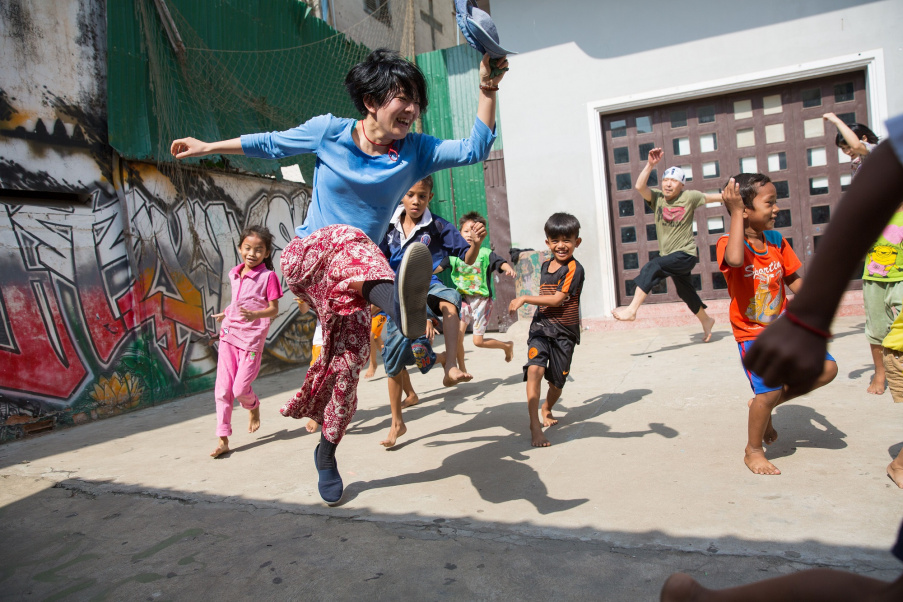
I also do outreach and other exchange activities between creations. One was a workshop with children. The Asia Center introduced me to Tiny Toon, a free school for children from poor areas. The other was a lighting workshop, which was held because improvement of stage skills was an issue.
Outreach/Venue: Tiny Toones (Photo: Akihiro)

After that, there was another joint performance in Japan with the Kyoto Art Center. And the second year will be the Philippines. After your performance in Cambodia in March 2017, you auditioned for a workshop in June.
What kind of people attended the audition? And from what point of view did you choose the performers?

Kitamari
Street dancers, ballet troupes, and actors. Our local partner, the Sipat Rawin Ensemble, was more of a theater person, so we had a lot of different people coming through that network. Also, because I knew about the local dance situation, I had to ask dancer Isa Hoxon to appear and select with me in the audition, so I had a hard time deciding how many people to hire in the end. However, due to the timing of the announcement, the number of people who gathered was not that large. So we ended up hiring three hip-hop and ballet people.
Okazaki
I looked for a dancer like Kitamari at each performance venue. Aisa Hoxong in Manila and Chey Chanketoya in Phnom Penh, who played a major role along with Tada and Kitamari, participated in the creation, including the selection of dancers.
Manila: Power Mac Center Spotlight (Photo: Claudia Enriquez)

- The performance was in January of the following year. How was the reaction?

Kitamari
People in Manila leave in the middle of Obladi Oblada. and everyone comes back (laughs). Like, "I'm repeating myself, so I think I'll just go to the bathroom.""I think I'll smoke." It continues, so even if I don't mind leaving once, I enjoy watching the next scene. I was at my own pace. Also, there were many young customers in Manila. Many of them stayed for the after-talk and asked many questions. For some reason, everyone wants to take pictures with the performers. I want to ask many questions and take pictures, so I stay until the end and enjoy going home.

> Continued from Part 8 "RE/PLAY Dance Edit shows cross-country dance collaboration"