
Part 2 Interviews
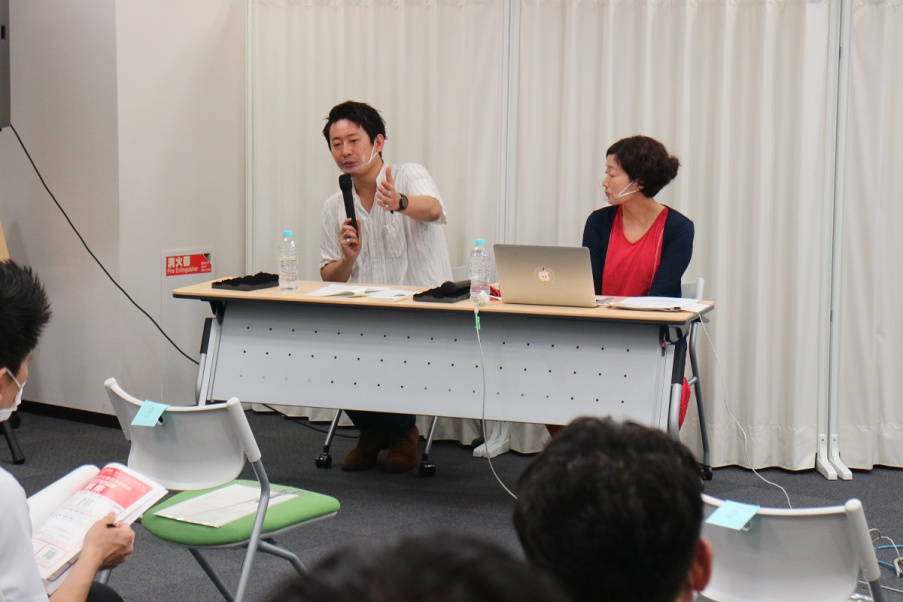
In the second part, Arts Council Tokyo 's Senior Program Officer, Satoko Ishitoya, moderated the event to hear more about the financial plan, structure, and performance results that supported the success of the Fukushima Trilogy. From the candid stories of Mr. Tani, who is a playwright and director and the head of the theater company, and Mr. Onozuka, who was in charge of the production, what emerged was their hard passion, steady production efforts, and their attitude of promoting their creations based on the relationship between human beings, including the audience.
Click here for Part 9 "Fukushima Trilogy and Fundraising" (Part 1)
- In this presentation, you talked about how to raise funds from where, how much and how to apply. First of all, there is ticket revenue as a source of funding, and there is also sponsorship money from the private sector. I would like to ask when and how you came up with this funding plan, including those.
- Onozuka
- When we applied for the grant, we were told that we wanted to decide the price of tickets, and Tani said that she wanted the price of tickets for the trilogy to be less than 4,000 yen, but 3,900 yen. After making a trial calculation, we realized that we couldn't cover it. I think we started thinking about what to do from there.
- valley
- I remember being asked, "Please make it 4,200 yen." (Laughter).
- Onozuka
- I made several versions of the budget and said, "I can't pay my staff this way."
- Grant applications take a long time to get results. It's easy to apply for another grant before you know if it's going to be accepted, or if you're crowdfunding, you don't know how much you're going to get if you don't try. Mr. Onozuka, as a producer, how did you estimate the assembly? Did you think about the odds of winning?
- Onozuka
- I have a feeling that I will make an application form so that I can get it as much as possible in a realistic situation, and if I don't get it, I will adjust it as if I didn't get it.
Did you consider private sponsorship?
- Onozuka
- I didn't think about it. I tried it before, but it's quite difficult.
- I see. Do you mean that it is easier to use the subsidy that you know when and what kind of applications are available because the time and effort you can put depends on the work and schedule?
- Onozuka
- Yes.
-In 2017, we applied to Arts Council Tokyo for a single-year grant, but it was rejected. Was there anything that forced you to change your plan?
- Onozuka
- We have not changed it because it was not adopted. We decided to apply for a long-term subsidy instead. However, if it had been selected as a single year grant, the budget for the first part advance performance might have changed a little.
- Thank you. Then about the preceding performance, it had a good reputation. How did that affect the second and third parts that followed? Please talk about both creation and management.
- valley
- At the end of the first part, there were subtitles saying that the second and third parts would be like this. As a writer, I was grateful that there were strong voices saying, "Then I want you to watch it right now." and it also motivated me to write the next part as soon as possible. Also, during the first part, I did sound operations myself and watched all the performances, so I was able to look at the audience's reactions and think about how I would like to develop this character in the second part or create this kind of human relationship in the third part. In that sense as well, I think it was good to perform the first part in advance.
- Onozuka
- I think it was a good thing that we were able to make a positive prediction that people would come to see the performance next year because of the good response to the first part.
-After you finished the first part, did you have any discussions about planning for the second year?
- valley
- I don't think we had a meeting all at once. Practical issues, such as how long to rent the theater and what to do with the staff, were discussed regularly, and I think the outlines became clearer each time the deadlines for decisions had to be made.
- Onozuka
- I think I kept saying things like, "Isn't it difficult to decide the cast now?."
- valley
- Of course, I had a certain level of image, but at each timing, I would say or "I'd like to have someone like this, but what do you think?."
- The second year's performance lasted about three weeks in total. How did you decide that the first week will be the premiere of the second part, the next will be the third part, and the last week will be the trilogy?
- valley
- In fact, we had no choice but to do this. The second part was performed in Fukushima in July, so I thought it would be ready at the beginning of August if I remembered it and practiced a little. We practiced the third part behind the scenes, and if we could open the curtain, we should be able to perform them side by side, and I thought that the practice would progress efficiently. But tickets for the second part of the first week in Tokyo were sold out. I remember looking at the sales table, but even on the busiest day in a theater with about 200 people, there were about 100 people. The numbers 60 and 50 were lined up, and I was terrified, and even though that was the only way I was able to set up, I thought, "It would have been easier for customers to come if we started with the first part."
- Some of the performers appeared in the first, second, and third parts, overlapping each other.
- valley
- I think it was really hard for those people. We are the only members of our troupe, but they have endured trials and tribulations, such as three stages a day and creating a new program in a week.

What has been the hardest thing for you over the past two years?
- Onozuka
- After the performance of the second part in Fukushima, I was practicing for the third part. Only about 30% of the tickets for the Tokyo performance have been sold, and the script for the third part is not finished. When I read back my diary from that period, it said, "My heart is in the desert." (Laughter)
- Thank you for your valuable talk. At that point, I think the ticket revenue in the budget was revised significantly downward. Under such circumstances, what were you thinking about in terms of funding? There was an SNS campaign to sell tickets.
- Onozuka
- We have no choice but to cut down on labor costs. I didn't have to do that in the end, but if the tickets hadn't been sold, that would have been the only way.
-If you knew that you would end up in the black, what would you have done with it?
- Onozuka
- I think we were able to reduce the burden on troupe members by increasing the number of people in the direction department.
- The reports we receive also describe the difficulty of performing three productions in a row. The staff and troupe members had no time to sit down and eat on the days of the performance, so they had to shift, bring in and serve customers on a minute-by-minute schedule from 9:00 AM to 10:00 PM. If there was one more person in the production department, the rotation would have been easier. However, it is possible to say that this kind of thing was possible because it was a theater company.
- valley
- On the other hand, the advantages of a theater company are the disadvantages of a theater company. They're two sides of the same coin. What I feel is the biggest difference between a performance produced by an outside company and a theater company is that a theater company is free and flexible. Even if I make sudden changes or additions, everyone will follow me, and even if the script is late, if I say, "I want to stick with it a little longer," they will understand and wait. Of course, I know that there are a lot of people who are being inconvenienced by it, and I think we shouldn't be spoiled by it, but I think it is the underlying strength of the theater company that they are able to hold their ground when they say, "Let me stick to this point," and that they wait for us to do what Tani wants to do.
- Onozuka
- The people of Darkara are really used to suffering. Even if Tani is not there, they will practice by themselves and make props by themselves. They actively do things like reception. I felt that the energy used for the theater company was amazing.
− When you apply for a Arts Council Tokyo grant, you will be asked to write down the goals and objectives of the project. To review what you wrote at that time, the first was to create a place where people could talk about the state of post-war Japan and nuclear power plants, and the second was to create a work that would be appreciated by both audiences and critics, and the specific goal of the Kishida Drama Award was also written here. The third was to attract 10,000 customers in a trilogy. It seems that all of these goals have been cleared, but what do you think of looking back?
- valley
- Now that it's over, I feel that this trilogy was the kind of work that should have been done, and that it should have been talked about. But when I first started working on it, before I started working with Onozuka-san, I talked to producers at public theaters and in the private sector about what I was going to do, and the response was that they were drawn back and said, "Let's talk about nuclear power." After all, this topic is difficult to deal with, and there is an atmosphere that I don't want to touch it. But the reason why we were able to do it without hesitation and without fear is because we were determined to do everything on our own. Also, I didn't just want to talk about the dangers of nuclear power, but I had the conviction that it was closely related to democracy and the decision-making system of society, so it was necessary to talk about it. Looking back now, I feel that this became the backbone and strength of my work. After all, what the writer put his or her heart and soul into writing carries a lot of weight, and I think the fact that I was able to work on such a subject for two or three years had an impact on the final product. I realized that it is really important to have a proper preparation period for creating works.
- It took three or four years to produce this work, if you count it from the beginning of your reporting. How long is the production period of a regular theater company performance?
- valley
- We spend about half a year or a year vaguely planning our ideas, but when it comes to the time we spend thoroughly reading materials, conducting interviews, and writing our ideas, I think it usually takes about one or two months, or three months at the longest. About a month for writing and a month for practice.
- In that case, does it mean that it is not often possible to devote time and energy to a work like the Fukushima trilogy?
- valley
- Actually, we are still looking for a new theme. It may be a different subject from Fukushima, but I have been thinking for a long time about what I can do with the same earnest effort.
- One of your goals was to attract 10,000 customers. How did you come up with this goal?
- valley
- The 17 th performance just before the preparation of this work started was the inactive performance. There was no profit at all, and two performances in a row were in the red, so we decided to stop the performance once because we would be financially bankrupt. Then, we decided to take this opportunity to make various reforms. As I said earlier, we reduced the costs of outsourced staff and paid the members of the troupe, and we devised the content, and as a result, we became profitable. Even the members of the troupe get bonuses. People usually put 5 yen coins in Oirebukuro, but they put 50,000 yen in it and handed it out. It was so popular and had a good reputation. The performance attracted about 3,000 people. In other words, a trilogy of films could easily accommodate more than 9,000 people. Of course, I was trying to create a work that was more powerful than the performance at that time, so I thought it would be good to see the number 10,000. I think this number was important for crowdfunding in terms of sharing dreams and ideals. But I remember thinking that I wanted to do what I wanted to do, rather than saying that I wanted to deliver this work to 10,000 people and talk about Fukushima with 10,000 people, so that they would understand me better.
- How did the performance of this trilogy help the company and Tani? Of course, winning a drama award is one thing, but is there anything else you really feel?
- valley
- There was one thing about making a book out of a play. It wasn't like we won any prize or the audience was full, and in the hellish situation that Onozuka-san mentioned earlier, we were asked to publish by Jiritsu Shobo. I don't know if it was intuition or smell, but I think you saw the potential. Even though tickets were not sold, magazines and newspapers mentioned it, so they might have expected it. In any case, it was very meaningful to be able to put it in print. Even 100 or 200 years from now, if you go to the National Diet Library and type in keywords like "Fukushima" or "nuclear power," you'll find this book. Of course, there are a lot of records on this theme, but I think a play is the best way to record the voices of people in Fukushima. I'm really glad that I was able to do that.
As a theater company ...... This is a difficult question, but for one thing, we were able to organize ourselves properly, do accounting properly, deal with grants, and settle all accounts, so we were much more organized than when we were a voluntary organization. I think that once we have built trust, it will be useful when we apply for something in the future, and I am glad that we did it.
Mr. Onozuka, what do you think were the benefits of using this long-term subsidy?
- Onozuka
- We were able to save a lot of money in the second year, and I think it was easy to make a prospect of performing all at once.
- I think this is an example of you making good use of the features of long-term subsidies. Lastly, I think we have had interactions with various people through crowdfunding and grants. What impressed you about building relationships through funding?
- valley
- Everyone in charge is really enthusiastic and they have their own stories. I was particularly strongly encouraged by those who supported us through crowdfunding. I have been sending out an e-mail magazine for about three years, and they have responded to it. As a return bonus, I was able to visit the rehearsal room, and we had drinks together, and some of us even traveled ...... We were always able to communicate with each other at the rehearsal room, at the theater, and even by email. The idea was not to just say, "Thank you for your money." The idea was to get a taste of the perspective of the people who make the plays, and to peek into the process, so it was interesting and encouraging to be able to run alongside the people who supported us.
Q & A
- Questioner 1
- Mr. Onozuka said that the timing of his participation in this project was after the production staff of the theater company quit. In the future, depending on the scale, will you find a producer to perform like this time? In that case, what criteria do you use to find the person?
- valley
- Of course, basic ability is necessary. They can calculate money, communicate with people properly, and worry about customers. While they have such skills, I think the people I work with are selected because they are fun to be with, they stimulate the work, and they have a good effect on the group ....... It's a short talk today, but as you can see, Mr. Onozuka is unique. On the one hand he is very silly, but on the other he has a very deep knowledge, he can name all the emperors, and he can tell all the history of the Habsburgs. He has a deep knowledge of mysteries and a sharp point of view. Of course, there are the basic skills as a producer and the point of view as a producer, but more than anything, when we are together, when I say, "What do you think about the practice going on like this now?" the one word that comes out in response is very core. So I often work with them.
- Questioner 2
- Tickets are not included in the crowdfunding returns. On that basis, you have exceeded your goal. Do you know to what extent the people who supported you were fans of the works of Mr. Tani and the troupe, or were they attracted to the themes of the Fukushima trilogy?
- valley
- I didn't take a survey, so it's just my sense, but I think about 7 to 80% of them originally liked my works or the theater company's works. However, it is clear that about 2 to 30% of them have never seen it. Therefore, it is certain that there were people who invested with the expectation that they would interview and talk about Fukushima. Some of them offered 30,000 yen or 50,000 yen, but they said they couldn't watch the performance because they lived in a local area, but they would support them. I think the main reason was that the topics of Fukushima and nuclear power were related to Japan as a whole.
(Reporting and composition by Rieko Suzuki)
Project Description: https://www.artscouncil-tokyo.jp/grants/program/16445/
Fukushima trilogy
Tani Kenichi, who has roots in Fukushima, reconsiders Japan's postwar history based on the Fukushima nuclear accident during the Great East Japan Earthquake. Over the course of two and a half years, he interviewed many people in Fukushima and rewrote the story as a trilogy of stories about three generations of families, from the decision to host the nuclear power plant to the eve of the disaster. A film that reexamines postwar Japan.
In 2018, the first part "1961: The Sun Rising in the Night" was performed in advance at Iwaki Arios in Fukushima and Komaba Agora Theater in Tokyo, and it was the theater company's first revival in 2 years. The following year, in 2019, he completed the second part, 1986: The Ring of Mobius, and the third part, 2011: Words That Want to Be Spoken, and performed the trilogy for about a month at a time.
Ken'ichi Tani
Born in Fukushima Prefecture in 1982. He grew up in Chiba Prefecture. After majoring in drama at Meiji University and studying drama at the University of Kent at Canterbury, Theatre and Drama Study in England, he founded the DULL-COLORED POP theater company in 2005. His pop and rock creative style earned him a high reputation for both writing and directing. In 2013, he received the 6th Odashima Yushi Drama Award and the Arts Festival Excellence Award from the Agency for Cultural Affairs for his translation and direction of "Saigo no psychoanalysis." In 2019, he performed "Fukushima Trilogy," which depicts the history of Fukushima Prefecture and the nuclear power plant through 3 generations and 3 families, in 3 parts, and attracted 10,000 people. This play won the 64 Kishida Kunio Drama Prize and the 23 Tsuruya Nanboku Drama Prize for the second part, "1986: The Ring of Mobius." On the other hand, he actively engages in activities outside the company, and has worked as a script or assistant director for many collaborative works with overseas directors.
His recent works include History of Humanity (2020/writer/director), Every Brilliant Thing (2020/translator/director), Before the Light: Dawn Runners (2018/writer/director), Three-sentence Opera (2018/libretto/director).
Hisashi Onozuka
When he was a high school student, he was deeply impressed by the Yukigumi 'Elisabeth' of the Takarazuka Revue, and started producing theater groups such as Penino Garden Theater Company and Engeki Bento Neko Meow while he was a student at Meiji University. After graduating from university, he was in charge of ticket business at Horipro. He went to Germany from 2005 to 2009. He participated in several productions as a trainee dramaturg at Deutsch Oper Berlin and Maxim Gorkie Theater.
Since 2010, he has been a member of the Goch Brothers. Produced again by Niwa Gekidan Penino in 2010. From 2012 to 2016, he produced all works of Théâtre des Annales, a unit of Kenichi Tani, Masayuki Nomura and Tatsuya Ito. He is also involved in the production of festivals such as Festival Tokyo, TPAM and Yokohama Dance Collection, as well as various performances such as Company Delacinella and Minamoza.
His main works include Théâtre des Annales (Ludwig Wittgenstein, a young philosopher in the army), Niwa Gekidan Penino (Jigokudani Onsen Mumyo no Yado), Dark Master, Takonyudo Forgotten no Gi, and Gekidan DULL-COLORED POP (Fukushima trilogy).