
This website uses cookies to improve your experience. You can also change the cookie function by setting your browser. You must agree to the use of cookies when browsing the site.

  • x
  • Instagram
  • facebook
  • Line
  • Youtube

Creation Grant: Creative Aactivities [Long Term] grant Activity report

Arts Council Tokyo has been implementing a program called "Creation Grant [long-term subsidy]" that subsidizes long-term activities for up to 3 years since FY25. Here, we will report on the activity report meeting by organizations that have completed subsidized activities.

Part 6: "Let's enjoy the stage together!"― Research and practice of theatergoing support together with the people concerned

target business
NPO Theatre Accessibility Network "Support for theatrical performances" (adopted in FY 2015: 3 years)
Speaker (Reporter)
Asako Hirokawa (Chairperson, Theatre Accessibility Network), Eri Ishikawa (Secretary-General, Theatre Accessibility Network)
moderator
Yoko Kitagawa Senior Program Officer, Planning and Support Division

Outline of subsidized activities

Under the slogan "Let's enjoy the stage together!", this project is operated by the Theater Accessibility Network, a non-profit organization established with the aim of creating a society where people with disabilities can easily visit the theater and watch the play. For three years from FY27, we received a long-term grant from Creation Grant to provide advice, equipment, and support for theater performances such as dispatching human resources to theater companies and theater organizers who wish to introduce theater support such as sign language interpretation and audio guides, as well as dispatch sign language interpreters when theater people with hearing impairments participate in theater rehearsals and workshops.

PART 1 AND PART 2: THE WORLD BEGINS FROM KNOWING AND EXPANDS

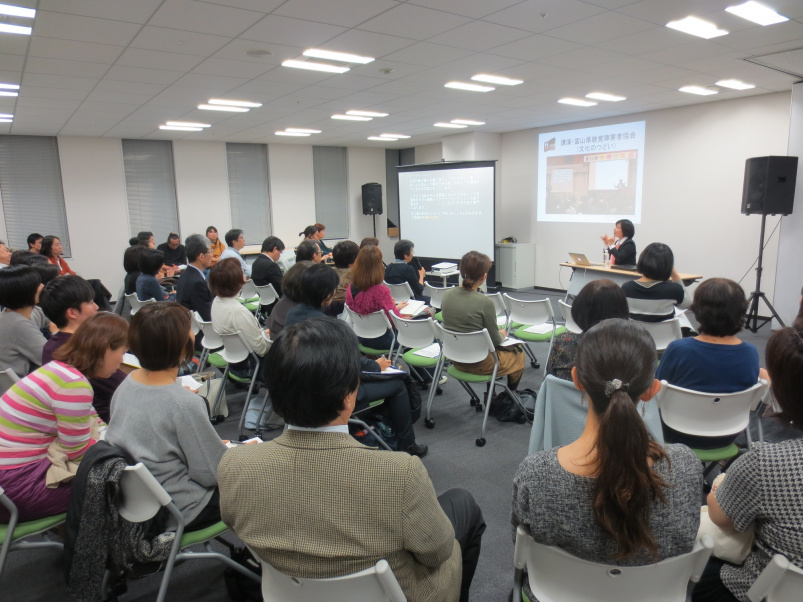
The Theatre Accessibility Network (TA-net) is an NPO that supports people with disabilities to go to the theater with the slogan "Let's all enjoy the stage together." At the briefing, Ms. Asako Hirokawa, President of the Board of Directors, introduced the contents and results of the theater support project and the communication support project, which were selected as long-term grants from FY 2015 to FY 29. There were also demonstrations of audio guides, stage subtitles, and stage sign language interpretation, allowing visitors to feel closer to the scene of theater support.
(Text: Rieko Suzuki)

As public cultural facilities and laws against discrimination against persons with disabilities are being developed, and various cultural events are being held with an eye toward 2020, the idea that persons with disabilities should have equal opportunities to appreciate culture and art has spread widely. In the performing arts, it is common to see leaflets and other printed materials offering support for the visually and hearing impaired and those using wheelchairs. However, the actual details of how they are prepared and operated, as well as the specific contents and methods, are not well known not only among audiences but also among producers and sponsors of performing arts.

The NPO Theater Accessibility Network (TA-net) received a Arts Council Tokyo grant for three years from FY27 to provide advice and guidance to organizations and theaters that wish to introduce theater support such as sign language interpretation, audio guides, and subtitles, and to provide necessary human resources and equipment. The application fee is 5,000 yen. The system of supporting everything else with subsidies seems to be quite "cheap and easy", but what is done there is "support", not a consignment contract to outsource theater support. "We don't take on everything and help TA-net, but we start by trying and experiencing it in various ways," explains Asako Hirokawa, chairman of TA-net. "For example, in the case of subtitle support, there is a way to place a holder in front of the seat and watch the subtitles on a smartphone or tablet attached to it. Also, on the stage of firewood Noh, I also watch the subtitles with glasses-shaped machines. There is a person who is developing such an app among the members of TA-net, and we are also researching together. In the case of subtitles, it is necessary to hold a monitoring meeting before the actual performance. The person who makes the subtitles is the one who can hear, but the one who can't hear the person who watches it. Therefore, during rehearsals and genepros, we have to ask people who can't actually hear to come and listen to their opinions and improve the quality of the subtitles."

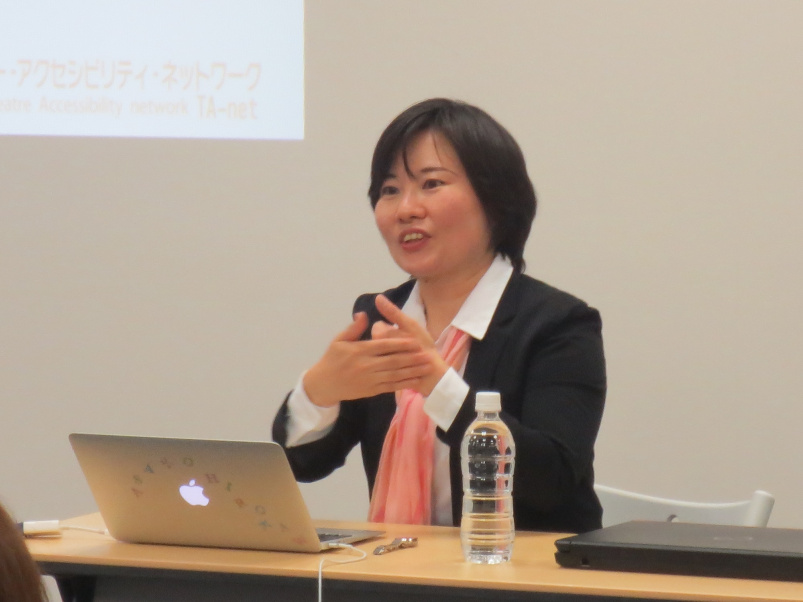
Part 1 Presentation by Ms. Asako Hirokawa, Chair of the NPO Theatre Accessibility Network

After the first year of the project, in which they tried to do everything in their power, in the second year they held a subtitle production course to help producers distribute their own subtitles, and in the third year they provided instruction on how to respond specifically to receptionists. At the same time, educational videos were also filmed and released for the hearing impaired, the general public, and theater professionals. # 1

※1: 「字幕をつけて観たい!」(3分34秒)https://youtu.be/ynwv-QNQy_I、「演劇公演に字幕をつけたい!」(6分45秒)https://youtu.be/63DFWrNFRmc

"Over the past three years, I have experienced various things at various sites, and I have been able to make various proposals to those involved in the production, as well as report to the app developers and NPOs involved in distribution. However, due to the problem of funding and human resources, there are few organizations that continue to provide support."

The educational videos released and the presentation show that learning how to interpret sign language and add subtitles does not equal supporting theatergoers. In addition to issues such as how to use subtitles that are easy to understand and how to guide people in the viewing environment and how to use the equipment, there are obstacles that are difficult for people without disabilities to notice in the flow from the time they arrive at the theater to the time they sit down. It is the attitude that supports the enhancement of "support for theater viewing" by solving each of these.

In addition, the long-term grant program promoted efforts to explore ways to support communication not only at performances but also at creative sites. What kind of support does a deaf person need when attending training or workshops? How can they make more creative experiences and contributions? In order to overcome the barriers posed by regional differences in welfare systems and by sign language interpreters who were not familiar with stage creation, the initiative to send trained interpreters directly to cultural organizations, although not on a large scale, seems to have led to an opportunity for more people to experience art more spontaneously. "Each municipality has a welfare system to dispatch sign language interpreters, but the rules of operation are different. In the case of a workshop, it may be considered as a hobby and you may not be able to use it. If you participate in such a place as a job, you may not be able to use the system because it is for profit. Also, training and workshops are different from sign language interpretation for regular conferences and lectures. You have to interpret considering the position of the lecturer, where there are people who can't hear, and the timing of the speech. In response to these problems, we have dispatched sign language interpreters to cultural organizations, and in the case of small group workshops, we have made efforts to create an environment in which they can be supported free of charge. However, we still need funding for this, and I think we need more places to train people to improve their sign language interpreting skills."

Asako Hirokawa

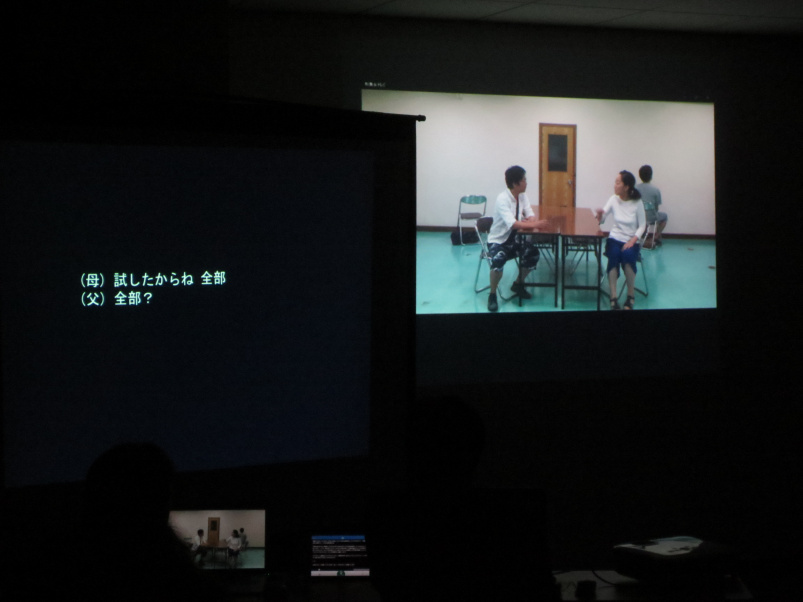
The briefing session also included a demonstration of audio guides for the visually impaired, sign language interpretation, and subtitles using the UD Talk application. What was interesting about both methods was that the method and content of support greatly changed the impression of the work. For example, how much laughter, cries, and subtle emotional swings are supplemented makes a big difference in how the work is received. How much should be translated and how much should be left to the imagination of the audience? Theater support is as meaningful as translation of foreign plays. Furthermore, in some cases, the method of translation affects the work and the way it is produced. On this day, an example of projecting subtitles onto the background of the stage like speech bubbles (making the stage look like a moving cartoon) was shown, and this was another example that left an impression on me as a clear example of how the use of tools such as sign language and subtitles can change the color of the performance space itself. Of course, because of such an influence, there may be situations in which one has to consider how to intervene theater support in a production. In the future, however, we may see the emergence of new expressions that actively take advantage of the influence and technological innovation. It seems that the future of this field may be one in which "support" is not merely a supplementary role, but a driving force for pioneering new "creations" in the performing arts.

Part 3: Fukahori Interview: What is the reality and future potential of theater support?

In the second half of the debriefing session, TA-net President Asako Hirokawa, Secretary General Eri Ishikawa, along with sign language interpreter Yumi Kojima, subtitle producer Yukiyo Kawashima, and audio guides Daisuke Suzuki and Megumi Mitsuki (who are all about theater groups), interviewed the participants about the challenges and future possibilities that they found in their activities, as well as the reactions from the groups and audiences they received support from. In a question-and-answer session with the participants, there were a number of specific questions about measures and technologies to achieve better support, indicating a high level of interest in theater support.

-Today, following the presentation, we also had a demonstration of audio guidance, captioning and sign language interpretation. The differences were very interesting, but are there any other methods used to support people with visual or hearing impairments?

Hirokawa
Among the people who can't hear, there are people who want to hear sounds using hearing aids. For those people, there is a service to improve hearing. For example, a hearing loop converts sound signals through a magnetic induction loop into electrical signals that are connected to a hearing aid to make sounds more clear. Also, there is a method to transmit sound vibration by embedding special equipment in a chair or a cushion.

-What was the reaction from the audience who actually experienced the support?

Ishikawa
Those who cannot hear have never seen a play before, so I often hear people say, "It was interesting that there are so many lines. I was surprised." However, in the case of those who cannot hear, there are differences in the educational environment, and some of them are not good at Japanese. So, there are cases that sign language interpretation is better than subtitles. It is better to have a sign language interpreter on stage and enjoy it together. In that area, I think it's good that each person can choose the best method for himself.
Hirokawa
As Ishikawa-san said, if you show a play with subtitles to people who have never seen a play before or had no opportunity to do so, you will find various information in the subtitles that they have never seen before. On the one hand, people are surprised that there is so much information, but on the other hand, there are people who say that it is difficult to process it, and on the other hand, they are confused and do not understand well.
I have also been devising various ways of expressing music over the past three years. The impression of music also changes depending on how you explain it. At first, in the case of subtitles, all we had to do was show musical note marks, but that wasn't enough, and some people wanted more specific explanations, so we tried various expressions.

-Thank you. By the way, how long has it been since you started interpreting, Ms. Yumi Kojima, who gave us a demonstration of stage sign language interpretation today?

Hirokawa
She has very long experience in sign language interpretation itself. But as for stage sign language interpretation, he experienced it once when he was young, and it was hard. So, when I held the training course I introduced in the video earlier in Yokohama, they applied. I worked hard on the training, and this time, I will be working as a stage sign language interpreter.
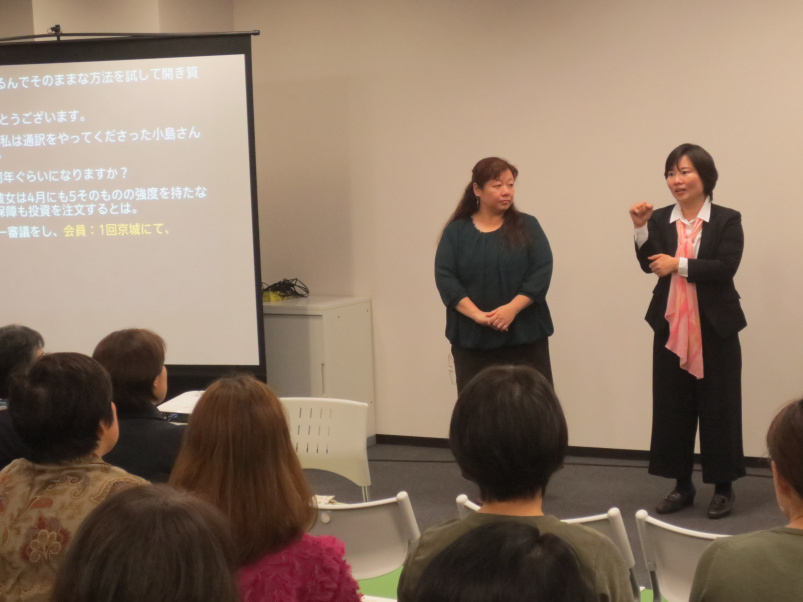
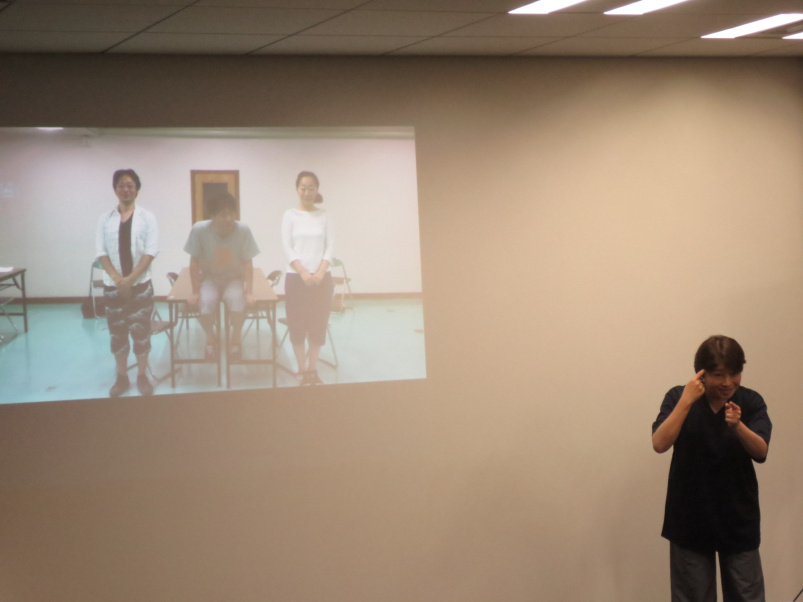
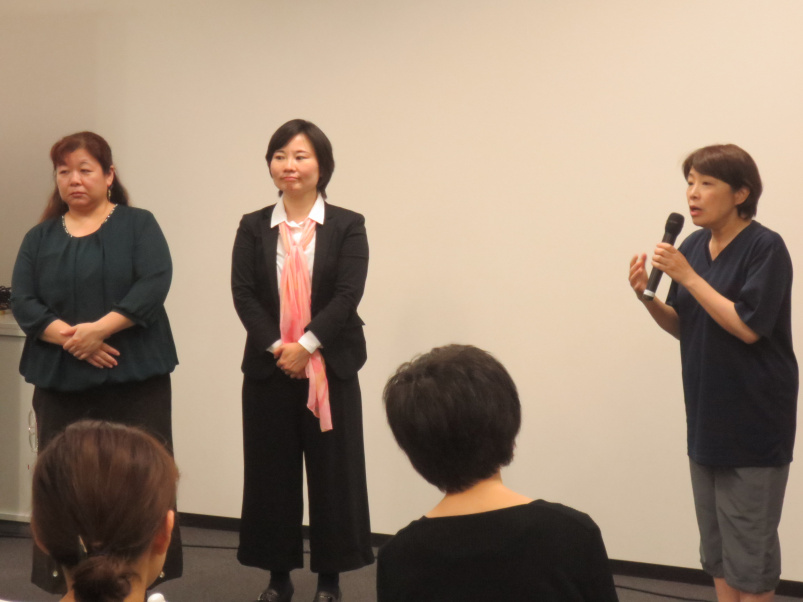
Demonstration of stage sign language interpretation by Kojima Yumi. prepare clothes to match the actors' costumes
Kojima
Speech interpretation and stage sign language interpretation are basically different. In the case of a sign language interpreter, you stand in a fixed position and do the interpreting, but in the case of a play, you dress the same as an actor. Also, for example, in a scene where a parent and child are running around, the interpreter wants the actors to look at them rather than tell them that they are running around, so sometimes we do this (direct their eyes toward the stage) instead of interpreting. We can't destroy the atmosphere of the work, so we lead the audience to the scene in that way. Also, in the case of ordinary interpreters, they sometimes supplement the meaning of the words and even explain the punch line, but in the case of plays, they don't supplement. Sometimes the lines are cut off in the middle. So stage sign language interpreters don't try to understand the meaning of the lines and supplement them. With the audience as the main focus, the audience will be able to understand the meaning by themselves in the same state as the audience. In order to do so, I learned that it is necessary to use methods that deliberately omit them. Through opportunities like today, I hope that you can see and understand the unique techniques of stage sign language interpretation.
Ms. Kojima explaining about stage sign language interpretation

-We provided long-term assistance for 3 years from 2014 to 2017. During this period, there must have been some changes in the social situation. Were there any new discoveries or challenges?

Hirokawa
The Disability Discrimination Elimination Act was enacted in 2016, and the Basic Act on Culture and Arts was changed last year. Also, in June 2018, the Act on Promotion of Arts and Culture Activities for Persons with Disabilities was enacted. These three laws have changed the administrative system in various ways. In addition, with the Tokyo 2020 Olympic and Paralympic Games 2 years from now in sight, there is a growing awareness in society that a variety of support is necessary, including for people with disabilities. I think that's the biggest thing.
Ishikawa
In the past, when applying for a subsidy, costs for subtitle production and interpretation like ours were not included in the items. But you can apply for it from this year. I think that's also a big change.

-The activities supported by the grant included advice and consulting activities for organizations and theaters that wish to support theatrical performances and provide information. What was the reaction from those groups?

Hirokawa
In the beginning, many people just want to support them, but when the actual preparation starts, they often find it hard. Even so, we are moved when we hear that people who cannot hear the performance were able to laugh at the same timing as the audience who can actually hear the performance and were moved to tears. When they feel that their efforts to enjoy the same space together are effective, they are happy enough to forget the hard work. However, even if we try to do this for the next performance, there are still issues such as the difficulty of funding and the inability to secure human resources.
However, with the cooperation of various venues, there are also examples of individuals supporting the subtitling of traditional performing arts. He is here today, so I will introduce his activities here.

-Today at this venue, we are providing subtitles using speech recognition software called "UD Talk." Mr. Yukiyo Kawashima, who is here to support the operation, is doing such activities.

Kawashima Yukiyo was in charge of operating UD Talk, a communication support software that uses speech recognition technology. A group called Tachibana-no-kai supports subtitles for traditional performing arts such as Nohgaku.
Kawashima
Hello everyone. Thank you for coming today. I think this was a very good opportunity for people to see not only subtitles but also various systems such as sign language and audio guides, and to learn that they can share the experience of theater.
As for subtitling support for traditional performing arts, we have been supporting TA-net for three years. At first, it was Takigi-noh at Zojoji Temple. In Noh, if you wear a mask, you can't see your mouth and it's hard to understand your facial expressions. The reason why it was Noh is that the utai which corresponds to the lines of Noh is predetermined. Also, Noh starts with a relatively slow tempo. So, because I happen to be involved in subtitling support, I started a trial of creating subtitles and putting them together with the dialogue. However, this was originally intended for people who couldn't hear, but surprisingly, people who could hear also began to come and enjoy it. "Noh," a Noh actor, "a monk" in a temple who doesn't usually have a chance to visit a temple and has a religious distance, and "deaf," a person who can't hear, met each other (laughs), and it was great to see how people who have a high threshold and are often considered "special" are trying to figure out how to communicate with each other while providing support in writing. It was very good that people enjoyed it as a "content" rather than a "support". In addition, under such circumstances, I think that people who can hear are also trying to improve the environment without realizing it, and the activities are leading to "Let's do it again next time." It is thanks to their help that we have been able to continue to this day.

-If you have any interesting examples of support for people with visual or hearing impairments other than traditional performing arts, please let us know.

Hirokawa
There are more and more people who want to support us not only in the field of theater but also in the field of music, so we try to respond to such requests. For example, there are festivals in Shiga Prefecture, such as the Kazuo Itoga Memorial Prize Music Festival, which commemorates Kazuo Itoga, who is famous for his support for people with intellectual disabilities. This year, for the first time, we provided support for people who cannot hear. Instead of assuming that people who can't hear don't listen to music, on the contrary, what kind of ingenuity is needed to encourage people to come? I would like to see more and more places start such a trial. By doing so, I think that people who cannot hear will have more opportunities to enjoy culture.
Ishikawa
People with intellectual disabilities, mental disabilities, and other disabilities sometimes come in and out, shout, or panic when watching a play. In such cases, more and more theaters are offering opportunities to see plays called "There's people like that, that's fine, we'll watch it together." There are also places that train supporters for that purpose.
Suzuki
There is a professional wrestling organization called hearing impaired professional wrestling which has wrestlers with hearing impairment. There, the game is played normally, but when there is a microphone appeal, a sign language interpreter is attached to the corner and interprets to the audience. We are also trying to watch games with visually impaired customers and give them audio guides. The technique is different between live wrestling and audio guide, so I am an audio guide who knows a lot about professional wrestling, and another person does it. For example, there is a technique called "The opponent's head is held under his arm and lifted, and the thrower's feet are on top. This is a technique called "brain buster"." which needs to be explained at least as follows:. Also, the two players are in charge of the red corner and the blue corner, and if the red corner player says, "I hit you!," the player in the blue corner will know that he was hit.
"This is a technique called "brain buster"!" Daisuke Suzuki shows live wrestling matches

-Thank you. There are many things I don't know, and I feel like the world opens up. Finally, I would like to ask you to tell us what you would like to do in the future at the Theater Accessibility Network and your vision for future activities.

Hirokawa
Our major goal from the beginning is to create a society that "Enjoy anytime, anywhere in your favorite way". We are still a long way from reaching this goal, but I would like to move toward it little by little. I would like to continue to increase the number of support sites and opportunities, and expand the range of support.
Ishikawa
Until now, we have focused on those who cannot see or hear, but from this year, we are expanding our activities to those who are blind or deaf. This is because I have heard stories from people with deafness who want to watch a play, but they are very worried about what to do, and they have no support or don't know how to watch it. As an organization like us, where the people involved in the play are active, we want to watch and enjoy the play together, so over the next three years, we will gather more and more information, including from overseas, and work hard to present it.

Q & A

Questioner 1
I saw a stage sign language interpreter for the first time today. How are these efforts progressing in other countries?
Hirokawa
Examples that we know of are the UK and the US. In either case, the dates and times for sign language interpretation are decided beforehand, and the information is available on the website. There is an application counter for people who can't hear, and if you contact there, you can get a seat where you can see a sign language interpreter easily.
Also, in the United States, there was a court case just the other day, and in the past, sign language interpreters and subtitles were provided only on a fixed date and time, but the court decided that sign language interpreters had to be provided when they wanted, so sign language interpreters can be provided on days other than the fixed date if they want.
Questioner 2
I heard that stage sign language interpreters are sometimes directly involved in the stage performance. What is it like? In the case of subtitles, it doesn't intersect with the performance and goes on in parallel.
Hirokawa
To explain briefly, let's say there is a scene where a father and his son are chatting while playing catch at the front of the stage. Usually, the sign language interpreter is in a fixed place at the end, away from the father, but in one case, he changed his position (stepped forward), turned his body, and interpreted the conversation before the game started. The director also thought about this, and the interpreter was moved to a place where there would be no strain on the eyes of those who cannot hear. I think it was a very rare case.
Ishikawa
When you are at the edge of the stage, people who cannot hear tend to look at the sign language interpreter. In fact, interpreters want people to watch the play together with the stage, and actors also want people to watch their own performances and see their facial expressions, so there are some cases where they want sign language interpreters to come as close as possible and perform the play together.
Questioner 3
In your presentation earlier, you mentioned that if organizers create subtitles by themselves, the range of support will be expanded. I would appreciate it if you could tell me more specifically how the range will be expanded.
Hirokawa
Sign language interpretation is one form of expression, and subtitles are also one form of expression, and I think they are important elements that make up a work. Therefore, I think it is best that the subtitles are created by the organizers who fully understand the work. For example, when it comes to how the music is presented, the organizers know best what they want to convey, what the music means, and what the intention of the scene is. If you know how to make subtitles, you can make your own subtitles with messages. Of course, you can outsource subtitles, but there's still a limit. You have to go to the rehearsal room many times, check the intention of the production, and so on. Therefore, I think it is necessary to create an environment in which people close to the organizers work together to create subtitles.
Depending on the site, even when I went to support, there was an atmosphere that the production of the stage had nothing to do with the production of subtitles, so I couldn't ask questions about the intention, and I couldn't produce proper subtitles. I think it is necessary to create an environment where we can be close to the producers and discuss subtitles with each other, including creating such an atmosphere. This is something I have learned from my experience over the past three years.
Ishikawa
There is also a way to display subtitles by making good use of stage background props. We have to think about how to make it interesting together with the director. Today, Daisuke Suzuki and Megumi Mitsuki's theater group, Engeki Kyokai Zoku Zoku, which presented the audio guide, put the lines spoken by the actors in the background like a cartoon bubble, and the color of the frame matches the costumes of the characters. Also, in the case of the subtitles of the traditional performing arts that Mr. Kawashima mentioned earlier, for example, Kyogen, there are many things that I want people to laugh at. We put emoticons at those points to express what emotion they are saying. It is only possible because the organizers think about it that they can devise while playing with such little games. Therefore, I would like each of you to take on various challenges.
Megumi Mitsuki explaining the audio guide
Mitsuki
I am Mitsuki who is always a theater group. It's not just about subtitles and sign language, it's the exact same thing with audio guides. When outsiders go to the site to create audio guides, they are often treated like "I wonder what he's doing here." But if directors, scriptwriters, and people close to them could work on audio guides with a clear understanding of what they want to express, I think they could make really good stuff. When I listen to audio guides for movies, I often wonder what the director's intentions are. In the same way, a stage audio guide can't explain everything, so you have to pick and choose. Of course, you have to learn how to make it, but I think it is the people involved who know what is most important. So, I would be very happy if you could create such a thing within the theater company.
Questioner 4
I think subtitles as written in Japanese may be difficult for some people who can't hear. In that case, do I need to change the words from the lines? Also, if they are not good at Japanese, do they want only sign language?
Ishikawa
Some people want subtitles as in Japanese, and others want them to be a little simpler. I think it's best to prepare both and let people choose.
Subtitle demonstration (Subtitle control: Hiroshi Kamakura)
Hirokawa
However, if you put it together, you need to have all the results checked by a director or a script writer. Summarizing is still difficult in the sense that nuances may change inevitably and it takes time to confirm it. So, as for subtitles, I think it's better to display the subtitles as you speak. However, as for whether sign language or subtitles are preferred, I think it is very important that the hearing-impaired person himself can choose.
At present, it is difficult to choose sign language and subtitles. However, in the United Kingdom and the United States, there are efforts to provide two opportunities during the performance period of a work, such as a day for sign language today and a day for subtitles next week. In Japan, we still need to spread stage sign language interpretation, but I hope that in the future we will be able to choose between subtitles, sign language interpretation, and audio guides.
Questioner 5
If there is a sign language interpreter on stage, what will the recorded video be like? In the case of a stage that is going to be made into a DVD, I think it is possible to use wipes and have an interpreter appear there, but what possibilities and progress are there actually?
Hirokawa
That's a new question. Even if you take a picture of the stage with the screen pulled out so that a sign language interpreter can come in, you won't be able to see the sign language properly. For the educational DVD we made, it was necessary to divide the screen or combine them, such as 2/3 of the stage and 1/3 of the rest in sign language. If you don't do that, it will be hard to see the sign language interpretation on the video. It's true that now the movies of stage productions are sold on DVD and people are watching them on the Internet more and more. In that case, it would be great if you could wipe in a sign language interpreter or display subtitles so that you can turn them on and off. If we can do that, I think it will be able to be enjoyed by a wider range of people.
Questioner 6
Have you considered introducing smart glasses for subtitles?
Hirokawa
Glasses, right? Since about 2 years ago, various kinds have appeared. The device called subtitle glasses and the subtitle system are separate, and the subtitle data is skipped from the PC and displayed on the glasses. So the system connects to the glasses and subtitles. It is said that there are 4 distribution systems with subtitles in Japan now. Two of them actually display subtitles on glasses. Shiki Theater Company uses it. The problem is that the glasses themselves are expensive. It costs 7 to 80,000 yen each, so it's not realistic for one theater company to have more than one. In the future, people who can't hear will be able to go to the theater with their glasses, connect them to the subtitle system, and watch them. As for the glasses themselves, Epson currently sells them, but with the entry of various manufacturers, I think competition will arise, research will advance, and lighter, easier to use, and cheaper glasses will be released. I hope this will lead to more widespread use.
Ishikawa
We are considering using VR with the cooperation of the person who developed the app called UD Talk, which I explained earlier. You've probably seen VR before, but not many of you have actually used it. We use a system that uses a smartphone camera plugged into a pair of goggles to show the stage and video, and also inserts video from a sign language interpreter taken elsewhere. Right now, it's just been created, but I hope it will spread in a year or two.
Questioner 7
In order to express the content of the stage faithfully, I think it is necessary to participate in the practice and elaborate the content of the interpretation. I think it depends on the work, but I would like to know how much you actually participate in the practice and how you connect it to the interpretation.
Hirokawa
The more times you go to lessons, the better. You start going to school around the time the rehearsal starts, and you participate as much as an actor, getting the flow, and receiving criticism. In it, I think you may ask about the intention of the work. After that, I will interpret. Any kind of work requires that kind of work, and it would be impossible for me to go there and do sign language interpretation on the day of the event. However, you need time to go and money security including transportation expenses. Therefore, it is also a question of how much they can afford.
Questioner 7
I'd like to ask you another question. I think sign language interpreters generally change every 15 to 20 minutes. Is there such a change for stage sign language interpreters? Does one person continue to do that to protect the world of the work?
Hirokawa
Basically, an actor of one role is not replaced by another during a stage performance. That's why one person interprets sign language. General sign language interpreters need to be replaced because the task of translating information heard on the spot and expressing it in sign language is very physically taxing. However, in the case of stage interpretation, you can practice in advance, get the flow, and think about what sign language expression to use. You don't translate on the spot, so you can adjust the pace of your physical strength and practice by yourself, so you can do it alone.
However, in the United States, there are examples of two-person system. Instead of taking turns, for example, you decide the roles of A and B, and show their conversation in sign language. So there are many ways to do it.
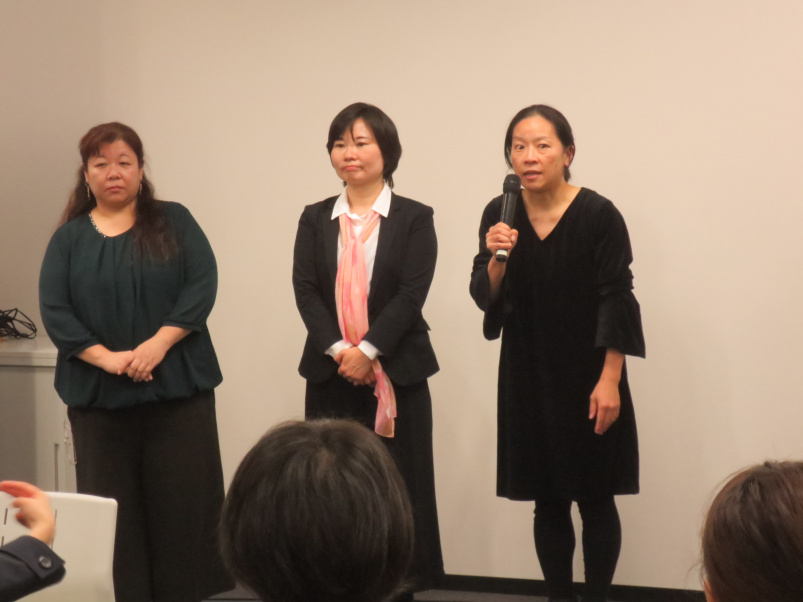
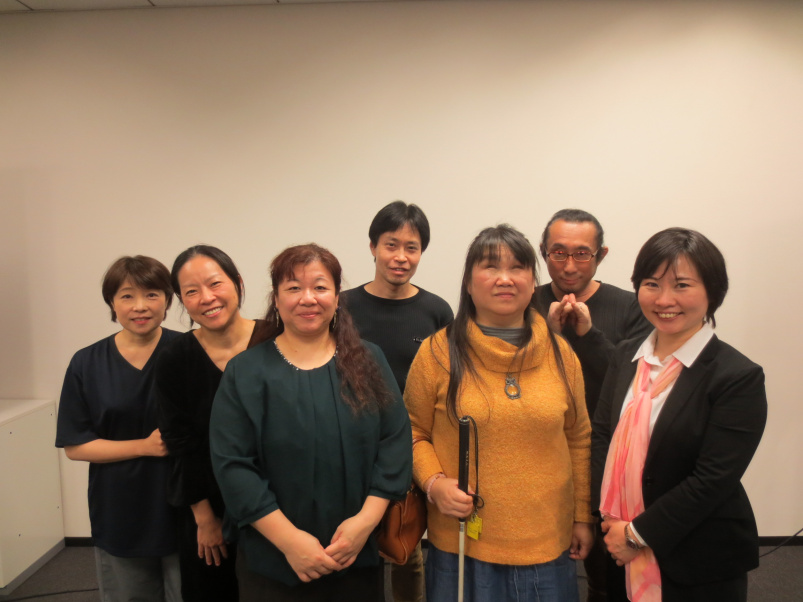
The members of the NPO Theatre Accessibility Network made a great team effort to report and demonstrate. From left to right: Yumi Kojima, Yukiyo Kawashima, Eri Ishikawa, Hiroshi Kamakura, Megumi Mitsuki (Engeki Kyokusha), Daisuke Suzuki (Engeki Kyokusha), Asako Hirokawa

NPO Theatre Accessibility Network

「みんなで一緒に舞台を楽しもう!」を合言葉に、当事者自身が主体となって視聴覚等に障害のある人々の観劇支援を行う中間支援組織。「日本ろう者劇団」で俳優・制作者として活躍してきた廣川麻子が、ロンドンで1年間に渡り障害者の芸術アクセシビリテイ支援の先進事例を学んだ経験を生かし、平成24(2012)年に設立。手話通訳の派遣や養成、観劇サポートのコーディネートや助言などを行う他、文化庁や全国公立文化施設協会などで障害者の鑑賞機会の拡充やバリアフリー化に向けた会議の委員などを務めている。
http://ta-net.org/

  • アクセシビリティ公演情報サイト(特定非営利活動法人シアター・アクセシビリティ・ネットワークのウェブサイト内)
    http://ta-net.org/event/
  • "Guidebook to Support the Visually and Hearing Impaired" (published in March 2018)
    This guidebook contains a wide range of knowledge and experiences that TA-net has accumulated to date, including support for not only the hearing impaired but also the visually impaired, as well as facilities, production, and budgeting. (Published with a Grant from The Nippon Foundation)