
- target business
- Nivoll "New Dance Performance Domestic and Overseas" (selected in FY 2013: 3 years)
- Speaker (Reporter)
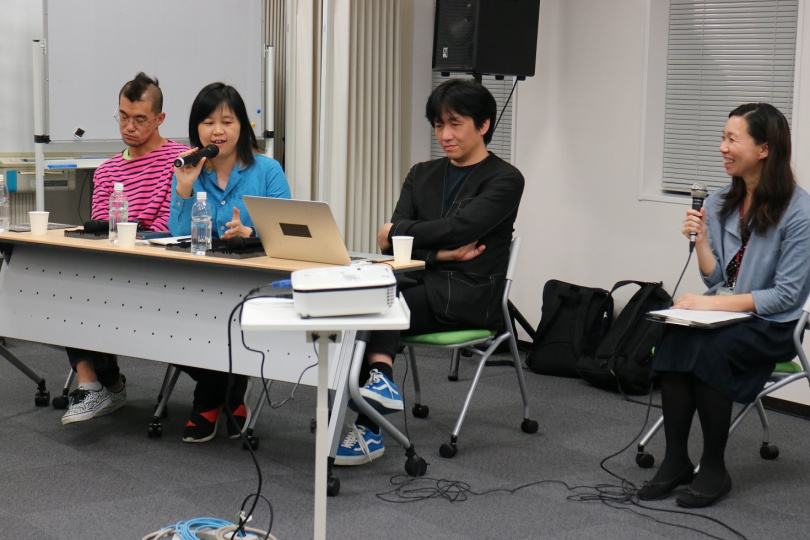
- Yoshikuni Yanaihara (Choreographer, director, playwright, and director of Niblor), Keisuke Takahashi (filmmaker), SKANK (musician)
- moderator
- Yoko Kitagawa Senior Program Officer, Planning and Support Division
Outline of subsidized activities
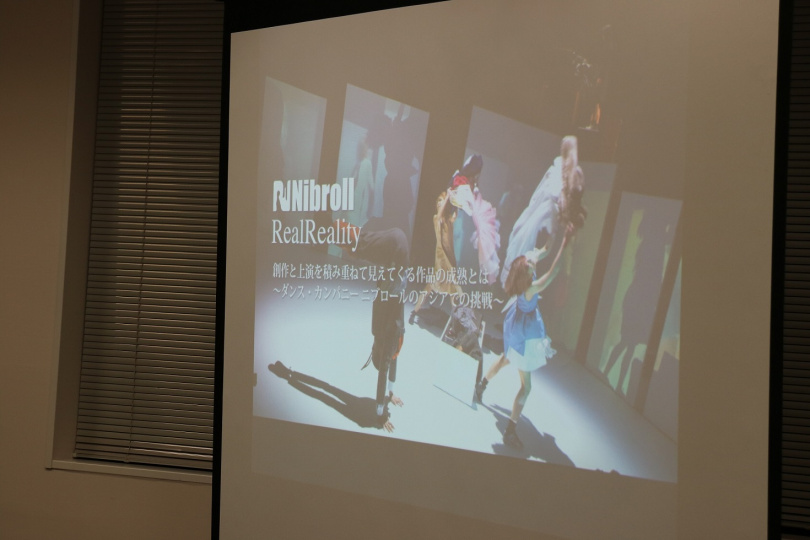
Long-term grants for the creation of "Real Reality" by the dance company Nibrol, in which members active in various fields such as choreographer Mikuni Yanaihara, filmmaker Keisuke Takahashi, and musician gather to present Creation Grant stage works In response, he held creation workshops in Wakayama, Aichi, and Tokyo, and created and performed them by incorporating elements from various regions. After that, they went on a domestic and Asian tour.
Part 1: A future-oriented project of repeated travel and thought
Nibrol's "Real Reality," which was selected as the 1st long-term grant program in FY 2013, is not only a "dance work" choreographed by Ms. Mikuni Yanaihara, but also a "project" involving many people involved in dance and the stage, in which thought, experiment, and practice are repeated. In Part 1 of the debriefing session, Mr. Yanaihara, Mr. Keisuke Takahashi, who was in charge of video, and Mr. SKANK, who was in charge of music, introduced the general flow of Nibroll from its establishment (1997) to the present, the process of creating "Real Reality," the feeling they got there, and the flow up to workshops and performances in Asia.
(Text: Rieko Suzuki)

The balance between "efficiency" and "waste" is a constant problem in the field of artistic creation. Everyone understands that new expressions are created from the accumulation of many "useless" thoughts and experiments. In the first place, they engage in art with the aim of deviating from or escaping the value of socioeconomic efficiency. That said, deadlines and budgets can shape the final form. Above all, "waste" is a luxury that is only possible when there is enough time and money.
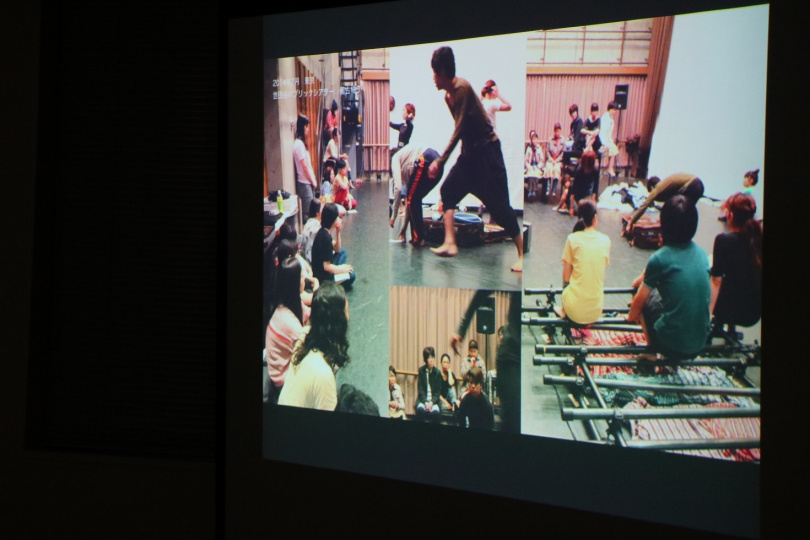
What Niblor was trying to achieve with his long-term grant program was a mechanism to organically connect this "luxury" to his work. It started with research and workshops held in Wakayama, Aichi and Tokyo over a total of 2 months in 2014. The effort to prepare for his new production of "Real Reality," which premiered next January, was a little different from the typical workshop.
"I think it's common for people who participate in workshops to also appear on stage, but this was not the case here, and the aim was for everyone to think about and discuss the work." said Yanaihara.
The theme of "Real Reality" is to search for the realism of the body, which is being lost due to the development of technology. In Wakayama, the participants, mainly students from Kinki University, where Yanaihara teaches, visited a garbage disposal site, used a tennis court, and experienced things that cannot be done at a rehearsal or theater. In the following workshops in Nagoya and Tokyo, the members, mainly dancers, discussed "about where our bodies are, and why our bodily sensations are becoming unreal." and worked out concrete pretenses and tried and tested how to fill the spaces.
"In this workshop, a total of about 80 people were divided into genres such as video, music, art, and production, as well as dance, and thought about the same theme and tried to create something. If there is such a viewpoint, the concept itself will be diversified. Not everything you create from that point of view will be adopted on stage. However, I think it is reflected in the work in various ways, and I have never experienced such a thing, so it was very good." said Takahashi.
"What I discovered in the workshop in Wakayama will be developed in Nagoya, what I discovered there will be further developed in Tokyo, and in the end, the members of Nibrol will create a work. It was interesting to be able to get a new perspective every time the work was built through such steps." (SKANK)
In January 2015, Real Reality opened at Setagaya's Theater Tram and toured the Kamitonda Bunka Kaikan in Wakayama, where it held workshops, the Aichi Prefectural Art Theater in Nagoya, and was performed at the Echigo-Tsumari Triennale and the Singapore International Festival of Arts. The dancers were selected through an audition held separately from the workshop participants, and 1 dancer in their 20 's, 30 's, 40's and 50's performed. Yanaihara himself said that 'there was not such a drastic difference,' but his body had a different background and time from generation to generation, and he felt the reality of 'putting one life on the stage.'. In addition, at the Echigo-Tsumari Triennale, in addition to performing his works, he also presented an exhibition and introduced a part of his workshop in Wakayama through video.
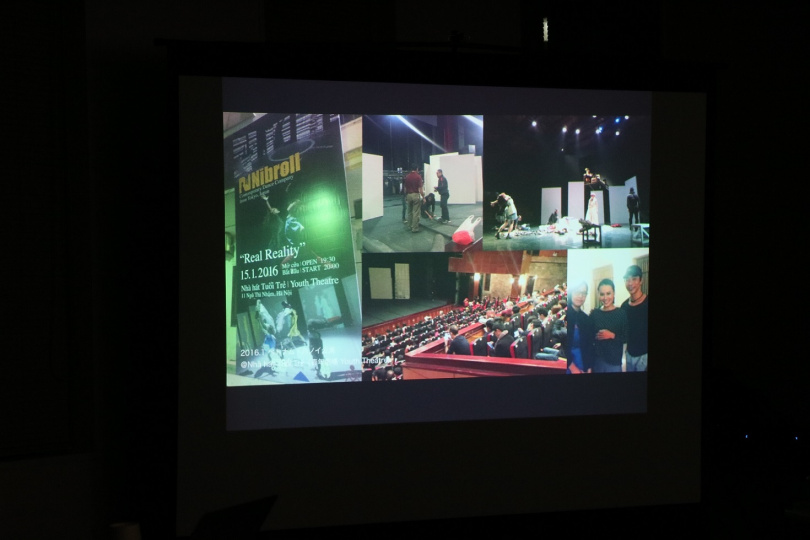
The following year, 2016, Yanaihara was appointed as the Agency for Cultural Affairs' envoy for cultural exchanges in August of the previous year, and the project expanded its scope of activities to Asia. In January, she performed in Surakarta, Indonesia and Hanoi, Vietnam. In March, a workshop performance was held in Jakarta, Indonesia, where students studying dance at a local university (Institut Kesenian Jakarta, IKJ) challenged themselves to reconstruct the work. Short-term workshops were held in each location before the performance, and there was an effort to experience and share the concept of the work. There were many different experiences from those in Japan, such as the varying attendance of workshop participants and the wait for practice and preparation for the time of Islamic prayer, but these were all exciting experiences for the company members. In particular, the workshop performance in Jakarta seemed to be a little different from the performance in Japan.

"At IKJ in Jakarta, we held a video and music workshop, or a lecture. The students there are very curious and actively involved in the work. So I think we had a good relationship." said Takahashi.
"What shocked me about Jakarta was that the only sounds in the city were cars. I was talking with the students about what kind of sound would be left when the sound of the car was gone, and I was creating the sound of the "street crowd."" (SKANK)
"In previous performances, we had only performed the works we had created, but in IKJ's workshop performances, we used the sounds that someone had recorded for us, and the videos that the students had taken at home were put on the stage as they were. It felt like a different landscape from what we had created in Japan was emerging in the works." (Yanaihara)
What's remarkable about the three-year Real Reality project is the richness of the process. No matter how open we try to create and practice, it is unlikely that so many diverse people of different ages, nationalities and interests will think and discuss the same work or theme. In addition, although only a few ideas have actually come to fruition on stage, there are many people in Japan and abroad who have experienced part of the creation of Nibrole and contemporary dance works through this project. Real Reality has come to an end, but if they're still thinking and doing what they do, it may have been a useful investment in the future of dance.
Part 2: Fukahori Interview
In the second part, Yoko Kitagawa, program officer of Arts Council Tokyo, hosted an interview to ask about the awareness of the issues in which "Real Reality", which was the target of long-term grants, was prepared, and how to build specific connections in Asia. From Mr. Yanaihara's passionate speech, we also saw the various problems faced by the contemporary dance scene in Japan and the challenges for the future.
We started supporting Real Reality in 2013, and it premiered in 2015. When he applied for the long-term grant program, his previous work, See/saw (2012), was created in Echigo-Tsumari, and his goal was to explore a new form of collaboration among artists and a new creative process. What are your thoughts on the results?
- Yanaihara
- Nibrol claims to be a "company," but it's not. That's because we haven't been able to pay regularly to hire dancers. Noism in Niigata City, where Minoru Kanamori is artistic director, is the only company in Japan that can be called a "company" on the same terms as in Europe. When we were young, we were optimistic that such a system would be established someday. In 20 years, the environment would be developed, and if we had the ability, we would be able to operate as a dance company. However, after 20 years, the genre of contemporary dance itself tends to shrink steadily, and it is difficult to convey its appeal to the general public. But every choreographer wants to do something about it. That's why I decided to hire dancers and train them in "Real Reality."
As a result, I was able to collaborate with 4 wonderful dancers in 3 years from 2013. Not only for the actual performance, but also for the rehearsal, we pay the salary. 2 of the 4 dancers had their own jobs, such as teaching ballet and lecturing at universities, but the challenge was how to develop the dancers, who had just turned 20 and 30, outside of stage rehearsals. There is still some work to be done on that.
However, I think it can be said that meeting various people and creating a work itself is an achievement. Whether you are an actor or a dancer, the degree to which you can take your work seriously will lead to the evaluation of the director, choreographer and audience. But some of the workshop participants haven't reached that level. You can't pay for it. But if we can think about creation together with them, I think it will lead to communicating the fun of contemporary dance.
During the national tour of this work, we always held a workshop at the place where the performance took place, which led to the creation. Even if they cannot perform on stage or their moves are not used in the production, if 40 or 50 people can get the feeling that "We thought together and created a stage." it will deepen their understanding of contemporary dance, which at first glance is said to be difficult and obscure. I think we succeeded in increasing such people in the audience.

Have any of the dancers who participated in the Real Reality workshop and performed on stage been involved in other Nibrole productions?
- Yanaihara
- It's just the three years I'm introducing here. In fact, we need to nurture them, and there should be an opportunity for an ordinary dance company, but we don't have the financial resources. I don't think we can say, "You don't have the funds, but you should go out with your heart," like in the past. All dancers have spent a lot of effort to learn their dance skills.
In the past, I had quite a skilled dancer in a production called Pulse. At that time, I really couldn't afford to pay, so I felt like I had to ask my friends to come out, but there was a problem. We do it by hand, but we all split up and spread the linoleum and go out and buy lunch boxes, and it's like, "That's not what dancers do." If it's a small theater, even actors will go to buy lunch boxes if they spread lino. Even in dance, that's the situation in Japan, which is different from Europe. So, at that time, I also thought, "Okay, that's enough." I didn't have to do unison for the rest of my life, and I thought that even if I couldn't dance well, I could create dance as long as I had expressive skills. So for a while there was a period when I stopped doing dance-like dancing, including Coffee. Even so, I never wanted to have a situation where the amount of money spent on the staff and the amount of money spent on the performers were different, or where the staff were paid but the performers were not, so I think I have made sure to pay according to the level.
Can you explain again where Nibroll's activities stand and where your work Real Reality stands?
- Yanaihara
- I had little interest in people who only danced, and for about 10 years I hated the finished body. I've always been like, "What's pirouette, what's passe". So I've been slammed by dance critics and people who do dance saying that nibbling isn't dance. Even so, the physical ability that each person has is interesting. When I said, "People can't dance, so we have to run." I said, “We have no choice but to run, ” and I showed my eagerness to show that every race might be over. The moment is beautiful, and you feel your body is there. Unlike ballet or modern dance where you try not to get hurt or something like that, the beauty of the moment that the stage is over after this one performance was very attractive. However, people said it wasn't a dance, so for Romeo or Juliet (2007), I hired a dancer to "Then I'll make a dance." After that, I decided to try dancing for about five years.
“See/saw, ” which preceded“ Real Reality, ” was a bit special. When the Great East Japan Earthquake occurred, all artists started to make works in response to it. But I'm from Shikoku and the place where I was born is far from Tohoku. So I have a lot of questions about what we can do with the theme of the earthquake disaster. But I had to go to Tohoku for an interview, and when I did that, I saw a landscape that I had never seen before. I was very surprised, and I thought that if I didn't make a work now about how many people had died, I wouldn't be able to make a work about something that will be forgotten forever. It was "see/saw," which was performed for a month at the YCC Yokohama Creative City Center with the city of Yokohama.
About two years later, Setagaya Public Theater asked me if I would like to do a new play, and I made "Real Reality." I started writing plays before the earthquake disaster, and I received the Kishida Drama Award. Little by little, I found myself in a situation where I had to do a play, and since I had been with actors for a long time, I wanted to do something with my body. That's why I used a lot of arabesques, pirouettes, and unison, which I hated at the time.
Even though Real Reality is a work of dance, through workshops you incorporated movements that can only be created in the moment.
- Takahashi
- When we held a workshop in Japan, we had some of them come to the concert as an ensemble. I didn't have that much time in Asia, but I think this work had the quality of being able to accept people from different approaches. The workshop itself is very wasteful, and most of what we create doesn't make it to the stage. But that waste is what supports this work. I think it is very luxurious to spend so much waste to create a work.
Are there any differences in creative activities between Japan and Asia?
- Takahashi
- This work transcended national borders and started from what is real. It is the same with images, but in today's world, we are satisfied with information through the Internet, or rather, we are omitting the body more and more. There are people all over the world who have some kind of discomfort or anxiety, and I think the fact that we were able to find such a common denominator was also a key to our success.
- Yanaihara
- What Takahashi-kun just said is very important. I think it is about what we can do for society by accumulating even seemingly useless things. For example, even in the workshop, there are people with autistic tendencies who come or leave in the middle. So we accept that absence and proceed. However, as we waste time with various people like this, they themselves change, and what we see through our works changes. I think that was a really luxurious time.

How much creative time did you spend in Indonesia and Vietnam?
- Yanaihara
- Both of the performers were single dancers, so I trained hard for a week or two. But the workshop is limited to 3 days. Even so, it's more than 10 hours a day. There were people who came on the first day and were tired, so they wouldn't come on the next day, but they would come on the last day, and there were people who came just to see the last day. When I am involved in the stage in Japan, I don't meet such people. But how do you share the space with people like that who don't necessarily have to do it themselves but are a little bit interested. I mean, I learned a lot about engaging with unprofessional people. For us, the performance is a special day and practice is our daily life. It was great that I was able to meet people I don't normally interact with in my daily life.
Do you plan to use your workshop experience and what you tried out there as a method in your future work?
- Yanaihara
- I haven't. That's a lot of time and effort. But I think it's better to have an opportunity to make things together or talk for even an hour, because I think it's also an opportunity for people who come to watch to understand the work more deeply. That's another challenge. If you have the energy, passion, money and time, I think you can do it.
Were you able to do that with Real Reality thanks to a three-year grant?
- Yanaihara
- Right. It took that much time. At the very beginning, when we talked about what we were going to do during the three-year grant, we said we were going to do things that require passion and time that we don't normally do. In the case of a workshop, even if it takes only three days to actually hold the workshop, it is necessary to prepare by first talking about how you would like to hold the workshop, researching what kind of place it is in that region ....... What to do and what you can do is different depending on the region. In Wakayama, there are no dancers, but there is a garbage disposal facility nearby, so let's think about how we can reuse things that are no longer used. In Aichi, there are many children who want to dance in big cities. Now, as a result of the Nibrol workshop, more people are doing contemporary dance in Aichi Prefecture, and we have a group called Nagocon. When we actually held a workshop, 50 people would be just right in Nagoya, but 100 people gathered in Tokyo, so we reduced the number to 50 through paperwork. Such regional differences have become clear through research.
I think that the cooperation of cultural institutions is essential for such research. How was that promoted in Asia? In particular, Surakarta in Indonesia may not be so familiar to Japanese people. How did you make the connection?
- Yanaihara
- In 2004, I participated in a project called "Flying Circus" in Singapore. Artists get together and travel for six months and have meetings every night, but they don't have to leave any results. I was there with Melati (Suruyo Darmo), who was also at the "Sunshower" exhibition (Mori Art Museum and National Art Center) last year. As I went around, I got to know Melati and Tiffany Chung from Vietnam, who is now a famous artist.
So, before I started doing "Real Reality," I said, "Actually, I'd like to do this kind of work." Melati had become a very important person. Surakarta, which is commonly called "Solo," has an art university there, and there are more people interested in contemporary dance than Jakarta, so he said, "Please come here (where he lives)." Now we have YouTube, so when people hear that Nib Roll is coming, they watch videos very hard. There were so many people in front of the theater that it was unthinkable in Japan. Both Vietnam and Indonesia have large populations. That's why the average age of the people is 28.5, so they are quite young and full of energy. That's why the Vietnamese Youth Theater knew Le Khanh (Vietnamese actress) through their activities for a long time, so when I said, "I want to do it," they said, "I'll make it possible."
This kind of connection may be quite similar to Europe and America. From 2000 to 2005, we did a lot of tours in Europe and the United States, and once we did San Francisco, we felt "There's going to be a dance festival here in Belgium." and the connection grew and we were able to do tours. In the same way, I have an image that artists also play the role of curators in Southeast Asia.
Until I was in my 20s, I thought Japan was a major power in Asia, but when I actually visited, it wasn't like that. On the contrary, there were many parts that were left behind. Moreover, in the art of Southeast Asia, there is no money from the government at all. However, it is very cheap to rent a space, so if you have a passion to carry out your art activities and a place, you can connect your art activities. Both Melati and Tiffany said that this is important.
In Southeast Asia, I often heard people say, "When I thought about what kind of appeal I could make to society, I had no choice but to make a work." When I was working in Japan, I didn't think much about society. It was just because we wanted to create our own work, but when I traveled with them, I realized that wasn't enough. It's the same for American and European writers.
>Continued from Part 4 "The Maturity of a Work Revealed through Successive Creations and Performances: The Challenges of Dance Company Nibrole in Asia"