



Toshokai "A survey of Kabuki music that touches the heart" Performance in Montenegro
*Information at the time of adoption.
- Name of the organization or individual
- The Saishokai Association of the Research Institute of Traditional Japanese Music
- subsidy category
- Creation Grant
- Grant Type
- single year
FY30 Creation Grant [Single-year grant program] 2nd term



Business Overview
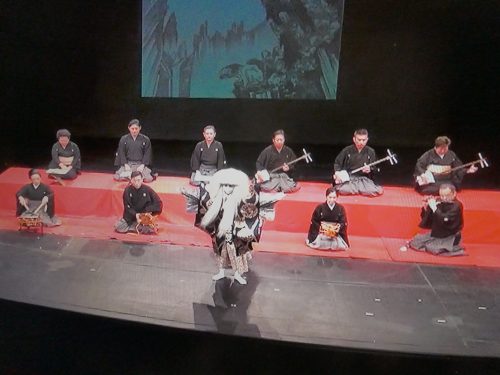
This project was organized for the purpose of promoting friendship between Japan and Montenegro by conveying the charms of traditional Japanese Kabuki music and Kabuki dance to the people of Montenegro and contributing to the mutual understanding, musical creation and development of the two countries. In Montenegro, traditional performing arts have not been held in earnest, and there has been no explanation of musical instruments or hands-on experience with them. This time, I was able to provide a valuable opportunity to experience Japanese culture.
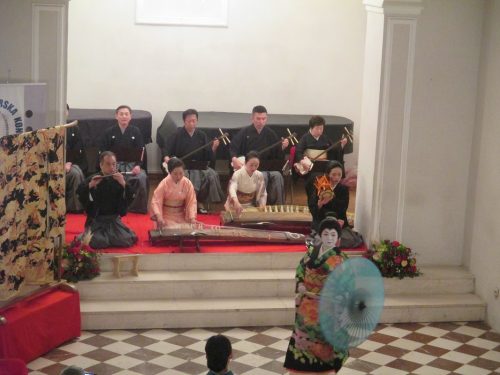
The main performance was held at the National Theater of Montenegro. The performance was introduced on a TV program in Montenegro and received a good reputation. Visual effects were added to the stage to make it easier for the audience to understand. It was an elaborate stage where visitors could visually feel Japan by performing with children's karate demonstrations from Montenegro, performing Japanese dance, projecting ink paintings associated with the song, and decorating the girders with furisode (long-sleeved kimono). [Program] - Kabuki Hayashi Kumikyoku [Heartbeat] (joint performance with Montenegro Children's Karate Enbu) - Yamada school koto music [Hana no tera] - Shamisen instrumental music [Nagare] - Kabuki Buyo [Kabuki Dance] [Stone Bridge] - Encore: [Hair Washing]
At the University of Montenegro, we held a lecture concert and a workshop (kotsuzumi, flute, Japanese dance and shamisen). I was able to convey the charm of Japanese musical instruments (otsuzumi (big drum), kotsuzumi (small drum), taiko (Japanese drum), fue (Japanese flute), shamisen (three-stringed Japanese banjo) and Japanese dance to many audiences, including university students and musicians of Western musical instruments. In the workshop after the lecture, the participants showed great interest in Japanese musical instruments and dances, which they had never encountered before, and were very excited. At the end of the workshop, all participants played the old song "Sakura" together on the stage.
The Kotor Church of the Spirits performed in a short program. Kotor is an ancient city surrounded by old walls, and the concert hall had various restrictions, but it is a tasteful church, and the following program was organized to make use of its beautiful sound. The stage was so close to the audience that they could feel the charm of Japanese musical instruments. After the performance, they took pictures with the audience and it ended in a friendly atmosphere. [Program] Yamada school koto music, "Hana no Tera" (temple of flowers) (with dance), shamisen instrumental music, "Nagare," "Kotor no Sora (flute solo music)" (with representative Montenegrin folk song), ensemble ancient song, "Sakura" (with dance)
[Main performers and staff] Hikojuro Mochizuki, Kieko Oku, Takao Ashino, Hikoyoshi Mochizuki, Sakijuro Mochizuki, Masao Fujisha, Hikotaki Mochizuki, Rokutayuki Kineya, Masajuro Imado, Ryuichiro Imado, Chikayoshi Sasaki, Mamiko Asaka, Kaname Higashiro, Tomiro Wakayama, Katsueji Kineya, Kotaki Yoshizumi, Koji Kiriyama, Akiyo Uehira, and others
- Period of Activity / Project
- Friday, March 15, 2019 – 17th (Sun)
- Venues
- University of Montenegro (Potogorica/Montenegro), National Theatre of Montenegro (Potogorica/Montenegro), Kotor Church of the Spirits (Kotor/Montenegro)
*Information such as project outlines is provided by organizations and individuals providing subsidies.
Profile
[General Incorporated Association Hogaku-bayashi Research Institute Saishokai]
It was established for the purpose of preserving and passing on the music of Hogaku-bayashi, as well as searching for and researching new forms of Hogaku-bayashi based on the techniques and sensibilities developed by our predecessors over a long history. In past concerts, he has commissioned and presented new pieces in addition to classical music such as nagauta and Kiyomoto. In addition, visual effects such as dances and images have also been incorporated to "convey the music of traditional Japanese music in an easy-to-understand manner." At last year's concert, she presented new works with Chinese and Korean instruments. As for other activities, he published a score of nagauta (Nagauta "Tokimune (Goro)" and "Tsurukame").