



Naoyuki MANABE GAGAKU Ensemble 2025 Performance: Tradition and Innovation 3 ~ Unraveling the Classics and Creating Future Tradition ~


Business Overview
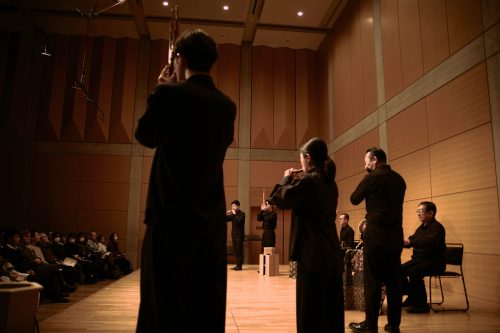
The program started with “Saka ” from Kagura-uta and was presented as part of a long-term Kagura-uta performance project.
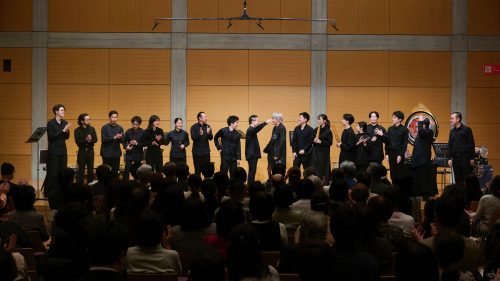
Kagurauta is a group of musical pieces that require a high level of singing ability and concentration, and this time as well, all the performers practiced and shared their breathing techniques and sense of pitch to enhance the sense of unity as an ensemble. Next, in "Banshikicho choshi," in addition to the conventional withdrawing, NMGE introduced its original playing method of "Shoryobuki" to explore a three-dimensional sound utilizing the whole space. In addition, in "Somozajo and Ba," he tried to reconstruct the traditional playing technique by adopting the rebuki divided into four groups and the original 'kabuki' as a new playing technique. Following these traditional songs, Toru TAKEMITSU's "Autumn Garden Song" is performed again. This is a repeat performance following the one in 2023, and this time it presents a new interpretation, with young performers playing the main role and veteran players providing logistical support. Finally, the third chapter of "Seishoru," a piece commissioned by Kaito NAKAHORI, was performed for the first time, marking the completion of the three-year gagaku suite.
◯Main performers
Manabe Naoyuki, Miura Motonori, Ota Yutaka
- Period of Activity / Project
- Monday, November 17, 2025
- Venues
- Tokyo Opera City Recital Hall (Shinjuku-ku)
Profile
【Naoyuki MANABE GAGAKU Ensemble】
The group was formed in 2020 during the COVID-19 pandemic with the philosophy that only musicians who value tradition and continue to study can create new traditions. While rooted in tradition, they have used gardens, archaeological sites, and theater spaces to perform in a new style of performance that is not bound by the format of stage and audience seats.
Taking out the musical elements of gagaku, the composer Naoyuki MANABE devised a new style by using "choshi" (tune) and two groups of playing techniques of Omeribuki and Oibuki (melody is played in a different way) and Omerimai (dance is performed in a different way). We continue to create projects that can become new traditions.