



- Date & Time
- 2025年4月22日(火)~5月6日(火・祝)
※火・金・土・日・祝のみオープン
火・金 13:00~20:00
土・日・祝 11:00~18:00
開室カレンダー - Venue
- Studio 04
(Oshima 4-1-1 Koto-ku, Tokyo 136 0072, 1st Floor 106, Oshima 4-chome Danchi Building 1)
In the workshop "Creating Expression from Records," which has been held every summer since 2022, participants collect records left behind based on their own interests and record them themselves. They then share the process with each other and practice expression to open up records and research through dialogue.
This exhibition explores and presents the current forms of expression of the past workshop participants, while composing works created based on their research and records, etc., on themes that they have been dealing with since then or on current interests.
Although there are a wide variety of themes that reflect the reality of life, if you put them next to each other, you may find that similar issues are found, or conversely, similar themes have very different details.
Each project is (or may be) a life's work. I have a feeling that stopping at each juncture to make a presentation and sharing it with various people will lead to richer activities.
Please come and enjoy the "present" form of the unique projects.
* Program is subject to change.
About the theme of the exhibition
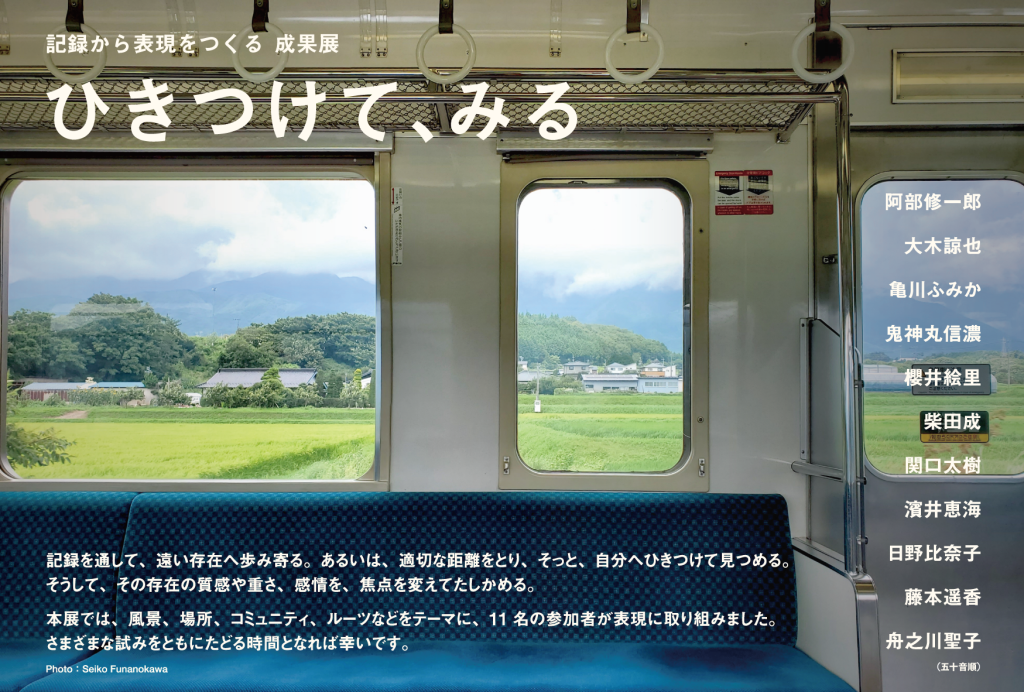
Through a record, I approach a distant existence. Or, take an appropriate distance and gaze softly and gravitationally toward yourself. In this way, the texture, weight, and emotion of the existence are confirmed by changing the focus.
In this exhibition, 11 participants worked on the themes of landscape, place, community and roots. I hope this will be a time to trace various attempts together.
admission fee
Free
Exhibit Participants (in alphabetical order)
Shuichiro Abe, Ryoya Oki, Fumika Kamegawa, Kinomaru Shinano, Eri Sakurai, Shigeru Shibata, Taiki Sekiguchi, Megumi Hamai, Hinako Hino, Haruka Fujimoto, Seiko Funokawa
Comments from Exhibit Participants
[Shuichiro Abe]
In the Noto Peninsula after the earthquake, the demolition of buildings at public expense is proceeding rapidly. Ishikawa Prefecture has set October 2025 as the target for completion, and 60% of the demolition work has already been completed in Suzu City, where I am visiting. I think that the transformation of space and landscape also means the loss of physical memory. I took pictures of houses and landscapes so that I could remember something someday.
Ryoya Oki
Manchukuo once existed in northeastern China. What was Manmokaku? The more you know, the more difficult it is to answer this question.
What has been said and how, and what has not been said?
I will try to express it based on my research.
[Fumika Kamegawa]
I've been thinking about distance since last year. While participating in "Creating Expression from Records," I became interested not only in the distance between people, but also in the psychological distance between people and things created by their ownership. I want to look at my way of being that I can't always be close to events.
[Kijinmaru Shinano]
Maybe everyone has scars they can't see ....... The scars that the person himself cannot see resonate with someone without knowing it, or inflict the same scars on someone else, or are passed on to children without healing ....... What should I do to be healed? With that in mind, I created a work based on the narratives I encountered in my daily life.
[Eri Sakurai]
I'm interested in the fact that "family" is universal, yet no one family is the same. Because of its complexity, we rarely hear from people who manage to deal with family issues. I want to create a work to honor people who try to live hard with their families without anyone knowing.
I have loved the pool since I can remember. In the water, I was freed from gravity and social roles, and I could forget any pain while swimming. But pools haven't always been that place for everyone. During the Pacific War, swimming pools changed from places for swimming to fire drains and shelters, and many people died in pools during air raids. I would like to get closer to the memory and locality that is transformed by war.
【 Sekiguchi Taiki 】
Recently, I've been told that my father and mother are alike in some ways. To behavior and feelings. I'm glad to hear that. Because that means the person I can't meet lives inside me.
He thinks that he will be able to see the deceased when he dies.
I came to miss my grandfather. So, looking at my grandmother's stories and what my grandfather left behind, I write a story about visiting my grandfather.
Hamai Keikai
After the Noto Peninsula Earthquake, I visited Noto regularly as a volunteer. And while I was involved in Noto, I learned that Toyama Prefecture, where I live, was also heavily damaged. Himi city, which was particularly damaged in the prefecture, is also my father's hometown. In this exhibition, I will work in two areas, Noto and Himi, in order to re-encounter the lives and people of those areas that have been hidden behind the words "disaster-stricken areas" and "disaster-stricken people," and how I relate to the disaster-stricken areas.
[Hinako Hino]
I used to write in my diary whenever I wanted to, but one day I suddenly couldn't write anymore.
The only thing I could do now was paint myself blue in order to regain my own speech and the rhythm of my speech.
While I was painting blue every day, I thought it would be nice, and I experimented with various colors in ways I didn't know about, and the booklets on display this time are the result.
I ask myself "Do you want to paint today? What are we gonna do?" every day, and sometimes skipping out is good for me.
[Haruka Fujimoto]
Noto has been known as a disaster area since last year.
The place has lost even the vestiges of its former days, and the landscape continues to change as the land is cleared from the ruins.
Even so, I feel a little happy when I visit Noto, talk with the people there, and find things that have not changed.
What was that place like? What kind of place is this?
I want to capture the scenery that people in Noto see before it disappears.
Seiko Funakawa
In the past, behind Japan's rapid economic growth, there were people who struggled against pollution and food contamination. Many of their voices, born out of their daily lives, disappeared unrecorded. I happened to come across this memory in a series of interviews with my parents over the years. Where do the traces of earnest thoughts and choices engraved in the remaining clues go now?
Related Events
Gallery Talk
In order to make the exhibition more enjoyable, participants of this exhibition will introduce the theme of the works and the process of their creation, and guide you around the venue. It will be held twice during the session.
Saturday, April 26, 2025 14:00~16:00
Exhibition: Ryoya Oki, Fumika Kamegawa, Shinano Kishinmaru, Megumi Hamai, Seiko Funokawa
May 3, 2025 (Sat, Holiday) 14:00~16:00
Exhibition: Shuichiro Abe, Eri Sakurai, Sei Shibata, Taiki Sekiguchi, Hinako Hino, Haruka Fujimoto
Venue: Studio 04 (Tokyo, Koto-ku, Oshima 4-1-1 Oshima 4-chome Danchi Building 1 106)
Admission: Free
*You don't need a reservation. Please come directly to the venue.
Talk Event (1) "let go and see" Talking with everyone about 3 days in Suzu
5 people who met in the workshop "Creating Expression from Records 2024" will talk about their 3 days in Suzu City, Ishikawa Prefecture in November and what happened after that. The five people, who live in different places and have had different relationships with the earthquake so far, will look back on what they felt and thought during their stay with the records, and will casually talk with the participants about the future of Noto, how to deal with the earthquake, and what they are thinking now.
Date: Sunday, April 27, 2025 14:00 ~ 16:00
Time Schedule: 14:00 ~ 15:00 Suzu Briefing
15:00 ~ 16:00 Roundtable Discussion
Venue: Studio 04
Speakers: Fumika Kamekawa, Taiki Sekiguchi, Megumi Hamai, Hinako Hino, Haruka Fujimoto
Admission: Free
Capacity: 20 (first-come-first-served basis)
How to apply: Please apply using this form.
Application Deadline: Saturday, April 26
* Application will close as soon as the number of seats is filled.
Talk Event (2) "Looking at the scenery of Suzu"
Haruka Fujimoto, a participant in this exhibition, will give a talk about the scenery of Suzu City, Ishikawa Prefecture, which is featured in her work. We will welcome Taiga Nakajima, a Zushu pottery artist living in Suzu City, Shuichiro Abe, a video artist and participant in the exhibition, and Natsumi Seo, an artist, writer and NOOK.
Comments from participants (Haruka Fujimoto)
I started going to Suzu when I was a university student. From the first time I visited, I was drawn into the scenery of Suzu, where the sea, mountains and people are together, and the air is blue and transparent. The Noto Earthquake occurred on January 1, 2024, and the landscape of various places changed. Suzu is one of those places. The base in Suzu, where I had spent a lot of time on university projects, also collapsed and underwent changes. Many people are still living in the midst of great change.
I think of landscapes not only as visible sights, but also as "what an individual sees and has seen and is made up of experience". How does the landscape look in each situation?
We have invited Taiga Nakajima from Suzu, who is a senior at the university and a Suzu pottery artist. Together with Shuichiro Abe, who has photographed houses and landscapes being demolished in Suzu, and Natsumi Seo, who has recorded the voices of people and landscapes in various places, we will try to put into words the landscape of Suzu and how we relate to it from each perspective.
Date: Sunday, April 27, 2025 18:00 ~ 19:30
Venue: Studio 04
Speakers: Taiga Nakajima, Haruka Fujimoto, Shuichiro Abe, Natsumi Seo
* Mr. Abe and Mr. Seo will participate online.
Admission: Free
Capacity: 20 (first come, first served)
How to apply: Please apply using this form.
Application Deadline: Saturday, April 26
* Application will close as soon as the number of seats is filled.
Guest Profile
Taiga Nakajima
Born in Kanazawa, Ishikawa Prefecture in 1994, he currently resides in Suzu. He is a Sushu ware artist and ceramicist. He creates pottery that incorporates the primordial expression of earth, glaze, and firing, centering on Suzu ware. His major exhibitions include the "Mangetsukai Art Exhibition '22" (Ishiguro Building, Ishikawa), "Kanaiwa Rakuza" (Kanaishi/Oono area, Ishikawa), and "Food" (atelier & gallery creava, Ishikawa).
Shuichiro Abe
Born in Aomori Prefecture in 1996. Looking for filmmaking to record memories deposited in a place or the physical sensation of being in a place. His major works include “Hear the Place Sing ” (2022) and“ Udo no Ue ” (2024). Major screenings and exhibitions include "The 25 Photo "1 _ WALL" Exhibition"(Guardian Garden, Tokyo) and (Cinema House Otsuka, Tokyo). As of 2025, currently enrolled in the master's program at the Graduate School of Fine Arts, Tokyo University of the Arts.
Natsumi Seo
Born in Tokyo in 1988. Artist, writer. While thinking about the records of the language and scenery of the local people, he creates pictures and sentences. He launched the collective "NOOK" to record and express while collaborating with various regions and communities, and traveled on the theme of "Karoku Recycle" to dig up records of disasters and seek expressions using them. His main books include "Awai Yukoro" (Shobunsha), "Double Town/Songs of the Alternate Land" (Shosho Kankanbo), "Strata of Voices" ( Survival Books) and so on. As a co-production with filmmaker Haruka Komori, he has produced "On the Soil with the Waves" (2014), "Double Town/Weaving Songs of the Alternate Land" (2020), and "I Was 11 Years Old" (2021-).
Contact Us
NOOK
E-mail:karoku.nook*gmail.com (replace * with @)