


- Date & Time
- 2025年11月23日(日・祝)~2026年2月14日(土)
※木・金・土・日曜日・祝日のみオープン
木・金 13:00~20:00
土・日・祝 11:00~18:00
※12月29日(月)~1月7日(水)は閉室
開室カレンダー - Venue
- Studio 04
(Oshima 4-1-1 Koto-ku, Tokyo 136 0072, 1st Floor 106, Oshima 4-chome Danchi Building 1)
80 years after the war. We have visited Tohoku, Okinawa, Hiroshima, Taiwan, South Korea, Malaysia, Singapore, and the Marshall Islands, and we will focus on the stories we have heard about war, the landscapes we have seen, and the records that have been left behind. This exhibition will allow us to look at war and the postwar era from multiple perspectives.
Many years have passed, and the number of generations who experienced those times has decreased, and the opportunities to hear the stories directly have decreased. However, we are living in a daily life in which new news of the war continues to flow. 80 years after the war, we began a small study group where we gathered together to read and talk about World War II and postwar records.
We were led by Mei Otaki, who has been doing fieldwork in Malaysia, Yichen Wang, a filmmaker from Taiwan, Ryoya Oki, who has been researching the repatriated community in Nagano, and members of NOOK, who have been recording and collecting accounts of the disaster since the Great East Japan Earthquake.
The end of war is not necessarily the beginning of "peaceful postwar". People were physically and mentally scarred by the enormous disaster of war, and in lands and societies that experienced colonial rule and wartime regimes, the effects were inherited in ethnic tensions and conflicts, and in institutions and systems. War continues to affect people's lives and society in different forms even after the war.
This exhibition is an attempt to create a place for visitors to think and learn together by carefully re-weaving voices and landscapes that we actually encountered in the places we visited and displaying them together with materials from various regions. As we live 80 years after the war, we would like to share memories and records and engage in small dialogues to think about what we can inherit from the past and how we can connect it to the future.
* Program is subject to change.
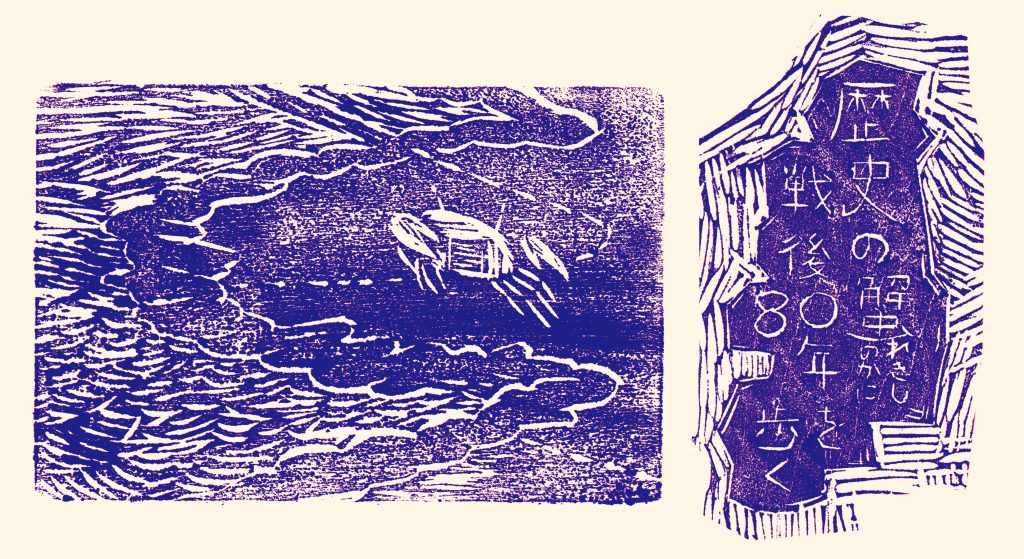
What is the "historical crab"?
The crab walks sideways, but surely moves forward. This represents our attitude toward the future while looking back on the past. Rather than recounting history from one direction in a straight line, sometimes taking a detour and looking at it from the side brings up voices, memories, and landscapes that were previously unseen and unnoticed. It is an attempt to pick up fragments of the war and the postwar period and reconsider them from multiple perspectives, connecting them through the small steps of the crab.
admission fee
Free
Members involved in this exhibition
Otaki Mei
Born in Tokyo. During college, he became interested in Southeast Asian countries and went to Malaysia to study. Since then, he has deepened his interest in Malaysian society and politics. Even now, as an office worker, he is still studying the Malay language and researching records of people who lived during the period of Japanese rule and what happened. In this exhibition, I will display the materials I have collected during my research and the records of my trip to Malaysia.
Wang Yichen
Born in Taiwan. A filmmaker. It will record and investigate a wide range of activities, from daily life records from the perspective of residents of the housing complex to social movements. As Japan entered the Pacific War, Taiwan became an important southward base, and many Taiwanese joined the battlefield and left their homeland. Through the stories collected from these people, as well as the remains and materials of the wartime period that she discovered when she actually visited Kaohsiung, her hometown, this exhibition depicts the state of Taiwan at that time.
[Ryoya Oki]
Born in Nagano Prefecture. When he learned that Shinshu was the largest number of Japanese who immigrated to Manchuria as pioneers, he began to investigate its history. Continuing issues are discussed through the collection of documents and testimonies. In this exhibition, we will display the narratives, scenery, and materials of people we met while tracing the repatriates to the port of repatriation and the postwar reclaimed land.
*上記3名はカロクリサイクルのワークショップ「記録から表現をつくる」の参加者であり、そこでの発表を起点に、それぞれ独自の調査を展開しています。
[NOOK]
Natsumi Seo/Daichi Nakamura/Mina Isozaki/Yuka Seki
A collective of artists and researchers who have been conducting research, recording, and expressing activities in Sendai City and along the Sanriku coast since the Great East Japan Earthquake.
He has recorded war narratives in Tohoku and Hiroshima. This time, he will exhibit stories and landscapes he heard in Japan, Busan, Malaysia, Singapore, Tainan, and the Marshall Islands.
Ryuhei Koya
Born in Aichi Prefecture. He is interested in the history of linguistics itself, where nature and norms intersect. In this exhibition, we will reconsider the role of linguistics as a science in colonial policy, mainly through a literature survey, and organize the chronology and materials of the whole exhibition.
Related Events
The following events will be held during the exhibition period. Please join us.
*The exhibition is not available during the Karok Reading Club "Reading War Poems" and the lecture and dialogue "Thinking about War Trauma" events. Please note.
*Events may be added at a later date. Details will be announced on this webpage or on Karoku Recycle 's website and social media.
*The personal information you fill in when applying will be strictly managed and used only for the operation and guidance of this business.
Gallery Tour
We will introduce the works of art and show them around the venue so that they can enjoy the exhibition more. It will be held twice during the exhibition.
Part 1: Sunday, November 30, 2025 14:00~16:00
Part 2: Saturday, January 10, 2026 14:00~16:00
Fee: Free
* Reservations are not required. Please come directly to the venue.
Karok Reading Club Reading War Poems
It is a place for people to sit around records of past disasters and related expressions (Movies, paintings, plays, memoirs, novels, etc.) and talk about their thoughts and feelings. This time, we will focus on poems related to war left behind in Taiwan, Malaysia, Manchuria, and Japan. Starting with the experience of reading words written in different regions at the same time, they talk slowly.
Date: Friday, December 19, 2025 19:00~21:00
Speakers: Members of the exhibition
Audience: Rei Nagai (philosopher)
Price: 1,500 yen
Capacity: 20 * If there are many applicants, a lottery will be conducted.
How to apply: Please apply using this form.
Deadline: Sunday, December 14
Lecture and Dialogue "Thinking about War Trauma"
The experience of the great disaster of war left deep scars on people's minds, and many people suffered even after the war. Akio Kuroi, one of the guests, learned that his father was suffering from war trauma and founded the Association of Families of Japanese Soldiers with PTSD and Citizens with Soldiers for PTSD. Since then, there have been connections between people with similar experiences. While listening to Mr. Kuroi's lecture, I would like to have a chance to think about the trauma of war, which has not received much light.
Date: Saturday, December 27, 2025 14:00~16:00
Guest: Akio Kuroi (President of the Association of Families of Japanese Soldiers with PTSD and Citizens with Soldiers)
Chair: Ryoya Oki (Participating member of this exhibition)
Price: 1,000 yen
Capacity: 30 people * If there are many applicants, a lottery will be held.
申込方法:こちらのフォームからお申込みください。
申込締切:12月22日(月)12月26日(金)※申込締切を延長しました(12月22日更新)
Talk Session "Memories that are left behind and memories that are not left behind"
Now that 80 years have passed since the end of World War II and the number of people who experienced the war is decreasing, what memories of the Asia-Pacific War remain and will not remain? With this big question in mind, Mei Otaki, a participant in this exhibition, will talk about "tracing memories of the war in Malaysia".
We also have a guest, sociology researcher Masaya Nemoto, who will talk about "hard-to-retain memories" based on his research. And I would like to think about the memories of war with the participants.
Date: Sunday, January 11, 2026 14:00~16:00
Guest: Masaya Nemoto (Senior Lecturer, Graduate School of Sociology, Hitotsubashi University)
Audience: Mei Otaki (Participant)
Price: 1,000 yen
Capacity: 20 people * If there are many applicants, a lottery will be conducted.
申込方法:こちらの申込フォームをご記入の上お申し込みください。
申込締切:1月6日(火)23:59まで
Talk Session: "Peace Education and Memories of Taiwan: How to Pass on History"
There are lessons to be learned from the history of wars that have passed. As the world continues to move forward, how can we pass on the memories of these wars to the next generation? This is a common challenge that we must all consider together.
For this event, we have invited Ms. Huang Yuxiang, who is from Taiwan and studied peace education in Okinawa while she was studying there, and she will share her experience. From there, I will consider with you the current state of peace education in Taiwan and how it should be promoted in the future.
Date and time: Saturday, January 31, 2026 14:00~16:00
Guest: Huang Yuxiang (staff member of peace related facilities in Tokyo)
Audience: Wang Yizhen (participant of this exhibition)
Price: ¥1,000
Capacity: 20 * If there are many applicants, a lottery will be conducted.
申込方法:こちらの申込フォームをご記入の上お申し込みください。
申込締切:1月26日(月)23:59まで
Contact Us
NOOK
E-mail:karoku.nook*gmail.com (replace * with @)