



On August 25, 2022, the second activity debriefing session was held face-to-face for the first time as a place to verify the effects of "Social Grant" and widely share future issues and visions. In the first part, we will report on the activities of the "Senior Theater Network of Non-Profit Organizations (NPOs)" in the first part. In the second part, we will tell you about the second part, the round table with the audience.
>Part 2: "The Search for Theatre Activities Facing Individuals: From Appreciation Support to Senior Theater Company" (Part 1) is here
- Date & Time
- Thursday, August 25, 2022 18:00~20:00
- Venue
- Arts Council Tokyo 5th Floor Large Conference Room
- Name of reporting organization
- NPO Senior Theater Network
- facilitator
- Tomoki Ogawa
- graphic facilitator
- Junko Shimizu
- sign language interpreter
- Yuko Setoguchi, Yuko Kato
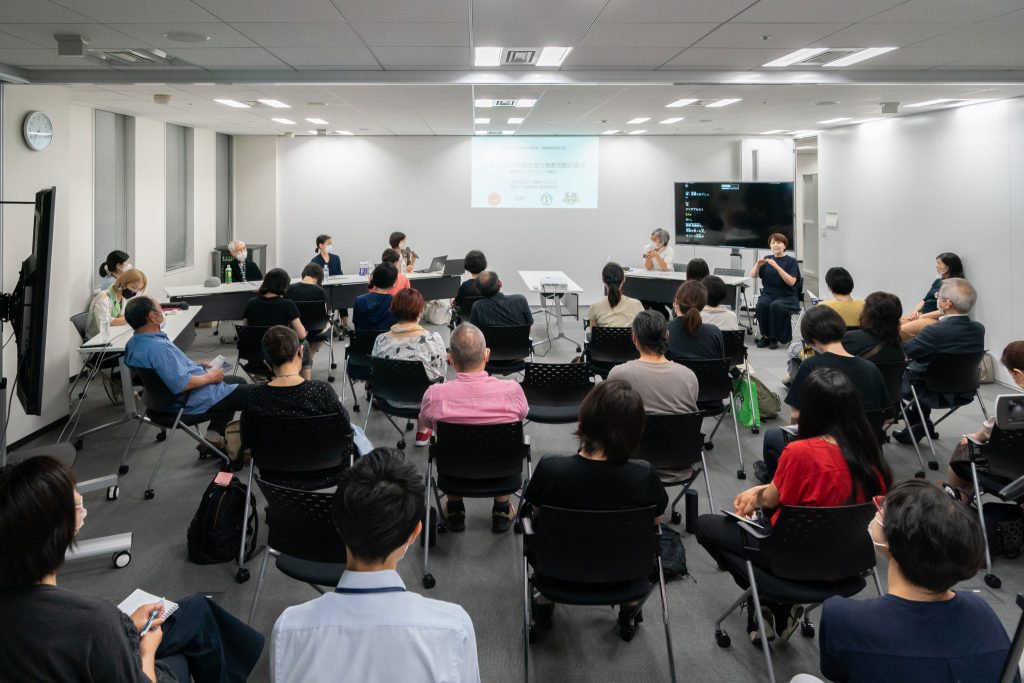
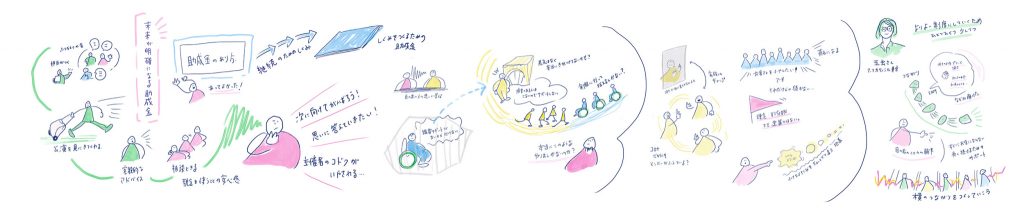
(Image enlargement: JPEG version)
relationship of trust that someone is watching our activities
In the second part, a roundtable was held with the facilitation of Tomoki Ogawa and a rough discussion. In a previous presentation, Mr. Whale said, "As a theater performer, it is very difficult to put your dreams into a rigid format because you live a life far from documents such as applications and report Arts Council Tokyo s. In response, Mr. Ogawa asked, "Have you ever received advice other than money?"
- Whale
- They check all the documents and follow up, and they actually come to see the business site. In addition to submitting a report after the project ends, there is an hour or two meeting with the staff in charge to review and discuss future activities. This is an experience that no other grant organization has, and it makes the future clear.
- Ogawa
- Don't you think inspection is a bit unpleasant like reconnaissance? (Laughter)
- Whale
- Not at all. I was impressed that you came to the island. He came to Miyakejima and Oshima, and twice to Miyakejima. With the goal of holding a national tournament in Tokyo, I have been to Oshima, Miyakejima, Hachijojima, and Kozushima to spread the word about senior troupes by going to places in Tokyo where there may be few opportunities to see plays or perform. (Footnote 1)
Footnote 1: In addition to the "Social Grant", the Senior Theater Network has announced that the "Tokyo Tokyo FESTIVAL Grant (formerly the Tokyo Cultural Program Grant)" implemented by Arts Council Tokyo as part of the "Tokyo Tokyo Festival Grant" (formerly the Tokyo Cultural Program Grant) implemented as part of the Tokyo 2020 Olympic and Paralympic Games to raise the momentum for the Tokyo 2020 Olympic and Paralympic Games Citizen Creative Cultural Activity Support 2nd Term" and "Tokyo Island Tour Trip 2019 (2018 Citizen Creative Cultural Activity Support 2nd Term)" were selected and toured to the Izu Islands.
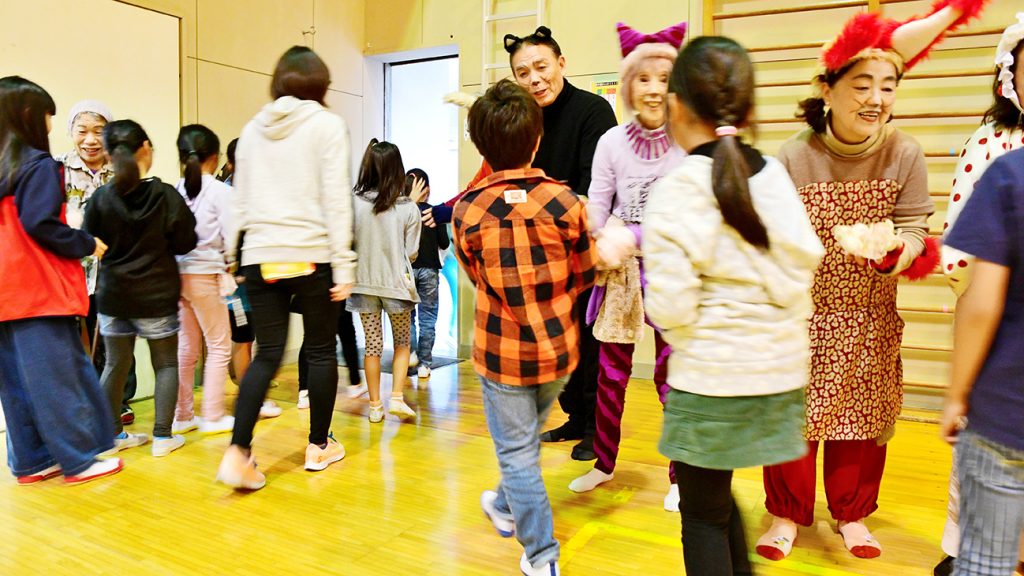
Photo by NPO Senior Theater Network
- Ogawa
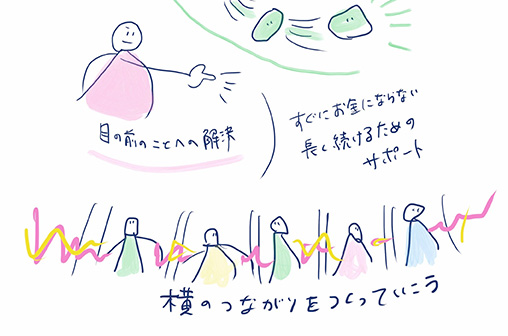
- I think what Arts Council Tokyo is doing is really good. However, if you rely on subsidies, you may not be able to do business if you are not adopted next time. It's like asking for it. If it is a project to create a foundation for activities, do you have any hope that you would like to receive long-term support for several years, not every year?
- Whale
- The "Performing Arts Appreciation Support Course for Artists" currently being implemented has not been finalized, but it has been subsidized for a three-year priority frame, and it is now in its second year, so it is helpful. In terms of long-term support, isn't there a small amount of subsidy to keep the organization going, not just Arts Council Tokyo? I think so. For example, in order to operate and utilize systems such as websites, SNS, and Zoom, I still want to hire a professional at "Mochi is a Mochi shop". It is painful that there is no funding to hire such people on a permanent basis.
- Ogawa
- In the current subsidy system, they are supposed to provide money to do some projects, but what they really want to be supported is, for example, rent or system reinforcement to continue their activities. But first of all, the current subsidy system was good.
- Whale
- Of course. You can also feel the desire of the subsidy provider to use the subsidy for what purpose, and you feel that you want to respond to it. It gives me courage and also heals the loneliness of the organizer. It's a relief just to have people watching us. The source is tax, so I can use it with peace of mind if you keep an eye on it. There aren't many people who can consult with you from an objective point of view.
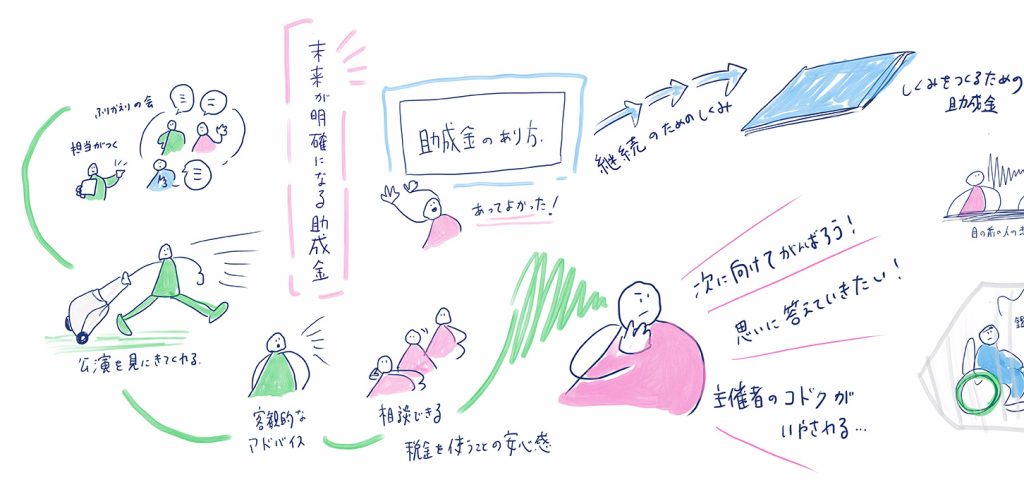
(Image enlargement: JPEG version)
We want to expand support for viewing beyond the boundaries of theaters.
- Ogawa
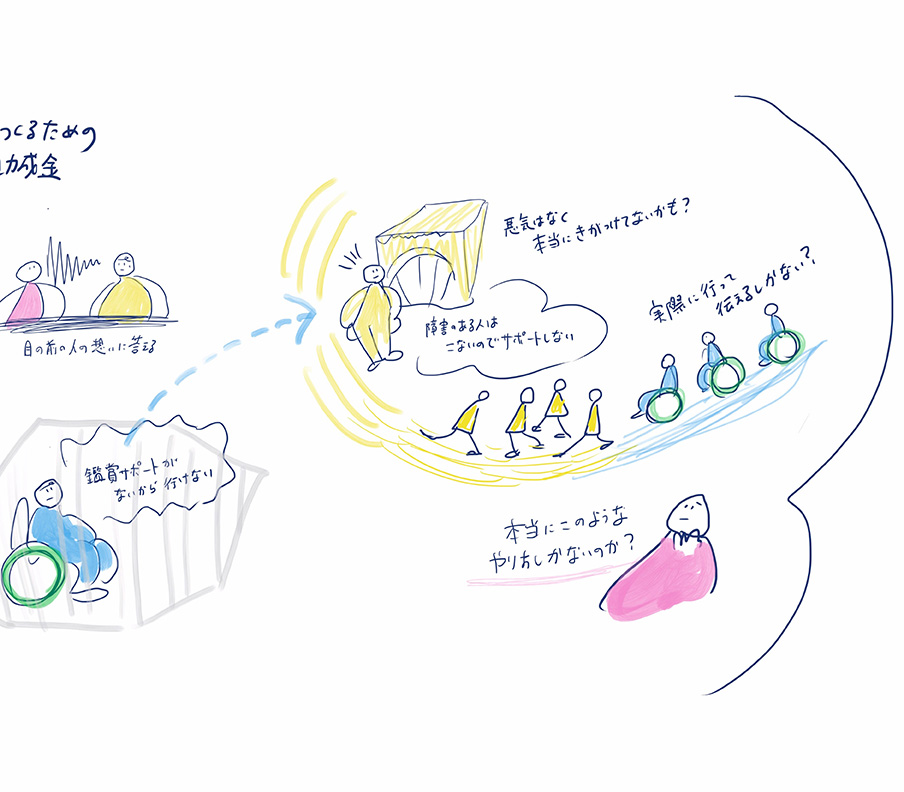
- By the way, you also noticed that there are many theaters that don't introduce viewing support, right?
- Whale
- I myself didn't expect that people in wheelchairs would come to see me until I actually met a woman in a wheelchair with an intractable disease. I learned through her that there are a lot of hurdles to get to the theater, including arranging a helper and paying for her transportation and tickets.
- Ogawa
- I prepared the data today. FY 2020 "Survey Report on Activities in Theatres and Concerthalls for the Promotion of Cultural and Artistic Activities for Persons with Disabilities" (National Association of Public Cultural Facilities). As a result of asking 2176 national and public facilities and 224 private facilities, 13.5% of facilities "provide services for persons with disabilities" and 86.5% "do not provide such services." When asked why they have not done so, 41.7% answered, 40.1% answered, and 37.6% answered "Lack of position, policy, and guidelines of the installer". Tokyo metropolitan cultural facilities are now promoting inclusive projects and trying to improve various things such as accessibility, but it is still such a situation nationwide.
- Whale
- Right. Even if the Act on the Elimination of Discrimination against Persons with Disabilities was enacted in 2016, I think there are still many places that have not yet taken action. Because disabled people don't come to our facility. But it's the other way around, you can't go because there's no viewing support.
- Ogawa
- Some of the responses in the free text include the opinion that they do not feel the need to distinguish between disabled people in culture and art.
- Matsuda
- I haven't had a chance to think about it during my 26 years at Meijiza. At any rate, they are grateful to be able to eat at the theater, and they value their customers. While they are working hard as a for-profit company, they provide high level services for the elderly, but they never tried to provide any services for the disabled.
- Ogawa
- That's why we have to change it now, even if it's little by little.
- Whale
-
We always make time for people with disabilities to come and talk with us during the viewing support classes, but if people with disabilities give up because they can't, the facilities won't notice. Ideally, the facility would have a support system in place, but people who look like you tend to gather around your living area, so it's understandable that you might not notice (unless you look outside that area).
A woman I was involved with who had an intractable disease and was confined to a wheelchair continued to go to a family restaurant with only stairs, and always had the staff lift three electric wheelchairs. There will be a ramp soon. It was true that they got there within half a year, but I felt sad that if they didn't do that much, it wouldn't change.
(Image enlargement: JPEG version)
- Ogawa
- A little bit about the elderly. In the 2020 Tokyo Welfare Insurance Basic Survey, there was a survey on the living conditions of the elderly, and 4711 elderly people in Tokyo, with an average age of 75.9, were surveyed on whether they felt a sense of meaning in life (pleasure and enjoyment), and 80% of them answered that they felt a sense of meaning in life, that they felt it enough, that they felt it, and that they felt it somewhat. 45.0% of them go out almost every day. It seems that it dropped by about 13 points due to the COVID-19 pandemic.
- Watabe
- Elderly people, especially those with chronic diseases, are sensitive. I don't mind that much, but my wife is very strict with me, saying "Where are you going?" and "Take a bath when you get home."
- Whale
- But the number of theater troupe members has increased in Kanjukuza since the coronavirus pandemic. People who have a strong desire to go out and socialize may not change much.
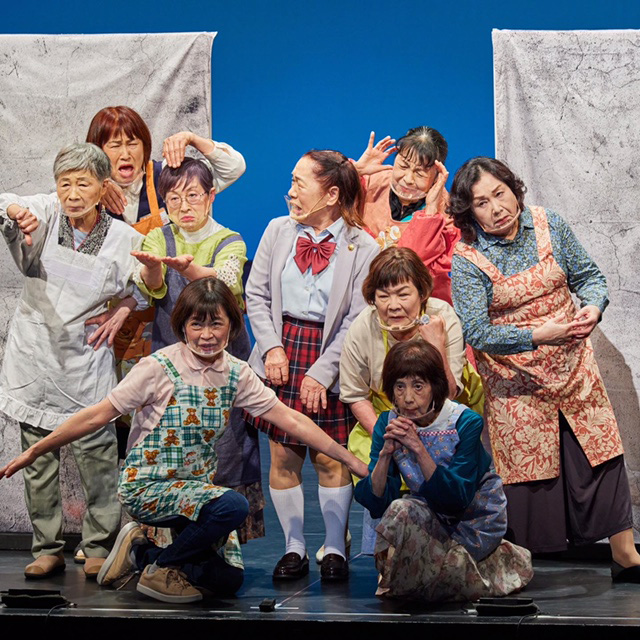
Photo by Senior Theater Network
- Ogawa
- Now, I would like to ask for comments and questions from the audience. Mr. Fumio Sato of Theater Company Dora, I heard that he was the only one who raised his hand when Kujira-san started the program to support audiences.
- Sato
- We are also in the second year of Social Grant 's three-year priority funding, and we are conducting theater workshops for young people who are facing so-called difficulties in living. With the idea of creating activities that integrate theater into daily life, I think the theater company producers raised their hands with the desire to have people with disabilities see it as well. After listening to your story today and looking back on the activities of Dogong, I thought that the aspiration to do something, the thoughts and philosophies of the group and the individual, are the basis for continuing the activity.
- Ogawa
- Thank you. In recent businesses, the trend is to solve problems by working backwards to solve them. But, when I listen to Mr. Kujira's story, I try it anyway, and there are various problems one after another, and when I get involved in them, I see something different. In that way, I wonder if we have no choice but to face our current challenges little by little.
- Whale
- Recently, I have seen cases of expressive activities, such as making plays with people with intellectual disabilities, or making small-scale works with people who have never been involved in theater at all. If you think about sales, you are going to do experiments that you probably wouldn't be able to do. Last year, I was surprised to hear about "Family Theater" by Osamu Komatsubara from Saga Prefecture. It is an activity to visit the homes of disabled people and perform plays for their families. It looked like you were having a lot of fun and I was encouraged. I think that's what we're aiming for. Well, it doesn't make any money.
- Ogawa
- Even if it doesn't make money?
- Whale
- Because I like it. I mean, you want to meet. I'm happy that I can meet things and people like that.
The person in charge of Arts Council Tokyo commented on the "Performing Arts Appreciation Support Course" (the second year of the three-year plan) for people involved in the arts, saying, "A variety of people, from young people to experienced people, participated, and even those who were new to interacting with people with disabilities said, 'There are great discoveries,' and first-time participants also said 'I want to participate next year,' so it is a very potential project." He says he is also looking forward to the activities of the appreciation support team that transcends the boundaries of theater companies and theaters.
In addition, Social Grant has been gradually enhanced, such as launching a framework to support projects with a long-term perspective from FY3 Reiwa, and increasing the upper limit of subsidies from 1 million yen to 2 million yen.
(Image enlargement: JPEG version)
Continuing from the previous session, the debriefing session was held to share activity reports and concerns, as well as opinions and suggestions. It is also an opportunity to connect not only with individual organizations and Arts Council Tokyo, but also to create a network between various organizations to work together on social issues. It was the first time I could see my face in person (although it was through a mask), and I felt like I had taken a step forward.
(Reporting and writing by Yuri Shirasaka)
Senior Theater Network
高齢者の演劇活動の支援と、障害者の観劇支援を主な活動とする。2006年任意団体として設立し、2012年に法人化した。現在は全国シニア演劇大会の企画運営や、シニア劇団の運営組織として活動するほか、さまざまな劇団、劇場の演劇公演でバリアフリーサポートを施している。
https://s-engeki.net/
Social Grant Grant results
- FY 27 (2015) "Audio Guide Producer Training Course for the Visually Impaired"
- Heisei 28 (2016) fiscal year (2) 'The 11 th performance of Senior Theater Company Kanjukuza "Neko! 2017"
- Heisei 29 (2017) fiscal year (2) "Senior Theater Company Kanjukuza: The 12 th Performance" Minori no Hata ""
- FY Reiwa 2 (2018) 1st Term "Barrier-free Lecture for Theater Professionals" Support for the Visually Impaired "
- FY 2021 (Phase 1) "Barrier-free Continuous Seminar for Theater Professionals 2021 (Year 1 of 3-year Project)"
- FY 2022 Phase 1 "Support Course for Appreciation of Performing Arts" (2nd year of 3-year project)
Social Grant
A program to support "Activities that allow people who have limited opportunities to experience and participate in art due to their social environment to engage in art experiences, such as appreciation and creation, and to exercise their creativity and enrich their imagination." and "An artistic activity that sets social issues based on one's own awareness of issues and works to solve them with a long-term perspective while collaborating with various people and organizations" for organizations working in Tokyo.
The system was launched in FY 27 (2015), and since FY 28 (2016), applications have been made twice a year. It has supported more than 120 projects. It is not just "art for art's sake" or "art that is useful to society," but it is trying to support activities that propose and materialize a new way of art in which society and creative activities are inseparable in a way that has never been done before, so to speak, "the third art."