


- Date & Time
- Friday, September 3, 2021 19:00~21:00
- Venue
- Online
- target business
- Sign Art Project. Asian SAP.AZN Project
- Speaker (Reporter)
- Hiroe Ohashi (Actor, director, sign art project. Asian national team)
Yumiko Kawai
Wolfie Sano (Musician, Universal Improver)
Hideo Watanabe (Actor, voice actor)
Dan Kotaro (barrier-free activist) - moderator
- UMEMURO Yoshiko (Senior Program Officer, Drama Section, Planning and Support Division)
Part 1: Activity Report
Pioneering "barrier-free" creative sites
A sign art project established in 2005 with actor and director Ohashi Hiroe at the core, which focuses on sign language performance and has worked to create performing arts that transcend "barriers" such as disability, nationality, and ethnicity. Asian. The 2017 performance of the rock musical "A Summer Night's Dream" was the culmination of these performances. How can people from diverse backgrounds participate in creation on an equal basis? This debriefing was not only about the results of the performance, but also about the trial and error in the workshops and rehearsals for the play, which had been held for almost two years.
Through the Tokyo Paralympics, the idea that everyone has the right to enjoy art and culture equally, regardless of disability, is becoming widely shared in society. Wheelchair routes are now available at public cultural facilities such as theaters and museums, and it is no longer uncommon to see subtitles and audio guides on flyers and posters for cultural events such as plays and concerts. This debriefing session was also held using an online conference system, with sign language interpretation, UD Talk captions, and audio guidance by Dan Kotaro, who was also the debriefer.
However, is "barrier-free" only about providing an environment for viewers to enjoy? Is it possible to be barrier-free at the same time in creation? It is the diversity that is realized that leads to the enhancement of artistic expression. A sign art project established in 2005. Asians have addressed this issue head-on for almost 15 years.
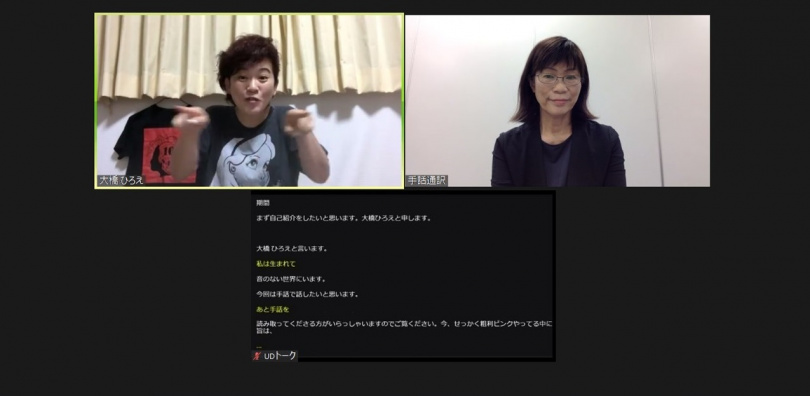
Hiroe Ohashi, who played a central role in the project, is a deaf actor and director. In 1999, she won the Yomiuri Theater Award for Best Actress when she was selected from the general public to play the role of Sarah in the Haiyuza production of The Little God. Later, while studying theater in the United States, he was impressed by the activities of disabled people on stage and in movies. After returning to Japan, he created a sign art project. He founded Asian and has continued to create stage productions incorporating sign language, sound and subtitles.
The grant covers a November 2017 performance of the rock musical "A Summer Night's Dream" and work done in preparation for it. I chose Shakespeare's masterpieces because I felt they would embody diversity. "There are both humans and fairies in this story. In addition, various people appear, from aristocrats to craftsmen. I wondered what would happen if we represented in today's society the image of people living together in different worlds, and if there would be something in common." (Ohashi)
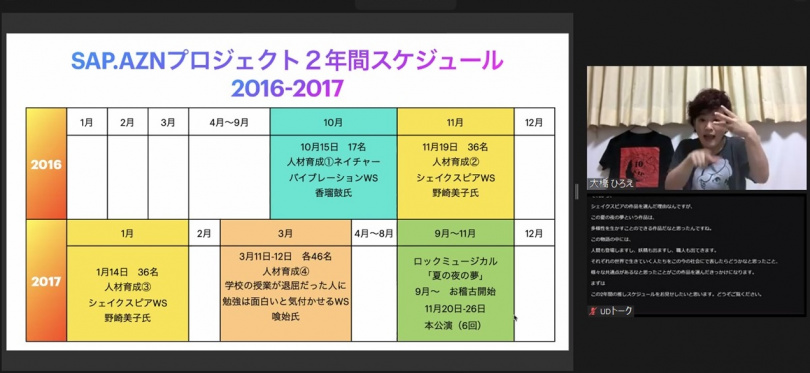
The WS was held 4 times from October 2016 to March of the following year. A total of 135 people participated in "Nature Vibrations WS" by choreographer Koruko, "Shakespeare WS" by director Yoshiko Nozaki (2 times), and "WS to make people who were bored at school realize that studying is interesting" by WAHAHA Honpo's Kuijime. They were very diverse in age, gender and disability.
"In the end, the casting was decided through an audition, but before that, I wanted to create a place where people from different cultures could gather and interact through the WS, and through that experience, I wanted them to have an awareness of how to approach the stage as professionals." (Ohashi)
In order to create a place where everyone can enjoy themselves on an equal basis, a variety of support was provided at the site, including sign language interpreters, guides for the visually impaired, and watchdogs for the mentally and mentally disabled.
"The Paralympics had already been decided to be held, and the time must come when we can create plays with people with disabilities. In that case, I proposed that we should make all basic creative processes barrier-free. So we were able to work with an access coordinator and a team of sign language experts." (Ohashi)
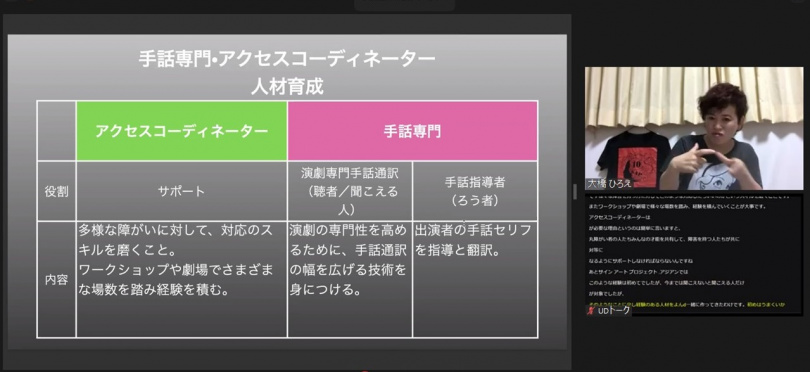
The workshops for actors and actresses, along with the training and training of sign language interpreters, sign language instructors, and access coordinators with the skills to deal with various disabilities, seemed to provide an opportunity for the actors and actresses to work on issues that they had not been able to resolve in their daily activities.
"Usually, theatrical workshops have a lot of movement. Also, sign language interpreters often stand next to the lecturer. Then, for example, when a lecturer instructs you to move that way, if you watch a sign language interpreter, your movement will be delayed or limited. To deal with that, we tried having sign language interpreters standing in the four corners of the hall. At first, the person who couldn't hear seemed to feel uncomfortable, but once he got used to it, he was able to use it well. However, there is a budget issue with this method, so it may not be very practical. But I think it made sense to think about those options. In addition, a sign language instructor was assigned to the team specialized in sign language. This person is in charge of translating the lines of the performers and teaching sign language. In the past, these roles have often been assigned to deaf performers, which is not the way it should be. I think sign language instruction should become something like dialect instruction, for example. This time, with a proper instructor, the hearing actors were able to check the signs properly, and the deaf actors were able to concentrate on their performance and what they had to do." (Ohashi)
Realization and suggestions gained through experiencing "walls"
The rock musical "A Summer Night's Dream" opened in November 2017. After the final audition, a total of 23 people (Four deaf actors, a blind actor, and a short actor using a wheelchair participated.) including those who participated in the workshop performed in the performance. Making full use of sign language, Japanese, body language and dance, it vividly depicts the flurry of love in a forest inhabited by fairies. In the second half of the briefing, four performers, including an audio guide, appeared and each reflected on the time.
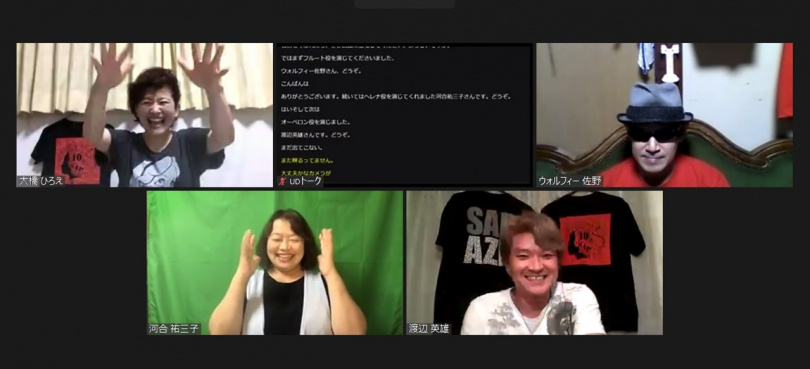
"I had no experience in theater, so I think I was able to do various things with the support of those around me. I am visually impaired, but it was a wonderful experience to get to know many people, including hearing impaired people. I also want to thank Mr. Nozaki, the director, because he is good at playing musical instruments and I think he was able to make use of that in the production. I also want to thank Mr. Ohashi once again after hearing his story and knowing how much trouble he went through." (Wolfie Sano/Sturvling)
"I think the workshop was a great experience for people with various disabilities and listeners. I had experience of acting with people who could hear, but I still felt a barrier about how to communicate. Once we had an opportunity to discuss our true feelings, I remember that the atmosphere changed in a positive direction. Also, as I am deaf, it would be a problem if I didn't have an interpreter. Some interpreters translate as they are told, while others change the translation to make it easier to understand. So when I didn't know what Mr. Nozaki wanted to convey, I sometimes got advice from professional actors. In the dance scene, I patted him on the shoulder to keep the rhythm, and I think we were able to put on a good stage because it was natural for us to help each other. I was able to work hard because I was with you, and I think I was able to keep up because I had a leader with the same disability." (Yumiko Kawai/Helena)
"There was a time when we sat down and talked frankly. There were times when my tone was quite harsh, but that was an opportunity for us to understand each other and wait when we had to. I'm a sign art project. She also appeared in the previous Asian film, Zansummer. At that time, sign language was new to me, and Hiroe said to me, 'I don't understand Nave-chan's sign language at all.' (laughs). So before A Summer Night's Dream, I joined a local sign language club and tried to brush up. Studying sign language also means understanding Deaf culture. Just like foreigners, it takes time to get used to each other's senses. This time, not only people with hearing impairments, but also people with other disabilities were performing together, so I was worried about what would happen, but I also had the experience from and I felt that the question of what it means to not be able to hear led to "So what about people who can't see?" and that we were able to have a relationship where people could naturally compensate for it, instead of trying to help them." (Hideo Watanabe/Oberon)
Wolfie Sano and his audio guide Dan Kotaro, a barrier-free activist, talked about their experiences of facing and overcoming communication barriers, and gave concrete suggestions for barrier-free creation and theater in the future.
"Actually, during the performance, I was performing while listening to Dan's audio guide. During the rehearsals, I didn't hear or get explanations about what other people were doing, so I wanted to know what other people were doing, so I tried it during the program. This is more fun than I thought. I thought it might be a useful way for blind people to mix and match." Wolfie said.
"Wolfie also performs, so he stays on the stage all the time. So I said, "If you don't know what's happening around you, it's boring when you're not playing. Do you want to listen?". After actually doing this, we both talked about how it would be easier for blind people to participate on stage if there were audio guides, just as there were sign language interpreters in rehearsals. Of course, it costs money, so it would be good if there is a system to subsidize it. Actually, Wolfie appeared in another play after this one. A visually impaired person who had no acting experience began to join the troupe on his own. That alone made A Summer Night's Dream a huge success. Also, if there is a next opportunity, I would like to increase the number of people who can do audio guidance. Now we have a training course for stage sign language interpreters, but we also want to train the next generation by holding a workshop for audio guides." (Dan Kotaro/audio guide)
The realization and prosperity of the performing arts, which make use of diverse backgrounds and individuality, is possible only through the support of the creative field and the support of the audience to the stage. Ohashi also notes that there is no single manual for how to do this.
"It doesn't mean that we should adjust to 'normal'. Fixing on a single correct answer causes distortion. Therefore, I think we need to adopt a method of acting and a method of training that suits the age of diversity. There are different needs, such as those who cannot see need this method, and those in wheelchairs need this method, so first of all, we need to know the difference and respond to it. This eventually led to the expression of acting and a new style. That kind of change is necessary, and we want to continue thinking about ways to achieve that."
Sign Art Project. Asian ended 15 years of work in 2020 to "move on to the next stage." I wonder what kind of scenery will unfold in the future as I sail through the experiments started here, the friends I have gained, and the "new wind" I have stirred up. The report gave a sense of impetus and hope for a future of coexistence and co-creation.
(Reporting and composition by Rieko Suzuki)
> Continued from Part 11: "Realizing Theater of Diversity" (Part II)