



- Date & Time
- Tuesday, December 7, 2021 19:00~21:00
- Venue
- Arts Council Tokyo
- Name of reporting organization
- Reigakusha
- target business
- Reigakusha Gagaku Project for Children (adopted in FY 2015: 3 years)
- Speaker (Rapporteur)
- Miyata Mayumi (Music Director, Reigakusha)
Miyamaru Naoko (Reigakusha)
Nakamura Hitomi (Reigakusha)
Sho Noriko (Tokyo Concerts) - moderator
- HORIUCHI Hiroko (Senior Program Officer, Planning and Support Division)
Outline of the Project -- Goals
The purpose of this project is to expand the audience and the number of audiences, including children, so that Gagaku, which has been handed down for more than 1000 years since its establishment in the Heian period, can continue to develop for hundreds or 1000 years in the future, and to expand the scale of activities of the organization, which will celebrate its 30 year anniversary in 2015. The aim is to create programs and works that will enable children, who will be the bearers of the next generation of culture, to meet and become familiar with gagaku.
Outline of Funded Activities: Three Pillars
- (A) Gagaku Concert for Children
In addition to a Gagaku work for children, "Ponta to Kaminarisama" (composed by Sukeyasu Shiba), Bugaku, Gagaku commentary, singing experience, introduction and performance of Gagaku instruments. Introducing musical instruments restored in Shosoin and performing works. - (B) Production of CDs of gagaku works and DVDs introducing gagaku for children
A tool that is easy to use in the field of music education that has never existed before. - (C) Commissioning and premiere of new gagaku for children
Harunao IZA's "Gagaku works for children" (new), etc.
Report
Part I: Briefing session report
Reigakusha was established in 1985 by Shiba Sukeyasu, a gagaku performer and composer. As a private gagaku performance and research organization, the organization has been actively engaged not only in classical music but also in the reproduction of abolished pieces, the performance of contemporary music, and the creation of new works. It has also organized many educational and promotional programs such as workshops and lecture concerts. Music director Miyata Mayumi, members Miyamaru Naoko and Nakamura Hitomi, and manager Sho Noriko of Tokyo Concerts gave an overview of the "Gagaku for Children Project," which has been implemented for 3 years since 2015, as well as the achievements and challenges.
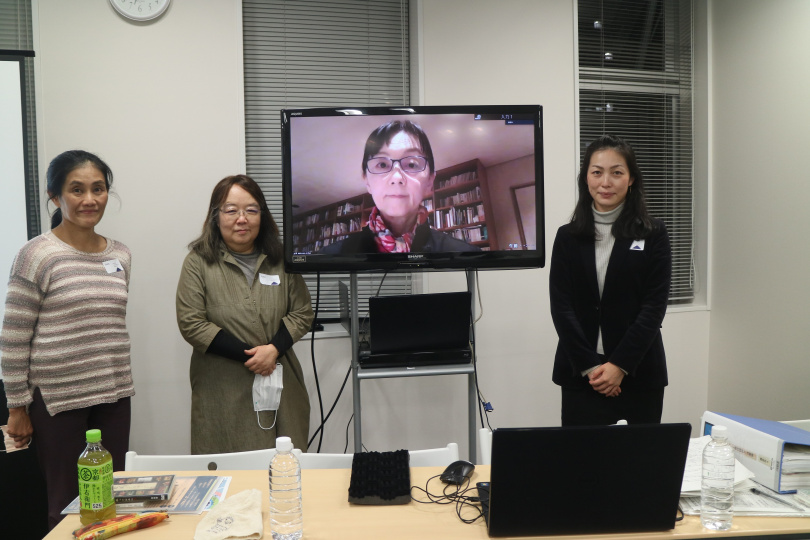
Reirakusha has pursued traditional classical gagaku performances, new gagaku performances, and creations as two pillars. The background to embarking on the "Gagaku Project for Children" was the creation and performance of new gagaku for children that founder Yuyasu Shiba worked on, especially the results of "Ponta and Kaminari-sama" released in 2004. "Even before I was involved in gagaku for children as a reigaksha, Shiba would bring his instrument to elementary and junior high schools near his home to introduce it and have several people play it. So, how can people enjoy the performance of gagaku, and after various experiences and trial and error, 'Ponta and Kaminari-sama' was born," recalls music director Mayumi Miyata. The simple story of the main character, Ponta, climbing an eggplant tree and meeting God above the clouds, was colored with the sound of gagaku with a deep expanse of gagaku, sometimes with humor, and became a popular performance at the Agency for Cultural Affairs' touring performances that followed. "We ourselves have a lot of fun playing this song, and we feel like watching a Disney anime or a fantasy movie. Also, if it is a gateway for children to enjoy gagaku in this way, we would definitely want to expand our activities around this work, and for that purpose, we have come to think that it would be nice to have CDs and DVDs. However, it is difficult to proceed with it on our own. That's when I learned about this Arts Council Tokyo grant."
The trigger was a dream of making CDs and DVDs. However, the projects that were actually applied for and adopted did not stop there. "I first performed 'Ponta and Kaminari' in 2004, and then I took up this piece when I performed 'Concert for Children' in 2006 and 2007. However, I was worried that I was not able to systematically promote such an educational program, so I thought that if that were the case, the Agency for Cultural Affairs' touring performances, We talked about thinking of a project that would culminate in my school experience."
How to create and expand the encounter between children, who are the leaders of the next generation of culture, and "gagaku"? In this way, based on the experience so far, three pillars (1) Gagaku concerts for children, 2. Gagaku CDs and gagaku introduction DVDs for children, and 3. Commissioning and premiering new gagaku for children began, and three years began to proceed in parallel.
The Attraction of Experience Gagaku Concerts for Children
The first pillar, a gagaku concert for children, was held once a year in different areas of Tokyo. In addition to the appreciation of kangen and bugaku, the first part mainly introduces gagaku (traditional Japanese court music), such as the experience of learning melodies by singing "shoga," and the second part presents pieces with stories, such as "Ponta to Kaminarisama." At the end of the first part, there was a time to experience playing and playing actual instruments such as Kakko, Taiko and Hichiriki. The response was particularly strong for the musical instrument experience. "Originally, we wanted people to experience percussion instruments and blowing instruments separately in the lobby and on the stage, but some venues can't make sound in the lobby, so we had to display costumes there and let people experience them on the stage. When you do that, it feels like people are rushing onto the stage. Our main focus was to have people listen to gagaku, so at first we didn't focus so much on the experience, but as we held more sessions, the challenge became how to make the experience go smoothly and satisfy people." (Miyamaru)
The way of watching and explaining the program has also evolved over the past three years. "In the third year, a dancer appeared in the intermission to give a commentary. This method was inspired by an introductory course at the National Theater, where they show you a mold and explain the costume. The kids are happy to watch this. In this project, children as young as 0 years old are allowed to enter, but sometimes the dancers leave the auditorium and cry when they pass in front of small children. But for us, those are the moments that make us feel like we've made it. In the second part of the program, Gagaku for children, we added lyrics and a score to the program so that they could sing it." (Miyamaru)
Creating educational materials that can be enjoyed and used (CD, DVD)
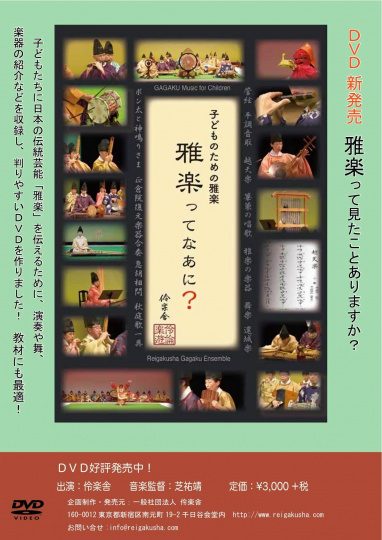
Along with the production and performance of concerts, the production of CDs and DVDs was also in progress. Recordings were made in year 1, and the CD was released in year 2, May 2016, and the DVD"What is gagaku for children?" was released in August. In addition to two traditional stories and gagaku (Japanese court music) “Ponta to Kaminari Sama ” and“ Karabo Kaze ni Ride, ” the CD includes “Etenraku Imayo ” and“ Ryoo, ” which were performed at the concert. "Gagaku is abstract music, so no matter how much I explain, children get bored in about 3 minutes, but when I tell them a story, children listen intently. In this work, one of the members has been in charge of the narration since the first performance and has been improving his skills. It may be difficult for children to listen to all the songs of "Ryooo," but looking back now, we were happy to be able to record it with Mr. Shiba's flute, and even now we are moved." (Miyamaru)
On the other hand, the DVD conveys the breadth of gagaku through classics, pieces for children, and excerpts from Toru Takemitsu's "Akitei Uta Ichigu," and at the same time, it also contains explanations by Shiba, introduction of musical instruments, songs sung by Hichiriki instruments, and highlights of bugaku. Consideration was given to usability in school classes. "You can watch the entire 36 minutes as it is, or you can watch each segment. We didn't have a video planner, so we basically left it up to the filmmakers to edit and "I'm not gonna use this one, I'm gonna use this camera over here." So maybe there was a better way to do it, and now I'm like, 'I could have included all the songs,' or 'I could have turned the narration on and off.'. However, after the workshop, when I give them to them, saying 'Please use it for review,' they are happy, and I am really glad that I made it." (Miyamaru)
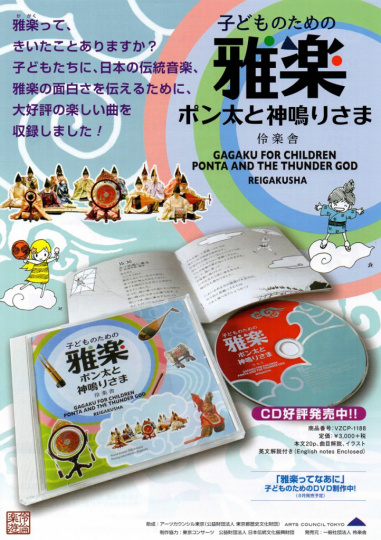
In addition, in connection with the production of these pieces, it can be said that the investigation of the actual condition of gagaku education in school education was a valuable initiative for the future. The survey was conducted between May and July 2016 by sending questionnaires to 2,318 elementary, junior high, and special needs schools in Tokyo (response rate: 9.7%). About 10 questions were asked. The questionnaire consisted of questions about how much time is spent on gagaku in class, whether CDs and DVDs are used in class contents, and whether there are opportunities for students to demonstrate and listen to live performances. It also included questions about teachers' experiences with gagaku. "When asked what kind of teaching materials they would like, there were many requests such as a DVD with separate pictures of each instrument or an explanation of each instrument. After all, it was confirmed that it is difficult to use a recording of the performance. Many elementary school teachers have made various efforts, such as singing songs (shoga), playing rhythms, and listening to music outdoors in accordance with the season. In the case of junior high school, 80% of the classes seem to focus on watching DVDs. There were also many voices that said they wanted to listen to the real thing but didn't have the budget or wanted a place for training because they didn't have the knowledge. It was difficult to send, collect, and collect these questionnaires, but they have been used in the activities of Reigakusha, and I hope that even schools that are not so interested in gagaku can understand that Reigakusha wants to help school education through these efforts." said Nakamura.
Creation of a new repertoire
If concerts and the production of CDs and DVDs are businesses that make use of the assets accumulated through performances, research, and creation, the third pillar of the project is the commission and premiere of new gagaku for children. From October 2015 to March 2017, he held workshops with 5 composers and musicians from Reigakusha, and premiered 5 new works (Akiko YAMANE, music by "Hoshi no tententen"; Keiko FUJIYA, music by "The Color of My Eyes is the Sky at Night"; Tamami HIGANO, music by "Gagaku Emaki Choju Gigaku - for the Restoration of Musical Instruments in Shosoin"; Michio KITAZUME, music by "Seasonal Picture Book"; screenplay and music by Harunao IZAWA "Dance! Tsukumo no Kami: Dojimaru Tentekomai no Maki") at his independent performance "Reigakusha Gagaku Concert No. 32 New Gagaku for the Next Generation (commissioned works for children)" in May 2017. "Up until now, Reigakusha had performed only three pieces with stories, so if we were to continue children's concerts every year, we thought it would be better to develop more pieces that children would enjoy. There is a financial burden involved in commissioning, but I think this was possible thanks to this long-term grant." Nakamura said.
In a series of eight closed-door workshops, participants exchanged detailed opinions on the new song. "Until then, when I was commissioned to perform new works, I had to overcome various hurdles, such as not being able to play with classical claws or having a difficult range ...... I think I tried to realize the image created by each composer. But at that time, I had the purpose of 'wanting my children to listen to me.'. We decided to discuss with each other to avoid overly complicated music and playing techniques." (Miyamaru)
3 out of 5 pieces announced at that time have already been performed again as repertoire of Reigakusha, and they are scheduled to be performed several times in 2022. In addition, a new piece by Higashino Tamami, who wrote "Gagaku Emaki Choju Giga: For the Restoration of Musical Instruments in the Shosoin," one of the five pieces, is expected to be introduced in the musical instrument section of the "Gagaku Concert for Children" in July.
This project, including the production of educational CDs and DVDs, the recording of a questionnaire survey, and the creation of five new pieces and their repertoire, has brought many assets to Reigakusha, gagaku appreciation, and education. What left an impression on me through presentations and interviews at the debriefing session was the pride rooted in tradition, the flexibility to live in the modern age, and the honesty with which the project was organized. You don't have to come up with a novel idea to take on new challenges and explore new directions. It is only through the efforts we have made that we can see the challenges we need to tackle. This is the case with Reigakusha's project, which began with a "systematic" review of educational outreach projects. However, it takes a lot of time and money to reflect on Koshigata, identify issues, formulate projects, and bring them to fruition. Long-term subsidy projects support these "Challenges to be tackled that are visible but untouched" and Reigakusha's Gagaku Project for Children is a major achievement.
(Reporting and composition by Rieko Suzuki)