


The Tokyo International Deaf Film Festival has been drawing attention from many audiences and the media since 2017, when the festival was established from scratch with friends. This is the first film festival in Japan where Deaf staff select and screen works related to the Deaf from Japan and overseas. Following on from the first part, which reported on how the festival began, its criteria for selecting films, its management methods, and the results of its activities over the past three years, the second part looked back on the achievements of the festival.
impact on society
The Tokyo International Film Festival for the Deaf has created a venue for more people to enjoy the festival by screening works from Japan and overseas, inviting guests from overseas, and enhancing information accessibility to support sign languages, spoken languages, and written information from around the world. The project was started to contribute to the development of Deaf society and art, and to create a place for mutual understanding between hearing people and Deaf people. After the first and second film festivals were held, the opportunities for media coverage increased greatly.
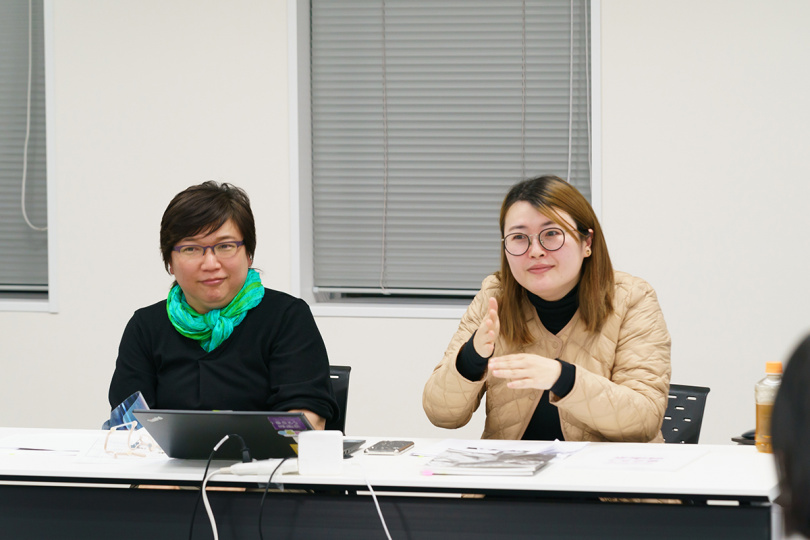
"In addition to TV programs such as TBS and NHK, newspapers, and online media, for example, I appeared on the TBS radio program After 6 Junction, which is popular among avid movie fans, about three times and had the opportunity to talk about movies related to the deaf. At first I thought, "A deaf person on the radio?" but when I tried it, it was surprisingly fun. The article transcribed after the broadcast was also uploaded on the official website." (Makihara)
"Sign language is not shown on the radio, so only sound is delivered. Since it was a live broadcast, it must have been hard to interpret in sign language, but I also enjoyed the radio very much." said Yuyama.
Influence on Japanese filmmakers
In 2022, the film Love Life (directed by Fukada Koji/2022/Japan/France) was selected for the Competition section of the 79 Venice International Film Festival, featuring deaf actor Sunada Atom as the main cast. Makihara was also involved as a collaborator.
"The relationship between the Tokyo International Deaf Film Festival and director Fukada has continued since 2018, when director Koji Fukada offered a film workshop for the Deaf. In "Love Life," a deaf actor is cast as a deaf person. Such cases are very rare, and in most movies and dramas, the role of the deaf person is played by a listener. The Tokyo International Deaf Film Festival may have had an impact on Fukada, and there are many things we can learn from Fukada's story. There are many issues that we need to consider, such as labor issues in the film industry and Fukada's efforts toward equal employment opportunities. And just like our meeting with Fukada, our activities have expanded from our connections with people in the film industry." (Makihara)
"At the 3rd event, there was an after-talk with director Itaru Matsui, who had previously screened his documentary film about the American coda community (2022, Japan). The film was released in theaters around the country in 2022, and Director Matsui introduced the pamphlet "What is a coda?" compiled by the CODA Child Care Support Program, which I am involved in through the film festival. Japanese codas are in the spotlight, and I feel the spread." said Yuyama.
Impact on Deaf Society
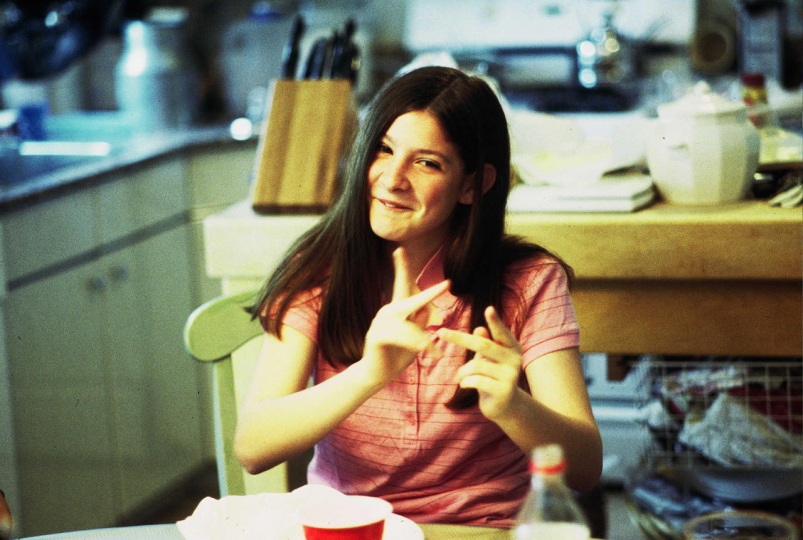
In addition to its impact on audiences, many of the films shown to date have provoked debate in Japan's deaf society, including the documentary film "In a world without sound" (1999, USA) and "In a world without sound: 6 years later" (2007, USA), directed by Josh Aronson.
"In In a World Without Sound, the daughter of a Deaf family, whose entire family is deaf, wants to get a cochlear implant, but her parents are hesitant. But in the sequel, Six Years Later, everyone in the family except the father got cochlear implants. The cochlear implant company subsidized it. When I was at a university in the United States, "In a world without sound" was a time when there was active discussion and many papers were written about the pros and cons of cochlear implants. After I returned to Japan, I was very surprised to hear that a sequel was made, and that it depicted the widespread use of cochlear implants. I told Mr. Makihara about it, and it was decided that we would take it up at the second film festival. Because each Deaf person has his or her own personality and diverse values, there are those who want to be closer to the audience and those who want to be Deaf just as they are. Values change with the times. I thought it was necessary to raise awareness of the current situation in Japan. However, to show that the Tokyo Deaf Film Festival Executive Committee is not in favor of cochlear implants and is neutral, we decided to hold a commentary by Professor Takeshi Matsuzaki of Miyagi University of Education, who is also a Deaf person, after the screening. I thought it was important not only to transmit the film, but also to share the intention with the audience." said Yuyama.
"Many teachers from schools for the Deaf and parents of children with the Deaf came to the event, and they all seemed very shocked by the movie. Some people expressed that if it had not been for Professor Matsuzaki's explanation, they might have left with unsatisfied anger. Although cochlear implants may make life more fulfilling for hearing people, they are a serious problem that could lead to the disappearance of the deaf community. Viewing a work means that we must consider the possibility of having various effects on each viewer. I feel like it's a very heavy responsibility." (Makihara)
Another film about hearing supremacy, (Directors: Ben Bahan, H. Dirksen Baumann, Facundo Montenegro/2008, USA) was also said to have caused controversy. The history of oral education is based on the idea that being able to hear is natural and not being able to hear is inferior. And in the modern era, where does it begin and where does it end? It was said that the Deaf staff members of the festival are also exchanging opinions with each other as they proceed with the management of the festival.
© 2006 Josh Aronson
spread of individual activities
Based on their achievements, Makihara and Yuyama expanded their individual activities.
"I started the Tokyo International Deaf Film Festival because I wanted to see more works by Deaf people, so I was surprised to see such a big change and influence." (Makihara)
Citing the spread of activities and enlightenment on the representation of the deaf and hard of hearing as an example, Makihara participated in the launch of the "Deaf Actors Course" as one of the planners of the "Nurture, Sign Language and Art Project" by the Japan Deaf Theater Company of the Tot Foundation, a social welfare corporation commissioned by the Agency for Cultural Affairs. In addition to strengthening his overseas liaison and child-rearing support projects, Yuyama has had more opportunities to communicate about the ADA (Americans with Disabilities Act), which is being enforced in the United States, and to talk about the expanding range of rights and activities for Deaf people as the law is revised.
Acceleration of Deaf Arts and Information Security through Long-Term Subsidies
Makihara recalls that the three-year long-term grant "produced a great result in terms of accelerating the penetration of the art of the deaf into society." He went on to say that the activities reported so far, such as networking with overseas deaf film festivals and producers, building a foundation for human resource development, and improving information accessibility, were possible only because of the grant. As explained in Part 1, one of the benefits of the grant was that it was used for sign language interpretation to connect deaf people and hearing people.
"For a three-year subsidized project, the cost of sign language interpretation alone will be several million yen. In addition to communication between staff and dialogue with the audience, information security is necessary for each person to obtain information on an equal footing. Some people may think that we don't spend that much money, but in our case, in order to connect with the world of listeners, we must first consider the cost of information security. Because of the grant, I was able to request a sign language interpreter. There is currently a Social Grant grant for Arts Council Tokyo, and the amount that can be applied for has increased, so I would like everyone who wants to jointly engage in artistic activities and want to provide information security for deaf people and hearing people to take advantage of it."
Future Challenges "People Who Connect" and "People Who Create"
As future issues, step up of "people who connect" and "people who make" and human resource development were raised. "People who connect" are mainly in charge of overseas liaison negotiations, interpretation, translation, and subtitling.
"First of all, regardless of whether they are Deaf or Hearing, it is important for them to understand Deaf culture, Deaf education, and current social conditions for Deaf people, and to learn cultural differences and communication in different languages. The question is how to properly use terms such as "deaf," "deaf," "hard of hearing," and "deaf" when interpreting international sign language and when translating into English. There are also old terms like "mute," "thump," and "deaf-mute." Every word has to take into account culture and historical context, so it's not easy for everyone." said Yuyama.
"In English, the meaning of "Deaf" depends on whether the D is uppercase or lowercase. In the United States, the capital D is used to mean "Deaf with a Deaf identity" and the lowercase d means "generally deaf." So we had a lot of discussions about which one was better for this piece. Now, the social situation has changed, and there is a trend to unify everything to lowercase d without distinction. It is important to be sensitive to such situations overseas and share them with subtitle producers. Also, I sometimes wonder how Japanese to English interpreters and translators who have no knowledge of Deaf people or sign language translate Deaf people into English. Japanese interpreters and translators need to update their awareness of the identity of Deaf people, and we also feel that we need to communicate this." (Makihara)
As for "creators," he says he first wants to train people who can take over the festival's activities.
"In order to run a film festival, it is important to have an interest not only in the art of the Deaf but also in the art of the audience, and to come into contact with various arts from around the world. In addition, I hope that Deaf people will have more opportunities to experience culture and art from an early age. At the Tokyo International Film Festival for the Deaf, we have had the opportunity to hold screenings and filmmaking workshops at several schools for the deaf. Parents and teachers who watched the films at the Tokyo International Film Festival for the Deaf connected us with the school for the Deaf. I would like to continue my approach to Deaf students." (Makihara)
It also points to the development of deaf filmmakers in Asia, including Japan, as an issue.
"This is also related to the understanding of the deaf and hard of hearing people in each country and the environment in which they are placed. In the past, when the Tokyo International Deaf Film Festival calls for submissions, Europe and the United States account for a large percentage of submissions. Because of issues such as information security, I think that there are still very few Asian filmmakers, including Japanese filmmakers, who can make strong films. However, in China, the environment for deaf people to make images is becoming better. and maybe even more." (Makihara)
Future Development "Expansion of Film Festivals" and "Incorporation"
The Tokyo Deaf Film Festival Executive Committee was originally a small group of Deaf people who wanted to hold a film festival. As it gradually grew, the social situation surrounding it changed, and the number of people who wanted to do something together increased. The festival, which began with the aim of creating a place for mutual understanding between the hearing and the deaf, has moved on to the next stage.
"In the future, we would like to make it an art festival that incorporates performing arts and marches in addition to movies. In France, there is an international art festival for the deaf called "Crandouille" which has been held once every 2 years since 2002. Deaf performers from all over the world gather there and marches line up. I also participated in the event and was surprised and deeply moved by the fact that Deaf people from all over the world were sharing the space beyond national borders. We are working to create a place to share the art of the deaf by holding such an art festival in Japan. Also, the Tokyo Deaf Film Festival Executive Committee used to be a voluntary organization, but it recently acquired the status of a general incorporated association, and is now called the Japan Deaf Arts Association. There has never been an organization that serves as a gateway between the deaf and the hearing people engaged in artistic activities, and I think it is necessary to improve the situation that people involved in the entertainment and arts, including television, film, and stage, do not know how to access the deaf. I would like to serve as an intermediary to increase opportunities for more people to connect with each other by sharing information about the arts with the deaf, the hard of hearing, and the hearing, including holding the Deaf Arts Festival." (Makihara)
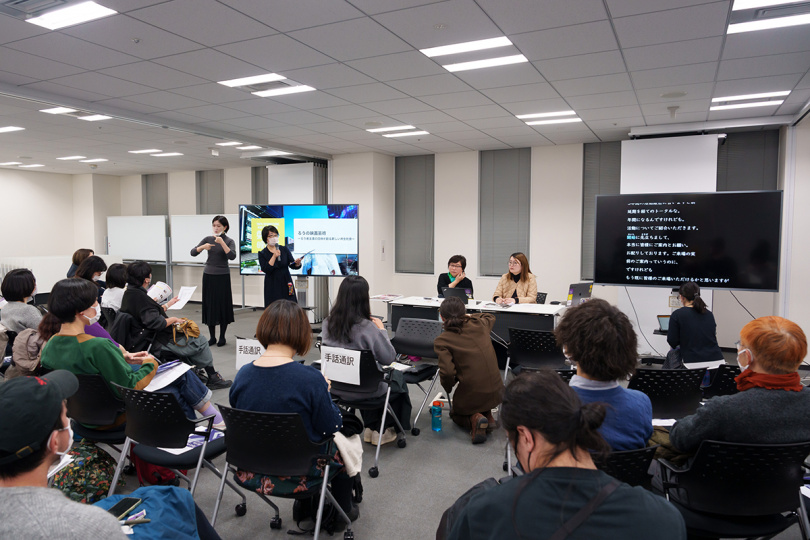
Q & A
Finally, Chizuru Usui of Arts Council Tokyo asked about the future human resource development of the Tokyo Deaf Film Festival Executive Committee. "The members of the film festival are 70~80% deaf and 20~30% are listeners, but how did the current staff come together? Also, you mentioned that you are conscious of human resource development, but please let us know if you have any thoughts on the human resource development of film festival staff and interpreters at film festivals in the future."
- Makihara
-
There are various opinions among the secretariat members about the recruitment of the film festival staff. Currently, there are many staff members who participate as volunteers, and of course we welcome anyone who wants to do it. But human relationships are important in film festivals. When we get a call from someone who wants to do something, we usually ask them to help us on the day of the film festival so they understand our situation. In addition, I sometimes ask friends and acquaintances I have worked with to become staff. In terms of human resource development, there is an argument that it might be better to make recruitment more open in the future, but I think it is also important to be cautious because the organization might collapse as a result.
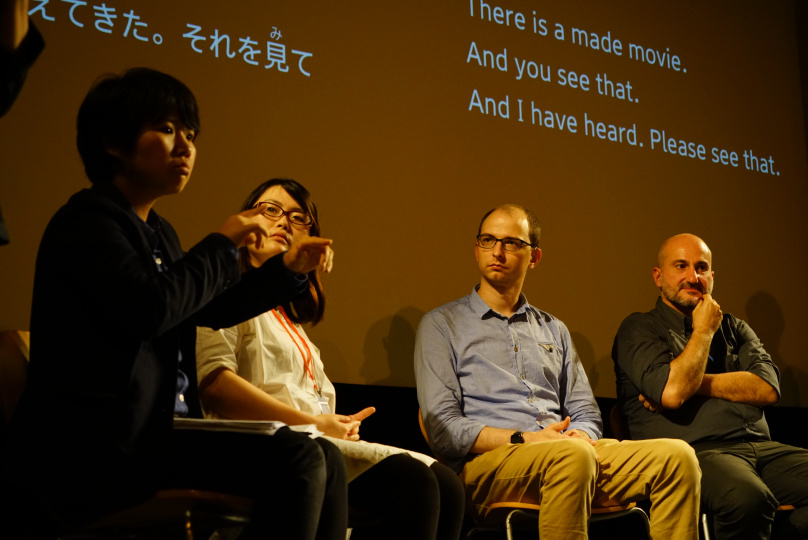
Choosing a sign language interpreter is also troubling. There is always a debate about whether to ask a young interpreter as part of training or an experienced interpreter to fully convey the content. Def jokes, which we talked about in today's briefing session, require learning about deaf culture and cannot be easily interpreted. I am always grateful to the two interpreters today. When we receive inquiries about volunteer activities from people who are studying sign language, we first ask them to provide support when audience members arrive on the day of the film festival. We then ask them to participate while considering what kind of work they can do. Also, regarding the selection of American Sign Language interpreters, we ask Mr. Yuyama, who can speak American Sign Language and has experience as an interpreter, for his opinion. In the first place, there are no qualifications for "American Sign Language Interpreters" or "International Sign Language Interpreters," so the festival selects interpreters based on visitor surveys. Europe has a lot of exchanges with neighboring countries and regions, so there are many people who can interpret international sign language, but Japan is an island country, which may have affected the situation, and there are not many people who can interpret international sign language. However, due to the spread of the novel coronavirus, more and more people are posting videos of international sign language on social media, and I think that more and more young deaf people are starting to use international sign language. From the perspective of nurturing, I have not found a method that is right for me, but I would like to work with young people to create a method that can serve as a precedent for others in the future.
Recently, sign language and Deaf people have been featured in movies and TV dramas. At present, all works are still produced mainly by the audience, but I hope that the environment in which deaf and hard of hearing people participate as staff and actors will soon become the norm. By creating works together, both listeners and Deaf people will be able to discover new things and expressions.
Project Description: https://www.artscouncil-tokyo.jp/grants/program/16496/
(Composition and text: Wataru OKUBO)
Profile
Tokyo Deaf Film Festival Executive Committee
ろうにまつわる作品をろう者視点でセレクトする東京国際ろう映画祭を2017年より渋谷ユーロ・ライブにて隔年開催している。中編・長編を中心とした作品を多くのろう者や聴者たちに届けることで、ろう者の社会や芸術の発展に寄与し、ろう者や聴者の相互理解の場を創出することを目的とする。
https://tidff.tokyo/
Eri MAKIHARA
Filmmaker and representative of Tokyo International Deaf Film Festival. Co-directed LISTEN LISTEN (2016), an art documentary about the music of the Deaf, with Shizukakai (DAKEI). His latest work is The Tanaka Family (2021). In 2017, he established the Tokyo Deaf Film Festival. In addition, he is promoting the distribution of the French film "Letters to Vincent" (2015) and working on the "Development, Sign Language, and Art Project" to develop human resources for Deaf and deaf people and to create a community where Deaf and hearing people can gather.
Yoko YUYAMA (Yoko YUYAMA)
Deaf interpreter and in charge of overseas relations at the Tokyo International Deaf Film Festival. B.A. in Environmental Studies from the University of Washington, Seattle. After returning to Japan, in addition to working as a deaf interpreter, he worked for IBM Japan for 10 years. Currently, he is engaged in social enlightenment activities and provides CODA parenting information to deaf parents with CODA (hearing children with deaf parents) in WP Group of OSBS Inc.