



- Date
- Tuesday, January 24, 2023 19:00~21:00
- Venue
- Arts Council Tokyo and Zoom Webinars
- Name of reporting organization
- The Dance Archive Initiative
- Speaker [Rapporteur]
- Toshio Mizobata
Naoto Iina (Director of the Dance Archive Initiative/Director of Dance and Media Japan)
Toshiko Oka (Ensemble Zone, choreographer)
Takao Kawaguchi (dancers and performers)
Tomomi Tanabe (dancer) - moderator
- Tatsuko Mizuno (Arts Council Tokyo Senior Program Officer)
The Dance Archive Project, organized by the Dance Archive Concept (Dance Archive concept), a non-profit organization working with the aim of creating an archive to record the changing dances of the times and transmit new values to the next generation, was implemented with the following three pillars.
- Developed and released a unique system called "Butou Digital Archive" that changed the concept from an archive with a location to a virtual archive.
- Conducted Buto Research 2017-2019 to collect quantitative and qualitative data to provide a bird's-eye view of buto activities around the world, and published the booklet "What is Buto?."
- A "Reconstruction Trial Performance" was held to demonstrate the creation and presentation of works utilizing archived materials and to publicize the significance of archives. Toshiko Oka, Takao Kawaguchi, and Tomomi Tanabe presented their works.
[Part 1: Report of the Debriefing Session]
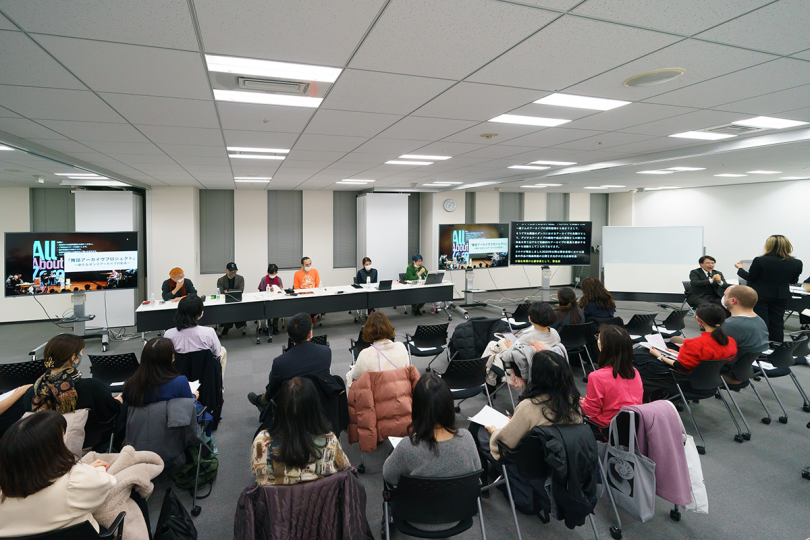
The Dance Archive Project, which has been a pioneer of archival efforts in Butoh and dance, has been implemented for three years since 2017 with the support of Creation Grant [Long-term Grant Program]. His unwavering passion for creating new archives for dance and butoh has led him to continue his creative archival activities. The first part of the report will introduce the history of the establishment of the dance archive concept, the purpose of this project, the secret story of the creation by the choreographers and dancers involved in the production of the "Reconstruction Trial", the archive attempt to bring out the origins of butoh, and the culmination of research on the status of Butoh activities in Japan and abroad.
In addition to being held on-site in the Arts Council Tokyo conference room, a Zoom webinar was also held to stream the venue in real time, with a total of 97 people participating. In addition, as in previous debriefing sessions, information was guaranteed through consecutive subtitles using sign language interpretation and UD talk.
Dance Archive Concept to Take Over the Activities of Kazuo Ono Archive
- Toshio Mizobata
-
The Dance Archive Initiative has been working on archiving dance from a relatively early stage. This is because the predecessor of this group, or rather the parent organization, is the Kazuo Ono Dance Laboratory. Kazuo Ono was born in 1906. He studied Western modern dance from the 1930s and was active as a modern dancer during the violent war period. He met Hijikata Tatsumi at the end of the 1950s, created a new dance called buto, and continued to work internationally after 1980. He lived a very long life and died in 2010 at the age of 103.
We began to recognize the importance of archiving in 1989. Since the end of the 1970s, dancing has become quite popular in Europe, and in the 1980s Ono was doing almost exclusively overseas activities, and we had our management office in Italy. I had just finished my performance in Rome and was about to leave for Berlin when my manager in Italy asked me if I needed to create an archive. I remember that time because it was a very tense situation just before the fall of the Berlin Wall. We didn't know the word archive well, and we thought that such a thing was necessary and that the stage would disappear.
In 1994, Kazuo Ono was 88 years old and very energetic, touring overseas about 1/3 of the year, but he knew it wouldn't last. The second son of Kazuo Ono, the dancer Yoshito Ono, initiated the "Kazuo Ono All Works Performance Plan" with the intention of performing his representative works one by one at a theater near his home in Yokohama. I think it's fair to say that I did it to keep an archive record.
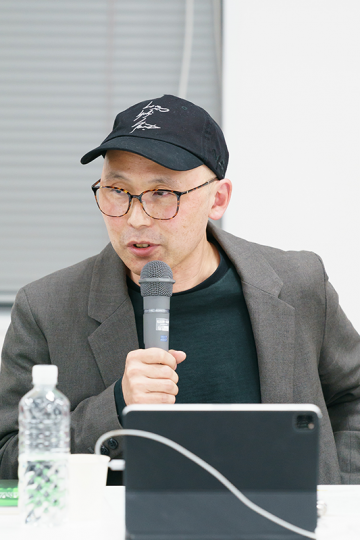
Speaker: Toshio Mizobata (Photo: Kazuyuki Matsumoto) - Mizohata
-
Kazuo Ono was born in the Meiji period, so he hardly throws away anything. Since the early 1930s, he had studied under pioneers of Japanese modern dance such as Desaru Ishii and Takaya Eguchi, so he had a large collection of documents. It was the beginning of the Kazuo Ono Archive to take them to the practice room and organize them, which became the foundation of the group's activities called the Dance Archive Concept.
In a sense, no one can take responsibility for personal archives if the person is gone, and they may be thrown away. I thought it was important to build a foundation for our activities as a social entity to prevent this from happening, so I first launched it as an organization and then turned it into an NPO. The year 2017, when we started our long-term grant activities, is the actual first year of our activities. With Arts Council Tokyo long-term subsidy and three-year subsidy, we believe that our business has become a startup.
Perspectives on creating a dance archive
Representing the archive
- Mizohata
- Mr. Iina, who is a director of the Dance Archive Initiative and also works as a filmmaker, will talk about how he sees our activities from the perspective of creating a new archive.
- Naoto Iina
-
The term "new dance archive" gives the impression that we are dealing with the latest digital and technological developments, but in fact, I think the most important thing is to lay the foundation for this. Our archive covers a wide range of dance genres, but considering that we started with Kazuo Ono, dance is still important. There are a lot of photos and texts about dancing, and there are also a lot of videos. It is very valuable as an archive that various images such as films and videos from the late 50s to the 60s remain.
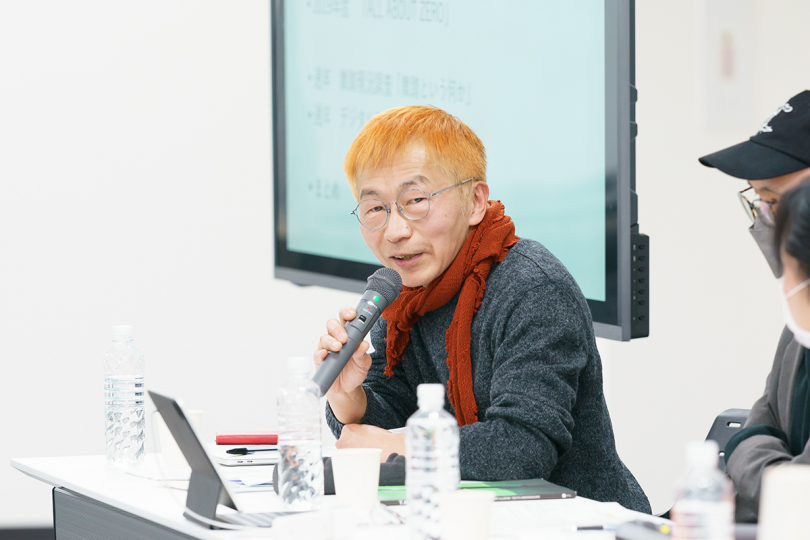
Speaker: Naoto Iina (Photo: Kazuyuki Matsumoto) - Iina
- In building a new dance archive, we need to think about how to handle images. Dance is both a temporal and a spatial art, so the reproduction of archives through photographs and text is of course very important in creating something new. And to verify what was actually going on, video is very good. The fact that there are so many documentaries left behind became one of the motivations for creating the dance archive. Of course, we have to think about how to preserve and store materials, but another important thing is how to disclose them. Introduce new ways of thinking, new media, and re-present the archive in new ways. This method of disclosure is a feature of the Dance Archive Initiative.
The significance of the creation and presentation of works using archival materials [Reconstruction Protest Performance] for archives
Reconstruction Trial performance 1st year
Fiscal year 2017 "The Chic Dancer" - Based on Tatsumi HIJIKATA's "Sick Maihime"
Dance: Tomomi TANABE, Takao KAWAGUCHI
This work was produced based on the text of Tatsumi HIJIKATA's literary work "Sick Maihime". Hijikata was born and raised in Akita, and his unique style of writing describes the world from a young boy's point of view. The text was serialized in the magazine "Shingeki" from 1977 to 78, and is considered surrealist literature. This work, which is said to be connected to Hijikata's "Butofu" in the 70's, is known as a bible for dancers, and many dancers and contemporary dancers have tried to create works based on this text.
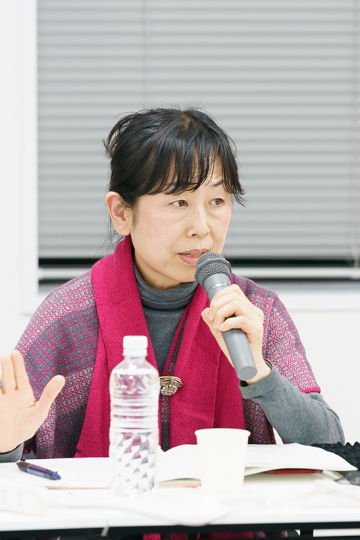
- Tomomi Tanabe
-
The impetus for this work came in 2012 when I was asked to direct a program at the Whenever Wherever Festival hosted by Yamazaki Kota to create works on the theme of The Sick Maihime. When I was young, I met Mr. Hijikata and was greatly influenced by him. I was also very attracted to his words. I was very interested in this program, partly because I had long participated in reading The Sick Maihime by critics Shigeo Goda and Kazuko Kuniyoshi. Since this is a rare opportunity, I wanted to see how Kawaguchi-san, who is not a dancer but a performer, reads this text and what he does. Since there were only 2~3 weeks between the time the 2 of us decided to work on the program and the time we presented it, I thought it would be impossible to cover all of this huge text, so I focused on the word "tatami" in the text and started reading from the word "tatami" in the text. They decided to use a tatami mat as a common item and create a solo for each of them. I dance only on tatami mats for 30 minutes in the first half. Mr. Kawaguchi uses two half-tatami mats to perform.
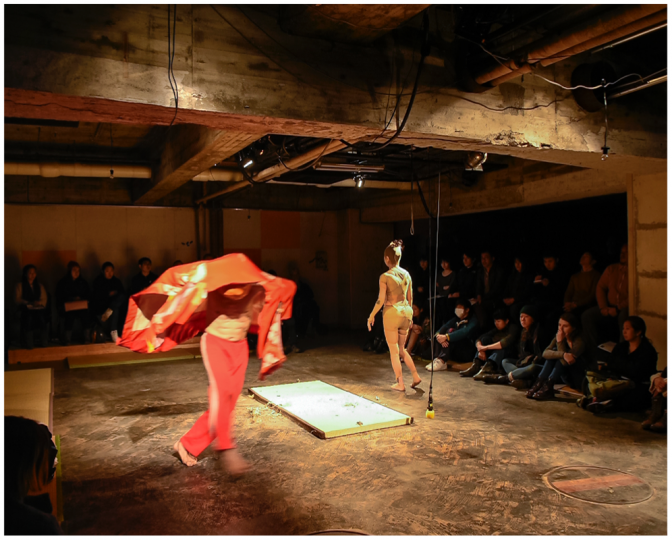
Source: "Sick Maihime" Text Notes Series II "(2012) (Courtesy of Dance Archive Concept, a specified non-profit organization) - Tanabe
-
"Sick Maihime" is difficult to understand with your head, but when you read it as a style, you feel it comes into your body. I read the text squatting, lying down, or like a Buddhist invocation. Words that came to mind, or words that caught my attention, such as feeling like I was wearing something, head and buttocks reversed, or creatures that I didn't understand well, were listed and created through discussion.
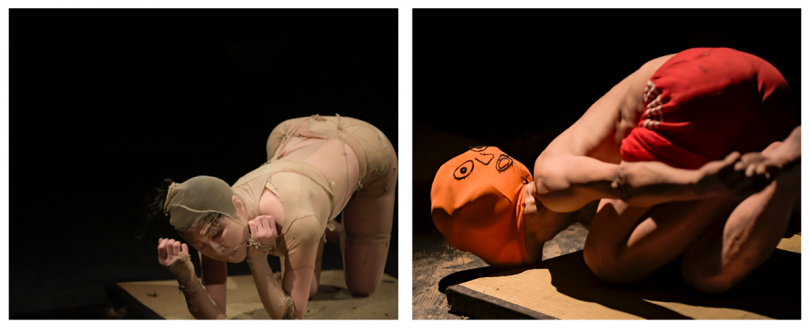
Source: "Sick Maihime" Text Notes Series II "(2012) (Courtesy of Dance Archive Concept, a specified non-profit organization) - Tanabe
- Kawaguchi wears an orange mask on his head, but his face is drawn on the back of his head. When he read The Sick Maihime, he said there's a face behind the head and it's shaped like this. My costume is full body stockings, and between the stockings and my skin, I stuff my own dried mugwort, and I enlarge one of my hips and shoulders so that I can't lie flat or move my joints well. I make mugwort jelly and chill it in the refrigerator before the performance. I put the jelly in various parts of my body right before the performance and let it melt while I dance.
- Takao Kawaguchi
-
For me, the image of "Kamaitachi," a collection of photographs of Hijikata taken by Hideko Hosoe, remained very strong. I also visited the Tatsumi Hijikata Archive at Keio University to see various photographs from the 1960s and read texts, and came up with various motifs from them. The reason why I'm wearing an orange mask is because I saw a lot of images of covered masks in the pictures that I saw. The mask in the picture was black. It was a big hit with me. And he thought it was very Hijikata-like that his face was behind rather than in front, so he wore the mask so that his eyes and nose were behind him. The following year, I used this orange head in a scene in my work "About Kazuo Ono," and at that time, I wore it so that my face was facing forward. For me, the contrast between Hijikata and Ono is very symbolic.
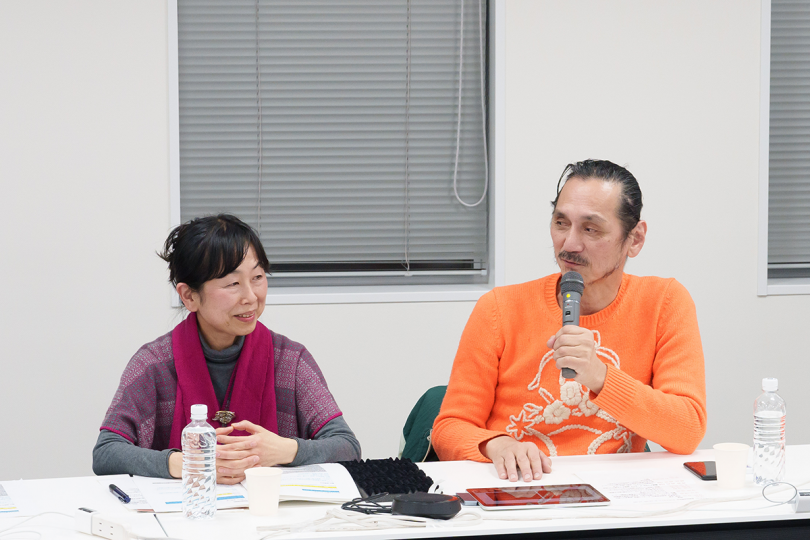
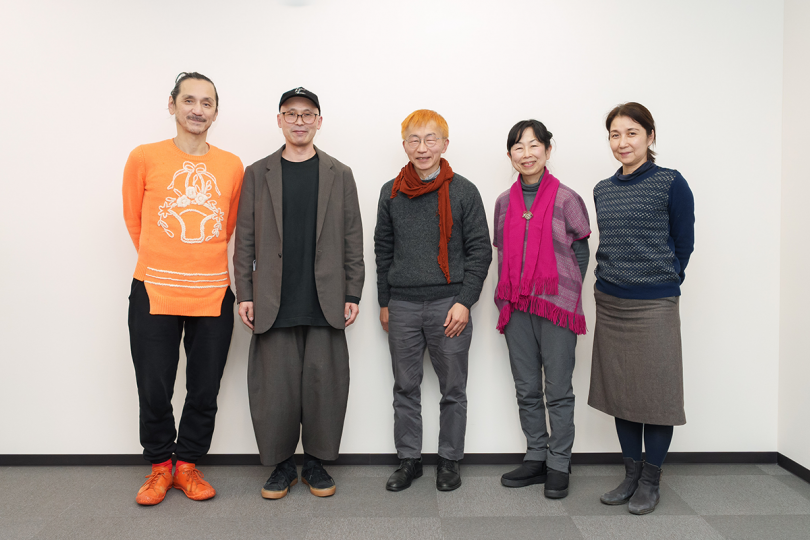
Speakers (from left): Tomomi Tanabe, Takao Kawaguchi (Photo: Kazuyuki Matsumoto) - Kawaguchi
-
When we performed at Kitasenju BUoY in February 2018, we included a video. For a performance in Brazil in the same year, it was decided to add English subtitles for the narration reading the text of The Sick Maihime. It's a piece that dances in the middle surrounded by the audience on all sides, so we put subtitles on both sides. We updated the production and screened in Brazil, Berlin, and Poland. The narration was done by Ameya Hosui, so you can hear the garrulous narration with a great atmosphere.
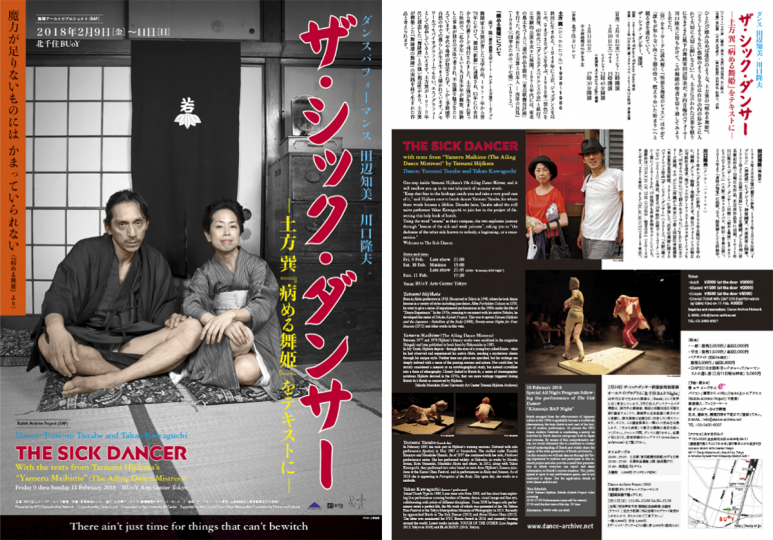
"The Chic Dancer" flyer (Courtesy: NPO Dance Archive Concept) - Kawaguchi
- I read somewhere that Hijikata's father often performed Gidayu-bushi, and I thought it was interesting, so I used some of Gidayu's CDs, and I read the text of "Sick Maihime" in the tone of Gidayu, and performed while growling like "Anno". It is doubtful whether foreign audiences could understand the text, which is quite difficult to read even in Japanese, by watching it with English subtitles. However, I think it was very well received in the aspect that the words became a trigger and connected the image with the stage. I don't work according to the dance method, but I hope that people in Berlin, Brazil, and Poland could understand the world of Tatsumi Hijikata's "The Sick Dancer" and the image of the work.
Reconstruction Trial Performance Year 2
FY 2018 "Green Table 2017" Choreography: Toshiko OKA
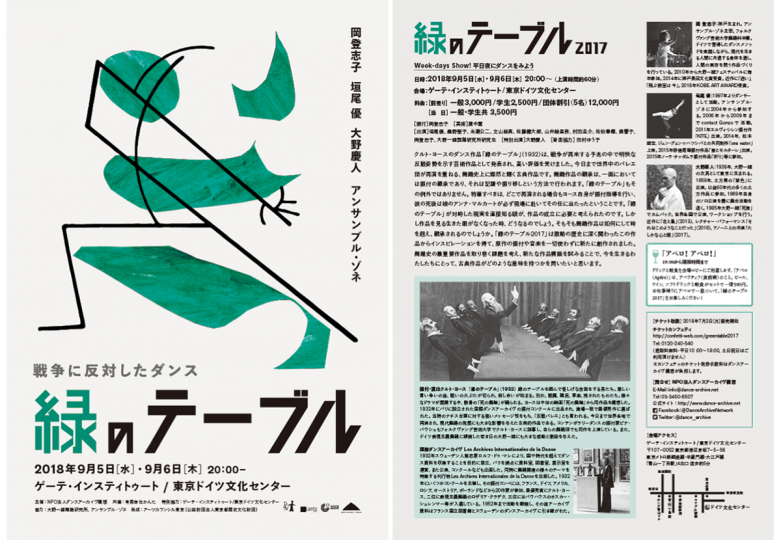
- Toshiko Oka
-
I would like to briefly explain the original Green Table. It was created by German choreographer Kurt Joos. He created this work in 1932 out of fear that the Nazis would rise in Germany and war would begin. The work won first prize in a choreographer's competition organized by the International Dance Archive in Paris. After that, the war really started, so this play could not be performed again for a while. The work is based on a medieval painting called The Dance of Death. Many people died during the plague epidemic in the Middle Ages, and this work is based on the big theme that death will come one day to all people. Inspired by these works, Jors created the "Green Table" with a war theme.
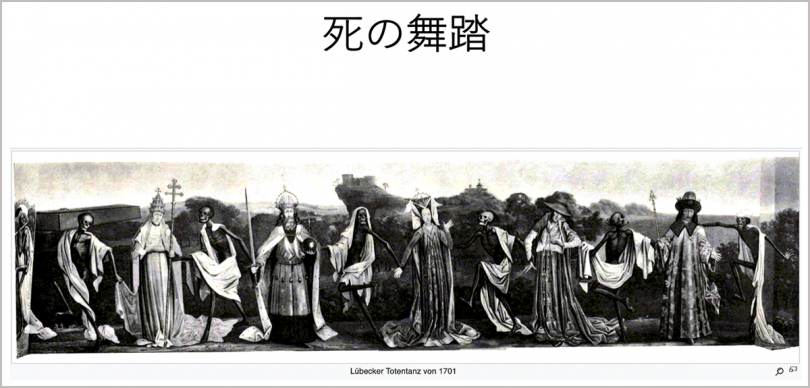
(Source: The Dance Archive Initiative) - Oka
-
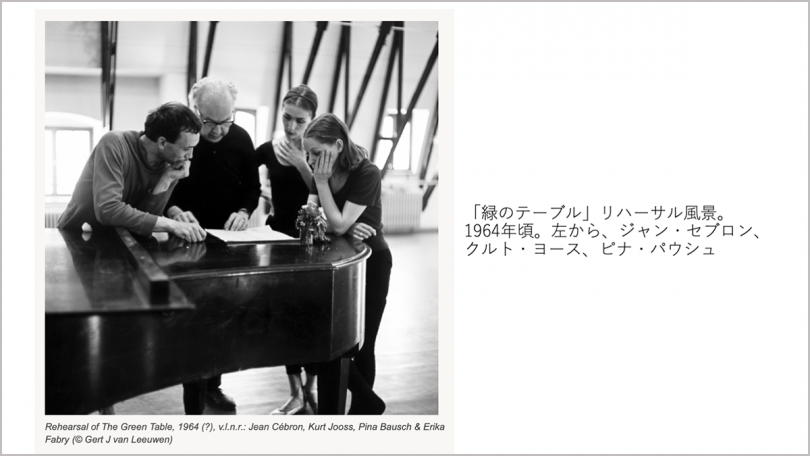
In order to recreate the Green Table, we had a dance-sheet. A dancer named Raban, who was Jos' teacher, made a dance-sheet, which is like a musical score, so he could reproduce the movements with the dance-sheet. Even if the dancers change, they keep repeating the performance.
This is a rehearsal in 1964. Everyone is thinking while looking at the dance score. The man in the middle with glasses is Kurt Josse, and on the right, with his hand on his chest, is Pina Bausch, who was in the Kurt Josse Dance Company. To the left of Jose is Jean Severon, who happens to be the teacher I learned while studying in Germany. The Kurt Josse method he taught me has become a major theme for me as I continue to dance.
(Source: The Dance Archive Initiative) - Oka
-
The original version of "Green Table" is still being performed around the world. In eight scenes, the dancers are tasked with playing the roles of grim reapers, soldiers, partisans, prostitutes, and refugees, portraying people tossed around in and plotting war. I created and composed various scenes to see what kind of roles the original casting would fit in today's times. For example, in the case of a soldier, I created a salaryman like a corporate warrior working hard. In Reconstruction, the wind that blows while looking at the era, the eternal wind, which does not exist in the original, is set. I thought that the presence of dancers who have danced to pray for peace is very important, so I asked Yoshito Ono to play the role of the wind in the first performance and several subsequent performances.
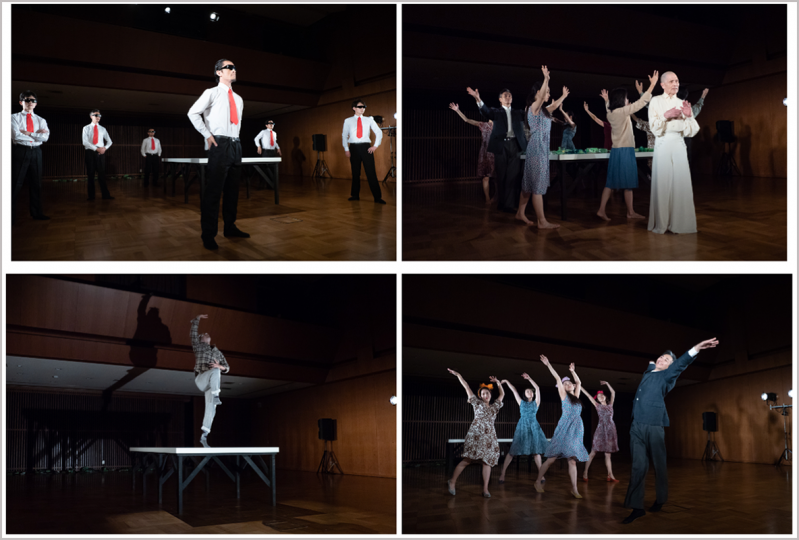
Photo from "Green Table 2017" (2017) (Courtesy of NPO Dance Archive Concept)
passing from the dance archive to the present
- Mizohata
- Kurt Joos never came to Japan, so there was no performance in Japan. However, Kazuo Ono was deeply moved by the Green Table. Why? Of course, you may have seen it in the picture. Another possibility is that at least 3 Japanese were present at the International Dance Archive competition in 1932. Takaya EGUCHI, Seishi MIYA, and Rikuhei UMEMOTO. They were in Germany and Vienna at that time, but they probably came to Paris to see this performance. Actually, Kazuo Ono has been practicing at Eguchi-san's practice room since 1936. Eguchi-san must have told Ono a lot about the "Green Table" at that time. Kazuo Ono always talked about the Green Table. Actually, I've never seen a "green table" before. When I saw the film, I wondered if Kazuo Ono was really moved by the work, but I was very curious about it, so I asked Mr. Oka if he would like to do this work. In the beginning, the work was more original, but there were copyright issues and so on, so I created a new work.
- Oka
- I think it was an opportunity for us to think about what it means to pass on from the archives to the present. People really in the past have a strong spirit through various experiences. I think this work is a wonderful original created under such circumstances. While respecting that, I thought about what I can do with my current perspective and what I can do with physical expression. I hope to be able to create new value from a different angle while building on my original work.
An Attempt to Archive the Origins of Dance from Videos, Talks and Demonstrations
2019 "All About Zero"
Yoshito Ono, Hironobu Oikawa, Mamako Yoneyama
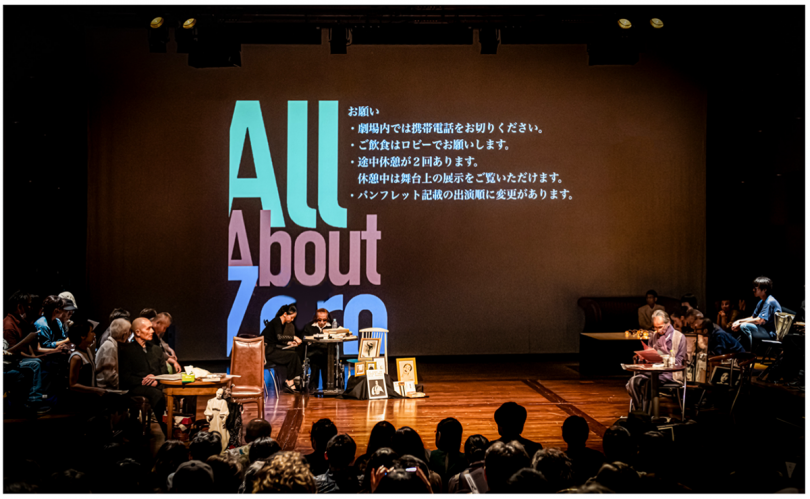
Performers (from left): Ono Yoshito, Oikawa Hironobu, Yoneyama Mamako (Photo by Tamauchi Koichi, Courtesy of NPO Dance Archive Concept)
- Iina
-
"All About Zero" was at Theater X in 2019. The picture is when we let customers in. Mr. Yoshito Ono is sitting on the left, Mr. Hironobu Oikawa is sitting in the middle, and Mr. Mamako Yoneyama is sitting on the right. I'm pretty happy that I got this shot. I tried to find out what method these people used to dance and dance, and to see the origin of dance. Since the parent organization of the Dance Archive concept is the Kazuo Ono Dance Laboratory and the Kazuo Ono Archive, we started from there. We also started to explore the relationship between these people and Kazuo Ono.
First, Mr. Mizobata and I will visit each practice hall or home and interview them. All of the videos are also recorded, and we started by capturing keywords from them. This is not an event to create a work of art, but rather to introduce each person like a documentary film, but it would be a talk event by itself. Even if you dance, your body is completely different from the one you had in your prime. So I decided to borrow some footage from that time, edit it and re-subtitle it to make the whole thing.
A video of the former stage will be shown, and then you will appear on the stage and tell us your history. At the feet of each of the three players and on the table, there were various items that they had brought from their homes, and they brought their practice time onto the stage. We asked Noh actor Kanji Shimizu to act as a facilitator, and we directed the audience to visit each space, which was modeled as a rehearsal room, and ask questions about dance and mime.
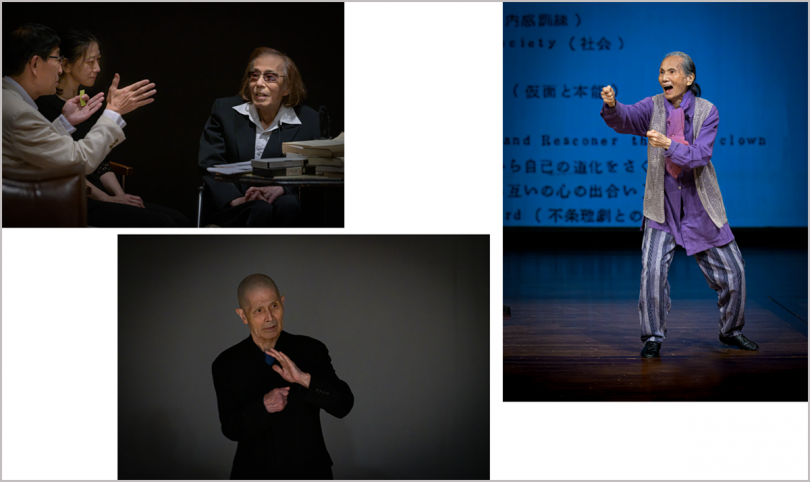
Photo from "All About Zero" (2019) (Courtesy of Dance Archive Concept, a specified non-profit organization)
- Iina
-
What I discovered was an interview with Dr. Oikawa. Professor Oikawa makes a clear distinction between mime and pantomime. To be honest, I didn't know much about the difference between mime and pantomime, but the more I dug into it, the more I found out. One is that there is such a thing as a corporeal mime. It may be a bit misleading to say that the corporeal mime is similar to the use of the body in Noh and dance, but it turns out that it is useful.
We also had a unit called tarinainanika re-enact the methodology of Etienne de Creux in France at the time. Instead of just asking "what is dance?" I began to see a world view that had been cultivated in some kind of big movement or human relationship before the word dance was born, such as modern dance and mime. Using the archives in this way, I learned a lot about the atmosphere of the time.
At the beginning of the event, we played a scene of Jean-Louis Barrault dancing in the movie "People on the Shelter". After that, we started the event with a video of Kazuo Ono's "Dream of Love." Corporate mimes are not the mainstream of today, but I think the event was an attempt to revisit the methods and history that have been surely left behind and present them with a new production.
A questionnaire survey of dancers around the world
"Something called dancing" was published.
Over the 3 years of the grant period, the Dance Archive Initiative conducted a questionnaire survey of 405 dancers in Japan and overseas as part of the "Dance Research 2017 -2019." A report on the results of this research was published in 2020 as "Something called dancing." It was the culmination of a painstaking research project into the state of dance in the world and who dancers there are.
- Mizohata
-
As All About Zero pointed out, dance began in the late 1950s, followed by Tatsumi Hijikata's Dark Dance in the 1960s, Ko Murofushi and others going to Europe in the late 1970s, Kazuo Ono, Sankaijuku, and Byakkosha in Asia.
Up until the 1990s, there was a picture of people from the West and Asia performing dance in connection with some Japanese. Now, however, it seems that some people are suddenly dancing, perhaps without any connection whatsoever. When asked what dance is, it was very difficult to answer, so the idea was to conduct a survey around the world and take screenshots of dance. In the end, we repeated the questionnaire several times in Japan and overseas over three years, and compiled the results into a booklet.
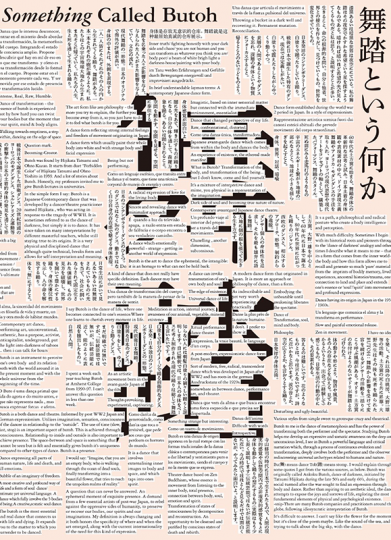
Cover image of "Something called dancing" (Credit: NPO Dance Archive Concept) - Mizohata
-
Dai Matsuoka, who has been in charge of this project for three years, is a core member of the Sankaijuku. He is currently rehearsing his new work, so I would like to read his report for him.
While the origin of buto is clear, there is still no answer to the question "what is buto?" and it is not easy to explain to third parties. Therefore, over a period of 3 years from FY 2017 to FY 19, in order to pass on the unique charms of buto to the next generation beyond national borders, we conducted a survey with the aim of connecting it to future-oriented creative efforts that go beyond preserving the past, while confronting the possibilities and impossibilities of archiving the intangible cultural property of buto.
First of all, as a stepping stone, we conducted a survey in order to grasp the current state of "something called dancing" which is derived from dancing and transformed in various ways around the world.
The target audience is professional and amateur dancers. The questionnaire included questions such as the practitioner's base of activities, form of activities, scale of performance attraction, expected target of attraction, economic situation, achievement of attraction, reason to start dancing, definition of dancing, memorable dancing works, joy of practicing dancing, and what they think is necessary for dancing to be handed down.
This was a pre-pandemic survey, so some of the responses may be very different today, but here are some of the results that stood out to me.
In fiscal 2017, a total of 125 responses were received from practitioners in Japan. In fiscal 2018, the survey was expanded to include overseas countries, with 332 responses from overseas and 73 from Japan. The United States had the largest number of responses, followed by France, Germany and Brazil. In South America, there were also responses from Mexico, Argentina, and Chile, which made us feel that dance practitioners or their communities have a solid foundation. There were responses from Madagascar, Nigeria, and other countries, though not many in Africa. I think we have been able to visualize a part of the current state of "dancing is spreading around the world," which until now has been described only as an impression, though it is a real feeling.
In terms of the form of activity, "performing in public performances" was the most common, followed by "workshop/lesson instructor." There was also no difference between Japan and overseas. It was confirmed that there are many people outside Japan who not only practice dance themselves but also teach it to others. It's not that surprising, but I think this may also be one of the main reasons why dancing has spread.
According to the survey we conducted before the COVID-19 pandemic, quite a few respondents answered that they were engaged in “independent video production and distribution ” overseas. I was able to reaffirm that in archiving dance, we need to consider the possibility that dance will evolve into more diverse forms of activity in the future.
As for the scale of customer attraction, many answers are less than 100 people both in Japan and overseas. In addition, there were many responses that the ticket fee was "free" outside of Japan. It is not clear whether there is a public subsidy system behind it or it is just a hobby, but in any case, it seems that it is not attracting a large number of customers.
Looking at the percentage of respondents who were professionals or amateurs, 66% were professionals overseas and 46% were professionals in Japan. However, at that time, 14% of respondents in Japan and 12% of those outside Japan had an annual income of 1 million yen or more. Reflecting the difficulty of monetizing dance performances, we can see clearly that professionals make money from workshops and lessons rather than from performances, which require a certain amount of expenditure. Education and outreach activities are essential for the popularization of buto, but on the other hand, if cost increases as a barrier to production and performance, there is a possibility that buto stage productions will decrease in both quantity and quantity.
In response to the question, "How did you first get into buto?" many respondents cited direct experience with buto, such as watching live stage performances, participating in workshops, or creating works. On the other hand, many respondents said they came across buto through media such as photos and videos, or printed materials such as flyers and posters. The fact that the appeal of dance is transmitted not only through events on the stage but also through recording media has an impact on dance, and I think it has the potential to remain effective in the future.
In response to the question, "How would you describe dance?," some people mentioned external characteristics such as "shaved hair" or "painted white," while the responses from overseas in particular showed a strong enthusiasm for dance as a whole, with various interpretations such as "soul," "life," "transformation," "death," and "existence," sometimes linked to the practitioners' views on life and philosophies. In Japan and abroad, the economic situation surrounding dancing seemed to be severe. For many practitioners, dance is inseparably linked to their lives and has a profound influence on their expression and lives.
So far, we have conducted surveys on practitioners, but in the future, we should consider conducting research on producers and viewers. I think it is necessary to consider from different perspectives what methods there are for dances to be handed down and spread throughout the world. Research methodologies always require reflection and reconsideration, but through such trial-and-error processes, new content and networks, and even archives themselves, will be born, and the outline of "something called dancing" will be revealed, albeit vaguely.
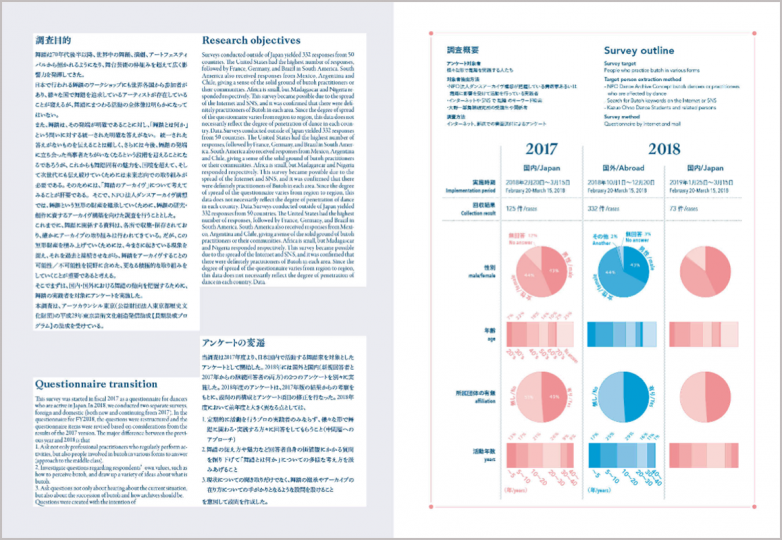
(Source: The Dance Archive Initiative)
Over the past few years, arts organizations that have been hit hard by the pandemic have begun archiving their past works to boost their profitability. Even before this movement began, the dance archive concept has been a pioneer in the field of performing arts archives, and has contributed to the creation of new values in dance by developing unique methods for the disclosure and utilization of such archives. Reports of the activities of "Reconstruction Preview" and "All About Zero" reveal a unique creativity and form of a living archive. While there are few public organizations in Japan that are working to preserve and open historical materials on contemporary dance, the Buto Archive Project has been a significant presence for many years. Through the reports of the speakers involved in the project from various standpoints, I was able to sense further possibilities for archives and their rich utilization methods, which are not limited to dance.
Continued from Part 15 "Dance Archive Project" - Creating a New Dance Archive (Part II)