


- Date
- Friday, July 5, 2024 19:00~21:00
- Venue
- Arts Council Tokyo
- reporting body
- Cherfitsch
- Speaker [Rapporteur]
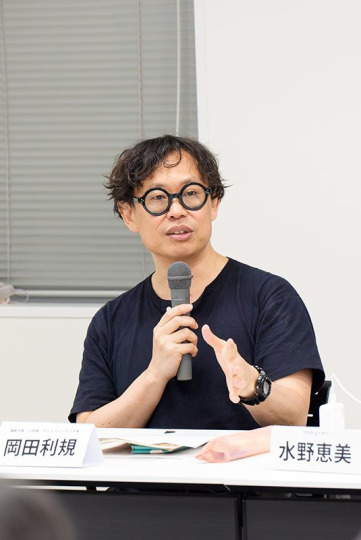
- Toshinori Okada (playwright, novelist, director of Cherfitsch)
Tamiko Koki (producer)
Emi Mizuno (producer) - moderator
- Haruna Matsutani (Arts Council Tokyo Senior Program Officer )
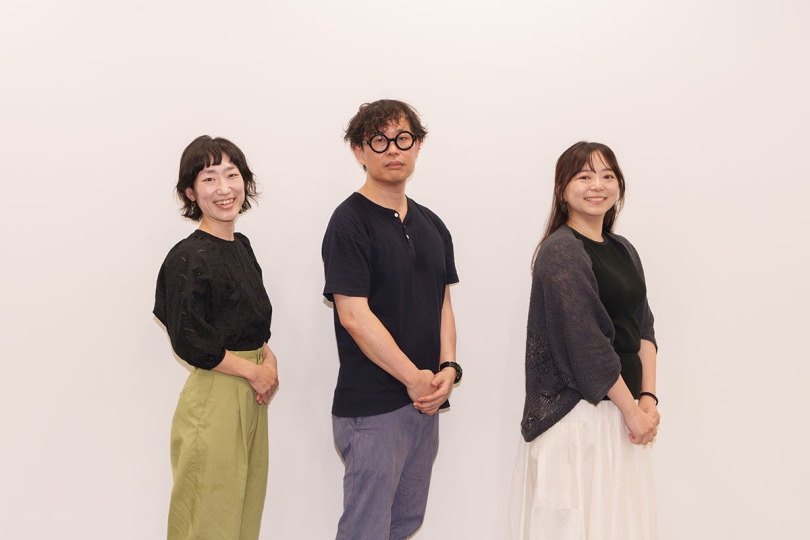
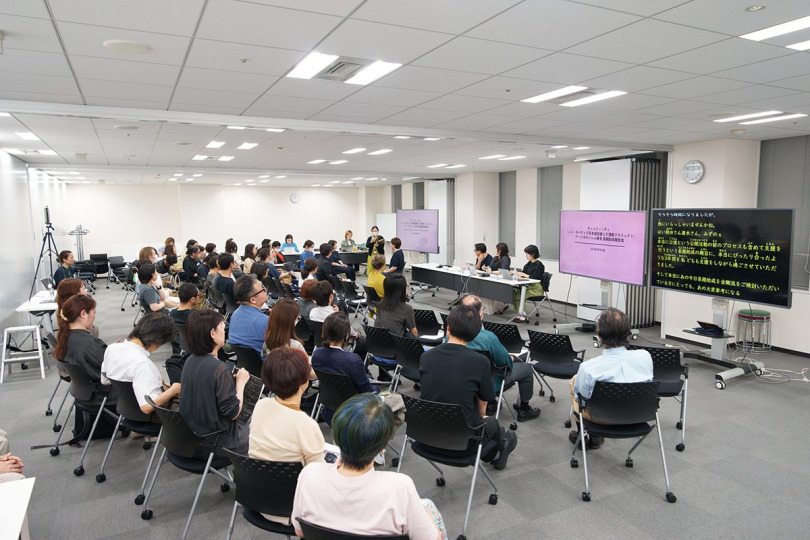
The Theater Project with Non-Native Japanese Speakers is an initiative launched by Cherfitsch in 2020 with the aim of exploring the possibilities of Japanese and its use in theater through collaboration with actors whose native language is not Japanese. In this briefing session, the chair, Toshinori Okada, and the producer talked about the process from the research for the direction of the project itself, to the workshop, to the presentation of the results of the production, "Window of the Spaceship in Between," and the "ambition" related to the future of modern theater.
Idea to Revamp the Japanese Language of Theater
There are no clear prescriptions for the challenges of artistic expression, especially theater that deals with the flesh and blood. Those who seek out a new approach from among the many possibilities, through repeated trial and error, eventually get a feel for it, and by sharing their experiences, scenes move and history is woven. The Theater Project with Non-Native Japanese Speakers, which the playwright Okada Toshinori and Cherfitsch worked on for 3 years starting in 2020, may be said to have been the beginning of such a change.
The starting point is Okada's realization as an audience that the words of the play do not enter. The audience can hear the voice, but the content goes by. In order to face this lack of response and to find new words for the play that would live in the audience, Okada sought to reconsider the Japanese language used in Japanese theater.
"In Japan, the Japanese spoken on stage is generally spoken by native speakers, but I had doubts about that. It is not just that it is bad that only native speakers speak, but it is an artistic and aesthetic problem that "Are those words in Japanese that go into the audience?". In the first place, theater is a form of expression that can be created even if there is a gap between the character of the actor and the character. If that is the case, there should be a gap between whether an actor is a native Japanese speaker and the role he or she plays, and it would be OK for non-native speakers to speak Japanese on stage, and I thought that would make a dent in this issue. But at the time, I was imagining that some public theater would take my idea and do something like the old Saitama Gold Theater." said Okada.
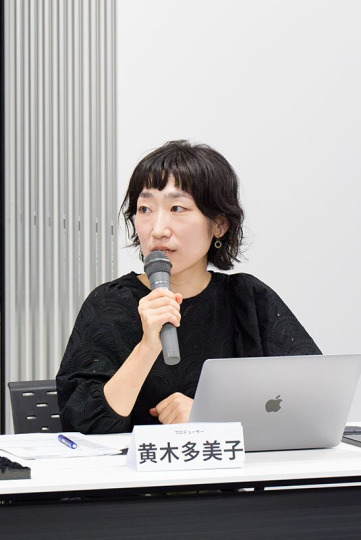
Producer Tamiko Koki says, "The premise was, of course, that this was not a problem that could be solved by a single performance organization." but she has decided to turn this idea into a project that she will work on herself.
"I thought it would be okay for Chelfitsch to have activities that are not the goal of creation itself, and I wanted to take on the challenge of working on something other than creating works that would change the state of theater and society through language issues, as I had never done before. Of course, it was a project that required a lot of time, and I didn't know how much time I would have to do what I could do, but I thought that if I was going to try it over three years, I could take the step, so I planned to apply for a long-term grant Creation Grant."
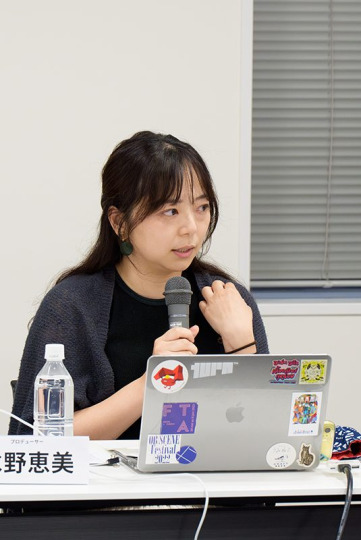
It was in November 2020 that the plan was successfully adopted, and efforts began to put it into practice. Due to the coronavirus pandemic, they were reluctant to meet people, and the research they had originally planned did not go smoothly. However, Mizuno Emi, who produced for the first and second years, recalls that an unexpected experience gave her a chance to confirm the essence of the project.
"In the course of my research, I went to an art space. It's a place where immigrants come and go and a children's cafeteria is run, but when I sent them an email asking them to visit, they didn't respond, and when I visited them in person, they showed a sense of rejection. "Every art-related event or festival, people come in and they don't trust them because they're not involved at all after that." he said. Originally, the project dealt with the issue of theatre, but it could potentially be rolled into a socially inclusive context. But after this kind of traumatic experience, I feel like I can confirm that we're doing a theater project, not a multicultural project." (Mizuno)
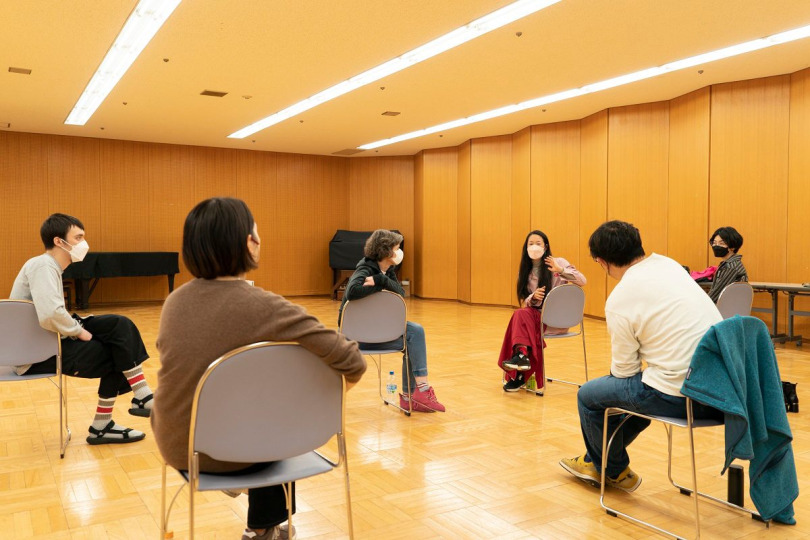
In September of the following year, participants were recruited under the conditions of high school students and older "Those who do not feel that Japanese is their first language" and those who are interested in expressing themselves. The first workshop was started with Okada as a facilitator, and participants worked to share the importance of having a strong imagination through activities such as explaining the layout of their own house while recalling it. Okada, who was planning to hold a workshop with the same content for the creation of works, seemed to feel that this first workshop was "business as usual" and that, because of that, there was a possibility to deepen his usual efforts.
"I think it's not so much the intonation of words or emotion as it is the imagination of the actor on stage. This project is a good place to think about that, and you can do a play without having to worry about the correctness of the person's Japanese, or whether they're not native speakers. In other words, we can do the same thing as before, which was a big discovery after doing the workshop." said Okada.
Sharing and expanding experiments and ideas
If the first year focused on finding and verifying the direction of the project, the second year focused on opening up ideas and methodologies outside the group and making them universal.
The number of workshops increased to the fourth. Actors Ando Mari and Yonekawa Yukirion, who are also cast in The Spaceship in Between, have also joined as facilitators.
"We wanted to increase the number of people who agreed with our project and participated in the workshop, and we wanted the workshop to be held without Okada-san. When I actually did it, it was interesting that the facilitation skills of the two actors got better and better." (Mizuno)
A total of 42 people, including students studying art in Japan, theater researchers, interpreters and translators, participated in the workshops from the 1st to the 4th. When recruiting participants, they were more keen than ever to meet new people.
"You can't find new people just by posting on the website or social media. Of course, we considered reaching out to embassies and other public institutions, as well as various private organizations, but that didn't exactly meet the people we wanted. As a result, many non-native speakers who are interested in expression have been introduced to us through university teachers." (Mizuno)
In July 2022, the theater critic Uchino Gi and journalist Tokunaga Kyoko were invited to a talk event to share their awareness of the project with a wider audience. However, at a time when the production had not yet begun, the discussion seemed to have shifted toward the ethics of native/non-native relationships rather than the issue of speech (acting), for which clear indicators are difficult to see.
"Whether it is necessary to exclude native speakers, whether the Japanese spoken by non-native speakers is different from dialects, and whether there is no problem with the structure in which native speakers enjoy the speech of non-native speakers ...... This was an event in which various comments erupted. Toward the end of the film, I think we came up with an idea that we wanted to create a work that would encompass that kind of awareness." (Mizuno)
"I don't know if the final product is like that. At that time, I thought, 'If I don't make it into a work, people won't understand.'. I think that the critical comments and awareness of issues that came out during the talk event were comments that came out against the creation of works based on the premise of approaching social issues. But I don't think I'm a good or capable maker. I thought that as a matter of art, of theater, I could do better." said Okada.
Don't hog the response. Becoming a platform that anyone can use
And the third year. After auditions, the troupe was selected, and in June 2023, concrete preparations and rehearsals for the premiere of The Spaceship in Between began.
"This time, we decided to hold a closed audition for participants of the workshop who shared Okada's creative philosophy. We selected 4 people from 16 applicants and decided on 6 performers including Ando and Yonekawa. Since we have been together for the first and second years, there was a good atmosphere in the practice room from the first time we got together, and I think this was the result of our long project. She has practiced about 35 times since June. As with the workshop, there was no big difference from the usual Chelfitsch. However, I tried to make practical efforts, such as adding phonetic pronunciation to the script, creating and sharing English texts, and arranging the schedule so that it would not be too burdensome, since there were very few non-native speakers whose main activity was acting." (Yoki)
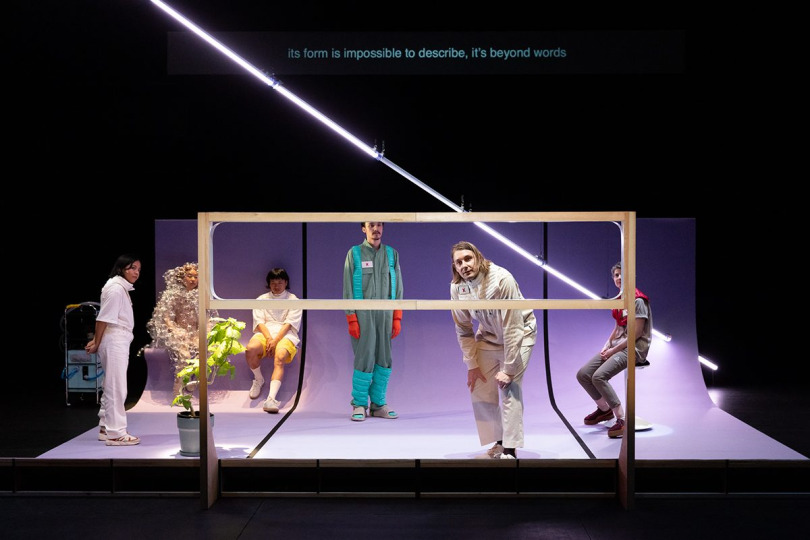
On August 4, the theatrical project "Spaceship in Between: Windows" with non-native Japanese speakers opened for the first time at the Kichijoji Theater. The story takes place on board the starship In-Between. A crew (played by non-natives) on a mission to stop "the great decline of our language" and a humanoid robot on board to do chores discuss the extraterrestrials that have slipped into the ship.
The play, which incorporates Japanese conversations by non-native speakers, the robotic rigidity of Japanese spoken by native speakers, and the machine voice of a coffee maker, also reflects issues of occupation, division, and discrimination through "language (Japanese)." In order to hear and understand the content, the audience seemed to be leaning forward and carefully watching the stage.
"When I started practicing, I realized that I had to do something about the Japanese of native actors. When you consider the Japanese spoken in the play as an aesthetic element, it is clear that the Japanese spoken by non-natives has a higher penetration. In retrospect, the same problem would have always occurred if all the works were written by native speakers. So this experience was huge for me. For example, this past June, I reperformed a play called “Mt. Eraser, ” and in that practice, I was already using standards that had been updated through this experience. I think it's very good that this project can be used for other, more general works." said Okada.
Through the project, Okada has gained a sense of feeling that it is not just a single work, but he has no intention of monopolizing it. At first, he envisioned a joint project with a public theater, and he calls this initiative "platform building."
"Today, we talk about the creation of a work called "I'm glad we're done here." as a way of concluding our talk, but our ambition is not to create a space ship. It would be great if we could continue this effort and create a platform that not only Cherfitsch but also everyone can use to think about Japanese spoken in theater. And if people are interested in that, then something else can happen, and I hope that happens." said Okada.
演出助手の公募、新国立劇場演劇研修所や座・高円寺の劇場創造アカデミーの生徒などを対象とした稽古場の公開、さらに『チェルフィッチュnote』 としてウェブ上で公開されたプロジェクトレポートなど、問題意識や創作のヒントを幅広く共有する試みは、3年目においても積極的に行われた。中でも山田由梨(贅沢貧乏)、山本ジャスティン伊等(Dr. Holiday Laboratory)ら、外部の演出家を招き、ノン・ネイティブの出演者とのワークショップを体験させる企画は、プロジェクトのコアともなる知見、方法を、惜しげもなく次世代に手渡そうとするユニークなものだった。
とはいえ「プラットフォーム」を志向するなら、勝負はむしろ、3年を終えた「今から」になるだろう。
"I received a grant for three years and created a work, and I think I was able to achieve great results. But more than that, it has not yet been introduced, publicized, and various directors and producers have become interested and access ....... The platform and Chelfitsch are too tied together, so we have to let people know that's not the case." said Okada.
The task of updating the Japanese spoken in theater is by no means the sole task of Okada and Cherfitsch. If there is a movement that goes beyond a single company, in which a variety of producers share their problems and prescriptions, and in addition discover a rich dramatic language, we may be able to encounter expressions and theatrical culture that we have never seen before.
(Reporting and text by Rieko Suzuki)
Profile
Cherfitsch
A theater company that pursues expression that is not bound by existing theater methods. Since its establishment in 1997, it has performed in more than 90 cities in Asia, Europe, North America and South America. Presided by Toshinori OKADA.
Toshinori Okada
He is a playwright, novelist, and president of the general incorporated association Cherfitsch.
His methodology based on the unique relationship between words and the body and his critical view of modern society have been highly evaluated, attracting attention both at home and abroad. He has produced a number of international co-productions, including repertoire works for German public theaters.
Tamiko Yoki
Producer of precog Co., Ltd.
Since 2010, he has been in charge of Chelfitsch production, producing more than 10 works. He has also been in charge of tour management in Europe, North America, South America and Asia, as well as domestic and international sales. Since 2020, he has been in charge of the planning and sales of domestic and overseas projects with a focus on projects with artists as chief of the artist division of precog Inc.
Emi Mizuno
Producer of precog Co., Ltd.
Since 2016, he has been involved in domestic and international concerts by Yanaihara Mikuni, Kamisato Yudai, and Ameya Hosui, as well as international projects in Southeast Asia such as Jejak Tabi Exchange and Pratana: Portrait of Possession. Since 2020, he is currently in charge of production and management for Cherfitsch and Toshinori Okada.