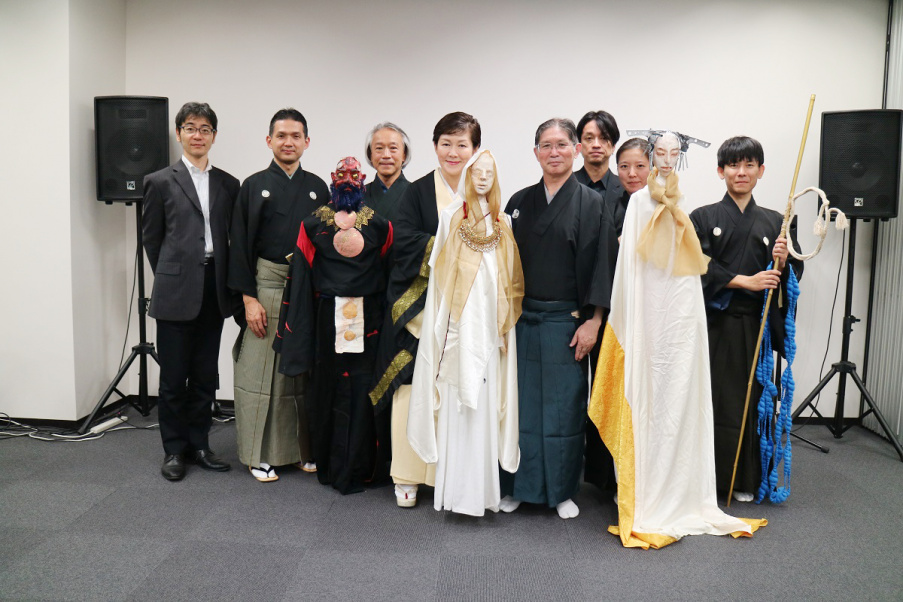



Exploring before and after the "Age of the Heart" through the methods of traditional performing arts --
"Tenrai" challenged the world's oldest Sumerian myth "Inanna's descent into the underworld"
- Date & Time
- Thursday, September 20, 2018 19:00~21:00
- Venue
- Arts Council Tokyo
- Name of reporting organization
- voluntary organization tenrai
- target business
- European performance of "Inanna's Descent from the Underworld" (long-term subsidy for 3 years from FY 2015 to FY 2017)
- Speaker (Reporter)
- Noboru YASUDA (Nohgakushi of waki-kata of Shimogakari-Hosho school), Nanafuku TAMAGAWA (Rokyoku performer), Kentaro OKUTSU (Nohgakushi of Kyogen-kata of Izumi-ryu school), Satoru ONO (composer and musician)
- moderator
- Mikako Tamamushi Senior Program Officer, Planning and Support Division
From 27 to 29, the "Inanna's Descent into the Underworld" performance project was adopted for the three-year long-term grant program of Creation Grant. At the activity report session, the origins of the project, which uses traditional Japan performing arts centered on Noh theater, were introduced and the trajectory of the three years was introduced. There were also short but fulfilling demonstrations, and I was able to witness the accumulation of thoughts unique to long-term projects, and a glimpse of their depth and breadth. Here, we will unravel the process and prospects of change that can be called the twists and turns of this project, starting from the performance of the performance. (Composition and text: Rieko Suzuki)
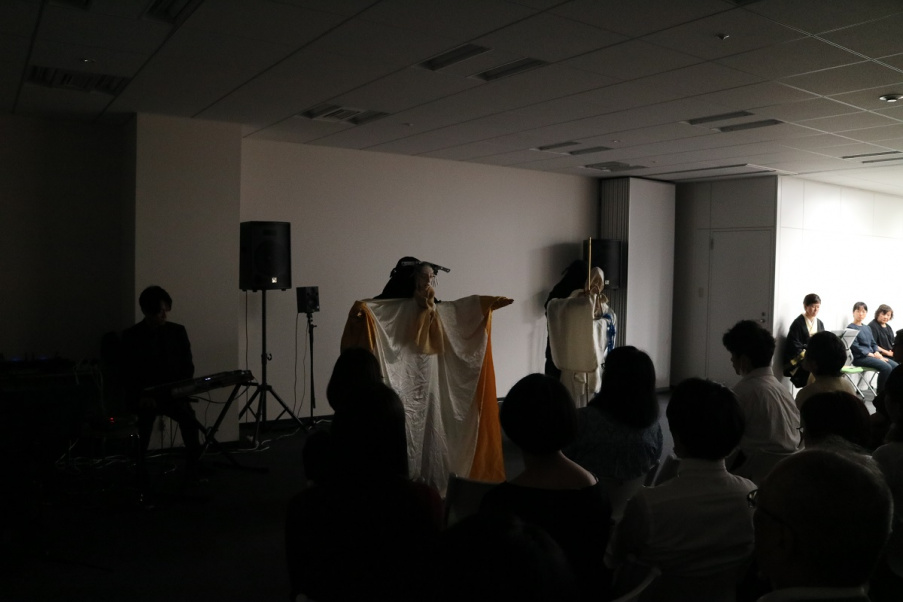
Life-size puppets quietly appear, led by shamisen and sharp scene descriptions by rokyoku performer Tamagawa Nanafuku. The rhythms of percussion instruments mixed with electronic sounds and chants echoing like proclamations begin to breathe life into the characters of mythology.
A performance by 'Tenrai,' a performance group organized mainly by Noboru YASUDA, a waki-kata (supporting actor) of the Shimogakari Hosho school, to report the activities of the "Inanna's descent into the underworld" project. In one of the oldest recorded myths of ancient Mesopotamia, the goddess Inanna deserts heaven and earth to reach the gate of the underworld, and encounters gatekeeper Neti, ordered by the queen of the underworld, Elekishgar, who strips her of the seven divine powers.
The chants and lines are in Sumerian. However, in addition to the help provided by the explanation of the scene, the pleasing sound, and the charm of a puppet show, it is possible to be drawn in unintentionally. On the other hand, Neti, who has a ruddy face and a mustache, looks strong like a Kongo Rikishi, Inanna, who is thin and has a beautiful face, has neither eyes nor mouth drawn, and praises the transience of the uneven surface made of clay as if it is about to collapse (the doll was made by Shohei YAMASHITA). Their confrontation was not accompanied by a big gesture, but it was certainly painful, and the modern translation of Inanna, who lost all her divine power and was hanging from the gate of the underworld, as "weak flesh" seems suggestive of the relationship between entertainment, Shinto rituals, and the body.
Mythology: The Era Without Hearts
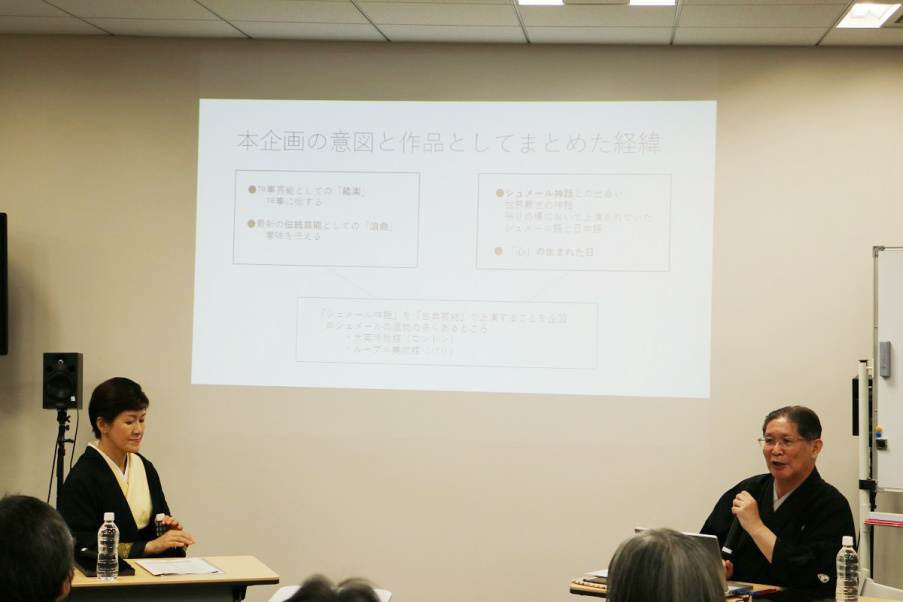
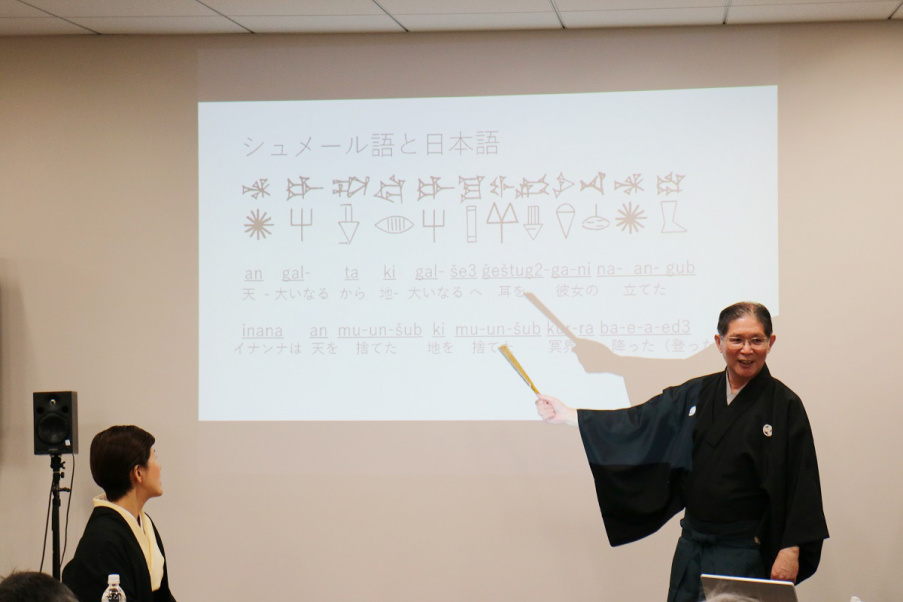
The performance group 'Tenrai,' organized mainly by Noboru YASUDA, a waki-kata (supporting actor) of the Shimogakari Hosho school, started to work on "Inanna's Descent from the Underworld," and it is said that the starting point was the problem of 'heart,' which has attracted people's attention and sometimes confused them, especially since modern times. Yasuda has long been interested in the existence and absence of "heart" in ancient times, ever since he learned the Ketsukoji, the original form of kanji (Chinese characters), when he was a student and learned that there was no "rishinben" (literally, "heart") in the group of characters. While performing, he continued his research into writing and mythology, and eventually came across the Sumerian language and mythology of ancient Mesopotamia, and the cuneiform script that described it.
"Sumerian is very similar to Japanese. They're similar phonologically, they're similar grammatically. I performed Noh in English a few years ago, but it was very difficult. I think that's because English has many words that end in consonants. Sumerian, on the other hand, mostly ends with a vowel. When I learned Sumerian, I first thought, 'I want to sing this.'. In addition, Sumerian mythology was originally handed down by mouth, and it seems that it was also sung. I thought it would be a better way to get closer to the problem of the heart, which I have been interested in for a long time, if I not only learned about it, but also performed it." (Yasuda)
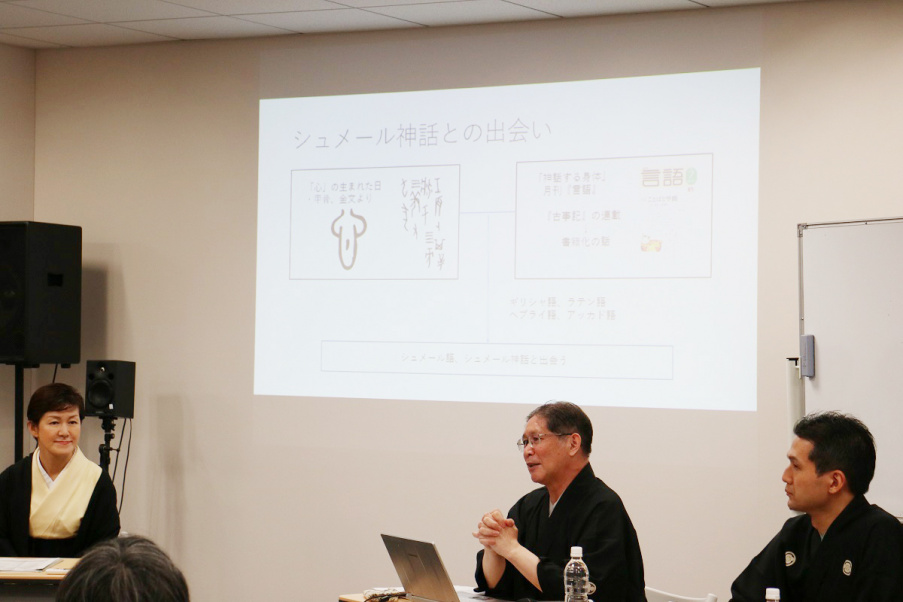
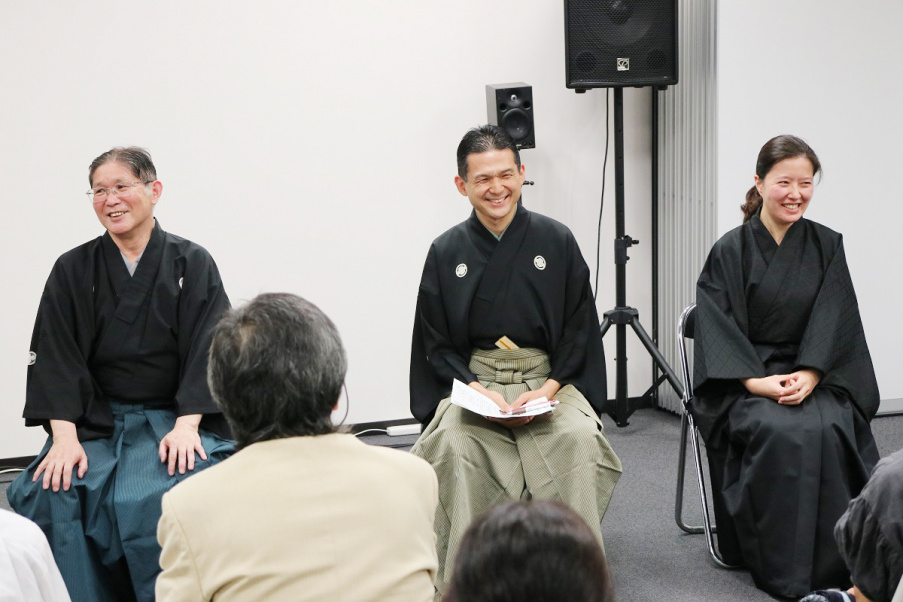
At the start of the project, Kentaro Okutsu of the "Tenrai no Kai", who is an Izumi-ryu Kyogen Noh performer and has been planning a unique stage performance with Yasuda for a long time, which is different from the group presided over by Shitekata, and Nanafuku Tamagawa, a rongoku master who had a history of co-performing with Yasuda's Terakoya, also participated. A new organization "Tenrai" was launched, and when it was adopted as a long-term grant program for Arts Council Tokyo, it officially started its activities in 2015. (At this time, the category I applied for was "a project with an ambitious project or creative activity that has never been seen before, and a goal to be achieved in two or three years.")
Twists and turns, ever-changing project
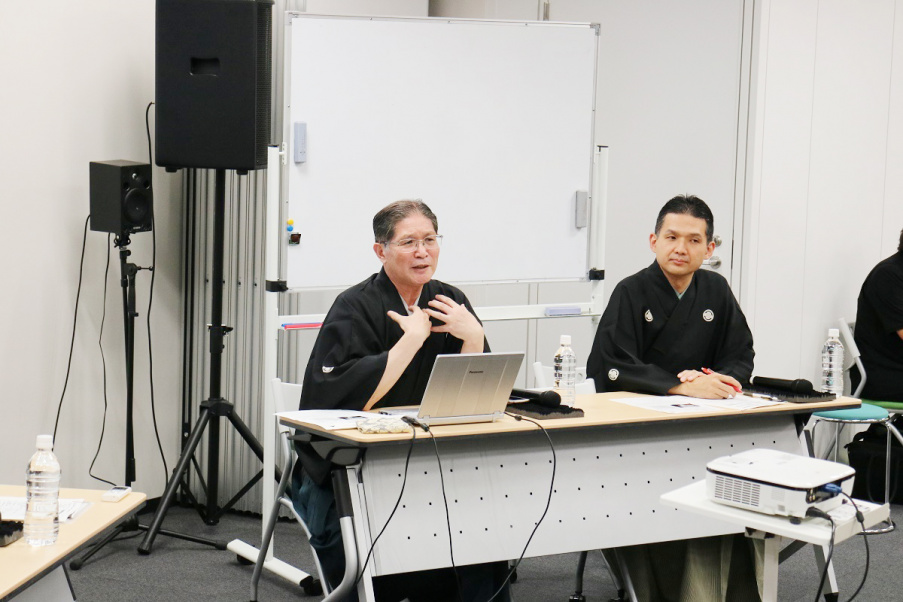
The "performance project" that Tenrai planned was not just about the success of a single stage performance. For this reason, he deliberately avoided imagining the final form of the work at the start, instead focusing on the changes and inspiration that occurred during the process. The first year's activities consisted of small performances based on scripts created with Sumerian language researchers, performances aimed at refining Noh and Rokyoku, puppet performances, and various workshops, including Noh and Kyogen, Rokyoku, and Sumerian. In this year, belly dancers and singers of medieval music participated. After the pre-performance at the Nasu Niki Club, they presented a spectacle of various performing arts, a performance with a Shinto ritual at a Noh theater, and a performance with a focus on hall performances.
It was only after the second year that there were signs of changes that would lead to the current style and themes. In April, after the performance of "Kodai-hen" at Saitokuji Temple in Taito Ward, Tenrai decided to work on "Kodai-hen Shinban" with members of the Noh and Rokyoku troupes, and to produce and perform "Mirai-hen."
"Since this project was applied for in a "complex field," performers from a variety of genres are on the same stage. That got used to each other and started asserting themselves. In Nohgaku, they don't practice and match in advance, but there is a common recognition that they move around the shite. But with so many different genres, that consensus started to slip.""The more we did, the more we wanted to do something for our customers. But that doesn't work. Noh hates insisting that 'I want to express myself this way.'"
It is easy to imagine that Nohgaku, which is characterized by Shinto rituals and ceremonies, is not an art form based on expressions and interpretations by individual performers. More than that, however, there must have been an attitude that was required because he faced the subject of "myth.".
"There are some things I want to express in rokyoku, but here I'm just saying exactly and loudly what's written in the script. I feel like I'm giving my voice and body, and I don't even feel like I'm acting."
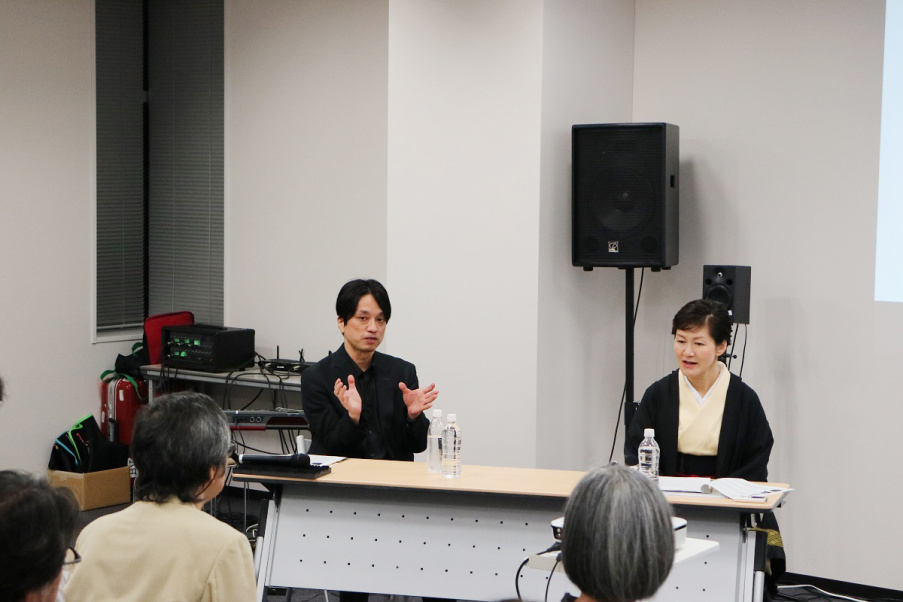
Musician Satoru Ono, who joined the project immediately after the pre-performance, talks about the history of the electronic sounds he deals with, and explains that what he has in common with Nohgaku is communication with things that are not here. "For example, a musical instrument called the theremin uses the principle of electromagnetic induction to produce sounds, but people a hundred or so years ago thought of it as the sound of the spirit world. Therefore, the combination of traditional performing arts such as Nohgaku and electronic sounds is not so alien. The other day, I performed at Kaifukan, which is owned by Itsuki Uchida, a philosopher and martial artist. At that time, Mr. Uchida said that even people with different attributes and values from different countries can sympathize with "What's not here right now" and people who are not alive. In that sense, I feel that working on this project with diverse and unique members leads to universality."
In year 2 of the project, at the end of 2016, a new edition with street dancers was performed, and in year 3 of the project, in June 2017, Eima Yuasa, a contemporary dancer, and Seiko Ito, a novelist, read aloud a new edition.
"It was interesting that street dancers participated in the ancient part, adding a lively atmosphere like kagura. The music at Shinto rituals is not only solemn but also lively and fun. I used various things such as sumo drums, samba and ketchup, but it didn't feel strange." (l)
"The story of around 2000 B.C., when "mind" did not exist, is called "Ancient Times." In the future (with the advent of AI, etc.), the "mind" may disappear again. "The Future Edition" was created because I wondered what the world would become after that. In contrast to "The Ancient Part," which is full of sound, "The Future Part" is silent, without words or words." (Yasuda)
The richness of nurturing ideas
In the final year, one of his original goals was to perform overseas in the UK and Lithuania. For the performance, English subtitles were prepared and the directing was greatly renewed (the performance at the debriefing session was also close to this version). Although the plan to perform at the British Museum, which has many materials related to Sumerian mythology, did not come true, many researchers in the field visited the performance in the hall of the University of London, and they left their impressions that "blood and flesh passed through this discipline for the first time."
In the three years that Tenrai was eligible for the long-term grant, Tenrai has performed nine performances in four different versions, and has continued to hold workshops with general participants. At the end of the debriefing session, Yasuda was asked about the merits of being selected for the long-term grant program, and said, "I was able to start this project itself because I had to do it because of the subsidy, the money, and the fact that I had to do it. Even if you have an idea, there are many things you can't start because of financial or time priorities. In addition, the person in charge of Arts Council Tokyo gave me honest and sincere opinions every time. It can be said that this changed the work."
Along the way, there were many things that did not go as planned, such as the change of the participating members, the cancellation of the restoration of the Sumerian koto requested from Iran due to the influence of IS (Islamic State) activities (it was finally ordered from the US), and the change of the venue for the Lithuanian performance just before the performance, after the performance in England. But perhaps the reason the project has been able to overcome and swallow its troubles so far is that it was based on trial and error from the very beginning. I understand why it is difficult to provide public subsidies for "ideas" whose destination is unclear and whose results are difficult to see. However, there will be no prosperous future for arts and culture unless we continue to create a method of supporting the arts that is not bound by the degree of achievement of goals or the form of results, and create a place for thinking and trying. The Tenrai project report was also an opportunity to make this point keenly.
In fact, most of the performers in the demonstration I introduced at the beginning were participants in workshops held over the past three years, not people who live in art or performing arts. Even now, Tenrai continues to pursue the performance of "Inanna's descent into the underworld" as a 'ritual' different from a stage for viewing.