



In addition to using local dancers, there were collaborations between SKANK and an Indonesian performance artist, and between Keisuke Takahashi and a Malaysian choreographer. How did you get started collaborating with Asian artists?
- Yanaihara
- There is a choreographer named Yao Shufen at the Century Modern Dance Troupe (CCDC) in Taiwan, and I collaborated with him at the 2008 Asian Performing Arts Festival. I was asked by Mr. Soh Miyagi to do a dance work, so I presented a work of about 10 or 15 minutes. At that time, the Taiwanese suggested switching between Japanese and Taiwanese dancers. At first anyway, the choreographer doesn't move and the dancers go. After that, choreographers go to Taiwan and Japan to choreograph. Doing that led to the artists themselves connecting and talking about doing something. At that time, curators and producers were the dominant producers in every country, and artists themselves didn't often transmit information. Even in Japan, JCDN, DANCE BOX, various theaters and producers planned it, and we were like riding on them. So we talked about how that's a good part of it, but it's hard for artists themselves to think and take action. The same is true of Taiwan, so we decided to do something ourselves and started a project called "Dance In Asia." I understand how hard it is for producers.
But the same kind of movement was already happening in the field of art, and I think it was starting to happen a little bit in theater. Artists connect with each other and think about how to live, rather than releasing a work. You can also find out what artists of your age, slightly older or younger, from different countries, are thinking and creating. Even in Japan, choreographers sometimes talk to each other, but it is quite difficult to be so interested and work together. There may be people overseas who are trying to do something as silly as Nivroll, so I wanted to spread the word. For the first 3
years, I took students to Taiwan and Japan. I was running a dance studio in Yokohama at the time, and once every three months I held a workshop limited to five people. We had a project called "Small Steps," in which five people made a five-minute piece and presented it. We chose one person at a time and took them to Taiwan at the end of the year.All of this is organized by the artist, so the people who work with you have to be like, "We're going to do it ourselves." I can't do it in a situation where I'm given a guarantee and only think about the work. You have to think for yourself and communicate in English, and you can't leave that to someone else. So, rather than doing nibbles, we often take the form of supporting people who want to do a little overseas. The choreographers, myself and Yao's were included in the five-minute piece. There are times when it is difficult to make 5 minutes, but in such a case, everyone makes good use of it. I created Dance in Asia as a place for artists to grow in this way. So far, we have been doing this every 3 or 4 years in Taiwan and Japan for about 10 years, and now we are going to do the same thing in Indonesia.
Are the bodies of Asian choreographers and dancers different from those of Japan?
- Yanaihara
- Yes. There is obviously. But now I'm taking it one step further. I am very interested in what makes it so, for example, to be South Korean, Japanese, or Indonesian through a country.
- Takahashi
- There is a difference between what is called a national character and a simple individual character or personality. When I meet Malaysians, too, I encounter gestures and bodies that say "This is obviously not Japanese." On the other hand, is this exactly what "Malaysia" is, or is it something traditional and cultural with the country on its back? When we went to Europe, we were often told that it was "Japanese" or "Kabuki-like," but one of the themes of "Dance in Asia" now is to think about where the movements and triggers that make people think that way come from.
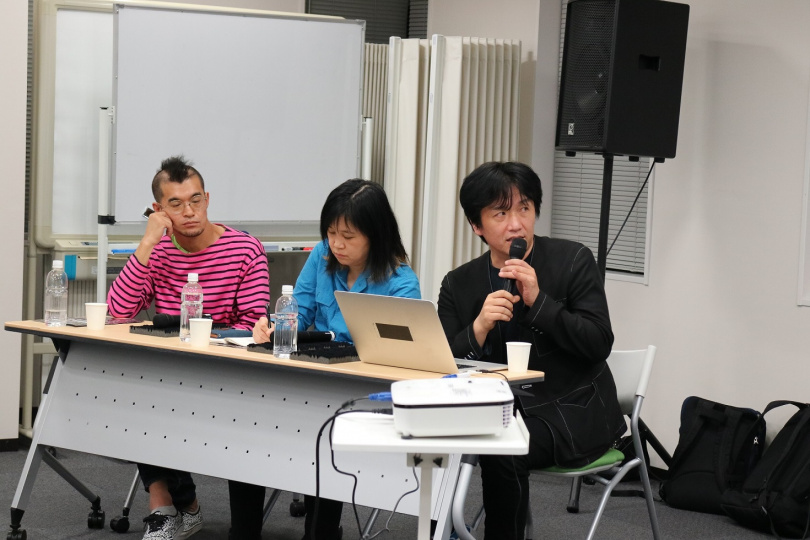
- Yanaihara
- It's not a cultural or traditional dance. Just by standing there, you feel like you're Korean or Japanese. I often talk with choreographers in Korea, Indonesia, Malaysia, and Europe about where that comes from, and I haven't yet been able to establish a clear theme for how to bring that "poi" into the body, but I think that it will be used in the next work and choreography.
Since this is a briefing session on the long-term subsidy program, I would like to hear your opinions on what could have been done because of this system, or what would have been better if there had been something like this.
- Takahashi
- The process of creating a Nibrole work is to share a theme with everyone, then work in areas that each person is in charge of, and then work in a rehearsal studio for three or four months to combine what everyone has been working on together to create a single piece. With Real Reality, we had the luxury of gathering other people [in advance] to do our creative workshops. This is all thanks to grants. It was three days in Wakayama, three days in Nagoya, and three days in Tokyo, and the content was gradually stepped up, and I was able to hold it while the participants were convinced, which was a big gain for me.
Also, images are not necessary for the stage, so many of the people who came to the workshop were not stage people. People who worked in movies and computer graphics, animators and other professionals, but "I don't know the stage at all," gathered. I think that was rather good. You mentioned earlier that it is difficult for dance to attract customers, but I think that images have the potential to show how many people who are not interested in the stage come to the theater. I think it was good that I was able to think again about the body in the midst of people who are not interested in the stage. - Yanaihara
- Around the world, it has been said for about 5 years that it is not divided into fields and that it is non-field. This has become a real necessity recently, and when I look at the works of young German choreographers, I see that they have released works that do not only dance but also take away the field of the stage. If there is a subsidy for something that goes beyond the field in this way, I think this movement will spread more. Instead of limiting the subject, such as art for art, or stage for stage, we should be able to search for new things while loosely connecting various fields. That's a luxury.
And when you say dance, there's jazz dance, there's hip hop, there's ballet. Compared to other genres, contemporary dance is rather weak and difficult to understand. Because you can't dance without thinking. You start with thinking and your body changes. Of course, dancing to the rhythm and traditional forms that have been practiced for hundreds of years is also important, and I think we should not lose that. However, at the same time, it is also important how to communicate that we change, evolve, and think. So, I don't think it's necessary to have a system that requires the announcement of final results. If I say such a thing, people will probably say, "What were you doing (receiving subsidies)?" But I think such a thing is OK. - Questioner 1
- In Mr. Yanaihara's talk, Noism was the only contemporary dance company that was able to perform with regular subsidies. Could you tell us more about that situation?
- Yanaihara
- In the first place, a subsidy is to help a part of the cost, not all of it. Therefore, Japanese manufacturers have to start their projects without knowing whether they will get subsidies or not, and without knowing the overall budget. In France and other countries, choreographers are stationed at a choreography center, which is like a civic center, and they come up with projects there. In Japan, there is no such system, so every company starts a project without money, and if they are lucky enough to get a subsidy, they can make a breakeven profit. In the case of Minoru Kanamori's Noism, luckily Niigata City wanted to own a company, and it worked well. Noism is funded by the city. I heard that it is decreasing year by year.
If it is true, I think it is not strange that such companies exist in all 47 prefectures. I hope these 47 companies will have a chance to convey creative works and dance to the citizens. In other countries, for example, in the U.K., there is a system in which a person such as a theater teacher or a dance teacher is required to be in the school to give instruction. But in Japan, this is not quite possible. In the case of dancers, when they reach the age of 30, they either quit and get married or become yoga teachers. If you're a yoga teacher, you can still dance, but 80% of you end up as a housewife. I'm not saying that's a bad thing, but it's a waste not to be able to use your previous experience. In England, there is a part-time job of teaching at a district hall, but there is no such thing in Japan.
Theater Act (※ In two years or so, people who have studied such things at universities may be dispatched to local public facilities to run projects, but dance is not included in that. So it's in a very severe situation. As I said earlier, 20 years ago, I thought that a choreography center would have been established by now, and if you had a certain level of ability, you would be able to work there. We will do various activities there, get people in the community involved, and the community will change more and more, and people will say, "Let's go see King Lear at that district hall today." But it hasn't. Even Mr. Kanamori, it is very hard. The city gets the budget. "What about the lack of mobilizations?". Mr. Kanamori is now trying to establish a dance school in Niigata. In the case of dance, if we can properly approach the field of education, I think the possibilities will expand a little.
People who have studied and practiced art and art are very important people. It is our original job to always think about how to manage the district hall, and we have to produce results. In fact, there are places where about 80% of the hall is vacant and nobody is renting it. For example, it would be better to encourage young troupe members to rent the space for less money, or to encourage people who have studied to develop new projects for the same salary. Of course, you could give the money to choreographers and their assistants. If we can keep doing that, I think the situation will change, and I want to make it that way somehow.
*Theater Act: The "Act on Revitalization of Theatres, Music Halls, etc."(Theatre Act, Act No. 49 of 2012) is a law enacted and enforced in 2012 with the aim of promoting the performing arts in Japan by improving the standard of the performing arts in Japan by revitalizing theaters, music halls, cultural halls, and other facilities based on the current situation and issues facing them.
In the "Guidelines for measures to revitalize the business of theaters, music halls, etc. (the Ministry of Education, Culture, Sports, Science and Technology Notification No. 60 of 2013)" announced in March 2013 following the enactment of the Theater Act, the training and securing of professional human resources and the improvement of staff qualities are listed as priority issues that should be addressed by theaters and music halls, etc., when conducting business, along with clarification of management policies from a long-term perspective and implementation of high-quality business. Efforts are being made to utilize professional human resources for business operations in accordance with the management policies of individual theaters and music halls, etc.
- Questioner 1
- What kind of comment would Arts Council Tokyo make to such a situation?
- Kitagawa
- Especially in the fields of dance and contemporary dance, I see that the expansion of the audience is interrupted.
For example, as Mr. Yanaihara said, I think it would be ideal for people who have been working hard in theater for a long time, to do business at local halls, get jobs in various places, and eventually become artistic directors of theaters. However, it is true that the only such example, especially in the field of dance, is Noism's Jo Kanamori, so I hope it will spread a little more. Also, if Arts Council Tokyo can do something about these problems right away, we don't have a magic bullet or prescription yet, but we don't just subsidize performances, we also have programs that can support projects to improve the environment, and even outside of subsidies, I am always thinking about whether I can help each field develop further, and I am also doing research. - Questioner 2
- If you look at the average age of countries around the world, the average age of the entire population of Japan is about 47 years old, which is pretty much at the top. As Japan's aging population is a reality, I feel that it is necessary to universalize people to go outside and exercise their bodies as much as possible, rather than watching TV at home and using robots to help. By expanding the base of the population in this way, the feeling of actually being physically active decades ago comes back. As you just mentioned, in a situation where people have not yet grown up to incorporate dance into school education, and the average age is 47 years old, I think it would be a good idea to start from a place where people who have even a little experience can move their bodies and work from the bottom up to create many small mountains. Instead of radio calisthenics, we do all kinds of dances, and from there we have a new genre of dance. By connecting in that direction, a certain kind of art will grow, even if it takes time. There was a time in the 80s when a lot of boxes were made, and we have to make effective use of them, so my impression is that it would be nice if someone could organize and do that.
- Yanaihara
- I hope we can do that. My mother started towel gymnastics in Ehime Prefecture when she was over 60 years old, and now she has about 1,500 students. It is a gymnasium that can accommodate 100 or 200 people at 1 time. It takes 25 to 30 minutes and costs one coin or 500 yen per month, so it is popular. So when we perform in Ehime, a lot of students come to see us. It's a crazy towel exercise, but if someone starts it in Tokyo, I think it will spread more widely. And if people in their 40s, 50s, and 60s who have been involved in dance start teaching towel exercises, even if it is just one coin, if there are 1,500 students, it will be 750,000 yen a month. It's a pretty high income. If you can start a business like that, the situation may change. In the case of theater, people in their 50s have passed the Theater Act and young people have become artistic directors. But in the case of contemporary dance, it is difficult to start now.
- Questioner 2
- Like Hideki Saijo (who choreographed "YMCA"), I think it would be a bit healthier if we linked this to the trend of society as a whole, where everyone puts their bodies and voices to the best of their ability. So you can do it in cooperation with music people, and I think it's good to experiment with various things.
- Questioner 3
- In Japan, not only dance but also art projects, art festivals, and theatrical performances are often evaluated based on the number of visitors and revenue. Mr. Yanaihara, who leads your company, would you tell us if you have any points that you would like to see evaluated in terms other than money, or points of view from which you can say that our project was successful because of this process?
- Yanaihara
- It is true that the number of visitors is often mentioned. Fortunately, Nibroll has grown from a few hundred to 500, and then from 500 to 1,000, but there are still interesting works that don't have many people. So I think we are in an age where we can leave it up to each individual to decide what to evaluate, and I think everyone has a feeling that they don't want to be decided by the number of visitors.
- Takahashi
- The amount of money and customers is important, but I'm not really interested in that. Nibrol also started at a small place and gradually stepped up, going overseas, and working at a big place, but I'm not interested in going up the stairs like that, and I don't think there's a "step up" after all. As an artist, I really feel that it will be difficult to continue to create works in the future unless you have a purpose to create works in other areas.
- Yanaihara
- What I want people to appreciate is that when you make your work, you focus on the vulnerable people. For example, we often use expressions like loneliness, feeling unhealed, violence, or standing alone all the time. I think Nibrol has always been focused on how weak people can gather and express themselves, and even if we don't do that in the future, I want to keep that perspective. The other day, I held a workshop in Sendai for the first time with people with intellectual disabilities. When I did that, unexpected expressions came up, and the actors simply said "interesting" and "amazing." Including that experience, Nibrol's focus on vulnerability itself is something that we often discuss in our work, so I hope people will see that.
Nibroll
Formed in 1997. Centered on choreographer Mikuni Yanaihara, video artist Keisuke Takahashi, musician SKANK, and other members who are active in various fields come together to create and present stage works in this dance company. He pursues the possibility of physical expression not only in theaters but also in museums and outdoor performances, but also from various perspectives such as images and art. He won the Travel Award of the Mori Art Museum MAM Contemporary Award (2004) and the Japan Dance Forum Grand Prize (2009) for Romeo OR Juliet. While mainly based in Tokyo and Yokohama, he has also been expanding his activities by presenting his works in Europe, America and Asia.
Mikuni Yanaihara
Formed Nibroll, a dance company, in 1997 and Mikunya Naihara Project, a theater company, in 2005, and presided over both companies. He has received high acclaim in both the dance and theater fields and has held many performances overseas. In addition to actively collaborating with domestic and international artists, he has been expanding his activities in Asia in recent years, such as being appointed as a cultural exchange envoy of the Agency for Cultural Affairs in 2015 and doing research in 6 Southeast Asian countries. He is an associate professor of the Department of Performing Arts, Faculty of Letters, Kinki University.
Keisuke Takahashi
While working as a video director at Nibroll since its inception, he has also held solo exhibitions as a filmmaker overseas, including in Italy, and exhibited his work at international exhibitions such as the Setouchi International Art Festival (16) and the Jakarta Biennale (17) in Indonesia. Awarded 'The 9th Agency for Cultural Affairs Media Arts Festival' (2005) as an excellent work recommended by the Jury.
SKANK
A musician. He joined Nibroll in 2005. He has been actively engaged in sessions with musicians and artists of other genres, and has contributed music, performed and performed on many physical expression stages in Japan and abroad. In recent years, he has been in charge of film music and held solo exhibitions. In 2018, the gallery in Chiang Mai and the MAIIAM Museum of Contemporary Art collaborated to produce a solo exhibition and performance, and the range of activities has been broadened.