



- target business
- Niwa Gekidan Penino (Arsch LLC) 'New "Hakobune" Project' (adopted in FY 2014: 3 years)
- Speaker (Reporter)
- Tanino Crowe (Playwright and director of Penino Garden Theater)
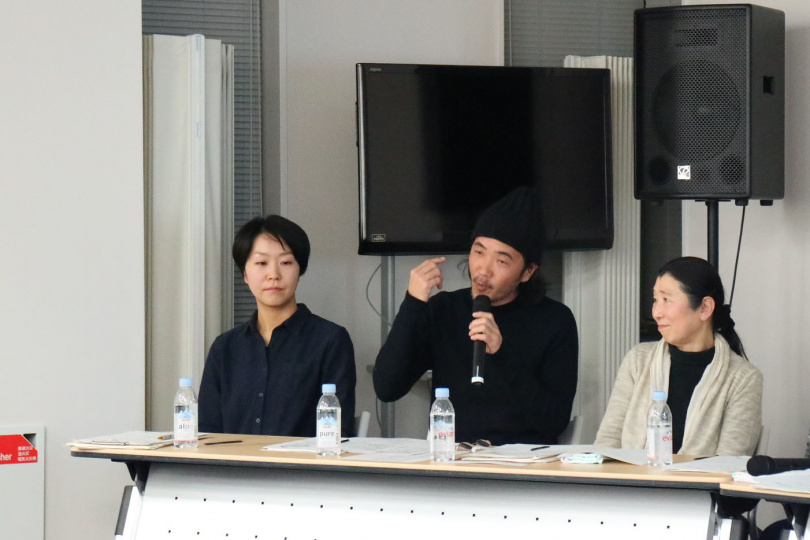
Kayo Ishikawa (actor), Susumu Ogata (actor), Yui Matsumoto (assistant director) - guest speaker
- Max-Philippe Aschenbrenner (performing arts presenter)
- moderator
- Akiko Sano Senior Program Officer, Planning and Support Division
Outline of subsidized activities
With the rotating tray stage "Hakobune" as the new symbol of the troupe, this project aims to become an internationally active creative group based on elaborate stage art and a detailed and original world view. The following performances were supported by the grant: A Box in a Big Trunk (2014 Swiss performance), Water cage (2015 Krefeld City Theater, Germany commission), Jigokudani Onsen Mumyo no Yado (First performed in 2015, toured Europe in 2016), and Dark Master (2016 Tokyo performance).
Part 1 Creating a "Place" for Creation and Presentation
It was adopted for the Creation Grant program (long-term grant) from 26 to 28, and during that time, the presiding officer, Mr. Tanino Kuro, won the Kishida Drama Award and toured Europe for the award-winning work, greatly expanding the range of activities. In the first part of the debriefing session, the process of applying for a long-term grant, the state of their creation, and their recent development, which is known for their exquisite stage space, which can be called hyperrealism, were introduced with comments from the cast, staff, guest speakers, and performing arts presenter Max = Philipp Aschenbrenner, who has become close friends through overseas performances.
(Text: Rieko Suzuki)
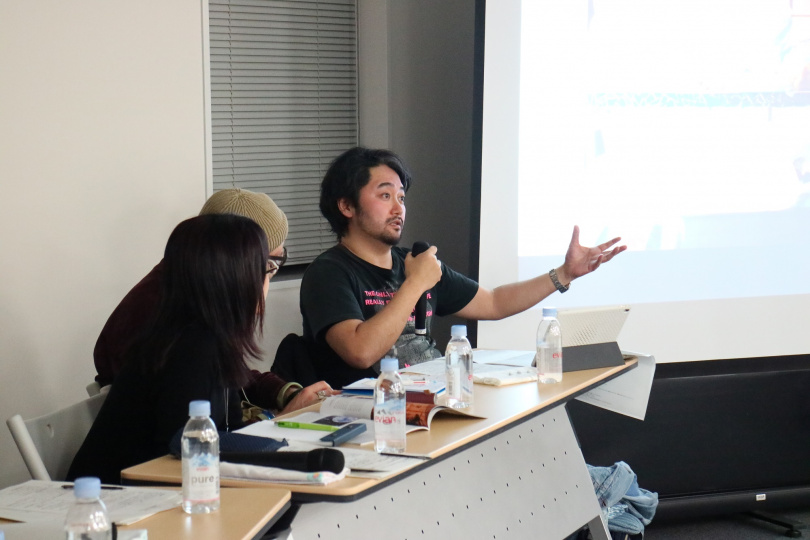
Creation Grant In the program (long-term grant), support for the garden theater company Penino began in 2014 (Heisei 26). In 2012, he left the theater company atelier "Hakobune" that he had been using for many years and succeeded in his first work "Box in the Big Trunk" (2013/Morishita Studio) with a rotating stage. At this time, the name of the submitted activity plan was "New 'Hakobune' Project". To establish the stage set "Hakobune" using a tray as a symbol of Penino and to disseminate it internationally. Create a new work based on this premise. And to continue the production of works with Osaka actors that began in 2013. The reason why the name of the former atelier was given to the plan to create and disseminate new ideas in a field different from the traditional "small theater world" based on the above three activities is because it symbolized Penino's creative attitude. At this debriefing session, a considerable amount of time was spent explaining the background.
"Hakobune" is an atelier and theater built in 2004 by renovating the apartment of Tani no Kuro, who is in charge of writing and directing the play. The experience of immersing yourself in a small, elaborately crafted space in a very common apartment has attracted the attention of theater enthusiasts from the beginning. "As it is now, young theater companies have to rehearse while drifting around the community center, and within two days at most after entering the theater, they have to adjust all the art, lighting, sound, and the sense of distance between the actors. I wanted to get out of that, and I didn't want to get used to it." Tanino explains why he came to have his own base a few years after its formation in 2000.
In fact, the creation process of the old "Hakobune" period was "everything under my control," says Tanino. The first thing that is made is art and props. After that, the lighting and sound are decided, and finally the actors are placed. Even at that point, there was no script, and only by taking pictures of the stage with the actors standing and arranging them could the theme and story be found and put into the lines. In a home studio where there are no restrictions on time or usage, late-night rehearsals are not uncommon, and it seems that the actors were particularly burdened. However, it is also true that this excessive environment in a sense brought out Tanino's creativity. Hyper-realistic and fantastic masterpieces "Frustrating Adult Picture Books" (2009) and "Your Room That No One Knows" (2012) were born from this small room.
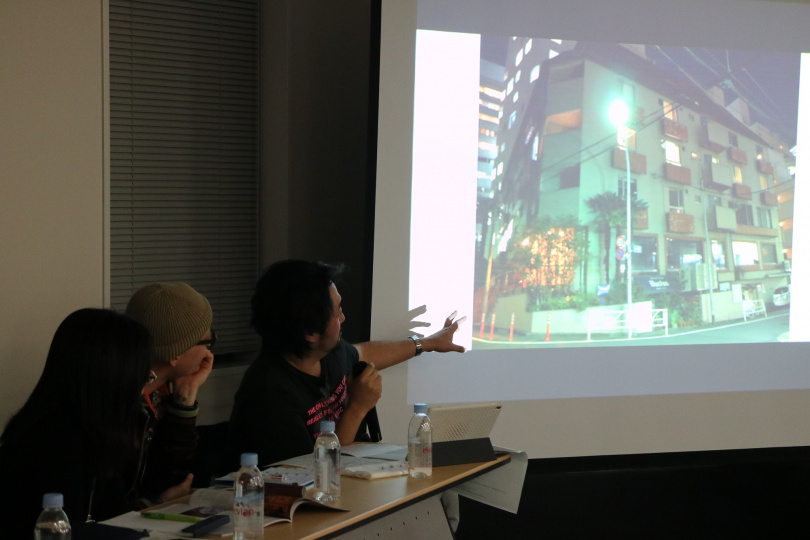
New 'Hakobune' Project Begins
However, in 2012, due to demolition due to deterioration, Penino was forced to end his activities at "Hakobune". "I was born in Toyama and have lived there since I was 15 years old, so I had a lot of memories of my adolescence. Until then, I had been acting like a king, so I didn't know how to make a work." After thinking about it, Tanino consulted with the Saison Cultural Foundation. He rented Morishita Studio for three months, but there was no way he could come up with a new idea for a new work right away, and he said that he spent a month in a "nightmare". "I had to put a hammock in the studio and sleep there from morning to night, wake up, scream, shadow box, take a walk, go back to sleep, and so on. At times like that, I don't know why I'm suffering. But one day, I suddenly realized, 'Oh, this is because the atelier is gone.' There was something that opened quickly. The image is like only a hump coming out of the room in that apartment and landing in Morishita Studio. In other words, I wanted to create a portable theater hut like Karajuro's red tent."
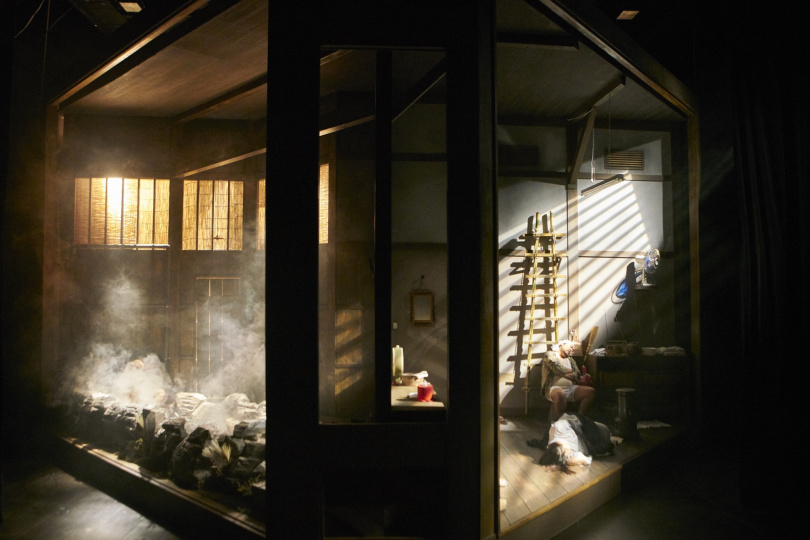
The result was a rotating stage "Box in a Big Trunk" (2013) that stored four sides of the scenery. The work, which houses representative works from the old "Hakobune" era in a single box, condenses the strength of its delusions and psychoanalytic essence, but combined with the transformation by the basin, it also has a boldness that is different from previous performances in closed spaces. "Even in this play, the stage design was present from the very beginning of the rehearsal, but there were some parts that I did not dare to create. Instead of doing whatever you want like in the past "Hakobune", I started to think about the physical characteristics of the actors and how they were seen from the audience. In that sense, human feelings were born...... It's natural. By having the lighting and sound operators always in the rehearsal hall and moving everything in conjunction, we were able to compose a stage where nothing was unconscious and everything had meaning." Arts Council Tokyo long-term grant was adopted, and support began with the Swiss performance in the fall of that year (from 2012 until the European tour just before that, it received a one-year grant).
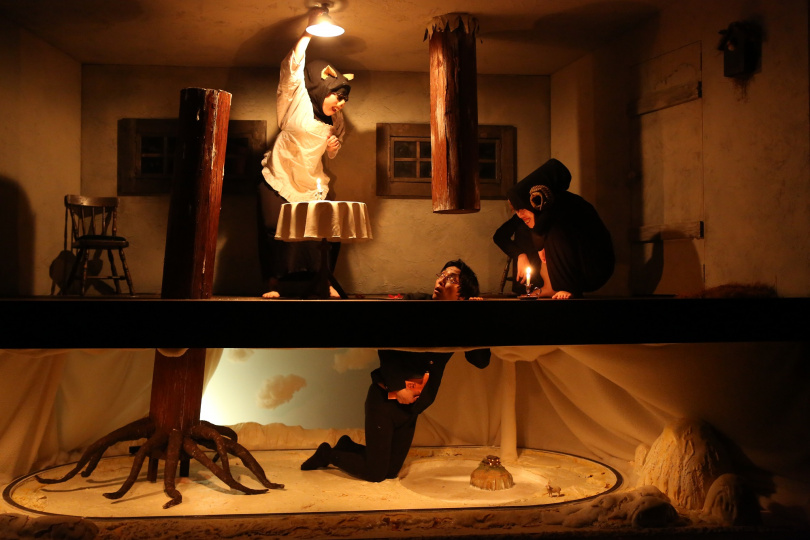
Thanks to the long-term grant, the creation using the new "Hakobune" finally began to take on the scale of a "project." "Jigokudani Onsen Mumyo no Yado" premiered in the following year, 2015, using the same revolving stage as the previous work, portraying the desire and desire for life that wells up in a rustic hot-spring resort. Unlike in the past, the script and art were almost completed on the first day of practice, which gave Tanino more time to face the actors and deepen his work's world. "I wanted the actors to put their own marks on the space to bring out the reality of the story. I just want you to live there. Even for art, collecting old furniture and props that were actually used. I thought of filling this work with the feelings that reside in such things." "Not only the art, the sound, the lighting, but also the actors were very meticulous in their criticism." said Kayo Ishikawa, an actor at the Saitama Gold Theater who played Penino for the first time. "Even for lines that are difficult to say, they try to figure out why they don't come out well, and sometimes they rewrite them. I think it was a very careful staging."
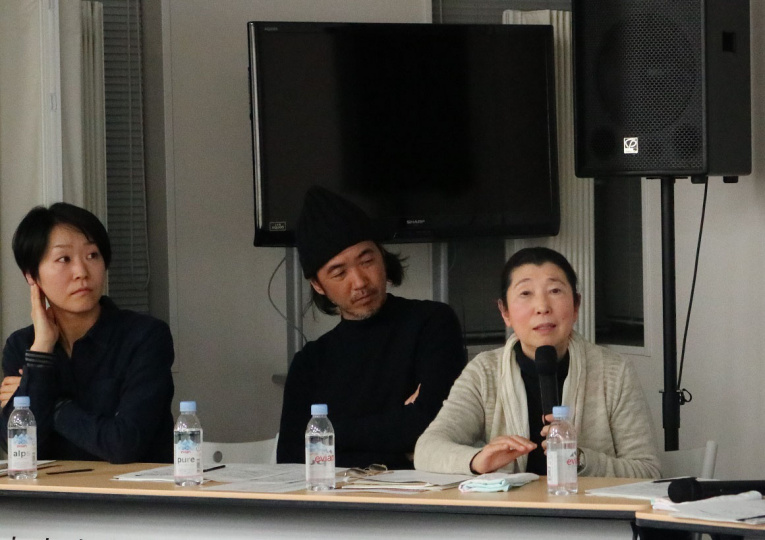
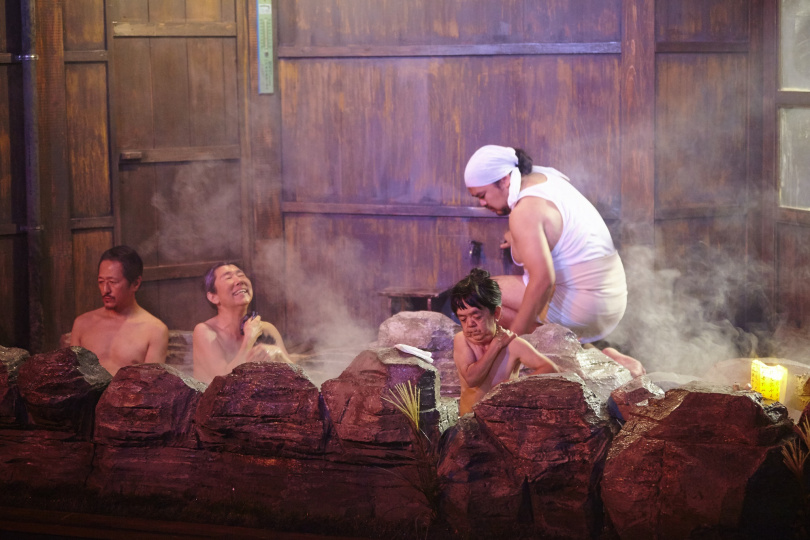
In the spring of 2016, Tanino won the Kishida Kunio Drama Prize for "Jigokudani Onsen Mumyo no Yado." In August and September, the third year of the long-term grant, the film went on a European tour, visiting Germany, the Netherlands, Denmark, and France. Penino's works, which do not focus on verbal dialogue, were likely to be easily accepted overseas. However, Penino's performance activities have been particularly active since around 2012, when the annual subsidy started, and his presence has been so strong that his activities were featured in the German theater magazine Theater der Zeit in February this year. "It's special for a German theatre magazine to have such an article highlighting a foreign artist." says Max-Philippe Aschenbrenner, who has performed in Lucerne, Switzerland, at the Vienna Arts Week, and participated in production at the Kinosaki Art Center with Tanino and Masayuki Nenguchi. "Tanino's work has a vision and an aesthetic. In contemporary theater, where the number of dry and conceptual works is increasing, he insists on reality itself. I feel there's truth and meaning in that."
increase the number of performers and spectators with the simultaneous spread of
Production of new works, international dissemination, and another activity mentioned during the long-term grant period was the revival of his masterpiece The Dark Master, which premiered in 2003, in Osaka and other regions, and its Tokyo performance. Penino's strategy was different from the revolving stage "Hakobune." In contrast to "Hakobune," which moves from stage to stage and expands its range of activities, this is a simultaneous effort to increase the number of performers and audiences through small-scale performances of old works.
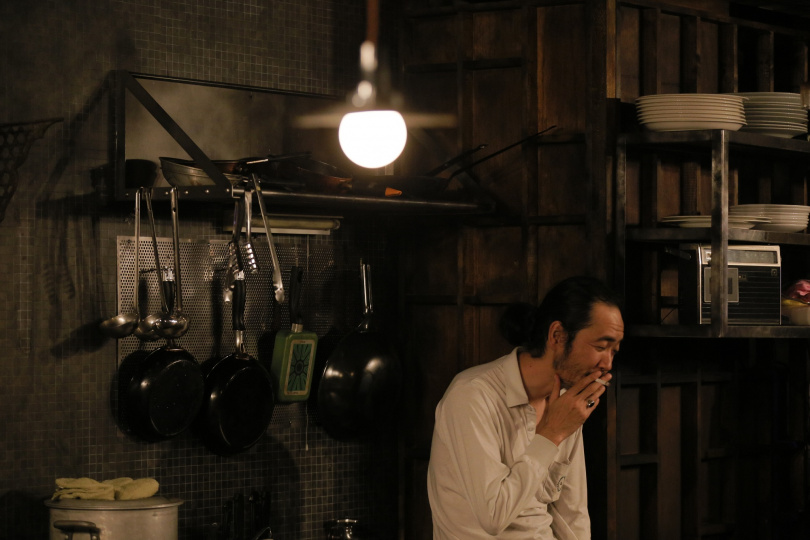
This performance, which was planned and realized in cooperation with the small theater Oval Theater in Osaka, was selected as a residency program of Kinosaki International Art Center in Hyogo Prefecture. Both training sessions at Kinosaki and at OVAL THEATER were conducted with a system that allowed him to freely spend a long time, enabling him to brush up on his work. In addition to the cast, there was also a massive “localization ” of the crew, with local talent being recruited. "They are very precise, like shaking a glass to make the sound of ice. New effects and foreshadowing emerge from such specifics. So as an actor, I felt like I was going to throw up (laughs) and I lost five kilograms. But it's rare to see such a sense of accomplishment. I learned a lot, including the importance of being there, not how to act." says veteran actor Susumu Ogata, who worked in Osaka for many years and played the mysterious master of a Western-style restaurant in Penino for the first time. According to Tanino, Darkmaster was originally intended for localization, with entertainment, a sense of accomplishment thanks to its technical sophistication, and the ability to recruit locals as extras. "At the first performance in Osaka, most of the players except Ogata were in their 20s, and they had very little experience. But at the Tokyo performance and the triumphant return performance in Osaka last year, the team itself became able to move independently. I'm glad I didn't touch most of it. The training period was only 2 days. If we create a system in which the people involved move around, it would be possible to create a professional team of "Dark Master" performers not only in Osaka, but also in other places. If we can achieve this with a small number of people, the guarantee would naturally be even and fair."
The "New 'Hakobune' Project," which began by moving out of an apartment building, is steadily expanding Penino's range of activities and audience. "Jigokudani Onsen Mumyo no Yado" was performed many times in Japan and overseas, and "Dark Master" was performed triumphantly in Osaka. Furthermore, in 2017, he started to produce works in M project with artist Kasper Bichner.
The activities of the garden theater troupe Penino, which does not have any actors and creates works based on the overwhelming spatial design of Tanino and his surrounding staff, may seem unusual among small theater plays. However, if we look at it from the perspective of how to create time for rich creative activities, how to hand over our works to society, and how to come up with sustainable forms of activity, we can find many hints. The Penino Garden Theater Company's plan and its path can be said to be a model case of a company that has taken on the challenge of solving the problems faced by many companies while honing its own creative originality.
* Continued in Part II (Part 2: In-Depth Interview)