


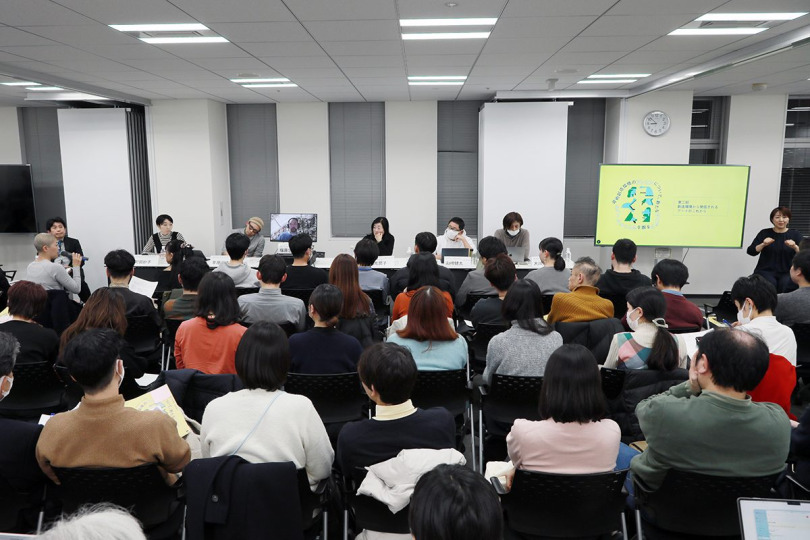
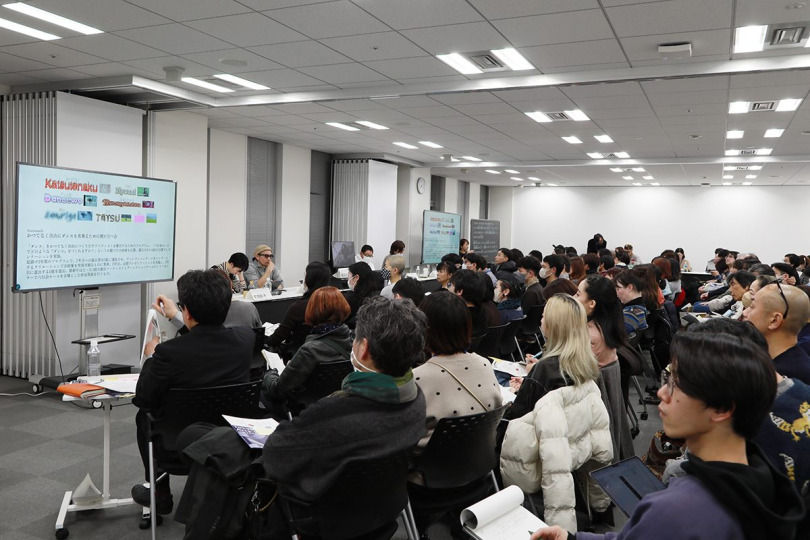
This briefing session was held with the aim of creating new ideas for projects that contribute to the improvement of the artistic creative environment, transcending various artistic fields. Instead of introducing completed projects as examples of success, the participants shared the ongoing situation surrounding the projects, including the points that are going well, the issues that are confronting them, and the things that were different from what they had expected. Although such reports tend to be organized by foundations and theaters, the fact that this report was attended by artists, producers, and critics indicates a heightened awareness of the problem of the creative environment. The event was successful with more than 100 applicants.
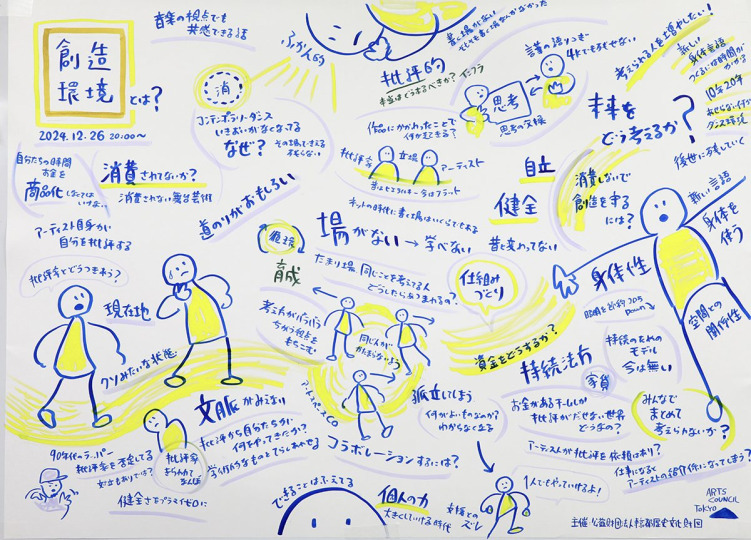
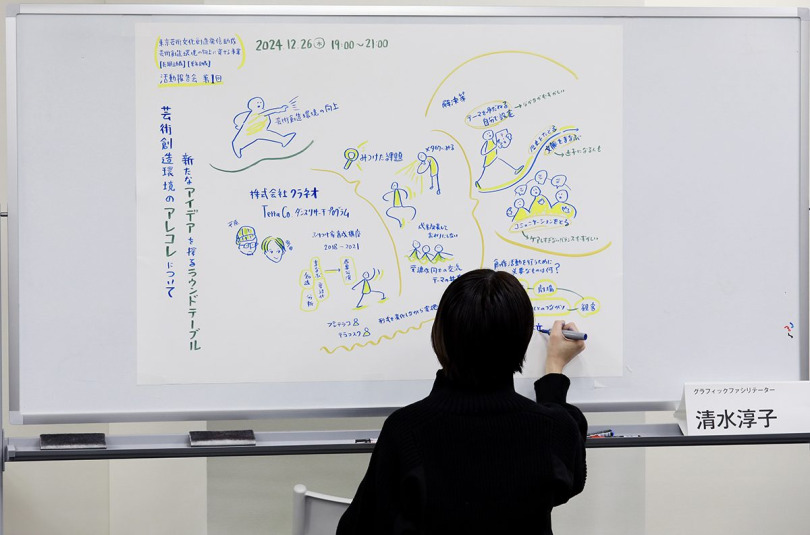
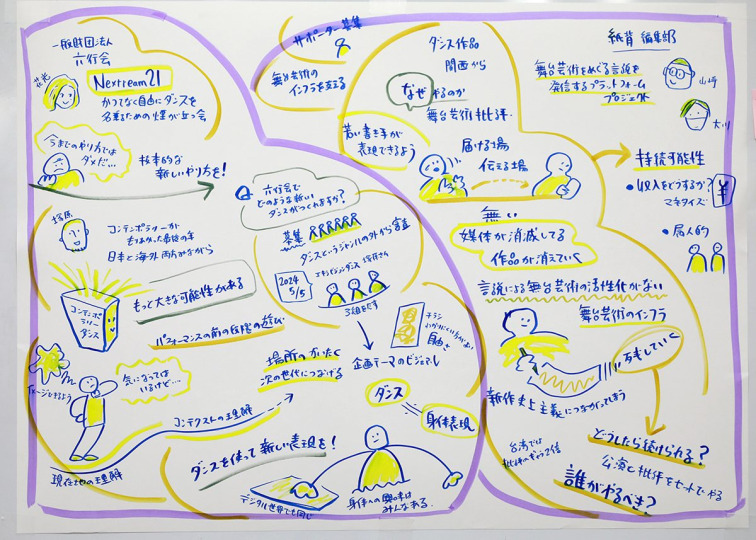
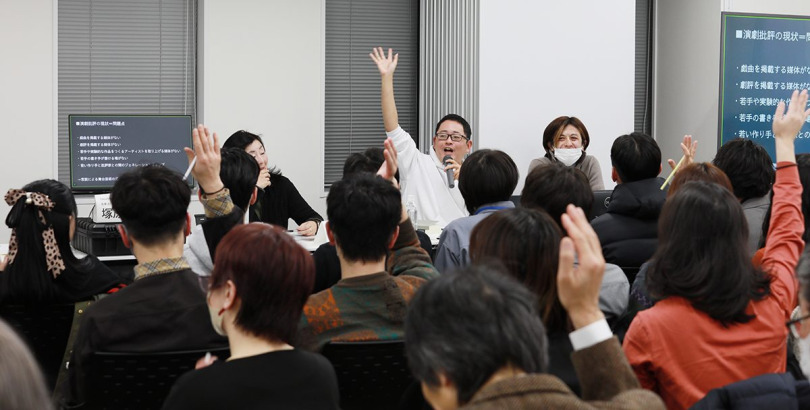
In addition, this debriefing session supported the creation of more organic dialogue and ideas by visualizing the content in real time by drawing up the content of the talk on the spot by Junko Shimizu, a graphic facilitator. Participants were given sticky notes and invited by the moderator to write down questions and comments as needed. During the break, the participants were asked to attach the sticky notes to the relevant parts of the graphic recording to get a bird's-eye view of the whole session.
*This report presents the contents of the meeting in two parts: Part 1 and Part 2.
- Date
- Thursday, December 26, 2024 19:00~21:00
- Venue
- Arts Council Tokyo
- target business
-
- "Terra Co. Dance Research Program"
(Creation Grant [Single-year grant] Reiwa 4 (2022)) - "Nextream21 A smoky meeting to call yourself a dance more freely than ever before"
(Creation Grant [Long-term grant] from FY Reiwa 5 (2023) to FY Reiwa 7 (2025) (3 years)) - Platform Formation Project "Paper Back" Phase 2 to Disseminate Discourse on Performing Arts
(Creation Grant [Single-year grant] FY Reiwa 5 (2023), Reiwa 6 (2024))
- "Terra Co. Dance Research Program"
- Reporting Organizations and Speakers
-
Kuraneo Co., Ltd.
Shintaro Hirahara (Director)
Taeko Machida (Producer)General Incorporated Foundation Rokugyokai "Nextream 21 Smoke rises to call it dance more freely than ever before"
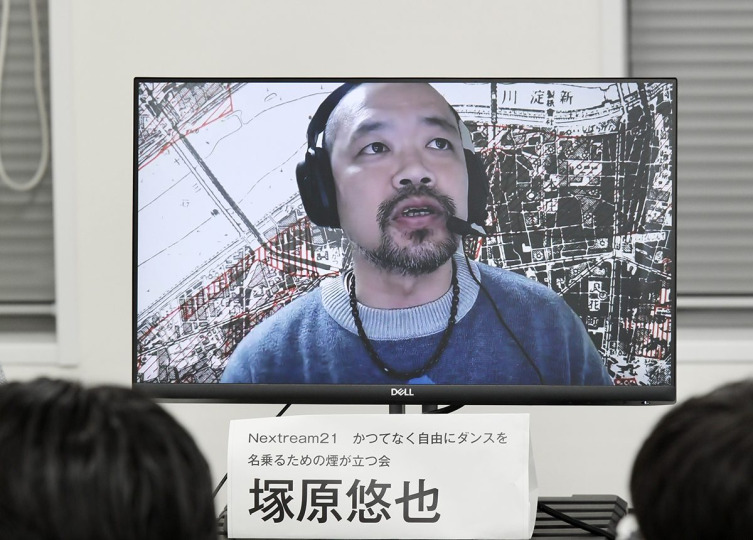
Yuya Tsukahara (Representative Director) * Online participation
Junko Hanamitsu (Producer)Paperbacks Editorial Department
Yamazaki Kenta (Editor-in-Chief of Paperbacks)
Okawa Tomofumi (Back Office, Online, Editorial Department, "Paperbacks") - facilitator
- MORIYAMA Naoto (Theater critic, Professor, Faculty of Fine Arts, Tama Art University)
- graphic facilitator
- Junko Shimizu
- moderator
- Tatsuko MIZUNO (Senior Program Officer, Support Division, Activity Support Division)
Grant Programs Activities
Kuraneo Co., Ltd.
"Terra Co. Dance Research Program"
"Choreographer Training Course Terra Co.": Developing Independent Artists
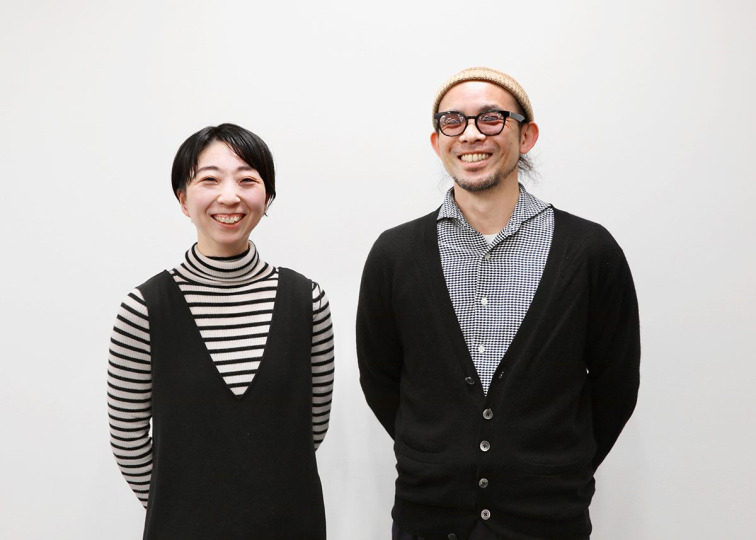
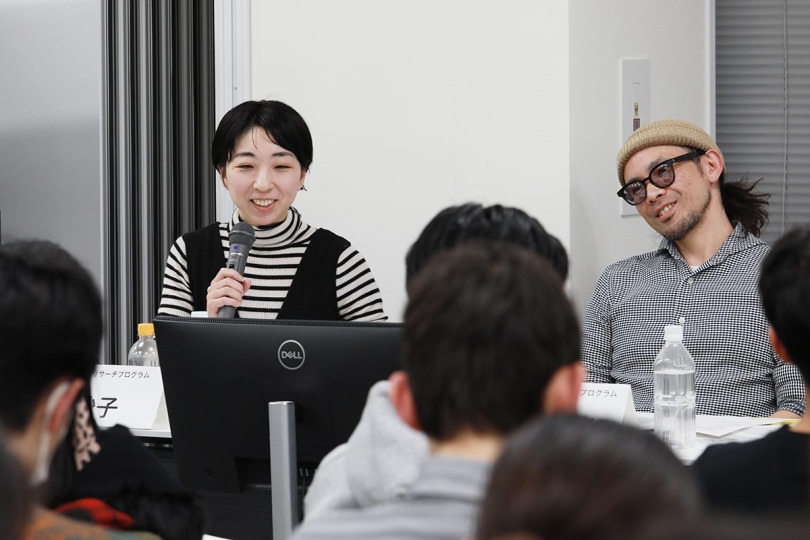
First, there was an explanation from Shintaro Hirahara and Taeko Machida about the "Choreographer Training Course Terra Co.", which is the predecessor of Grant Programs. This training course was held three times from 2018 to 2021, and then in FY Reiwa 2022, it was implemented as a project selected for the Creation Grant [Single-Year Grant]. While cultivating independent artists, it also aims to improve the audience's understanding and satisfaction of the work, and aims to improve the creative environment of the entire dance world in a way that includes both artists and audiences.
① 11 classroom and practical lectures as "learning"
(2) rehearsal space and advice as "creation"
(3) theatrical presentations and feedback as "performance results"
Musician Kagei Masayuki, rapper Rofu Karma, filmmaker and dancer Yoshikai Nao, and other artists working in genres other than dance were invited to teach the students how they verbalize dance, with the aim of training them in the ability to think from a panoramic perspective of the contemporary dance genre and the ability to verbalize their work. On the other hand, as a problem, it was pointed out that the performance itself became a goal, and the feedback and encouragement to find learning afterwards were not sufficient.
Another problem was that there were not enough opportunities for exchange among the students. The relationship between “lecturer and student ” could not be completely removed, and this may have been a factor in moving away from the realization of an independent artist, which was the aim of the program.
About "Terra Co. Dance Research Program"
The "Terra Co. Dance Research Program" was launched in response to new issues discovered through the implementation of the "Choreographer Training Course Terra Co." We implemented the following five concepts, each of which had positive results and reflections.
-
Given the diversity of motivations and backgrounds among the participants, the participants set their own challenges and goals in order to prevent the organizers from setting uniform goals, which would render the participants' autonomy ineffective and passive. However, this was a somewhat high demand for the participants, and they reflected that they were unable to follow up sufficiently because they valued their autonomy. - Tracing the Genealogy of Contemporary Dance
We held a course to learn about the genealogy of dance expressions created by our predecessors and how our own creative activities can be positioned within that context. However, there was a limit to understanding the lineage of dance and recognizing the current place of one's own expression in a limited time, and it became a superficial learning. - Creating an environment where people can communicate with others on their own
We increased opportunities for natural communication with each other, such as by setting up discussion time in the course and holding questions on LINE groups and Zoom. As a result, voluntary communication was promoted. - Feedback from a variety of perspectives
We have created an environment where feedback can be provided from a variety of perspectives, including dance and drama writer Ayako Takahashi, performing arts researcher and physicist Yuuma Etchi, dance researcher, dance aesthetics researcher and choreographer Hokuto Kodama, and Hirahara. As we had hoped, we were able to elicit feedback from each expert from a variety of angles. - Sharing the process with the audience through the presentation of progress and results
Instead of presenting only the final results, various stages, such as the presentation of the creative process and the interim presentation, were opened to the audience, and the performance of the results, which used to be paid, was made free of charge to reduce the burden on the participants.
what it takes to create
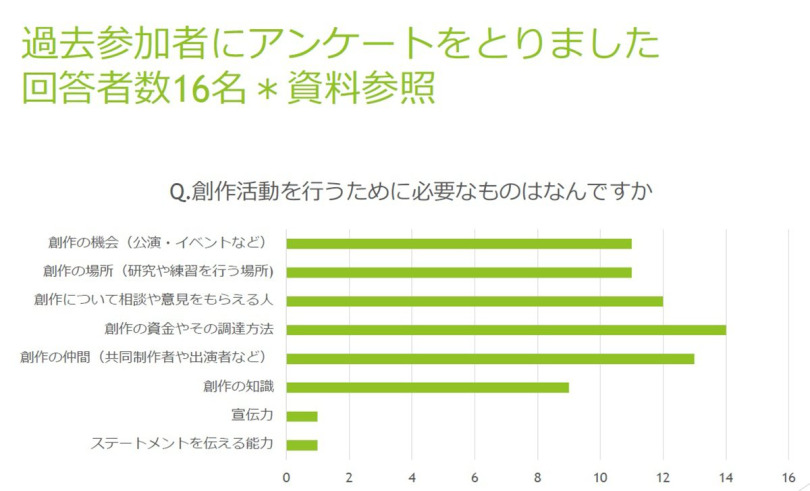
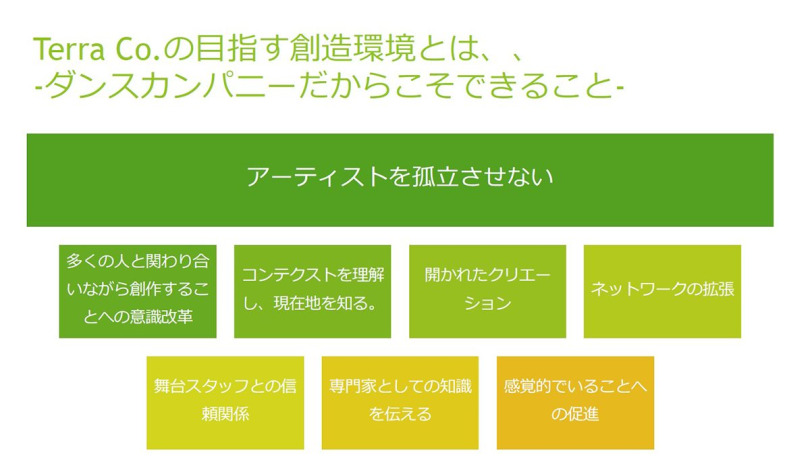
Finally, Hirahara presented the results of a questionnaire that he conducted for past participants. The results of the responses to the question, "What do you need to create?" show that people need support for the basic elements of a creative environment, such as opportunities and places to create, exchange of opinions and advice on creative content, and funding and procurement methods.
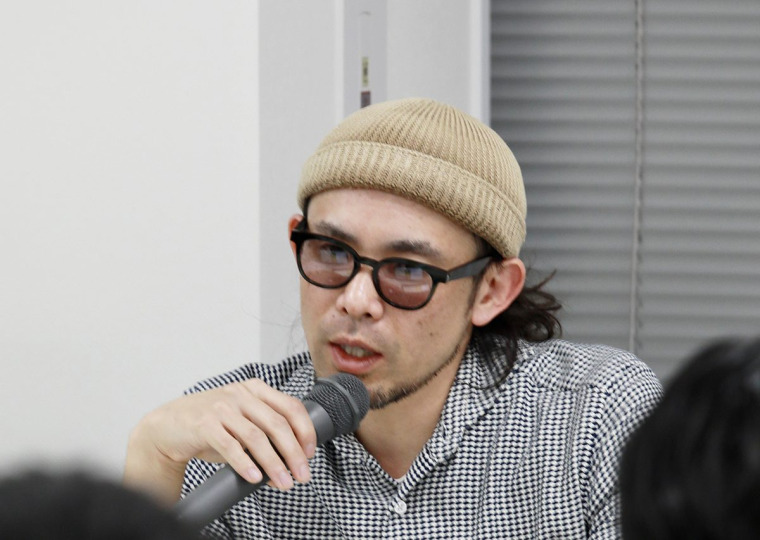
Hirahara concluded by saying, "As a company, we have been practicing how to provide artists with something to learn. After several years of doing business, I have come to understand that it is necessary to create the environment itself before learning. And since we are a dance company with artists, we will continue to think about how we can avoid isolating artists as our main mission."
General Incorporated Foundation Rokugyokai
"Nextreme 21 Smoke Rising Society to Call Yourself Dance Freer Than Ever"
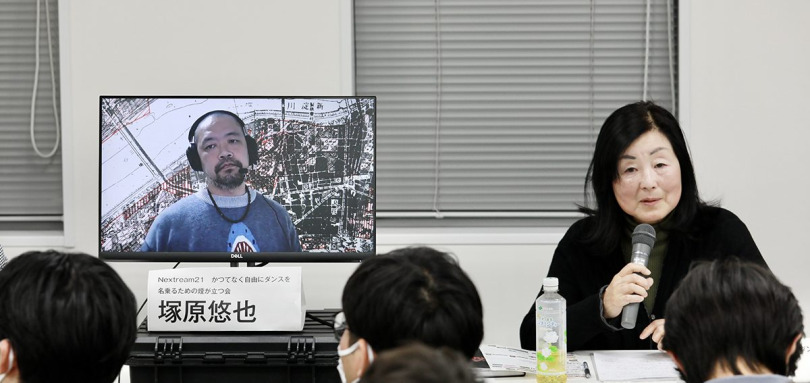
次に、一般財団法人 六行会による「Nextream21 かつてなく自由にダンスを名乗るための煙が立つ会」について、本事業の代表ディレクターの塚原悠也とプロデューサーの花光潤子が報告した。
an attempt to create a new expression of dance
Rokugyokai is a theater located in Shinba, Shinagawa, an area where townspeople culture flourished from the Edo period as Tokaido Minamishinagawa-juku. Rokugyokai was a private organization established by influential people, townspeople and merchants in the area to promote the restoration of education, culture and welfare. Since 2002, it has held the competition "Nextreme 21" to support young choreographers, and since 2008, the non-profit organization Kaibunsha has been in charge of its operation as the secretariat.
However, he felt a sense of crisis due to the recent stagnation and stagnation of contemporary dance, and in order to break through this situation, he launched a program called "Nextream21 Smoke Rising Association for Freedom to Call Dance More Freely than Ever Before" to fundamentally reform the existing program and create a new dance that goes beyond the boundaries of contemporary dance. It is being implemented as a three-year Creation Grant [long-term grant] project from 2023 and is currently in its second year.
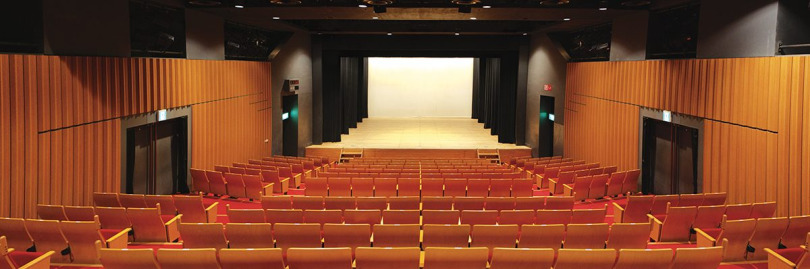
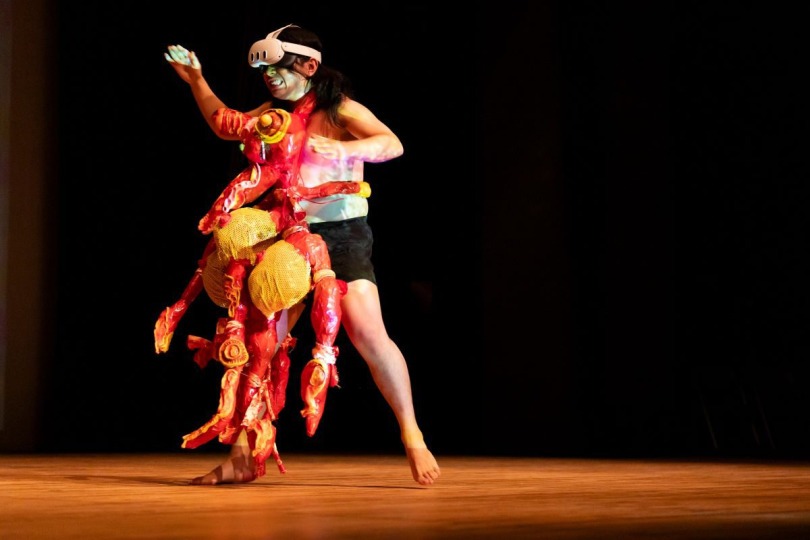
In the first year, proposals were solicited from the public under the theme "What kind of "dance" can we make at Rokugyokai Hall?". The 6 groups selected in the first round (JACKSON kaki, TOYOTA Yurika, New Dance Study Group, YAMAMOTO Takutaku Solo x HAGIWARA Yuta, WAKUI Tomohito, WADA Nagara) made public presentations at the Rokugyokai Hall in May 2024. Then, three groups (JACKSON kaki, Yurika Toyoda, Tomohito Wakui) are selected to advance to the second year, and through creation with the direction team as a mentor, the plan is updated to something feasible. Then, in May 2025, a public presentation will be held again and only 1 team will be selected to advance to year 3. In the final year, new works are presented at the Rokugyokai Hall through trial and error between the participating artists and the direction team.
"Contemporary dance should be more crazy. Humans have that imagination."
Representative Director Tsukahara explained the purpose of this project. Around 2002, when she was still a graduate student and contemporary dance was at its last peak, Tsukahara became involved with the non-profit organization Dance Box as a staff member, where she met people working in various genres. For the past 23 years, he has been involved in the creative scene by publishing his own works. During this time, I had the opportunity to go abroad, and as I came into contact with situations both at home and abroad, I observed what people involved in creative writing were thinking.
"Contemporary dance is a format that has the potential to do so much more, so why is this the case? You could do a lot more. Humans must have that kind of imagination, and how can we attract people who think that kind of interesting thing to the field called contemporary dance? We are proceeding with this project with the awareness that this will have a major impact on the years 10, 20, and 30." he said.
(参考)代表ディレクター 塚原悠也によるステートメント
「本来であればカート・コバーンあたりがバンドではなくコンテンポラリーダンスをやってくれていればよかったのだ」
(全文は団体のウェブサイトに掲載 https://www.kemuri-ga-tatsu.com/opencall )
The following three points were specifically addressed to the current issues.
- Creating Competitive Situations
With few opportunities for artists to interact with each other, the number of works that reflect the history of dance and are in sync with society and the ideas of the times has decreased. He created a competitive situation against the current situation where he has not yet established his identity as an artist. By doing so, we aimed to become a place for people to start new expressions using dance while understanding history and context. -
The influence of dance on the art world as a whole is weakening, and artists, including those in the art field, are less likely to enter the realm of dance, and changes and movements as a dance scene are slowing down. On the other hand, in order to attract artists from other fields to the dance scene, Tsukahara, Rieko SHIGA, a photographer, and Yantu, an artist, who are working in fields other than dance but create works deeply related to the physical nature, were invited, and a total of three people served as directors and judges.
After completing year 1, we received more than 20 applications from a wide variety of artists, not only from dance but also from other fields of expression. The theme, director, and visual design (Aiko Koike) worked effectively, and we were able to start off with a high impact. Furthermore, public presentations have attracted more attention than expected, and it has become clear that both artists and audiences are interested in physical expression itself. - Creating a New Free Zone of Expression Distinguished from the Creative Environment of Today's Dance Scene
When discussing the creative environment, we tend to focus on resource issues such as lack of grants and space, but we also raise the question of how much artists themselves are able to cultivate “free zones of expression ”.
Finally, Tsukahara concluded with the following outlook.
"It is deeply related to any field of expression, and it is becoming clear that physical expression will become even more important in the wave of digitalization. I hope that the field of contemporary dance will be able to play a role in creating new expressions in response to topics such as movement and physicality. And we want to think about what we can do to make the project more meaningful both inside and outside the dance scene."
"Paperback" Editorial Department "Project to Form a Platform for Discourse on Performing Arts" Paperback "Second Phase"
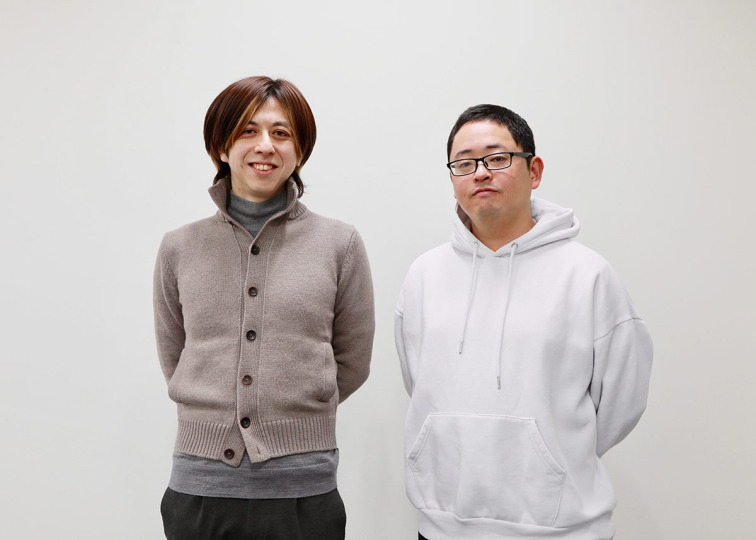
続いて、『紙背』編集部の山﨑健太と大川智史より「舞台芸術をめぐる言説を発信するプラットフォーム形成プロジェクト『紙背』第二期」の紹介があった。『紙背』は、冊子の『紙背』とウェブサイト上の「紙背WEB」の2種類の媒体で批評やインタビューを発表する演劇批評のプラットフォーム。『紙背』は文庫サイズの雑誌で、2017年5月から現在まで6冊が刊行されている。1冊に3本の戯曲を掲載し、その掲載戯曲1本につき劇評2本を掲載している。この演劇批評誌については助成対象ではなく、編集部の自費出版となっている。
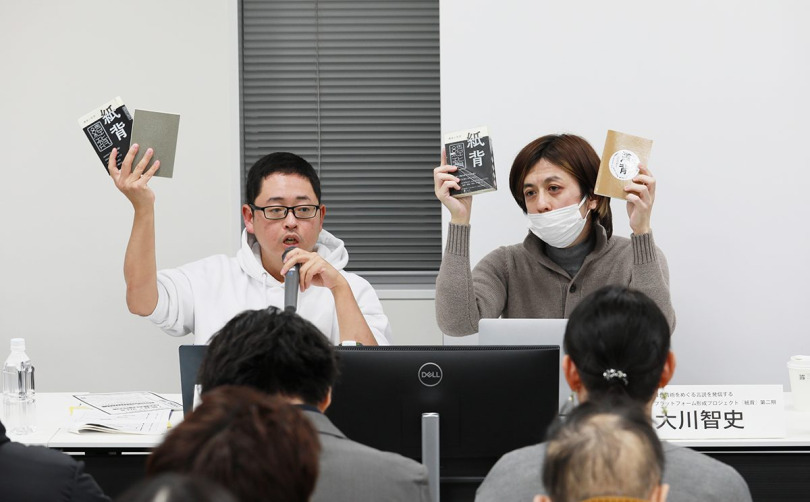
The revitalization of the performing arts through discourse is not working.
The "Paperback Web," a subsidized project, was launched in November 2023 and features 1 ~ 2 works a month, with 1 interview with the artist and 2 reviews for each work. Unlike the theater criticism magazine "Kamisai," which focuses on plays, it publishes interviews and theater reviews, which makes it possible to deal with dance works without plays.
In Reiwa 5 (2023), Reiwa 6 (2024) and Creation Grant [Single-Year Grant], in addition to Yamazaki, who specializes in theater, Yurika Kuremiya was invited as a guest curator specializing in dance. In addition, artists from the Kansai region are also featured, and both the breadth and quality of their activities are improved.
The following points were cited as problems to be solved in implementing the project.
- There is no medium to publish the plays
Even the finalists for the Kishida Kunio Drama Award, most of them have not been published. 2 of the 3 plays published in the November 2023 issue of the theater criticism magazine "Kamisei" were shortlisted for the award. - There is no medium for criticism
Media has disappeared. Some theater magazines remain, but there are no places to cover the works of young artists. As a result, even when performances are held, works disappear without any record or review. This also means that there are no opportunities for young critics to write criticism, and it is difficult to see the activities of critics younger than Yamazaki or of the same generation. - Generation Gap Between Young Producers and Critics
The lack of young critics has created a generation gap between young artists and theater researchers and critics, who tend to be older men.
Based on these problems, Yamazaki believes that the revitalization of the performing arts through discourse is not functioning.
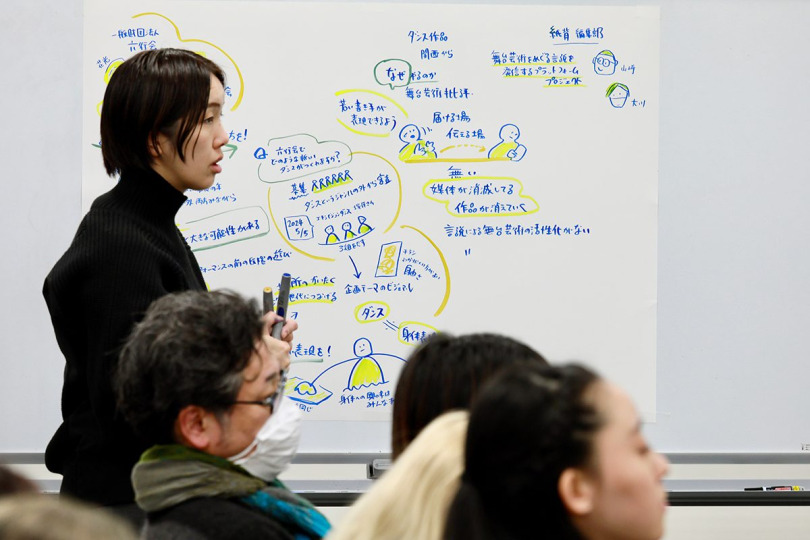
"If art is “something that stimulates thought in a way and from an angle that is different from reality, ” criticism can expand its reach and revitalize the performing arts. In addition to expanding one's thinking, recording makes it possible to preserve for the future the performing arts, which, unlike art and novels, only appear during the time they are performed. If there is no record of the thoughts stimulated by a work or the work itself, there is no clue to look back on the work. This makes it difficult to look back on the past, and the industry as a whole tends to crave new releases one after another. In other words, it's a problem that leads to the so-called “new work first ” mentality, where artists are ultimately discarded." says Yamazaki.
Is it individuals who support the infrastructure for the arts?
The following are some of the issues that have come to light during the project.
- 持続可能性がない
収入を得る手段がほぼなく、特に「紙背WEB」は無料公開しているので収入にはならない。課金制にすることも可能だが、批評は誰でもアクセスできる状態にあることが非常に重要。収入を得るため、2024年度はDance Base Yokohamaと愛知県芸術劇場の「パフォーミングアーツ・セレクション」とコラボレーションを行い、原稿料を折半する形で資金提供を受けた。
また、“舞台芸術のインフラを支えることを一緒にお手伝いしていただく”というコンセプトのもと、サポーター制度も導入している。「紙背WEB」にアクセスすると、任意の金額を選び『紙背』の活動をサポートできる。サポーターになると、メール配信で記事がいち早く届くというものだ。しかしながら、これらの取り組みによって資金を賄うことはできていない。 - too personal
Both Yamazaki and Okawa find it difficult to balance this project with other jobs. This subsidy is also a 2/3 subsidy, so the remaining 1/3 has to be covered by their own funds, and they have to take it out.
This, Yamazaki continues, leads to the question of how to maintain the space for performing arts criticism.
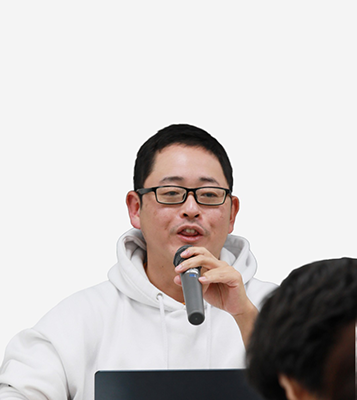
"I think criticism is one of the infrastructures that support art. Of course, he is a critic himself and cannot survive without a place to write. But fundamentally, I believe it is necessary to enrich the creative environment. Is this struggle to support infrastructure really just an individual effort?"
For example, it was suggested that Arts Council Tokyo could incorporate criticism into the funding system and require funded performances to submit reviews, or that Arts Council Tokyo could submit reviews. For example, he also mentioned that efforts such as ROHM Theater Kyoto and KYOTO EXPERIMENT are gradually being carried out to set performances and criticism. He also mentioned that in Taiwan, where he visited the other day, the amount of compensation for critics was twice that of the Japan market, and introduced that a cycle aimed at sustainability is being created and that Grant Programs to critics is also being made.
"These were problems and solutions I had already considered when I started. We are doing it because there is no one else to do it. I think it is best if we continue to make our existence widely known and people feel the significance of our activities, and eventually create a situation where we don't have to do it."
This was the first part of the presentation in which the three organizations examined the creative environment from a variety of angles, identified issues, and worked to improve them. In the second part, we report on the talk session with the speakers and the exchange of opinions with the participants, inviting the facilitator Naoto Moriyama.
(Composition and text: Yuko TAKEDA)
Continued from Part 1 "A roundtable exploring new ideas about the art creative environment".