


- Date and time of implementation
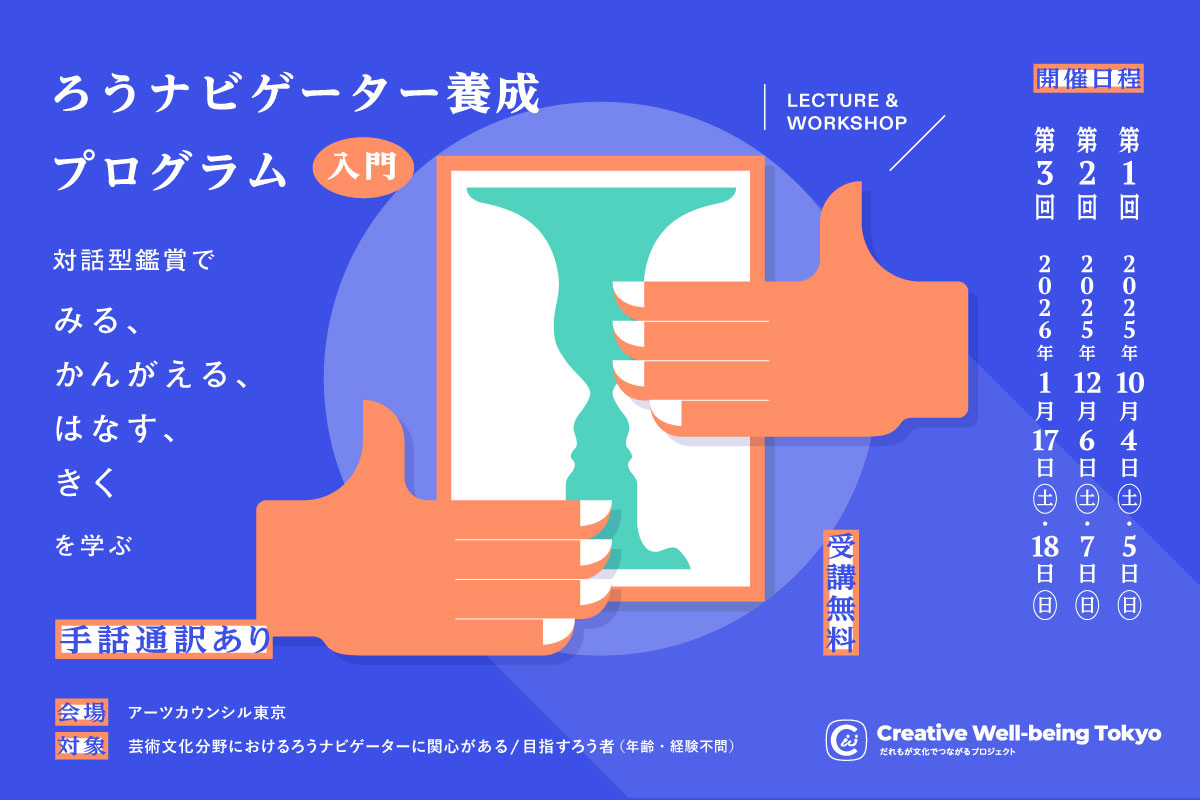
- 1st meeting: Saturday, October 4, 2025, 5th (Sun)
2nd meeting: Saturday, December 6, 2025, 7th (Sun)
3rd meeting: Saturday, January 17, 2026, 18th (Sun)
10:30~16:00 each day (1 hour lunch break, with breaks as needed)
* In-person only - Venue
- Arts Council Tokyo
(4-1-28 Kudankita, Chiyoda-ku, Tokyo)
As part of the Partner Program * for FY 2025 (Reiwa 7), in cooperation with the Art Communication Research Center (ACC), which provides educational programs for interactive appreciation, we will hold a training program for "Deaf Navigators" aiming to work at art museums and museums in the future.
In this course, we aim to develop "navigators" who connect works and viewers by creating a place where Deaf people can communicate with each other in a rich way by adopting the method of interactive appreciation.
*The Partner Program works with cultural institutions, NPOs, universities, and social welfare facilities to investigate, verify, and develop models for programs that improve accessibility.
Course content
This course consists of three sessions (six days in total). The purpose of this course is for the participants themselves to face the works carefully and to improve their "appreciation ability," which is the foundation of a navigator.
In addition to lectures by lecturers, students will hone their ability to see works of art (visual literacy) through intensive practice through workshops using the four steps of the interactive appreciation program ACOP/ACOP (Art Communication Project), and further develop the ability to ask questions to interpret works of art based on dialogue.
*Interactive appreciation began in the late 1980s at the Museum of Modern Art (MoMA) in New York with the VTC (Visual Thinking Curriculum), an appreciation education program designed to deepen observation and thinking through dialogue. VTC was later developed for school education and codified as Visual Thinking Strategies (VTS). When it was introduced and popularized in Japan in the 1990s, it was given the name "interactive appreciation" and gradually came to be used in a wide range of situations.
"ACOP (Art Communication Project)" is an interactive appreciation education program and its research activities developed from VTC/VTS to Japanese art college students. At present, through facilitation courses and educational programs for interactive viewing, we are working to develop skills such as observation, information gathering, analysis, and dialogue-guiding skills, which are used in a variety of fields, including museums, schools, medical institutions, and companies.
Theme of the course
- Part 1: Basics of interactive viewing: What is interactive viewing?
- Part 2: Skills required for interactive viewers
- Part 3: Deepening questions with others
lecturer
DATE Takahiro (Director, Art Communication Research Center/Professor, Kyoto University of Arts)
Target
- Deaf people interested in/aiming to become Deaf guides in the arts and culture field (regardless of age or experience)
- Deaf persons who can participate in a total of 3 lectures (total of 6 days)
course fee
Free
capacity
20 persons
About the application
Please fill in the necessary information on Peatix below and apply.
Application page: https://rounavigator2025.peatix.com * Application ended
Application period: Thursday, August 28, 2025 -Friday, September 26 Thursday, October 2 * Application deadline extended (updated September 26)
*Personal information will be strictly managed and used only for the operation of this business and for information.
Notes
Please confirm the following items and apply.
- The contents of the program are subject to change.
- If the number reaches the limit, we will close the application before the end of the application period. Please apply as soon as possible.
- A sign language interpreter (Japanese Sign Language) will be available on the day. If you have any questions about information security, please fill in the application form.
- Group work in the course is done in Japanese sign language.
- All will be conducted in person. There is no online distribution.
- Inside the venue, the staff will take a recording. Please note that the photos taken may be posted on the report article or website at a later date.
Credit
- Sponsor
-
Tokyo, Tokyo Metropolitan Foundation for History and Culture Arts Council Tokyo
- planning
-
Art Communication Research Center, Kyoto University of the Arts
- management cooperation
-
Re; Signing Project
Contact Us
Tokyo Metropolitan Foundation for History and Culture Arts Council Tokyo
Business Division, Business Coordination Division, Social Coexistence
E-MAIL: info-cwt*artscouncil-tokyo.jp (Please replace * with @ in half width)