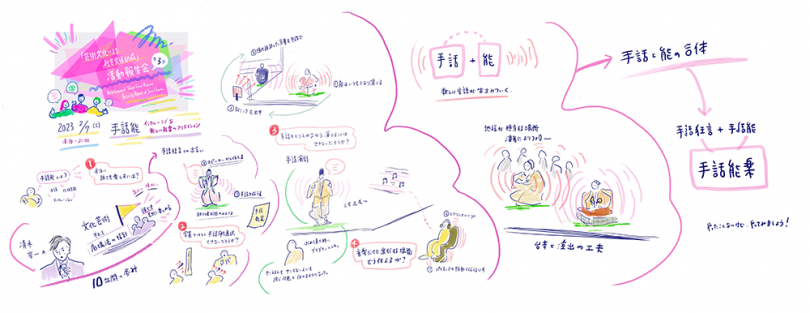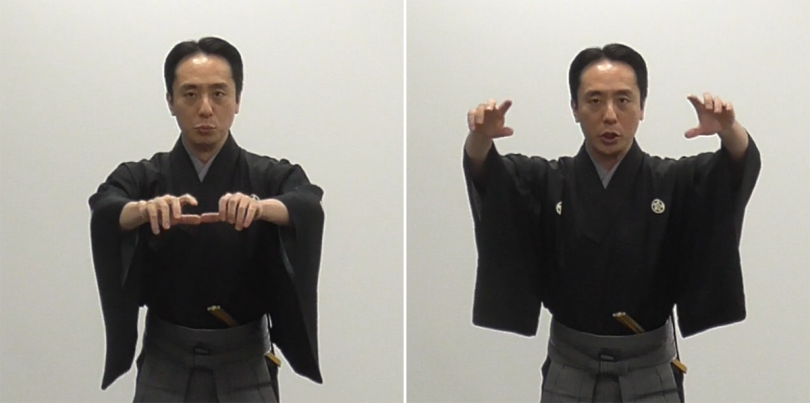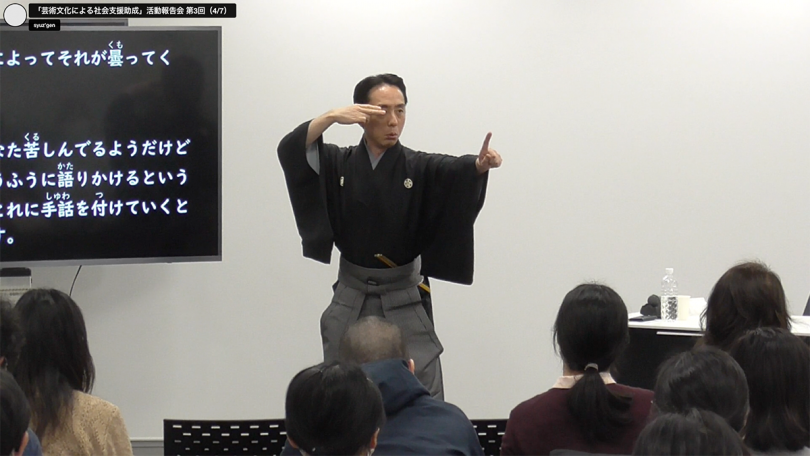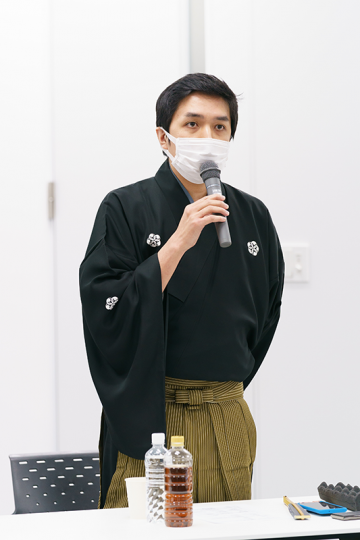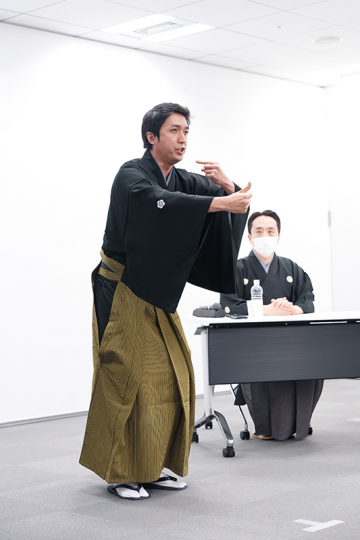

On February 7, 2023, the third activity report meeting was held as a place to re-examine the significance and effects of "Social Grant" and widely share its results and future issues. At Kita Noh Theater, operated by the 14th Rokuheita Memorial Foundation, the "Noh Kyogen Appreciation Party in Sign Language" is held every year, where both hearing and non-hearing people can enjoy Noh Kyogen together. With the theme of "sign language Noh" born from this activity, in the first part, Mr. Kenichi Shimizu, director of Kita Noh Theater, presented from the perspective of planning and production. In the second part, Teruhisa Oshima and Chikinari Miyake gave presentations from the perspective of Noh performers, followed by a roundtable with participants. We will deliver the situation in the first part and the second part.
- Date & Time
- Tuesday, February 7, 2023 18:30~21:00
- Venue
- Arts Council Tokyo 5th floor conference room
- Name of reporting organization
- The 14 Roppeita Memorial Foundation
- speaker
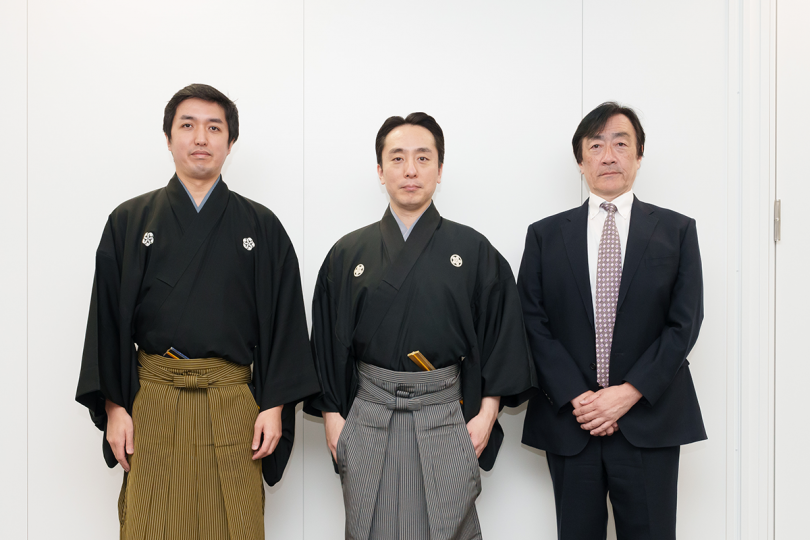
- Kotoichi Shimizu, Teruhisa Oshima, Chikanari Miyake
- facilitator
- Tomoki Ogawa
- graphic facilitator
- Junko Shimizu
- sign language interpreter
- Yuko Kato, Yuko Setoguchi

Photo by Maejima Photo Shop Courtesy of Roppeita 14 Memorial Foundation

Photo by Kazuyuki Matsumoto

(Image enlargement: JPEG version)
Sign Language Kyogen and Sign Language Interpretive Noh in One Nohgaku Appreciation Event
In Noh, there are four roles: shite-kata (lead actors), waki-kata (supporting actors), hayashi-kata (musicians), and kyogen-kata (kyogen performers). At present, the shite-kata of Nohgaku has been handed down in five schools, and the Kita school is one of them. The 14 th Roppeita Memorial Foundation operates the Kita Noh Theater (Kamiosaki, Shinagawa Ward, Tokyo), the home of the Kita school, and has a wide range of activities to promote the art of Noh to children, foreigners and the physically challenged, as well as to hold regular Noh performances. In 2019, it signed a business partnership agreement with Shinagawa Ward, a local municipality, and is now playing the role of a cultural promotion center in the region.
One of the sponsored projects for the popularization of the Noh theater, "Noh Kyogen Appreciation Event to Enjoy 'Sign Language'", has been selected for the "Social Grant" of Arts Council Tokyo a total of six times from 2016 to Reiwa 4 (2022). In the first part, the planning and production of Noh promotion projects, cooperation with local governments and local organizations, Kenichi Shimizu, director of Kita Noh Theater, who is in charge of and promotes external activities such as fundraising, took the stage. He talked about how the "Noh Kyogen Appreciation Party" was born and brushed up.

Courtesy of the 14 Roppeita Memorial Foundation
"Kita Nohgakudo used to be dedicated to the management of a theater, and it was operated as a rental business, in which Noh actors of the Kita school rented the theater and performed performances, but since it was recognized as a public interest incorporated foundation in Heisei 23 (2011), it has changed its direction to be more active in the community and to spread Noh of the Kita school."
When Mr. Shimizu became director of the museum in Heisei 25 (2013), he first referred to the Basic Law for the Promotion of Culture and Arts (now the Basic Law for Culture and Arts) to find out what activities he should do. Article 2, paragraph -2 of the Basic Principles states, "In promoting culture and art, in view of the fact that it is the birthright of people to create and enjoy culture and art, efforts must be made to develop an environment in which citizens can appreciate, participate in, or create culture and art equally regardless of the region in which they live." At the same time, the "Act on Revitalization of Theatres, Conservatories, etc." enacted in Heisei 24 (2012), was referred to in the planning and production, but the question that remained until the end was, “What activities can we do for people with disabilities ” in order to realize a symbiotic society?
"One day, on my way home from Shinagawa Ward Office (Oimachi) to Osaki Station, I changed my mood and took a different road. I saw a white building at the top of the slope, and when I approached it, I found the Tot Foundation, a social welfare corporation chaired by actor Tetsuko Kuroyanagi. One of the main projects of the social welfare corporation TOT Fund is the sign language kyogen performed by the Nippon Deaf Theater Company, which is run exclusively by the organization. I had never seen it before, but I heard the name, so I was surprised that it was so close. Later on, you will be blown away when you actually see the performance."
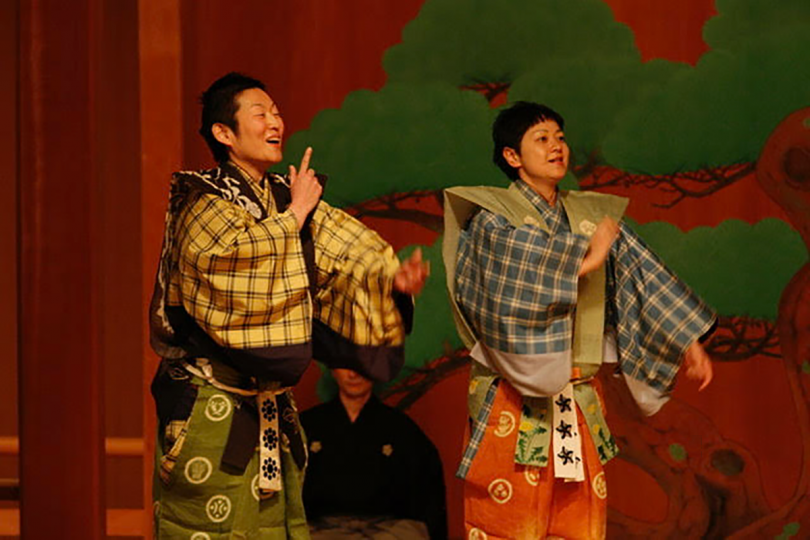
"Sign language kyogen has a history of 38 years. Deaf actors will perform in sign language under the guidance of Ukon Miyake, the father of Kyogen performer Chikanari Miyake, who is on stage with us today. The performance is performed by Miyake Kyogenkai including Chikanari Miyake from the broadcasting room. Therefore, the audience who can hear can watch Kyogen as usual, and the audience who cannot hear can understand it by the sign language expression of the performer. Therefore, it is a Kyogen that both those who can hear and those who cannot hear can enjoy. This type of performance is highly regarded overseas as it is unique in the world. Every New Year, we hold a performance sponsored by the Tot Foundation at the National Noh Theater for two days."

Courtesy: Miyake Kyogenkai
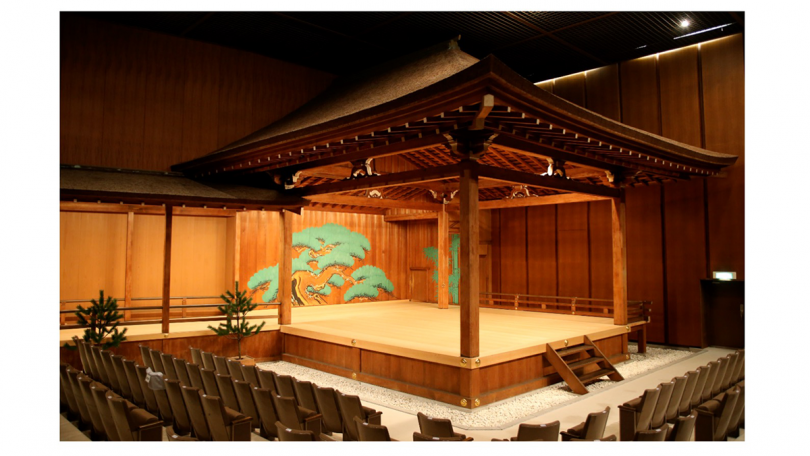
"I saw an announcement of a sign language class led by Tetsuya Izaki of the Japan Deaf Theater Company on the bulletin board of Totto Bunkakan. So I wondered if it was possible to perform Noh with simultaneous sign language interpretation. You may think that subtitles are fine, but the Noh stage is shaped like audience seats surround the stage, so it is very difficult to place subtitles. When the characters move, even people who don't need the subtitles are drawn to them. I have been thinking that subtitles are difficult to concentrate on the stage."
Shimizu came up with the idea of simultaneous sign language interpretation because Kita Nohgakudo was already offering simultaneous commentary via Twitter. For performances for non-Japanese audiences, a script is translated into modern Japanese, written in short sentences in English and Japanese, and an operator sends out the script one after another while watching a monitor, and viewers can watch it on their own computers or smartphones. They thought that since they could do it on social media, they could do it with sign language interpretation.
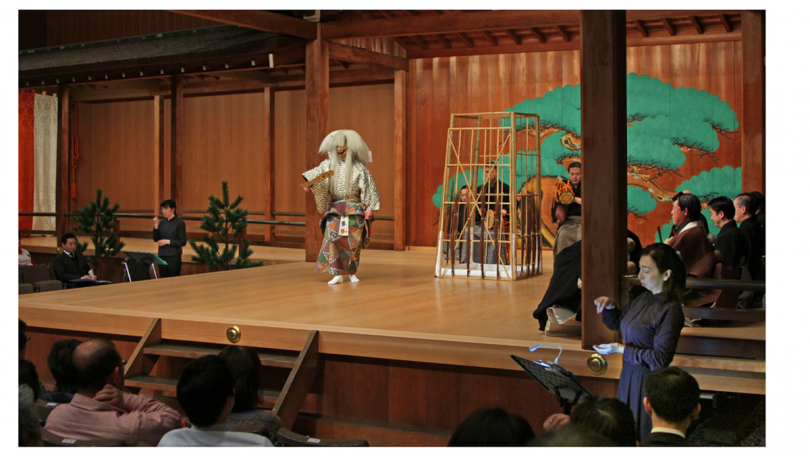
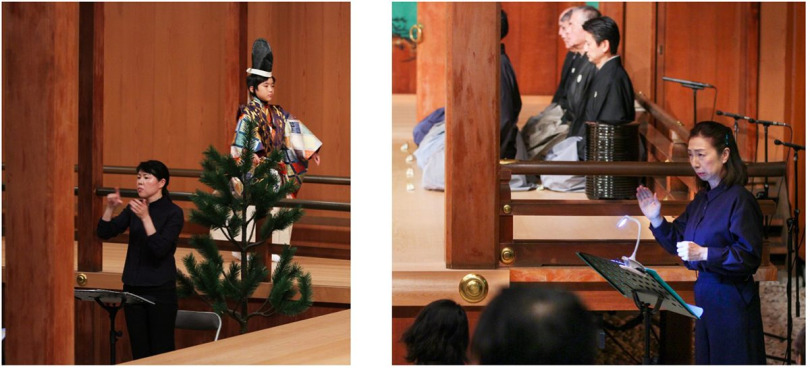
"The Noh stage is surrounded by audience seats, so if two sign-language interpreters, one at the bottom of the stage and one at the bridge, can be seen from almost anywhere in the audience. I tried to think of a form where Noh actors perform as usual and have two simultaneous sign language interpreters. I immediately contacted the Tot Foundation, and they said, "We've never done this before, but let's do it.""
"So I went to Ukon Miyake's dressing room together with Teruhisa Oshima, a Nohgakushi of the Kita school (today's speaker), and told him that I would like to welcome sign language Kyogen to the Kita Nohgakudo, and hold a Nohgaku-appreciating party consisting of Kyogen and Noh with simultaneous sign language interpretation."

Courtesy of the 14 Roppeita Memorial Foundation
After watching the video, Shimizu explains what it was like to do simultaneous sign language interpretation. "First, we translate all the verses of Noh into modern Japanese and number each paragraph. Sign language interpreters face the audience, so they can't interpret while watching the performers, so we put a prompter in the seat in front of the interpreter. When you signal that the first scene has just come, the interpreter interprets the first scene in sign language by looking at the script on the music stand in front of you. That's how we got to the actual performance. In other words, noh can be performed as it has been in the past, and without a supplementary system, a script and a sign language interpreter can be used anywhere."

Courtesy of the 14 Roppeita Memorial Foundation
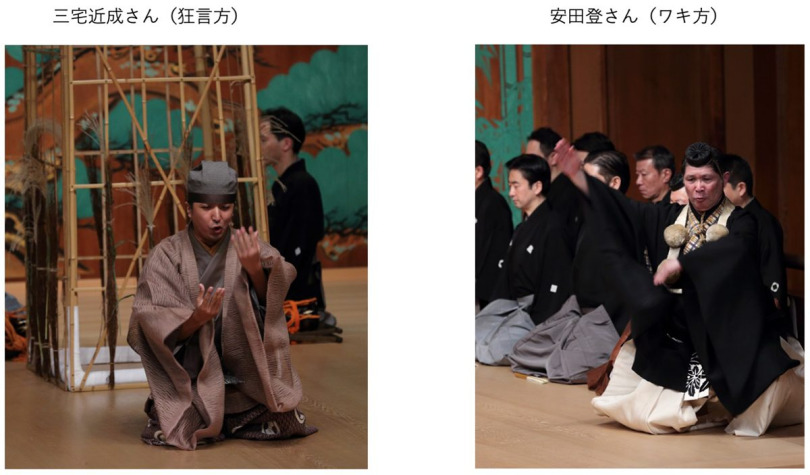
The program performed in this first performance was "Kurozuka." "It's a story about a hag in Adachigahara. Tokobo Yukei and the Yamabushi group arrived at a house where a woman lives. The woman goes to the mountain to get firewood to entertain the Yamabushi party, but she leaves and tells them never to look into the nenya. When you say no, I want to see it (laughs). When a member of the party tries to look into it, Yukei chides him. The interaction between the two is very comical and thrilling. One of the actors is Kyogen-kata Miyake Chikanari. In sign language kyogen, you don't appear on the stage because you have to use your voice, but since Mr. Chikanari Miyake appears on the stage and can use sign language, I thought it would be possible for him to perform the scene while using sign language. I thought I would be scolded if I asked him, but when the producer of the Tot Foundation asked Mr. Chikanari, he replied that he would try it."
"After hearing that, my partner Noboru Yasuda tried it, saying, "I also want to learn sign language and perform dialogue in sign language." It was the first time for Chikanari and Yasuda to perform in sign language." I watched the video of the performance to see the moment when the sign language performance was born.

Courtesy of the 14 Roppeita Memorial Foundation
"I remember being horrified when I saw it for the first time. In what can be called a sign language version of Ai Kyogen, the dialogue and sign language are performed at the same time, so even those who cannot hear without an interpreter can understand the performance on stage. This is the first attempt in the Nohgaku world, and we were able to make such a novel attempt in the first performance."
On the other hand, Shimizu continues, "There was another challenge." "Unlike Kyogen, Noh sometimes moves only with music. In "Kurozuka," the ogre who was peeked into the bunkhouse comes out saying "I saw you" with a very strong musical accompaniment, but for those who can't hear it, this is a quiet scene with nothing."
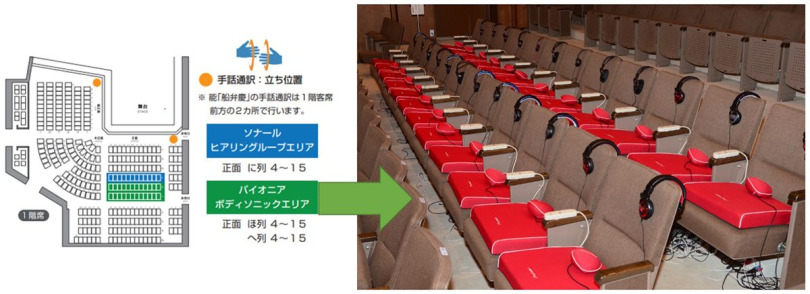
The solution was Bodysonic, a system developed by audio company Pioneer. "This device combines a vibrating mat on a chair for the whole body to feel, a small pouch, and headphones for hearing with small bone conduction. Each device can be used according to the level of the person who cannot hear. I contacted Pioneer when I saw an article in a newspaper that they were holding "Music Concerts with Your Body" as a social contribution activity. Again, they said, "I've never done noh, but let's try it.""
In this way, two rows of Bodysonic seats were installed for the first performance. "Even if the scene was not moving, people who could not hear could feel the music with their bodies." The company also introduced the Hearing Loop, a system that amplifies sound through wires around the seats so that the sound can be heard clearly. This solves some of the music-only problems, so I continue to use Bodysonic and Hearing Loop.

Courtesy of the 14 Roppeita Memorial Foundation
In the second performance "Kurozuka" was performed again, and in the third and fourth performances "Funa Benkei" was performed as a new work. In the first half of the program, a sign language kyogen performance by the Japan Deaf Theater Company will be performed. In the second half of the program, simultaneous sign language interpretation will be added to the noh performance, and the kyogen and noh performances will form a single performance.
At that time "I was worried that the presence of sign language interpreters in front of the stage might disturb those who did not need sign language interpreters, but both those who could hear and those who could not were very pleased. The stage was lined with jiutai and they could see the interpreters, so the performers said that they didn't expect the rhythm of Noh and the rhythm of sign language to match so well, which made me realize the affinity between Noh and sign language."
At the same time, understanding and sympathy for sign language spread. "There were many people who were studying sign language at this performance, and they said that they learned a lot, and some said that they became interested in sign language. Furthermore, with the ingenuity of Miyake Chikanari and Yasuda Noboru, a new form of sign language expression was created in Noh."
From "Sign Language Interpretive Noh" to "Sign Language Noh" in which all Noh actors perform in sign language
Evolution continues. It happened when Nohgakushi of the Kita school, including Teruhisa Oshima, were invited to a New Year's performance of sign language kyogen sponsored by the Totto Foundation. "Ukon Miyake gave me the order to perform Tsuchigumo in Noh, and to have the shite-kata also do sign language. From here, all the Noh actors on the stage began to perform in sign language."
"Tsuchigumo" is a story in which MINAMOTO no Yorimitsu, who had trained himself with his military prowess, was sick in bed when a spirit of Tsuchigumo disguised as a monk appeared, and he realized that the disease was caused by Tsuchigumo, and a battle between Tsuchigumo and warriors began. Tsuchigumo is said to have been transformed into a specter from the grudge of powerful clans who were killed for disobeying the Emperor during the Yamato Dynasty.
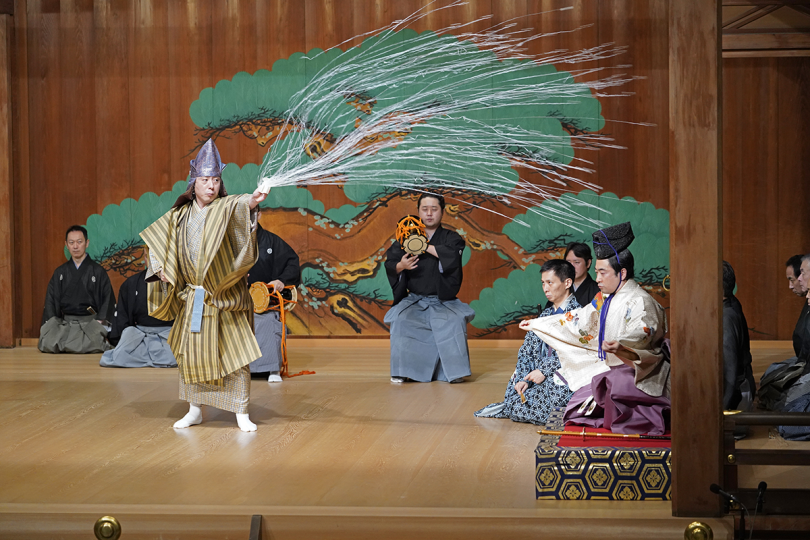
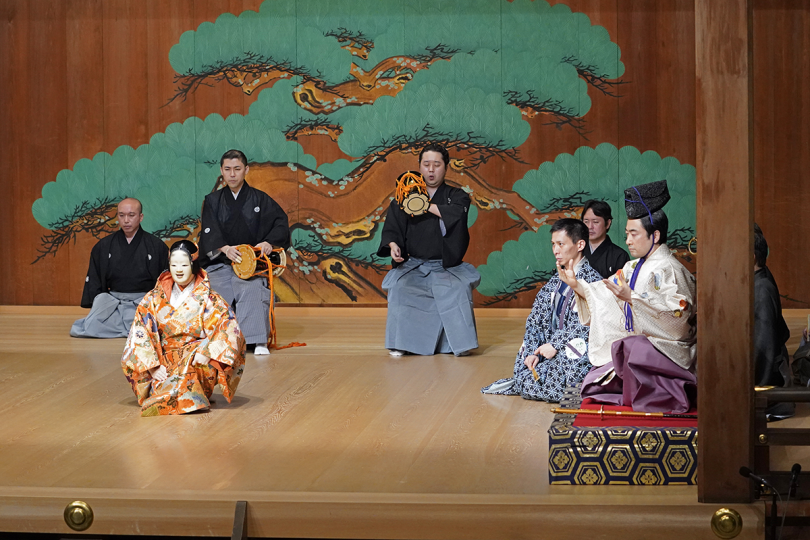
For the first time in the January 2021 performance sponsored by the Totto Foundation, Noh actors including shite-kata performed in sign language. Based on that experience, in 'The Fifth Noh Kyogen Appreciation Meeting Enjoying with Sign Language' at Kita Nohgakudo in the same year, he performed "Tsuchigumo" using sign language by all onstage performers. "However, there is a style of Noh performance called Jiutai, in which the scene is explained by a chorus or sentence of the ground. This is where the chorus members are in charge, not the characters, so sign language interpretation is also necessary, so we added simultaneous sign language interpretation."
Finally, at the “6th Noh Kyogen Appreciation Meeting Enjoyed with Sign Language ” in Reiwa 4 (2022), Shimizu said, "We asked Teruhisa Oshima to modify the script so that the jiutai part could be conveyed by the sign language of the characters, and we tried to create a performance with the jiutai part supplemented by the performer."

Photo by Maejima Photo Shop Courtesy of 14 Roppeita Memorial Foundation
Along with the jiutai, which expresses Yorimitsu's feelings, Sasaki Tamon, who plays Yorimitsu, also expresses himself in sign language. "of night and day in every color. of night and day in every color. in a state of ignorance. Time passes. I don't know. It is a person who does not change his mind and thinks about it as it is. Your heart will suffer, sad."(With that in mind, I receive various treatments day and night, but the pain is so severe that I can't even see the passage of time. Even if I try to change my mood a little, my heart just sinks and I can't escape the pain in my heart. What a sad thing for myself.).
"In fact, this is the part of the Jiutai where everyone is singing, but since this is the scene where Yorimitsu is singing about his painful feelings, we asked Mr. Sasaki Tamon to let Yorimitsu express himself in sign language. I created the script in a slightly different way than usual, and created the Jiutai with the characters following it with sign language. By changing the staging like this, sign language interpretation was finally eliminated. Like sign language kyogen, it was possible to see sign language and normal Noh performance together on the stage, and it received a great response."
"Until then, I had called myself "Sign Language Interpreting Noh," but I think it would be OK to officially call myself "Sign Language Noh" at the 6th performance in Reiwa 4 (2022). Noh kyogen is often referred to as "noh gaku" by combining kyogen and noh, but there was already sign language kyogen more than 30 years ago, and if "sign language noh" was created last summer, I came to think that "sign language noh gaku" was born by combining it."
At this meeting, Ms. Tomoki Ogawa, the facilitator, commented, "Shimizu-san, you are trying things you have never done before." Shimizu replied, "When I came up with an idea and consulted with them, they were willing to do it even though they had never done it before." In this way, it became clear that a new genre called 'nohgaku in sign language' was being created.

Photo by Kazuyuki Matsumoto
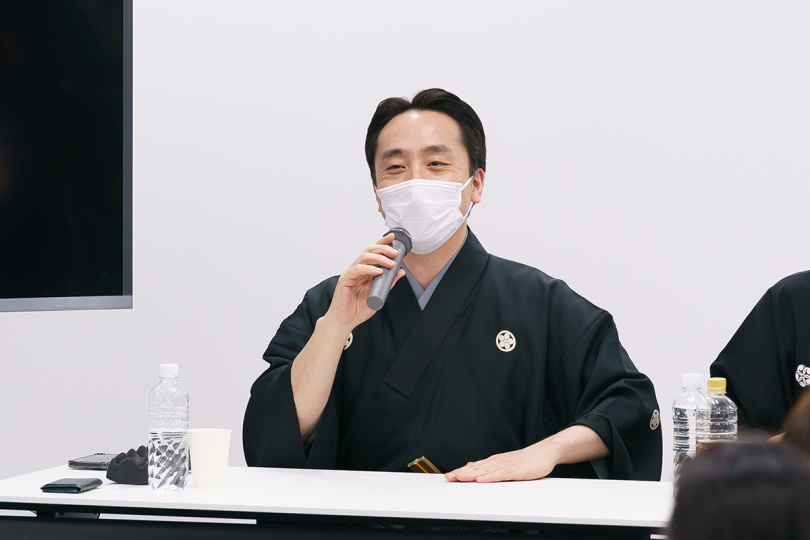
In the second part, microphones were given to Oshima Teruhisa, a Nohgaku-shite-kata Noh actor of the Kita school, and Miyake Chikanari, a Nohgaku-kyogen-kata Noh actor of the Izumi school. Since his debut on stage at the age of three, Oshima has performed large pieces such as Shojoran, Dojoji, and Ishibashi. In recent years, he has been exploring the new possibilities of Noh, appearing in and planning groundbreaking performances such as English Noh and VR Noh. The shite is not only the main character but also the director, and plays the role of deciding the whole program such as casting and direction.
In "Tsuchigumo," the main character plays Tsuchigumo disguised as a monk in the first half and the spirit of Tsuchigumo in the second half. In fact, after performing in a normal Noh form, he explained on the spot how sign language would make a difference. "Tsukiki. It's not even midnight. My mind is clouded by clouds. How does Yorimitsu feel? How does he feel?"(Even the peaceful world and the clear light of the moon are covered by clouds of demons. How good is Yorimitsu? How you feeling?)

Photo by Kazuyuki Matsumoto
"The spirit of Tsuchigumo disguised as a certain priest in Tsuchigumo first appears and chants these words. Yorimitsu comes down on the left and faces Yorimitsu. Clouds appear where there is a clear moon. This cloud means Tsuchigumo's spider and the cloud of the sky as a kakegotoba. clouded by the appearance of spider spirits. He goes so far as to say to Yorimitsu, "You seem to be suffering, but how are you?". and we're going to add sign language to it."
"Satoshi Ezoe, the representative of the Japan Deaf Theater Company, created all the sign language. When I asked him what to do with the part where the two words, clouds in the sky and a spider, are kakekotoba, he created a sign language in which I raise the movement of my hands, which represents the spider, and connect it directly to clouds in the sky. This allowed us to express the words in sign language."

"You also have to create new proper nouns. There is no picture of Yorimitsu because he was from the Heian period, but when Mr. Ezoe searched for a picture of Yorimitsu, he said that he was a very strong military commander with thick and sharp eyebrows, so we decided to show him with two fingers, the index finger and the middle finger, on his eyebrows."

It is also said that the rhythm of the body slows down more when singing with sign language than when singing with normal Noh because the sign language is used to avoid being too loud and sloppy. "We call it "I may sing a little heavy, but please do so." when we sing slowly, but we performed it to the Hayashikata by saying, "Shoku." This sign language Noh play "Tsuchigumo" has been performed about five times, including at Oshima Noh Theater in my hometown, Fukuyama City, so I have finally learned to sing at a normal speed."

Photo: Kazuyuki Matsumoto
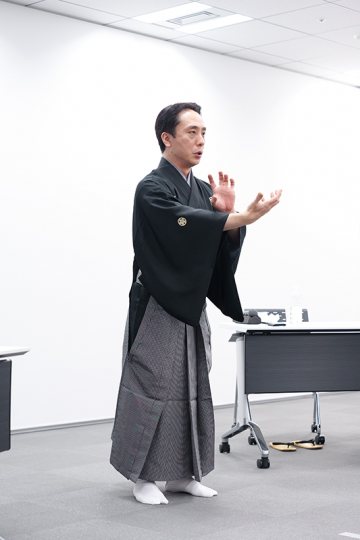
Next, Miyake Chikanari, a Noh actor of the Izumi school of Noh Kyogen, took the stage. He studied under his father Ukon MIYAKE, and his grandfather was the Living National Treasure, the late Tokuro MIYAKE, the ninth. Since his debut on stage at the age of three, he performed large pieces such as "Sanbanso," "Tsuri kitsune," "Kanaoka," and "Hanako," and for many years taught sign language kyogen to the Japan Deaf Theater Company. First of all, using "Tsuchigumo" as an example, he explained the role of 'Ai Kyogen,' which connects the first scene (the first half) and the second scene (the second half) in the middle of Noh.
"In "Tsuchigumo," the role is to talk alone about what has happened so far, and then leave with a preview of what will gradually happen. It has the effect of buying time for the shite-kata to change costumes, but it is also to sort out what happened so far. Talking alone is called "standing chishaberi," and you talk alone and come back alone. In "Kurozuka," which was shown in the video earlier, there was a conversation with a Yamabushi who was a waki-yamabushi, but in "Tsuchigumo," he talks alone. I want to do a little bit of this scene. I think you can feel a slight difference between the sign language of the shite-kata of Noh that Oshima-san talked about earlier and the sign language of Kyogen, so please take a look at that."

Photo by Kazuyuki Matsumoto
"The tempo is a little different after all. Noh has a rather relaxed image of singing and dancing, but Kyogen is a dialogue play, so it may be a little slower than modern words, but the dialogue is fast. I am trying to perform sign language that suits it."
Through their performances, they were told how sign language is used in sign language kyogen and sign language noh, as well as the differences between them. In the second part, we will report on the roundtable that further reveals the appeal of sign language Noh.
(Reporting and writing by Yuri Shirasaka)
> Continued from Part 3: "Creation of a new Noh play that is inclusive of sign language" (Part II)
The 14 Roppeita Memorial Foundation
約450年の歴史を持つ能楽シテ方5流のひとつ喜多流の本拠地、喜多能楽堂の管理運営を行う。定期公演をはじめ、初心者や子供たち、外国人や障害のある人々に向けた能楽の普及活動を広く展開している。また2019年には地元自治体の品川区と事業連携協定を締結し、地域における文化振興拠点としての役割を担っている。
http://kita-noh.com/
Social Grant Grant results
- Heisei 28 (2016) FY 1 "Noh Kyogen Appreciation Meeting Enjoyed with Sign Language"
- Heisei 29 (2017) FY 1 "The 2nd Noh Kyogen Appreciation Meeting Enjoyed with Sign Language"
- Heisei 30 (2018) FY 1 "The 3rd Noh Kyogen Appreciation Meeting Enjoyed with Sign Language"
- Heisei 31 (2019) FY 1 "The 4th Noh Kyogen Appreciation Meeting Enjoyed with Sign Language"
- FY 2021 (1st) 'The 5th Noh Kyogen Appreciation Meeting Enjoyed with Sign Language'
- FY 2022 (1st) 'The 6th Noh Kyogen Appreciation Meeting Enjoyed with Sign Language'
Social Grant
A program to support "Activities that allow people who have limited opportunities to experience and participate in art due to their social environment to engage in art experiences, such as appreciation and creation, and to exercise their creativity and enrich their imagination." and "An artistic activity that sets social issues based on one's own awareness of problems, collaborates and works with various people and organizations, and takes a long-term perspective and engages in practical problem-solving." for organizations working in Tokyo.
The system was launched in FY 27 (2015), and since FY 28 (2016), applications have been made twice a year. It has supported more than 120 projects. It is not just "art for art's sake" or "art that is useful to society," but it is trying to support activities that propose and materialize a new way of art in which society and creative activities are inseparable in a way that has never been done before, so to speak, "the third art."