


On February 7, 2023, the third activity report meeting was held as a place to re-examine the significance and effects of "Social Grant" and widely share its results and future issues. At Kita Noh Theater, operated by the 14th Rokuheita Memorial Foundation, the "Noh Kyogen Appreciation Party in Sign Language" is held every year, where both hearing and non-hearing people can enjoy Noh Kyogen together. In the first part of the report, we talked about the presentations by Kenichi Shimizu, director of Kita Noh Theater, and Teruhisa Oshima and Chikinari Miyake from the perspective of Noh performers from the perspective of planning and production. In the second part, we will deliver a roundtable with participants.
> Click here for the 3rd "Creation of a new Noh play inclusive of sign language Noh" (Part 1)
- Date & Time
- Tuesday, February 7, 2023 18:30~21:00
- Venue
- Arts Council Tokyo 5th floor conference room
- Name of reporting organization
- The 14 Roppeita Memorial Foundation
- speaker
- Kotoichi Shimizu, Teruhisa Oshima, Chikanari Miyake
- facilitator
- Tomoki Ogawa
- graphic facilitator
- Junko Shimizu
- sign language interpreter
- Yuko Kato, Yuko Setoguchi
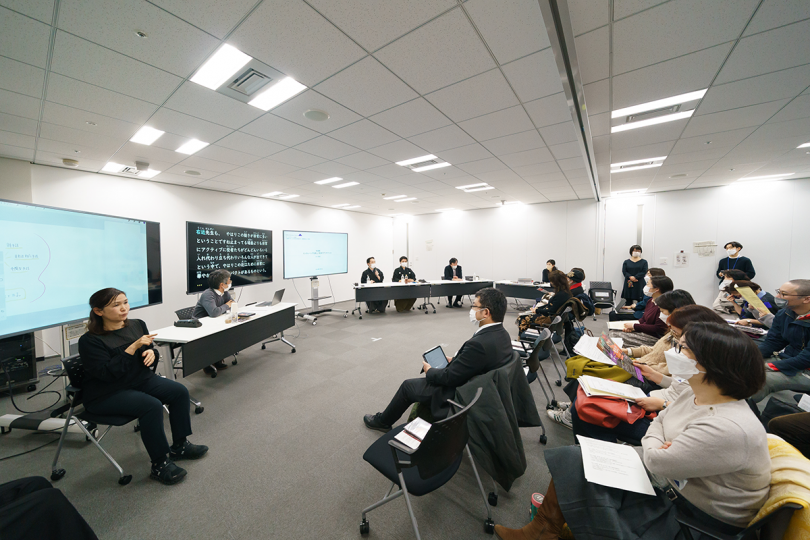
Photo by Kazuyuki Matsumoto
have someone learn sign language as a form called choreography
In the second half of the second part, Shimizu Kotoichi, the director of Kita Nohgakudo, Oshima Teruhisa, a Nohgaku-shite-kata (main actor) of Kita school Nohgakushi, and Nohgaku-kyogen-kata (Noh Kyogen actor) of Izumi school Nohgakushi, Miyake Chikanari, took the stage again and a round table was held. Facilitator OGAWA Tomoki asks frank questions and draws out the appeal of sign language Noh.
- Ogawa
- There is something called "kata" in Japanese traditional performing arts. I'm sorry to be an amateur, but what do you mean by kata in Noh?
- Oshima
- In Noh, all movements are called kata. Each type has a name, and by combining the patterns, a dance is formed. For example, where the center of gravity is placed, and whether the foot is hung or twisted, just that makes a difference. Just changing the direction is a type.
- Ogawa
- I see. Is it the same for Kyogen that it is made of kata?
- Miyake
- Yes, it's the same.
- Ogawa
- Does using sign language when performing mean breaking the traditional forms of Noh and Kyogen?
- Oshima
-
No, we've had people ask us before, "Did you destroy something traditional and create something new?" We don't have that feeling at all. As you saw in the previous demonstration, my sense is that the second performance was just a sign language addition to the usual Noh performance performed the first time. All the forms of Noh that we have inherited as a tradition are also used in Sign Language Noh, and the newly created sign language movements are added to them. I had a strong feeling that I was performing a new form rather than a new one. I consulted with Satoshi Ezoe, the head of the Deaf Theater Company of Japan, and asked him if, ideally, the sign language would not be seen as sign language, but as part of a Noh pattern.
Therefore, I was very happy to hear in the questionnaire after the performance that "I didn't understand which part was sign language and which part was Noh movement." I wanted to make the sign language look as natural as the pattern in Noh so that the sign language would not look out of place on the stage.
- Ogawa
- I'm looking at it too, but I don't know how much is sign language and how much is kata. How about you, Mr. Chikanari?
- Miyake
- Right. This "Sign Language Kyogen" has been going on for 38 years now, and I have been making it up until now, so I have rarely been on stage, but from this performance I was able to do sign language while also speaking. What I felt again was that I had to be careful about the balance of the amount of sign language. Although there is a lot of spoken language in kyogen, it is a little too much if all the spoken words are replaced with sign language. In the case of Noh, I felt that the amount should not be too much. After all, sign language must be created in such a way that the elegant movements and pauses unique to Noh are not broken. As we worked together to translate each line and song into sign language, there was a point where we narrowed down the number of signs to the point where we could understand the meaning.
- Ogawa
- I see. I heard that there is a form of crying in Noh.
- Oshima
-
Yes. In fact, there are so many types of Noh. Let me demonstrate the most commonly used mold. It's called Shikake Hiraki. Shikake means to set a move forward, and when you take several steps forward and hold a fan in your right hand in front of you, this is called shikake. And if you do this shikake, you almost always do the "hiraki" next. While pulling your legs back, open your hands wide and bring your open arms back to your body. This movement is done at various times in Noh.
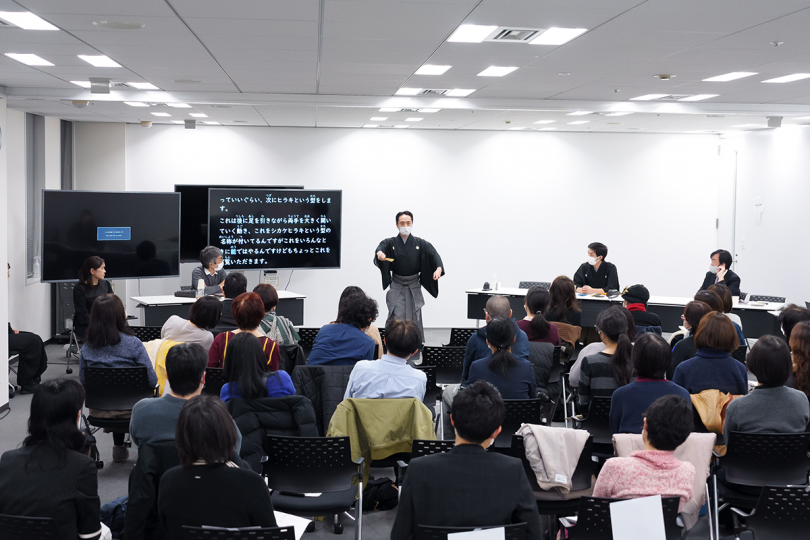
"Shikake Hiraki" demonstration by Teruhisa Oshima
Photo by Kazuyuki MatsumotoI think it is safe to say that it is about 90% of all types, but basically there is no specific meaning. When asked what the meaning of "shikake hiraki" is, there is not much to answer. In other popular dances and dances, I don't think there is much meaning in each movement of the arms and legs to the music. I think the goal of dance and dancing is to amplify the image of the song from the person dancing by moving their arms and legs to the music, for example, singing.
In the same way as in Noh, each "shikake hiraki" does not have a meaning, but by repeating it to the accompaniment of the song, it has the effect of amplifying the character's inner image. I played "Shikake Hiraki" quietly now, but you can play different characters just by changing the way you use your body. This time, I will try "Shikake Hiraki" when I play a strong character, for example, a warrior or a demon. You can express various roles by changing the use of the body, the sense of speed and the sense of strength.
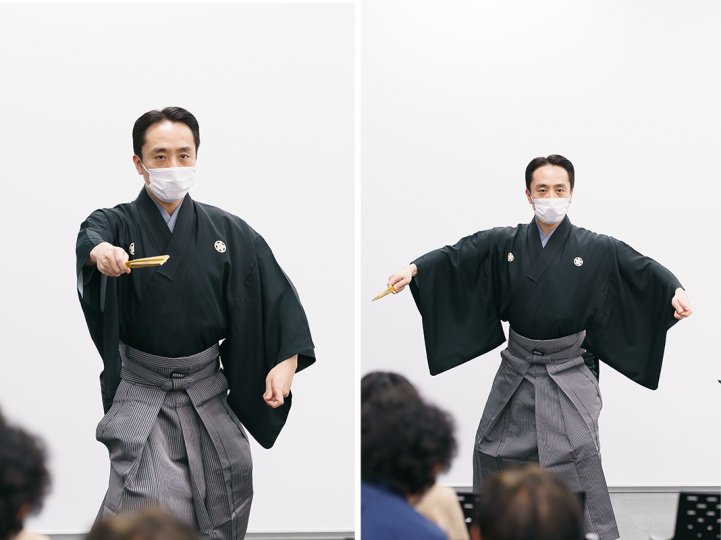
Teruhisa Oshima demonstrates "Shikakehiraki" with big movements
Photo by Kazuyuki MatsumotoIn this extension, emotional expressions and concrete meaningful forms rarely appear 10% or 20%. A typical example is the movement called "shiori." I mostly use my left hand, but I extend my fingers and bring this to the area between my eyebrows. This is the expression of sadness. Tears come from the eyes, but over the course of many years, our predecessors refined the technique of holding back tears, bringing the hand to the area between the eyebrows and forehead, and lowering the head slightly to express sadness. In other words, they define human emotions as a mold.
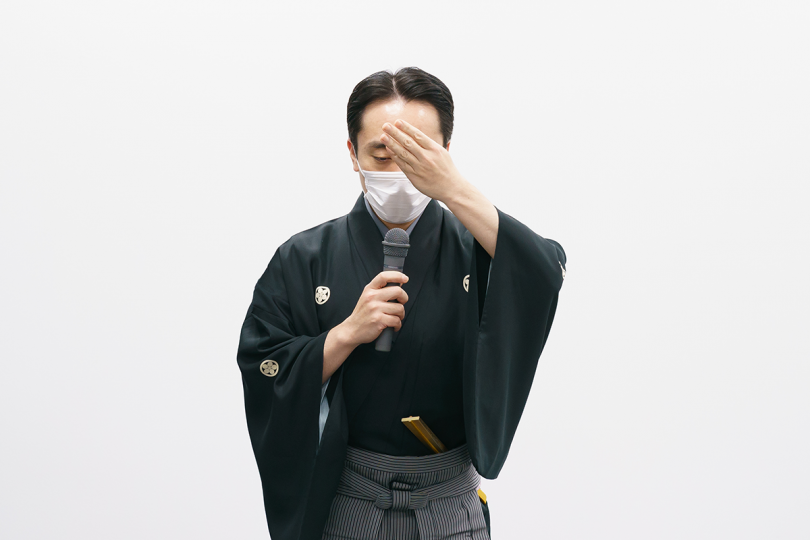
"Shiori" demonstration by Teruhisa Oshima
Photo by Kazuyuki MatsumotoIn a workshop for elementary school children, I asked them what they were doing, and some of them said, "Are they embarrassed?" or "Are they dazzled?". When I say, "This is an expression of sadness, you know, holding back tears." everyone agrees, saying, "Oh, yeah." In other words, human emotions are expressed in the form of a body, which is determined as a rule called "kata." When I actually learned sign language, I strongly felt that the process of making sign language and the process of making Noh movements were based on the same ground.
I have collaborated with other genres, but the collaboration between Noh and sign language was the most comfortable. We just doubled or tripled the number of kata while we were doing our usual Noh, but we didn't feel that we broke anything, and I can say clearly that we didn't break anything.
- Ogawa
- I see. It doesn't change. What kind of impressions do you get from Nohgakushi of the same profession?
- Oshima
- We receive many impressions that Noh and sign language go well together. I thought some of my seniors might feel uncomfortable, so I changed the cast every time so that as many people as possible could participate. I wanted many people in the Kita school to understand the significance of my activities and that I am not trying to break something. When my teacher, Tetsuo Shiotsu, saw the first performance and said, "It's been a long time since I was so moved by a performance," I was glad I did it. I still remember how grateful I was to the top people in the Nohgaku world who moved me.
- Ogawa
- That's what's happening. How about you, Mr. Chikanari?
- Miyake
- I have been doing sign language kyogen for a long time in this Nohgaku world as a kind of independent performance, but I have rarely been asked by other schools, so I was very grateful to hear from you. There are not many schools or Noh performers willing to step forward. There were originally 3 schools of Kyogen, Okura, Izumi and Sagi. There are various theories, but there is a story that Sagi school was abolished because it broke the rule not to have a relationship with other performing arts, so there was something like an iron rule not to break the form. Today, that has gradually changed, and there are people who are active in TV and movies, and people who are on stage together with various performing arts. Even for those of us who have been doing sign language kyogen for a long time, we were grateful that this sign language Noh was created.
- Ogawa
- I thought it was a world where people would say no to trying new things, but it is unexpectedly tolerant.
- Miyake
- It has changed recently, hasn't it?
- Oshima
- Right. I believe that people of the generation of Mr. Chikanari's father, Ukon, have made reforms. I heard directly from Ukon Sensei that he had actually performed with people from other genres, and at that time he said, "Oshima-kun, why don't all the main actors use sign language?" because the passion for creating new things has always remained. At that time, I was about to say, "I can't do it," but I was asking for an unreasonable request that Director Shimizu had told me up to that point, so I couldn't refuse without consideration (laughs). "Tsuchigumo" is a program in which a lot of tachiyaku (leading actors) appear, and there are so many shite-kata (main actors) alone, including a priest, Tsuchigumo, Yorimitsu, Tachimochi, and Kocho. If it was just me (the monk and Tsuchigumo), I would have to ask other performers to do this (laughs). I kept thinking about who would accept it, but I kept trying to make it happen.
- Miyake
- At first, I was asked to perform Aikyogen in sign language in a program called Sign Language Interpretive Noh, and I thought it would be difficult. I think I'm saying the same thing in sign language while speaking with my mouth, but the content expressed in sign language is slightly different from the spoken language. I have been involved in sign language kyogen for many years, and I already know the meaning of the sign language, so I thought in my head that the next sign would be like this in modern language, but I had to say something completely different with my mouth. The more I practiced, the more I felt that I was being asked to do something difficult (laughs). I always wanted to do it again one day, so when I was told, ""Tsuchigumo" (Tsuchigumo): I would like the main actors of Noh to do sign language." I thought, "Okay, here he is!". I strongly agreed, saying, "Let's do it."
- Shimizu
- Chikanari-san can speak sign language, but the shite-kata, waki-kata, and other characters did not try to perform after mastering all the sign language. Instead, they memorized Ezoe-san's choreography, including sign language, as a form for their own parts. It's probably something that's hard to do even in the field of modern drama. I think it is very difficult to express meaning and emotion with dialogue and do both at once with the physical language of sign language. When I think about why the Noh actors were able to do it, I think it was probably because they incorporated sign language as a form called choreography. Noh actors have been training to create a performance by kata since they were children. Their training is to follow the instructions of their master and make a proper form, but they were able to handle the sign language choreography as a form. I think that was a major factor in achieving this. I think it can be said to be a form of theater that was created because it was a form of entertainment.
- Ogawa
- I see. The other thing is that if you try something new and fail or get lost, you can still come back to the genre because the original is well established.
- Shimizu
- Right. Noh Kyogen is the best genre of traditional performing arts. You may think it's conservative, but it's a new experiment. When you think about it, it may be the strength of having such a solid source book that you can go back to the source book and look at it again and try again when you are lost. I think it is very interesting that such a radical experiment was born out of the traditional theater representing Japan.
- Ogawa
- As the number of new forms increased, it was difficult to move the ring and pinky fingers when moving the fingertips with the spider/cloud movement.
- Oshima
- Yes. I had a hard time to move my fingers finely because it is not in Noh. Both Chikanari-san and Ezoe-san move their fingers very well. I can't move my ring finger well, so I did the overall feeling, but I think the movement of the finger was a little different from the movement of Noh, and it was a unique movement of sign language.
- Ogawa
- Could you tell me more about the episode of Jiutai that Director Shimizu mentioned in the first part?
- Oshima
-
Yes. There is something like a chorus of 8 people on the stage of Noh, and this is Jiutai. Their roles are very diverse, but they are mostly engaged to describe scenes and mental images of characters such as shite and waki.
Ukon Sensei said that he did not want to have a sign language interpreter in "Tsuchigumo" because, in "Tsuchigumo," especially in the latter half, there is a battle scene in which an underarm warrior and this Tsuchigumo ogre fight each other. They wanted people to see the movement, but they were worried that if a sign language interpreter interprets the scene in sign language under the stage, it might be a little disturbing. So at the premiere sponsored by the Tot Foundation, we did it once without an interpreter under the stage. However, at the beginning of the performance, when there was no sign language interpreter in the scene where the jiutai was being sung about Yorimitsu's painful feelings that he was not feeling well and did not know what would happen tomorrow, the stage visually seemed to stop moving, and Deaf people who saw the performance also said, "I felt it was a little unsatisfactory." So, that scene was performed once with sign language interpretation at Kita Noh Theater.
When Ukon Sensei saw it, he said, "I don't think it's necessary," and I thought for a long time that since it was a scene where Yorimitsu was expressing his feelings, it would be better for him to use sign language. So I thought I had no choice but to ask Sasaki Tamon, who played Yorimitsu, to increase his sign language skills, so I asked him to learn sign language. He also asked the Deaf Theater Company of Japan to reconsider Yorimitsu's sign language. I also asked Ukon Sensei, "What do you think?."
In other words, what I'm doing is "mediating" to find a way to make it happen (laughs). I feel that the cooperation of everyone and Ukon Sensei's sensitivity to the stage, which is completed on the stage without a sign language interpreter, is beautiful as a Noh stage. Ukon Sensei mentioned his ideal, and while we were considering what we could do to realize it, I think we came up with what can be called sign language ability this time.
- Ogawa
- Have you been watching it too, Mr. Chikanari?
- Miyake
- Yes, I've always been a mediator.
- Ogawa
- Is Director Shimizu watching from the side at that time?
- Shimizu
- No, I leave everything to you. It's like say hello (laughs). Not only the performance, but also the practice scene where Ezoe-san, who is a sign language choreographer, directs is interesting. I think that if we make a documentary that captures this situation, we will understand it even more.
- Ogawa
- Do you have an ambition to go global in the future?
- Shimizu
- I haven't thought about it yet. Kita Noh Theater has about 380 seats, and Noh is performed once a day, so it can only be seen by a limited number of people at one time. This time, with a grant from Arts Council Tokyo, I was able to make a DVD. First of all, I would like various people to see it and spread the word that such a groundbreaking attempt came out of Japan's classical performing arts. If you invite me, I would like to go to the performance.
Sign language is a language with its own grammar
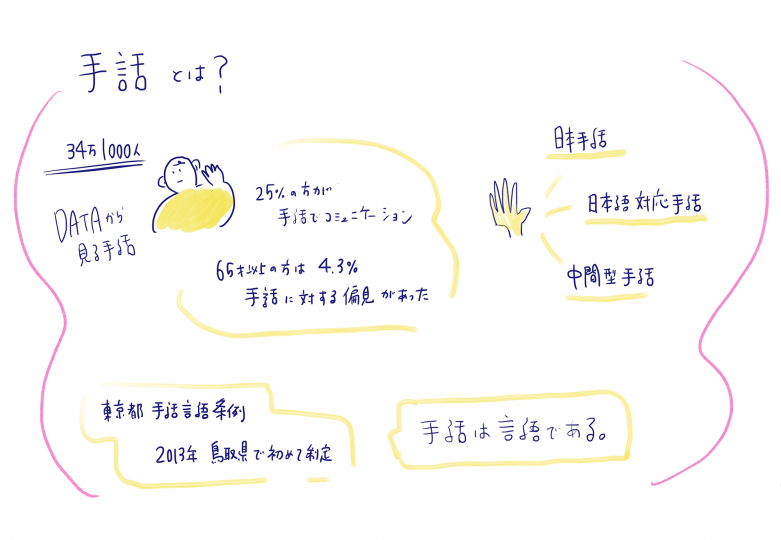
(Image enlargement: JPEG version)
- Ogawa
-
Let me tell you a little bit about what sign language is that we talked about today. There are 341000 people with speech and hearing impairments nationwide. Director Shimizu said that about 30% of the audience who perform sign language Noh kyogen are deaf.
Among them, those with hearing loss are native speakers of Japanese. Also, some people born deaf are native speakers of sign language. In other words, not everyone who is deaf or deaf can sign. There are many kinds of people who can't hear, and this time you are continuing to challenge people whose mother tongue is sign language.
the Ministry of Health, Labour and Welfare's "Survey on Difficulty in Living" shows what the situation of people who can't hear is like. According to data from 2016, 25% of deaf people under the age of 65 communicate using sign language. Other than that, they communicate with hearing aids, written communication, smartphones and tablet devices. But when people are 65 years old or older, 20.2% use hearing aids, and those who use sign language for daily communication decrease to 4.3%. There was a long time when sign language was not accepted (In order to acquire Japanese for the Deaf, oral language education was conducted to read the shape of the mouth.), and people at that time were not properly educated in sign language. On the other hand, I think the number of people who can use sign language will increase from now on. In other words, "sign language Noh" and "sign language kyogen" may be fields with potential.
In addition, the Tokyo Metropolitan Government established the Sign Language Ordinance in 2022. It is stipulated in the ordinance as the preamble "Sign language is a cultural product of language activities that cultivate a rich humanity and lead an intellectual and spiritual life." Article 2 (Basic Principles) states that "with the recognition that Sign Language is a language with its own grammar," which means that "Sign Language is a language." Since the first sign language ordinance was established in Tottori Prefecture in 2013, it has been spreading rapidly. In Tokyo, this sign language ordinance has been established in 17 wards.
There are various types of sign language. "Japanese sign language" is a language that Deaf people learn and use naturally without any special training. It has a different vocabulary and grammar system from Japanese. "Japanese-compatible sign language" is a language that expresses Japanese grammar and word order in sign language based on the premise of Japanese. "Intermediate sign language" is an intermediate expression between "Japanese sign language" and "Japanese-compatible sign language." I think there are relatively many people with hearing loss who can use Japanese sign language. Japanese Sign Language is another system of language. Taking all of these together, I think today's talk was particularly focused on Japanese Sign Language.
I think it was a place where I was thinking about what this culture is and what language is by listening to your talk.
The possibility of theatrical expression in which words expressed by mouth and different contents can be expressed simultaneously in sign language
Finally, we took questions from the audience.
- Question
- Please tell us how you chose Tsuchigumo and if you have any future programs in mind.
- Oshima
-
Tsuchigumo came in response to a request from Ukon Miyake. There is a lot of movement, and the actors come and go actively. I think they probably chose something gorgeous and impactful such as the scene of throwing a string. Noh is often performed by one shite and one waki, but he was worried that if the same person plays sign language all the time, people might get bored, so he chose a song with many characters. In addition, since it was the first time for me to learn sign language, I think I was grateful that the burden on each person was reduced.
I think the first and second Kurozuka and the third Funa Benkei, which I did as a sign language interpreter, are good places to start. In "Funa Benkei," I asked Chikanari to perform "Aikyogen." Chikanari-san plays the role of a boatman, and there is a movement called "rowing a boat." Originally, you row with both hands.
- Miyake
- Yes. We paddled with one hand and spoke sign language with one hand, put the kaiso down and spoke sign language with both hands, and picked up the kaiso again when we were done.
- Oshima
- I think we need to make such efforts each time. In Tsuchigumo, Ukon Sensei looked at the scene from the front where the actors were supposed to face each other for a long time and sing, and said, "Why don't you turn diagonally in the middle?". When the actor hears the other person's voice, he turns to the audience and signs. There are such ideas everywhere. Little by little, we hope to have our own material and challenge ourselves to various songs in the future.
- Ogawa
- Is there any sign language Kyogen that is not suitable?
- Miyake
-
Yes, there is. We have made about 70 to 80 Kyogen into Sign Language Kyogen. Izumi school has 254 pieces of "current music" which has been handed down from long time ago. Among them, Kyogen with main Noh chant is hard to be a sign language Kyogen like Noh. If the story continues in utai, it is very difficult to express the emotion of utai only in sign language, even if the utai is translated into modern language and done in sign language.
I thought it would be impossible, but I turned it into sign language kyogen. It is a kyogen performance called "Boshibari." The servants Tarokaja and Jirokaja always steal and drink sake, so the master binds their hands. One is tied to a stick and the other is tied behind his back. What should we do with the sign language at this time? I tried and tried a lot, and usually I tie it at the wrist, but I tie it a little bit around the elbow, and if I use sign language in that state, it's a little bit inconvenient. And when you tie your hands behind your back, you tie them with your chest. I used sign language with my hands all the time as the story progressed, but there were pros and cons (laughs). It's important to try anything, so I think it's good to try again.
In Kyogen, we often hold things, so we put things down and guardians come to give them to us each time. For the New Year's performance, for the first time, we put out a new play in sign language every year. We used to put out all three plays as new plays, but it became difficult gradually. Recently, we always put out a new play for the first play, and we put in a new play for the other two plays, including young actors.
- Oshima
-
It's not impossible, but if you think about whether it's interesting or not, I think it's suitable or not.
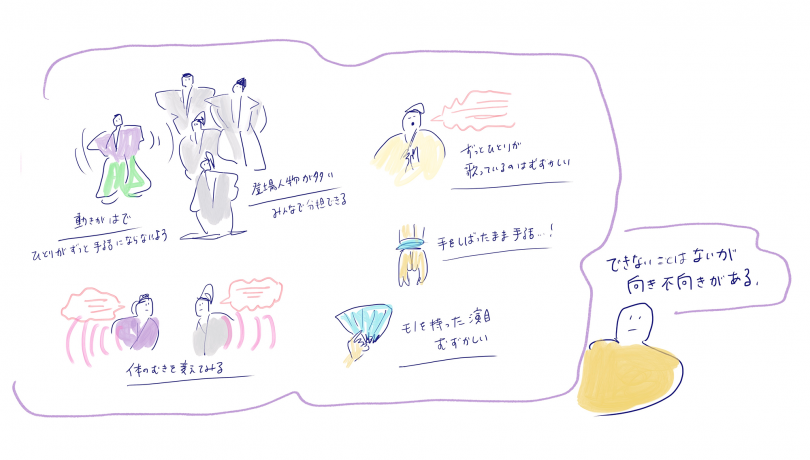
Graphic Recording (Production: Junko Shimizu)
(Image enlargement: JPEG version) - Question
- My question is as a beginner in sign language. You said that 1 to 20% of the forms have meanings, but if so, do sign language expressions and forms have slightly different meanings? In other words, isn't it possible to get confused between the movements seen by someone who knows sign language and those seen by someone who knows kata? Also, I thought it would be international sign language if they perform in the world.
- Oshima
- We do all kata, so we don't insert sign language in the middle of kata in this sign language Noh. In other words, they put sign language where there is no movement of the body. That's why we don't use sign language to remake the form of, say, Shikake Hiraki. I don't think there will be any confusion even from the viewpoint of people who don't know much about kata and mainly know sign language, but we may encounter such situations in the future.
- Ogawa
- Thank you. Do you have the same opinion, Mr. Chikanari?
- Miyake
-
Right. In Kyogen, a form of expressing sadness that Oshima-san was doing earlier, you cry aloud. In Kyogen, the expression "cry" in sign language is not used, but it is conveyed just by crying in the form of Kyogen. In that way, they perform by combining skillful things. In addition, there is a type that hits the knee with a word that means "Oh, yeah." or "I made a mistake!" You can understand the context by looking at it.
Even if you don't understand the meaning of each part, I think that in the first place, Noh kyogen was not made to make you understand everything. The good thing about Noh Kyogen is that there is a blank space where you don't understand and wonder what it was. I would be happy if you think that it is not sign language and that it is a form of Kyogen by doing it without breaking the form so that you can go deeper by feeling doubts about the margin.
- Ogawa
- What about "International Sign Language"?
- Shimizu
- We have already started talking about it, but in order to realize it, we have to learn it first, so there is a hurdle, but I would like to try it by all means.
- Ogawa
- Director Shimizu is a person who does all the things he has never done before, so he may apply for a big grant to Arts Council Tokyo. By the way, I would like to ask for your opinion on those who use sign language as a means of communication, but has Asako Hirokawa of TA-net ever seen sign language Noh?
- Hirokawa
- Yes. I myself work on Sign Language Kyogen in the Japan Deaf Theater Company, so I went to see Sign Language Noh several times. It's the same for Kyogen, but I agree with the opinion that Noh kata and sign language are easy to match. In order for Deaf people to see, understand, and really enjoy it, we need to devise more ways, and there are more things we can do, such as explaining the meaning of the background. I hope you will have more opportunities in the future.
- Ogawa
- Please say one last word.
- Shimizu
-
Thank you very much. I think it's amazing that one stage actor can express two languages at the same time, a spoken language and a physical language called sign language. In past performances, actors express their lines in sign language, so they express the same content as they speak, but I wonder if it might be possible to express completely different content in sign language, such as background explanations, from the content of the lines expressed in the mouth. This would never have happened in performance art.
Some people are beginning to realize the meaning of this, but I would like to think more about it from now on, and I hope it will be an opportunity to reconsider it in the expression method of theater.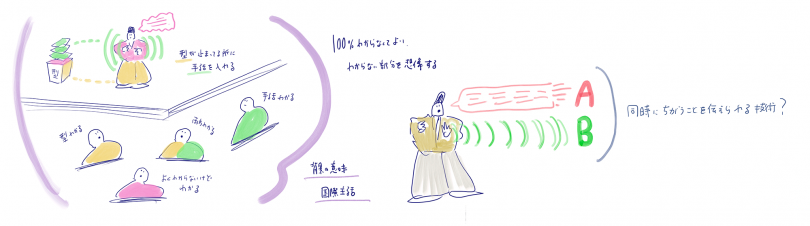
Graphic Recording (Production: Junko Shimizu)
(Image enlargement: JPEG version) - Oshima
- I've told you everything today, and I have nothing to say. Thank you for staying late. Thank you for your continued support.
- Miyake
- I have a lot to say (laughs). To put it simply, it is quite difficult to create a good product with subsidies unless you can handle the numbers. "Sign Language Noh" has been gradually developed through trial and error, so I would like to see more subsidies and increase the number of stages so that we can create a good one.
Finally, the person in charge of Arts Council Tokyo said, "I thought again that this is a rare project that has continued to evolve by bringing together people who always think about what can be done, people who throw ideals for beauty, and people who are active in all directions to realize it. I felt the beauty of subtraction that had been stripped down, and at the same time, I was able to realize the fun of Noh and Kyogen at the same time."
The birth of "sign language noh," a new form of noh that goes beyond support for viewing, has stimulated a variety of fields, including traditional art, sign language, and social inclusion. I would like to take this opportunity to visit the Noh Kyogen stage.
(Reporting and writing by Yuri Shirasaka)
The 14 Roppeita Memorial Foundation
約450年の歴史を持つ能楽シテ方5流のひとつ喜多流の本拠地、喜多能楽堂の管理運営を行う。定期公演をはじめ、初心者や子供たち、外国人や障害のある人々に向けた能楽の普及活動を広く展開している。また2019年には地元自治体の品川区と事業連携協定を締結し、地域における文化振興拠点としての役割を担っている。
http://kita-noh.com/
Social Grant Grant results
- Heisei 28 (2016) FY 1 "Noh Kyogen Appreciation Meeting Enjoyed with Sign Language"
- Heisei 29 (2017) FY 1 "The 2nd Noh Kyogen Appreciation Meeting Enjoyed with Sign Language"
- Heisei 30 (2018) FY 1 "The 3rd Noh Kyogen Appreciation Meeting Enjoyed with Sign Language"
- Heisei 31 (2019) FY 1 "The 4th Noh Kyogen Appreciation Meeting Enjoyed with Sign Language"
- FY 2021 (1st) 'The 5th Noh Kyogen Appreciation Meeting Enjoyed with Sign Language'
- FY 2022 (1st) 'The 6th Noh Kyogen Appreciation Meeting Enjoyed with Sign Language'
Social Grant
A program to support "Activities that allow people who have limited opportunities to experience and participate in art due to their social environment to engage in art experiences, such as appreciation and creation, and to exercise their creativity and enrich their imagination." and "An artistic activity that sets social issues based on one's own awareness of problems, collaborates and works with various people and organizations, and takes a long-term perspective and engages in practical problem-solving." for organizations working in Tokyo.
The system was launched in FY 27 (2015), and since FY 28 (2016), applications have been made twice a year. It has supported more than 120 projects. It is not just "art for art's sake" or "art that is useful to society," but it is trying to support activities that propose and materialize a new way of art in which society and creative activities are inseparable in a way that has never been done before, so to speak, "the third art."