



Over the past nine years, "Social Grant" has subsidized about 150 projects by arts and welfare organizations. On February 9, 2024, an activity debriefing session was held to introduce the activities of the organizations centered on the projects that received the grants, and to share their achievements and challenges with the participants. Starting from the 2021 (Reiwa 3) fiscal year, we are also aiming to build a network through the exchange of opinions with participants.
This time, the fifth edition is based on the theme of "Song, Words, and Body: The Possibility of Creating a Place for Diverse People to Meet", and in the first part, "Expression Club Yagaya", which has been creating a place where people with intellectual disabilities and various people can enjoy music and dance workshops for nearly 20 years in Hikarigaoka, Nerima Ward, and in the middle part, "Ryogoku Monten Hall" as a regional hall/art space open to everyone in Ryogoku, Sumida Ward We will deliver the state of the "General Incorporated Association Monten", which has developed a variety of projects, and the second part of the roundtable.
- Date & Time
- Friday, February 9, 2024 18:30 ~ 21:00
- Venue
- Arts Council Tokyo 5th floor conference room
- Reporting organizations and speakers
- EXPRESSION CLUB GAYAGAYA Miri Kojima, Tamami Yamada
MONTEN Yaeko Kurosaki, Miki Akaba - facilitator
- Tomoki Ogawa
- graphic facilitator
- Mihoko Seki
- sign language interpreter
- Yuko Kato, Yuko Setoguchi
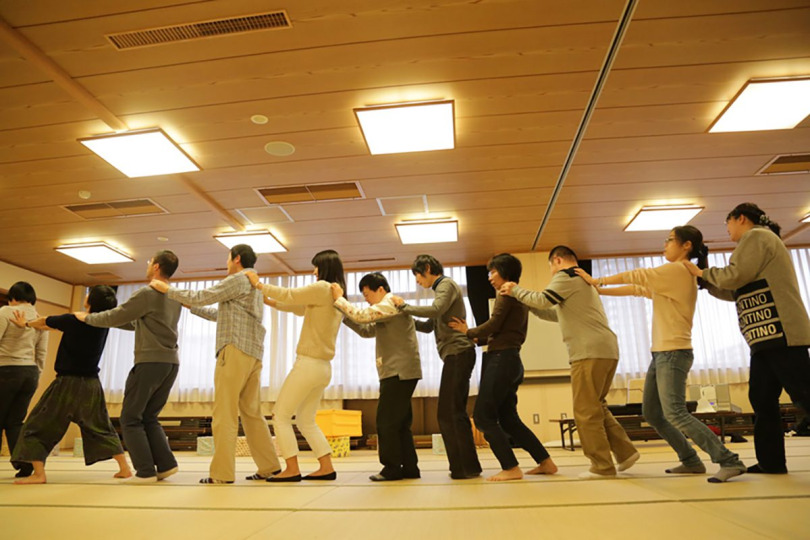
Photo by Himari Domoto
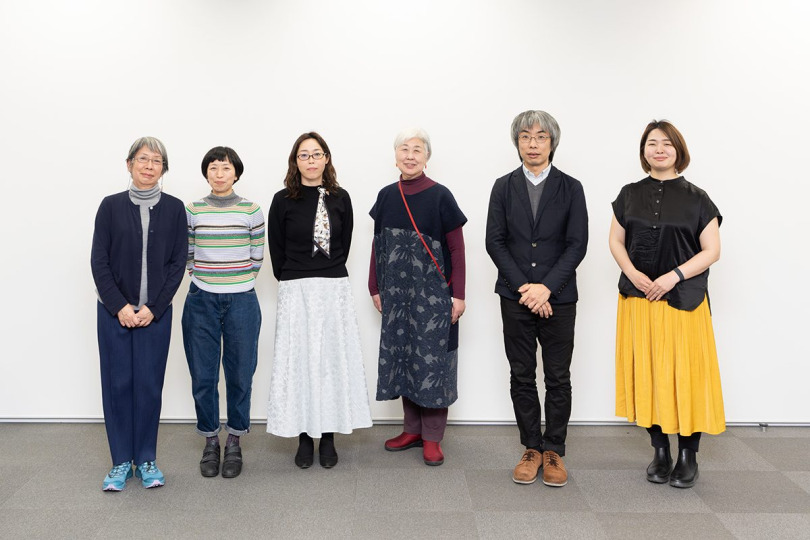
Photo by Kazuyuki Matsumoto
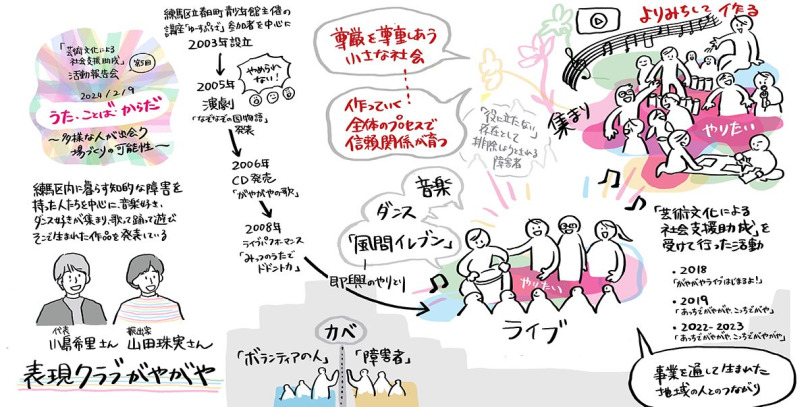
(Image enlargement: JPEG version)
When songs and dances are born -- from "disabled" and "able-bodied" to people with proper nouns --
Music lovers and dance lovers, mainly people with intellectual disabilities in Nerima Ward, gather and hold play-like workshops every month called "Expression Club Gayagaya" (hereinafter referred to as "Gayagaya"). The songs and dances born there are presented at "Gayagaya Live" once a year. Representative Nori Kojima and choreographer Tamami Yamada introduced their activities centered on the three projects selected for "Social Grant".
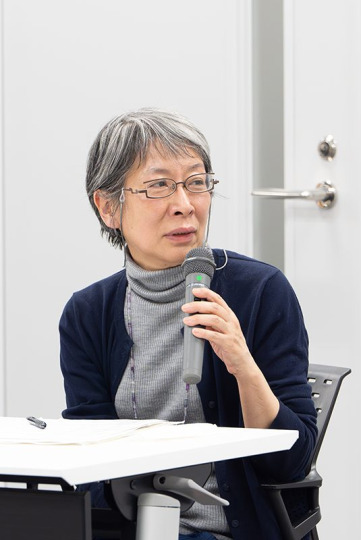
Photo by Kazuyuki Matsumoto
Gayagaya was established in 2003 by participants in the Yusuplaza, a class hosted by the Kasuga-cho Youth Center in Nerima Ward. Originally, Kojima was approached by a ward staff member who wanted to create a place where young people, regardless of whether they had disabilities, could interact with each other. At first, Kojima tried to figure out how to get people with and without disabilities to cook and make candles together, but he decided that he wanted to create a place where people could talk beyond the roles of volunteers and people with disabilities, and started a theater workshop with actor Hikaru Hanazaki. However, students from the nearby Nihon University School of Art also joined in, and the class ended. Still, Kojima says, "The participants did not want to quit, so we moved to the Hikarigaoka Community Center and continued the activities."
As he continued acting and dancing, he made connections with various people. He worked with composer Minato Daihiro on a CD titled "Gayayaya no Uta." In 2008, he received a grant from the Meiji Yasuda Life Insurance Social Contribution Program to participate in "Able Art on Stage," where he met Miki Akaba (a musician) and Keiko Masaki (a percussionist) of "Sokkyo Karameirudan." Inspired by the two participants who "create music and dance from their own words," she presented "Mittsu no Uta de Dodontoka" with music by Tsurumi Yukiyo and direction and choreography by Yamada Tamami at Waseda University's Ono Memorial Auditorium in 2008. The audience laughed when Kojima said, "From the beginning, there was a motif called "Kazama Eleven," which was like a skit based on a conversation with a convenience store clerk, and the combination of music, dance and "Kazama Eleven" became the basic form of performance in Gayayaya."
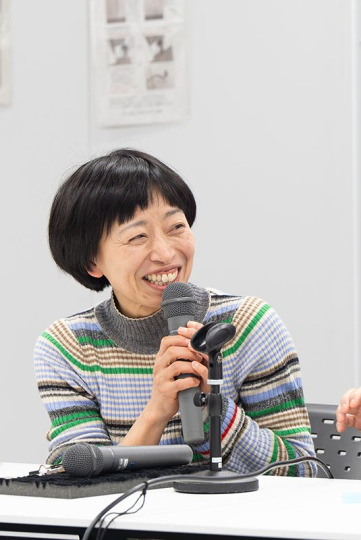
Photo by Kazuyuki Matsumoto
Mr. Kojima applied for "Social Grant" to expand the activities of "Gayagaya". Mr. Yamada read it on his behalf, saying that he wrote these things every time in the "Social Issues to be Tackled" column.
"While multicultural coexistence and social inclusion are advocated in modern Japan, there is even a growing tendency to exclude people with disabilities as 'useless'. By implementing this project, we hope to create artistic expression together and take a steady step towards creating a rich community that is nurtured by diversity."
However, Mr. Kojima says, "Rather than creating a program to achieve this, we are thinking about how to create a fulfilling time with people who are already gathered in the area." It was conveyed that the content and "place" that suit the "people" are valued first, rather than "people" matching the "purpose".
Trust grows in the process from workshop to live. Small society that respects dignity
While watching video recordings, the participants were introduced to the FY 29 2017 FY 2 "The clamor concert will start!," FY 31 2019 FY 1 "clatter over there, clatter over here," and FY 2022 FY 1 "There it is, there it is, 2022" that were subject to the grant.
- Yamada
-
“The first performance in 2018, "The clamor concert will start!" was held at Kierakudo in Keyakinomori. We held seven or eight workshops and composed the lyrics from the words created by the participants, and mainly had composer Masami Noda add the music for the live performance. It is a beautiful space renovated from a 150 year old traditional house, and it is arranged so that you can enjoy the tranquil and relaxed atmosphere of the usual workshop held by Gayaraya by moving from the large garden to the dirt floor.
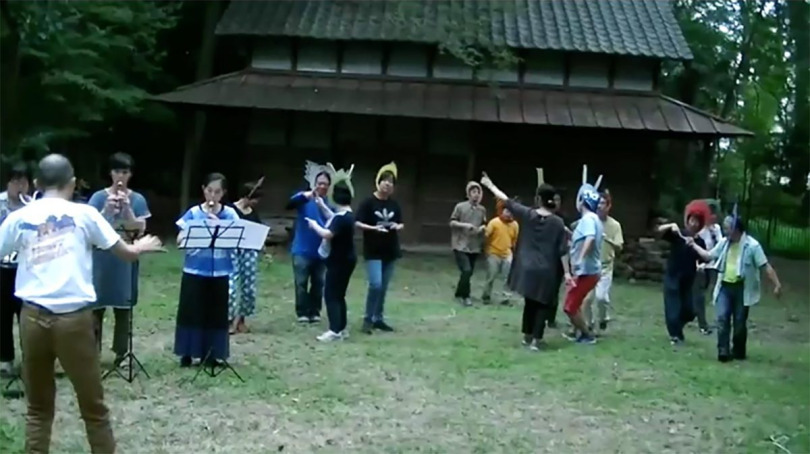
"The clamor concert will start!" Year 2018, in the garden of Kirakudo in the Keyakinomori. "Asa Hiru Ban" (It is not the live video shown at the Kierakudo in Keyakinomori on the day of the activity report meeting, but you can watch the same work.) 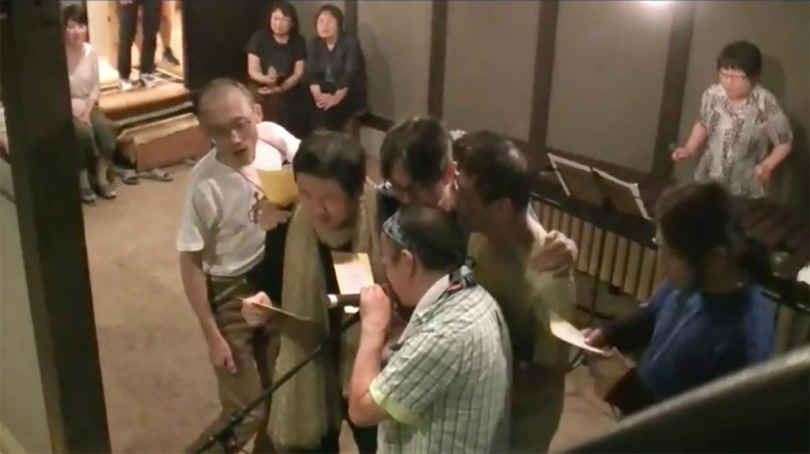
"The clamor concert will start!" Year 2018, Keyakinomori no Kisarakudo - Kojima
-
"It was a big stage for us, so we needed to be a little more expansive in various situations, such as picking up and dropping off and handling audiences who needed to be guided. In fact, this project has led to a volunteer group of local seniors, and I feel that people in the neighborhood have started to say something like, "Gayayaya-san."
In the second Heisei 31 (2019) 1st term "clatter over there, clatter over here," the live concert was cancelled because there was still a corona problem. But in the course of six workshops, I came up with a song called "Yesterday." After the activities were over, Ms. Noda made an animation of the song she had written and recorded on YouTube. I thought there was another way to present a song, and for the third "There it is, there it is, 2022" in FY 2022, I applied for a grant by creating a channel on YouTube and presenting a song. At that time, I thought it would be more fun to take side trips instead of going straight into writing and presenting a song, so I danced with Tamami Yamada in October and Terunobu Osaki in November. "
We continue talking while watching a digest video from the workshop to the live.
- Yamada
-
"There is a song that I always sing every time. Sometimes children come to play, and I feel that the place is invigorated when there are children."
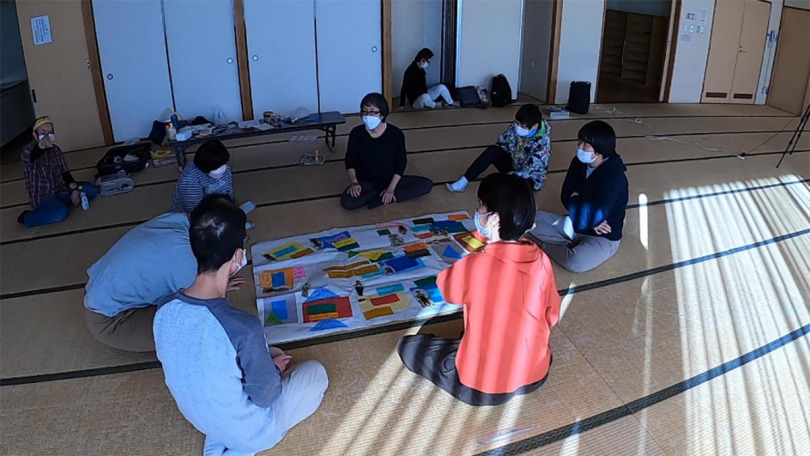
Workshop from "There it is, there it is, 2022" - Kojima
- "Mr. Yamada lives in Kyoto now, so we talk on the phone for a long time about what to do before the workshop, and I suggested rolling up paper. The movement is interesting, cheap, light, safe, and easy. There are always people who don't do anything, who are not interested, or who don't do anything but come, but I could imagine that the existence of people who don't do anything would not be cut off. Then Mr. Yamada said that he wanted to make a tube, and he had an idea. There is a dramatic and emotional song called "Naked Island" by Lin Kwang, and he told me to do that in the workshop because he had an image of dancing after rolling up a piece of paper."
- Yamada
- "If I turn the paper gently without making a sound, I feel calm somehow. We also threw the rolled papers together and piled them up. This is one of the people who doesn't do it, but I really like walking with him. When I watch him walk, I feel like I'm seeing something that I don't feel in my daily life."
- Kojima
-
"I wanted to create another aerobics program, so I asked the dancer Terunobu Osaki (aka Terupo). They showed each other how they eat their favorite food and composed the dance by putting it to the song "Gingiragin ni Casual" (laughs).
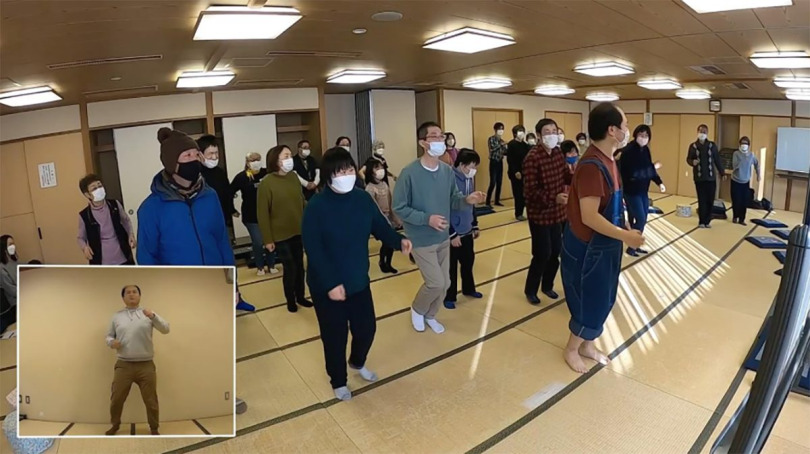
And you did an impromptu dance. Ken felt so fulfilled by this that he asked me to make a leaflet because he wanted to hold a live concert with Terupo (laughs). In January, they performed live under the name of "Ken and Terupo". I'm glad that I took a side trip because such a spontaneous thing was born.
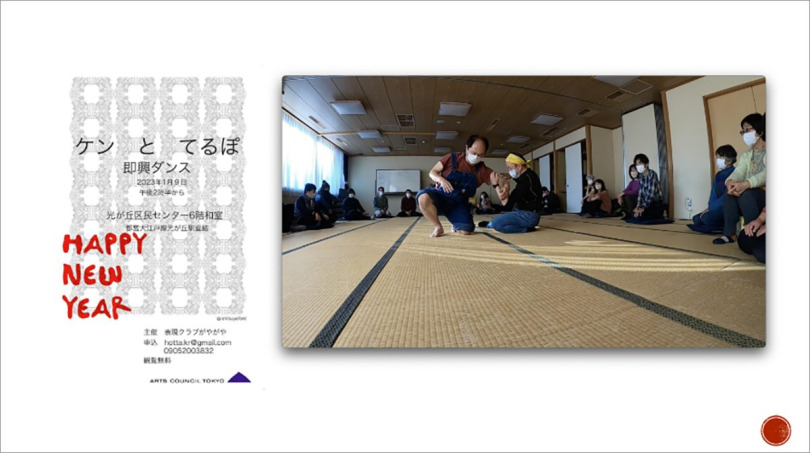
"Ken and Terupo Improvising Dance" Year 2023, Hikarigaoka Community Center, 6th Floor, Japanese Room I also composed various songs and uploaded three new songs on YouTube for "There it is, there it is, 2022" with Tetsutaro Takeshi of Bakurocho Band, Arisa Yokote of Tsumugine, Ms. Noda, and Momoko Nakamura. "
I saw one of those videos called "Inside Your Backpack.".
♪ In my backpack, I want to call, Ameyuki, weather forecast, Maiasa TV, soar 〜〜♪
- Kojima
-
"I interviewed people who participated in the workshop, and based on the poem, I compiled it, and Momoko Nakamura, who has been participating in the workshop for a long time, wrote a song."
"In a backpack" (Video production: Tetsutaro TAKE) - Yamada
- "Kiri came up with the idea of interviewing me on the subject of "What's in your backpack?" but at first she was hesitant to do so because it seemed like she was looking into my privacy. But when you actually listened to them, you said, "It gave me a concrete sense of their daily lives and their lives.""
- Kojima
- "It's something you take with you when you go out, so it's something that connects you to society. Their society was there, and I felt that the words were standing up, and I was glad that I was able to write a song. Takeshi connected the pictures we drew together and made them into an animation. We also uploaded a version with video recitation by Haruko Nakamura, who has participated in Gayayaya since she was a child and is now a university student."
Summing up, Kojima said, "Through these activities, I think the participants went through various processes from listening to the interview to the presentation."
- Kojima
- "First of all, I was asked questions and answered them, then I listened to the music that was made into a song by the composer, then I sang it together, and then I presented the video and heard the impressions of people who watched it. I think it was very meaningful that I was able to share and experience the time in which my words were reborn with many people. If this whole process fosters a relationship of trust among the participants and creates a small society that respects each other's dignity, I think that can be called social support through art and culture."
After the presentation, Mr. Ogawa, the facilitator, asked several questions. For Ogawa, who has been active in the theater industry for 20 years, Gayayaya is a legendary figure.
- Ogawa
-
"Mr. Kojima, you seem to have spent a good deal of your life thinking about what you can do with the chaos."
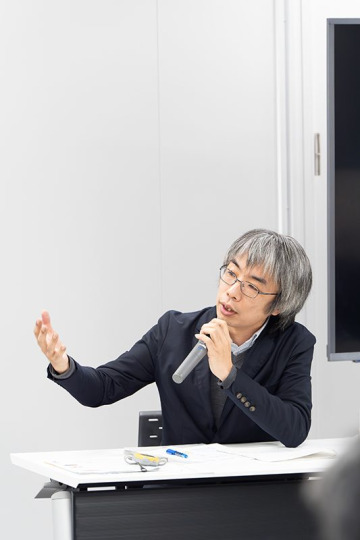
Facilitator Tomoki Ogawa
Photo by Kazuyuki Matsumoto - Kojima
- "It's interesting to think about how we can all be together, because while we're doing it, there are things that we want to do and things that we don't want to do. Issues arise every time, so it's interesting to discuss them with others."
- Yamada
- "Even if we try to arrange for them to do so, they often don't come out if they don't want to. If you don't find a point where you can have fun together with other members, it won't happen."
- Kojima
- "In the beginning, Mr. Yamada was worried that a performance can only be performed when people appear on the stage and peel off the stage, but he didn't know how to make it work in a noisy situation."
- Yamada
-
"Right. Now that I think about it, it is obvious, but I think it is necessary for everyone to witness the situation from the beginning to the end. On the stage of an ordinary play, only those who perform appear and those who do not perform wait in the wings. But I realized that this structure doesn't hold. So from the beginning, everyone went up to the stage and spread a rug on the stage, dividing it into small areas, and that was the area where the performers were sitting. Since everyone was on the stage from the beginning, the performers could go out from where they were and onto the rug. You don't have to go through the steps, but if you want to come out, it will come out."
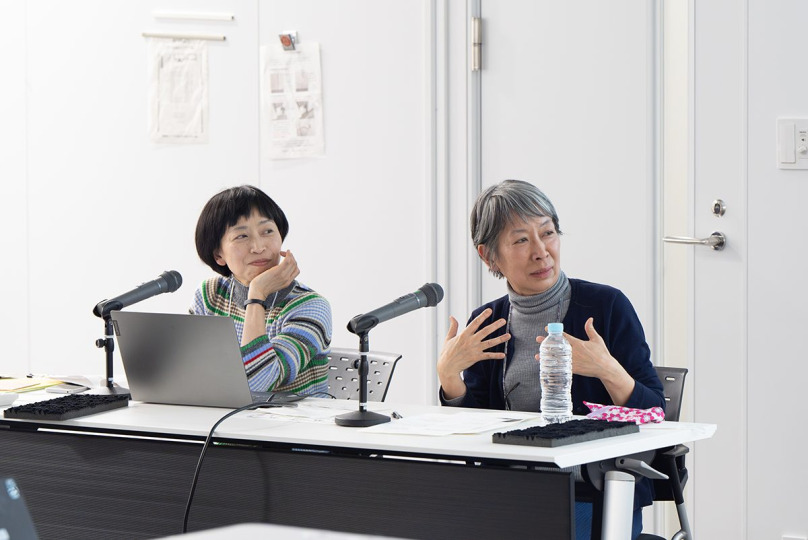
Presentation by Expression Club Gayayaya Tamami Yamada, Misato Kojima
Photo by Kazuyuki Matsumoto - Ogawa
- "Gayayayaya seems to have dealt with artistic genres that focus on physical movement, such as music and dance, but Ms. Kojima herself works as a translator and has an image of herself as a literary person. Are both genres common or different?"
- Kojima
- "For the songs “Inside My Backpack ” and“ What I Want, ” she mentioned her name as “Lyrics: Kirito Kojima and WS participant. ”. I think I was able to get involved in the writing of lyrics and connect it to my own interests."
- Yamada
- "Actually, I understand that Kiri-san edited the words that everyone wrote. What do you think?"
- Kojima
- "Even if I say I write as I hear it, I write through my head, so I think I go into it rather than "No, I didn't. It's everyone's word." I feel like I'm doing something I shouldn't be doing, so it's difficult, but I feel like I'm going to do something here that I haven't done for a long time. Mr. Akabane and others have a special skill to interview each other and turn it into a song on the spot, but I don't have that skill. So rather than saying that we're all doing it together, I thought it would be more honest to say that I'm doing it and that I'm involved."
- Ogawa
- "There is a part of you that is devoted to creating a noisy place, or creating a place, and there is surely something that has been matured in 20 years and handed down from generation to generation, but in the field, you are waiting for what is born from the people there and shaping it."
演劇やダンス、音楽などを通じて、自分の言葉で自分を語ることができる、そんな喜びが体からあふれてくるような舞台。YouTubeのがやがやのチャンネル(https://www.youtube.com/@gayagaya-youtube)をぜひ見てほしい。
(Reporting and writing by Yuri Shirasaka)
EXPRESSION CLUB GAYAYA
It was established in 2003 by participants of a course held by the Kasuga-cho Youth Center in Nerima Ward. Mainly people with intellectual disabilities who live in the ward, music lovers and dance lovers gather once or twice a month to sing, dance and play. The songs and dances created there are made into works, and once a year they perform as "Gayayaya Live."
Social Grant Grant results
- Heisei 29 (2017) 2nd term "Gayayaya Live Hajimuyo"
- FY 31 (2019) 1st Term "clatter over there, clatter over here"
- FY 2022 1st Term "There it is, there it is, 2022"
Social Grant
A program to support "Activities that allow people who have limited opportunities to experience and participate in art due to their social environment to engage in art experiences, such as appreciation and creation, and to exercise their creativity and enrich their imagination." and "An artistic activity that sets social issues based on one's own awareness of problems and works to solve them through cooperation and collaboration with various people and organizations" for organizations working in Tokyo. It was started in fiscal year 27 (2015), and since fiscal year 28 (2016), public applications have been held twice a year. It has supported about 150 projects so far. It is not just "art for art's sake" or "art that is useful to society," but it is trying to support activities that propose and materialize a new way of art in which society and creative activities are inseparable in a way that has never been done before, so to speak, "the third art."