



Part 2 Interviews
In the second part, Arts Council Tokyo 's Senior Program Officer, Hiroko Horiuchi, hosted an interview that delved into the current state of gagaku performance activities and traditions, which were the background of this project, and new initiatives by performers.
- First of all, could you tell us about the recent situation of gagaku, what kind of characteristics and changes have there been in both the performers and the viewers?
- Nakamura
- I'm taking a practical gagaku class at university. The number of children has decreased and it has become small, but they are studying hard. However, most of the time, students graduate saying, "I want to continue, but I can't find a place to continue, so I feel a great dilemma." I myself did not enter university with the idea of "doing gagaku," but I came across Professor Shiba just when he was trying to "do something with young people," and I was able to participate in it without knowing what it was, and that's how I was brought up. It's hard for that to happen now. I feel that I am in a position where I have to create such a place, but it is difficult for me to do so.
- Miyamaru
- I think the number of enthusiast groups is increasing nationwide. Nowadays, we can upload our performances on the Internet without spending a lot of money, so it's a mixed bag, but I think the number of people who know about instruments such as Sho, Hichiriki, and Ryuteki flutes by watching them has increased dramatically compared to before. The other day, I held a workshop at a junior high school. At that school, they used the Internet to study in advance, and they wrote a report on what they were interested in. So in class, when the teacher asked, "Can you name a gagaku instrument?" many of the children said, "Of course." I feel that things like this have changed considerably since around 2015 (when we started the long-term grant project).
- Miyata
- When I started performing gagaku nearly 40 years ago, it was just the time when the activities of the National Theater were flourishing. But I think there was still a strong sense that gagaku should be listened to formally, and I think there are many people like that even now. So I'm really happy that young people are starting to enjoy gagaku really freely. In The Tale of Genji, there are many scenes where music is played, but the expression "imamekete" is particularly impressive. At that time, listening to gagaku must have been the experience of listening to the wonderful music of a foreign country that came from Chang'an, the highly developed capital of Tang. I think that young people of today are listening to gagaku in this way, as if rediscovering it, and I hope that they will accumulate experiences that move their hearts in this way.
- Miyamaru
- After all, I think it is very important to deepen the understanding by listening to the live sound and actually touching the mechanism of the instrument. Therefore, the concerts for children that we have been working on are called for children, but we are hoping that they will spread not only to children but also to people who know gagaku for the first time and adults who want to listen to it again.
- I have heard that the form of "gagaku" now performed by the Imperial Household Agency dates back to the time when the Meiji Senjofu was established and the style of performance was specified, and is different from the form up to the Edo period. Mr. Sukeyasu Shiba has been working to expand the range of appeal of gagaku by restoring the lively sound of gagaku from before, rather than the gagaku from the Meiji era, which is now often listened to in a formal manner. In modern times, the Internet environment that I mentioned earlier has been improved, and through such technology, I feel that the possibility of encountering the various charms of gagaku beyond that of the Meiji Senteifu is expanding. I feel that the various activities conducted by the members of Reigakusha are not necessarily about playing solemn and formal gagaku, but about directly enjoying the variety of sounds of the instruments. Based on this, I would like to ask your thoughts on future activities of Reigakusha, such as increasing the number of people who are familiar with classical gagaku, or expanding the audience while broadening the range of gagaku.
- Miyamaru
- I think there are various ideas among the members. What we did in this project was to let people know that the sounds of musical instruments are interesting and that there is such music in Japan. From that entrance, I really want people to understand the charm of this special music, such as the special rhythm system that has been handed down and the formation of classical compositions. The concept of the music is completely different from Western music, so I hope people will start with the fun of the sound and listen to it. I also hope that gagaku will develop in the future. I always tell my children, "In order to pass on gagaku, which has been connected for 1000 years, 1000 years from now, new ideas must be developed." but I am still not sure if such a wide range of activities and newly commissioned works will lead to such expansion, but I am hopeful.
- Nakamura
- I think the number of people who actually use gagaku instruments is increasing because they want to try new music and this instrument. On the other hand, there is no such thing as a feeling of guilt about tradition, and they are doing things with a sense different from the previous generation. But, for example, there is no group that performs music commissioned by Reigakusha. I think it would be interesting if there were such a spread and movement, but I feel that there is an issue that such an organization is unlikely to emerge.
- Miyamaru
- It's really developing there. Last month, at the National Theater, we held a rare concert for Reigakusha, in which all but one of the pieces were classics compiled by Meiji Senjofu. Surprisingly, it was sold out in no time. I felt that the needs of the world were there. I hope that people will listen to the classics and then listen to new ones.
With the aim of getting more people familiar with gagaku, he took a new approach by introducing children's gagaku pieces created by Shiba Sensei and commissioning new composers to create creative new works for people who encounter gagaku for the first time. I strongly feel that this is the direction that Reigakusha was able to make. Then, I would like to ask you about the situation of gagaku from the viewpoint of the hall side and the producer side. What is the position of gagaku in such a situation? I would like to ask Mr. Hisashi of Tokyo Concerts, who is in charge of management, to speak.
- still
- Through this long-term grant project, we have been able to enhance our programs for children and gain know-how, so we have received requests for outreach such as holding workshops and then holding concerts. I think that such an approach to listening to a performance after touching an instrument is the mainstream in Western music, and there are many requests for such a request from Reirakusha as well.
In the past few years, I have been asked by the organizer hall to ask if it is possible to collaborate with another genre of gagaku. I was invited to the "Japonism" in Paris in 2018 with the Imperial Household Agency Orchestra, and I also showed a collaboration between classical music and dance. In 2016, he planned and performed "Autumn Garden Song" with Saburo Teshigawara (this performance won the 16th (2016) "Keizo Saji Award" of the Suntory Arts Foundation. Arts Council Tokyo 28 Creation Grant [Single-year Grant Program] 1st Term Subsidy Target Project), I think there was a place where we were approached because there was such an attempt.
Regarding the performance in Paris, both at the reikaksha and Kaiji Moriyama, who worked with me, I strongly felt the enthusiasm of the audience. There was just the Olympics and the trend of rethinking Japan's music, and overseas audiences were very happy with the charm of Japan's music. So, since 2018, there has been talk of wanting to do this project again, and this year, with a subsidy from the Agency for Cultural Affairs, we were able to perform the other day ["Dancing with Gagaku, Dancing with Gagakusha Reirakusha ×Kaiji Moriyama", Tuesday, November 30, 2021 at Teatro Giglio Showa]. At this time, I danced to the songs commissioned by Reirakusha, "Higan no Time" composed by Atsuhiko Gonshiro and "Silk Ribbon" composed by Noro Saruya, but Mr. Sarutani said, "In this busy modern age, I think we should rethink the flow of gagaku music. How to express that the flow of time is different from today." This was an intriguing perspective in a different way from the appeal of individual instruments and songs. Also, Mr. Moriyama said that he was surprised that the tempo was different even though they were playing on the same day for the first and second times during the rehearsal. The choreography was decided on a beat, but the tempo was different each time, and there was no conductor, so how to start was different. That may have been the original Japan music, but we studied Western music and grew up with Western music, so that's also an interesting point. As a management side, I feel that it would be nice if we could pick up and promote such materials better.
It is true that rhythm and tempo are important elements of Western music, but in Japanese music, it is interesting to listen to the taste of the sound in addition to that. If Western music is developed and constructed horizontally, Japanese music has a vertical tonal flavor. I think the characteristic of gagaku is that you can enjoy the sound with your whole body. I think that the experience of actually touching an instrument like this experience program leads to the enjoyment of all five senses, not just hearing and sight. What do you think about that?
- Miyamaru
- I think the emotion of the child who actually touches the instrument is something special that is different from listening to the live sound or explaining the structure. Now it is difficult to experience wind instruments, so we offer experiences of percussion instruments and dance. For example, some students write in the questionnaire that they liked shoko the most. The way of playing a percussion instrument in gagaku is extremely simple. In the case of a shoko, you just "chin" with one hand and "chichin" with both hands. So in a traditional gagaku group, shoko is a relatively unimportant position for young people and beginners, but children have no preconceptions, so they are deeply moved by making a single "ding" sound. I feel that there is a big difference between trying and not trying.
- Nakamura
-
Before the COVID-19 pandemic, we had Hichiriki instruments lined up in the lobby, and the children would take turns playing them, of course, while disinfecting them. Hichiriki flute and Ryuteki flute are made of plastic, and you can surely feel the joy of making sound with simple structure. For children, any instrument may be fine, but instruments for gagaku are easy to get a direct feeling of "When I breathe in, it makes such a beautiful sound" and easy to use for many people to participate in.
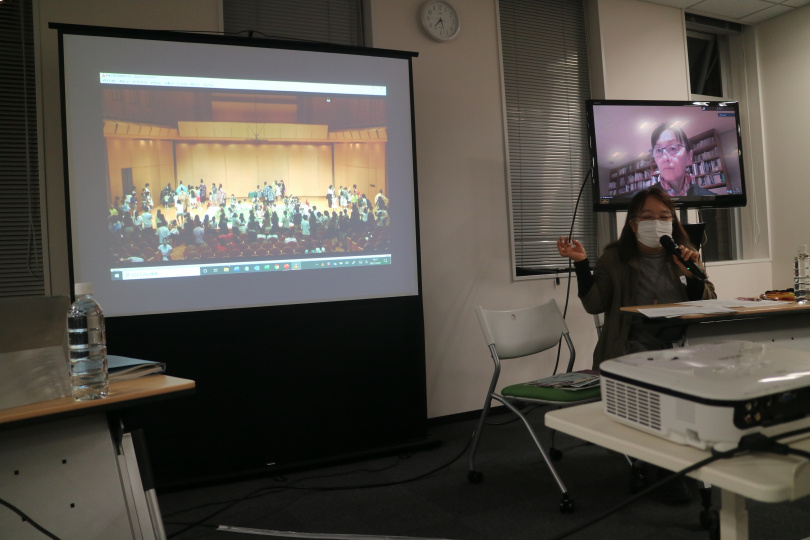
Naoko Miyamaru explaining how children can experience gagaku instruments
Capturing and conveying the "breadth" of gagaku
- Thank you. Now that you have completed the long-term grant project, could you please tell us again about the points that have been useful for your subsequent activities, the areas that have developed, and the future developments?
- Miyamaru
- Even before applying for the long-term grant, Reigakusha had been engaged in activities for children, but I felt that we would not be able to continue unless we achieved good results. This coincided with the school's demand for performances and workshops in traditional arts. I counted the number of public performances that are different from concerts, such as performances at schools, workshops, and requested performances, such as experiencing musical instruments and singing songs. After all, the number gradually increased from around 2014. 2020 was a special year due to COVID-19, and most of them were canceled, but we received constant requests from 2017 to 19.
Therefore, we feel that this long-term grant was a punctuation mark that allowed us to think about what we should do in the future by taking what we had been trying to figure out as a total, and we continue to hold concerts while looking for ways to make further improvements. We organized a series of gagaku concerts for children in 2018, 19, and this year (21). The parents are young when it comes to concerts for children, and if you make the ticket fee expensive, they will avoid it. Therefore, it is sometimes called "Why do you do it when you're losing so much money?". But when I want to spread the word to a wide range of people, I want to have a place where people can say, "Come here," not just in a closed space like a school. Last year and this year, we were not able to accommodate so many people at the same time, but I hope we will continue to hold concerts and try to include new works.
- I understand that children's activities are one of the main pillars of Reigakusha's activities. I wonder if you will continue to pursue this business at the risk of losing money. If you are going to continue, I would like to ask if you are going to devise something. For example, could it not be possible to commission a composer to write a new piece of gagaku for children in a small composition that combines several instruments instead of a full composition? Or is it possible to create experimental and educational musical works in which children can actually participate? What do you think about the possibility of planning concerts for children in the future that are inexpensive and effective?
- Miyamaru
- When we receive direct requests from schools, there are many cases where only a small number of people can perform even if they try hard to raise money. Many requests from local governments are workshops for 4 or 5 people. We can do it without spending a lot of money, and we can have enough experience, so I think we should do this. But after all, I would like you to see the amazing sound of gagaku performed by 11 or 16 people and the stage wearing costumes. That's why I always think it's necessary to have a place where people can listen to classics or hear the sound of a large group as a development for people who have listened to them or taken a workshop with a small group.
- Do you mean that there are conflicting ideas?
- Miyamaru
- I need both. For example, we sometimes go to the workshop wearing T-shirts. But some things don't get through just by themselves.
- In traditional performing arts, styles and forms have already been established, and it is important to pass them on to your own body. Therefore, if you break the mold or make use of modern ideas, it may not be "traditional performing arts." On the other hand, there is a method to extract the essence of the concept that makes the performing arts established, which is different from Western values of art and culture, and convey it as the core. However, in this case, if you focus too much on the concept, it may be difficult to convey the style and form of the classics. I think that traditional performing arts are in a situation where they are engaged in activities for succession while consulting with the economic aspect in such a struggle. I think there are two ways to increase the number of people who enjoy traditional performing arts. One is to increase the number of people who appreciate the art, and the other is to increase the number of people who actually perform the art. What do you think about that in the case of Reigakusha? Of course, it may be ideal if both directions overlap in an activity.
- Nakamura
- Most of the activities of Reigakusha today seem to be aimed at viewers and listeners. The association does not conduct so-called teaching activities. Of course, there are people who give guidance to each of them, but the fact is that the association itself cannot accept many performers, and it is difficult to train performers and eventually work together. In fact, even when I play "Musical instruments, interesting" and people say, "I want to learn because it was fun," I can't tell them where to go to learn. It is a dilemma that I cannot guide you one step ahead. Also, at concerts for children, we tend to be conscious of those who are listening for the first time, so the songs, such as Etenraku, tend to be somewhat similar. There is a reflection that we have not been able to lead the team one step further. So what should we do? It would be great if we could have a studio in Reigakusha with musical instruments, and "Well, this time is for the children's class." or something like that, but I can't see any way to achieve that.
- Miyamaru
- I had a dream that it would be a rental but permanent place, that it would have musical instruments, that it would have a short concert at night on a fixed day of the week, and I actually looked for such a place. But ordinary buildings were not good. I was frustrated because the drums were too loud in any studio. If it's a temple or shrine, people won't get angry even if they hear the sound, so I think we can consider using such venues as practice sites, but it's still a big issue because it's difficult to do so now due to COVID-19. Also, one of the courses I was working on to realize was "the first biwa" and "the first koto," and to learn to play one piece in six months. This has also been put on hold because it is difficult to share the same instrument at present.
- still
- At a performance of the "Children's Development Project by the Agency for Cultural Affairs," a question was asked, "How old were the musicians when they started playing this instrument?". At that time, Mr. Miyamaru said that the children in the Music Department of the Imperial Household Agency would have to be quite tall to play a musical instrument, so they would sing songs from an early age and get used to their bodies and ears before they started playing a musical instrument. When I think about it in this way, if the experience of drumming remains in a child's project, I think it would be better to try it later, when they are really adults.
- I think Reigakusha's activities, which are based on hands-on experience, are very significant. Through these activities, the wonders of gagaku and traditional Japanese performing arts will reach more people, and eventually more people will try it themselves. In addition, I think it would be ideal if, at the same time as firmly inheriting the classics, the instruments of gagaku would be used to create a new world of sound that incorporates modern sensibilities.
- Miyata
- I think it was a very big thing that I had the opportunity to come into contact with Mr. Arts Council Tokyo through this grant, and that I was able to not only receive a grant, but also to think objectively about our activities in this way. I would like to thank you again. Thank you very much.
Q & A
- Questioner 1
- About the collaboration with dancers, the dance you introduced earlier is a contemporary Western dance. Are there any choices in collaboration? I would like to know what you focused on when you collaborated.
- Miyamaru
- When I did my first independent performance of Akiteiuta Ichigu with Mr. Saburo Teshigawara, I contacted many people and finally asked Mr. Teshigawara to do it. After that, the organizers told me about the collaboration. So, Mr. Kaiji Moriyama was not chosen by us, but by that kind of connection. Regarding the collaboration, I would like to add one more thing. Last year, we filmed and recorded a collaboration between Reigakusha and the New Japan Philharmonic Orchestra for a project called "Sound VR," with the cooperation of the National Theater during the COVID-19 pandemic. It was fun to play Kimigayo and Jupiter. After that, I had the opportunity to collaborate with the New Japan Philharmonic Orchestra on a concert for children. So, if I keep my antennae up, I think I will be approached by various people.
※「音のVR」――国立劇場×音のVR 雅楽とオーケストラの360度アンサンブル:https://time-space.kddi.com/otonovr/gagaku/
- Questioner 1
- Thank you. When we collaborate, it's like we sublimate it into music while incorporating accidental elements from time to time.
- Miyamaru
- Right. In January of this year (January 2021), I performed "Akiteiuta Ichigu" with Minoru Kanamori at ROHM Theatre Kyoto, and the ROHM Theatre staff had seen the activities of Reigasha, and decided to combine them.
- Horiuchi
- When you collaborate with dancers, how much do you discuss and practice beforehand?
- Miyamaru
- It depends on the idea of the dancer. You don't have to rehearse so much for songs like "Shuteiga Ichigu," which have a strong form.
- Nakamura
- Basically, the music has already been performed for the first time and does not change its form, so it is not so much a compromise between the two sides as a dance to the music. If this was the first performance of the music, I think it would be a different story, but I think this time we had the dancers accompany us.
- Miyamaru
- Right. However, as I mentioned earlier about the collaboration with Moriyama-san, the tempo of our performance changes, so I think they had a lot of trouble adjusting to it, and I think it was an eye-opening experience for the dancers.
- still
- Reigakusha performs at Yotsuya Citizen's Hall as its home. It's a hall with a capacity of about 400 people, and it's usually full, but when we did "Seigaiha" it was really full. The song is related to "The Tale of Genji," so it seems that Japanese language teachers and people interested in literature came. I thought the sold-out performance at the National Theater the other day (where they performed the same "Seigaiha") was a result of that kind of spread. In the performance with Moriyama-san, it was unusual for the seats to fill up from the first row, and it was clear that these were fans of the dancers. In dance, we have collaborated several times, but in the future, what kind of combination will broaden the elements of gagaku, and will it be listened to by people who are different from the audience in the past? We have to think about it, but if there is anyone who thinks about other combinations, we would like to try something new.
- Horiuchi
- I think there is another way to create a new work together, apart from adding expressions of another genre without changing the existing gagaku work. This is not a combination that producers and producers choose, but Reigakusha may expand the range of collaborators regardless of the genre, be it art or film.
- Miyamaru
- Of course, I can't mention your name here, but there are many things that we do with this kind of person in private. But it hasn't been realized yet.
- Miyata
- People interested in various fields such as literature, ancient Chinese history and culture, and modern music come to the performance, so people can enjoy gagaku in various ways. Children's exposure to musical instruments is one thing, but I think gagaku also broadens their interest in various cultural arts. Therefore, we would like to try to expand the world by ourselves rather than just performing the works, and we would like to convey that to those who perform with us and those who listen to us.
(Composition and text: Rieko Suzuki)
Project Description: https://www.artscouncil-tokyo.jp/grants/program/16905/
Profile
Reigakusha
1985年に芝祐靖(初代音楽監督)が創設した雅楽演奏団体。発足以来、現行の雅楽古典曲以外に、廃絶曲の復曲や正倉院楽器の復元演奏、現代作品の演奏にも積極的に取り組み、国内外で幅広い活動を展開している。特に、現代作曲家への委嘱作品や古典雅楽様式の新作の初演には力を入れ、年2回のペースで開催している自主演奏会で度々発表している。他に、解説を交えた親しみやすいコンサートを企画し、雅楽への理解と普及にも努める。また、文化庁「文化芸術による子供の育成事業」他、小中高校生を対象としたワークショップ、レクチャーコンサートなどの教育プログラムも多く行っている。令和2年(2020年)「第50回ENEOS音楽賞邦楽部門」受賞。
https://reigakusha.com/home/
Mayumi Miyata
After graduating from the Kunitachi College of Music, he studied gagaku. In 1983, he held a Sho recital and attracted attention. In addition to classical gagaku, he actively engages in contemporary music and is active worldwide. He was an invited professor at the National University of Music. 2018: He received the Medal with Purple Ribbon. He was the music director of 'Reigakusha,' a gagaku performance group.
Naoko MIYAMARU
Graduated from the Faculty of Music of Tokyo University of the Arts and the Master's Program in Musicology. He studied gagaku under Sukeyasu SHIBA. He has participated in the gagaku performance group 'Reigakusha' since its foundation in 1985. He performed at concerts and music festivals in Japan and abroad. Co-authored "Zusetsu Gagaku Nyumon Jiten" (Illustrated Introduction to Gagaku) (Kashiwashobo)
Hitomi Nakamura
Graduated from Tokyo University of the Arts. He learned Hichiriki flute, Gakuso, Samai, ancient songs and ballads from Sukeyasu SHIBA, Nagao OKUBO, Akihiko KAMI, Hideaki TOYOTOMI and others. He joined 'Reigakusha' in 1986. Developed activities to explore the appeal of the Hichiriki instrument as a solo instrument from classical gagaku to modern music. Part-time lecturer at the National University of Music and Okinawa Prefectural University of Arts.
Shonoriko (Noriko SHO)
President of Tokyo Concerts Co., Ltd., a music firm. He was in charge of the management of the performance group 'Reigakusha' (Planning and production of concerts and public performances of gagaku at elementary and junior high schools nationwide).