



- Date & Time
- Thursday, February 17, 2022 19:00~21:00
- Venue
- Arts Council Tokyo (Zoom Streaming)
- Name of reporting organization
- Tokyo Genken Project
- target business
- Tokyo Genon Plan Concert, Archive (Project adopted in FY 2016: 2 years)
- Speaker [Rapporteur]
- Sumitoshi ARIMA (Members of the Tokyo Genken Project, Electronics)
KURODA Aki (Tokyo Genon Project members, piano)
Shinya HASHIMOTO (Tuba, a member of the Tokyo Genken Project) - moderator
- Mikako Tamamushi (Arts Council Tokyo Subsidy Section Manager)
The long-term subsidy projects of the Tokyo Genon Project include the Repertory Database project, which releases the recorded images of the stage since the group was formed in 2012, and the Selection Series performance, which brings the three perspectives of <Musicians, Critics, Composers> into concert planning.
1.July 14, 2016 Tokyo Genon Plan #07
~ Critics Selection 1: Yuji Numano
2.December 19, 2016 Tokyo Genon Plan #08
~ Musicians Selection 3: Shinya Hashimoto
3.January 31, 2018 Tokyo Genon Plan #09
~ Composers Selection 4: Yuzuru Kondo
4. Repertoire Database Project
Since its establishment in 2012, 31 works from stage films to 2016 have been released on the organization's website. Works by Japanese composers commissioned by the Tokyo Genon Project, and as a guide to special playing techniques that are difficult to decipher with only musical scores, the book is open to both domestic and international references.
Part I Report Meeting
For two years from 2016, with the support of Creation Grant (Long-Term Grant Program), the contemporary music ensemble Tokyo Genon Project concert series and repertoire database was built. From the activity report, we could convey an aggressive attitude of stimulating and updating the contemporary music scene while having fun.
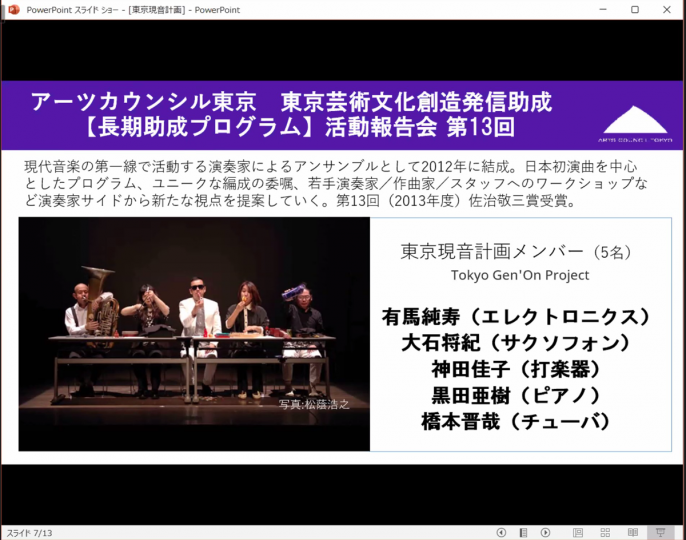
The Tokyo Genon Project, a contemporary music ensemble that celebrates its 10 year anniversary this year, is known for its unique composition of piano, percussion, saxophone, tuba, and electronics, as well as its wide range of activities unique to a collective of specialists. Their concerts are a series of programs commissioned to producers, composers, and other professionals from different standpoints. At the briefing session, they introduced the contents and results of their performances, including the Critics Selection, which commissions critics to select music, the Musicians Selection, which is planned by members of the Tokyo Genon Project on a rotating basis, and the Composers Selection, which commissions composers to plan and compose music.
Different Perspectives = Selection Invites Discovery, Expansion
"Composer's Selection" and "Musicians' Selection" had been held with a single-year subsidy from Creation Grant before that, but "Critic's Selection" started under a new long-term subsidy in 2016. This project was created as a place for experts with a different perspective from performers, such as critics and researchers, to throw and propose to the contemporary music scene, and in the first session held in July 2016, music critic Yuji Numano was in charge of the selection under the theme of "Toward a New Resistance". Some of the videos introduced are Steve Reich's "Pendulum Music" (1968). It is an experimental work composed of howling sounds from multiple suspended microphones passing near speakers installed on the floor. "I think many people have heard the title and the sound itself, but have never actually seen it. According to Numano's speech on the day of the concert, which was introduced at the same time, the meaning of "new" included in the theme is not "new" but "another". "I think that resistance and politics are usually thought of as against power, in other words, composers who clearly state their political policies or composers who grew up in an environment where they had to be aware of them in some way. But here I was conscious of a more "simple work". For example, in "Pendulum Music", everything is visible, so you can see what is successful and what is not, and you can react in various ways. Some people may think it's crap, while others may think it's great. I think that works that can elicit such a reaction are works with a certain kind of political and social nature."
In December of the same year, the Musicians Selection was held by member Hashimoto Shinya (tuba). The concept of “pedigree of modern chamber music and tuba 0-quintet from low notes ” was developed by making use of existing pieces, while the budget allocation is relatively small compared to performances in which critics or composers are commissioned to select pieces. "Tuba is a minor instrument, so I don't have much repertoire. We still have solo and duo pieces, so we asked Tanaka (Yoshifumi) to play the trio and Bando (Yudai) to play the quintet. When I had completed 1, 2, 3, 4, and 5, Mr. Arima suggested that I create a piece without a performer, that is, using my recordings as material. By creating a form from zero to quintet with no one at all, we wanted to convey the transition and what role the tuba, an instrument that has always played the bass part in an ensemble, could play." said Hashimoto.
In January 2018, a concert titled "Composers Selection" was held under the direction of composer Joe Kondo. A total of 5 songs were performed, including Shugi (Shugi) (2000) and a new song, Preface (2018), by Kondo. "As for the direction by composers, we ask as many people as possible with different personalities. As for Professor Kondo's lecture, I was told at a very early stage that I would do this. This is not limited to Professor Kondo, but what kind of music he chooses for a concert with a biased composition like ours tells us a part of how he sees other than his own music, and I think this selection is also interesting." said Hashimoto.
Although these 3 concerts were held during the period of the long-term grant, the 3 selections have been continued since then, and the "Musicians' Selection vol. 12 Aki Kuroda with Francesco Dillon" held in July 2019 was introduced at this briefing. This performance was co-produced by member Kuroda and Italian cellist Francesco Dillon. Dillon and his guest violinist Aldo Campagnari are members of the classical ensemble Quartet Prometheo and have a career in contemporary music. They also participated in a piano trio with Kuroda. "I have been active in the field of world music such as rock and live house, so I wanted to bring that element to the Tokyo Genon Project. Francesco Dillon has also been playing La Scala, doing impromptu gigs with underground DJs, doing rock gigs, so I talked with him and we came up with a program that would bring contemporary music and a little pop from that." Kuroda said. The concert, which included body gestures by Simon Ruffler and Simon Sten-Anersen, and a contemporary version of Keith Emerson's "Tarcus" by Kuroda and Maurizio Pisati, "Zone-Tarcus," attracted a wide range of attention, including rock and pop fans. "It was a turning point for me to be able to combine the activities of the Tokyo Genken Project and international exchange into one form. It made me think again that I would like to continue working while straddling my bases in Italy and Japan, and I think it also led to broadening the scope of activities of the Tokyo Genken Project." said Kuroda.
"If you don't have one, build one" database project
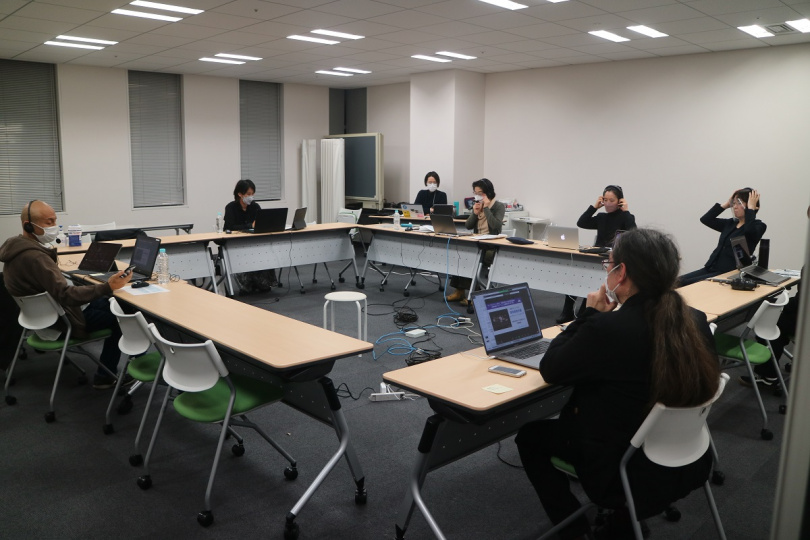
コンサートを通じ、多彩な試みを進める一方で、長期助成申請のもう一つの柱とされた「レパートリー・データベース・プロジェクト」も着実に進行、2018年5月には、これまでの東京現音計画の演奏動画を撮影、アーカイブし、公開するウェブサイトが立ち上げられ、現在も稼働している。「ヨーロッパはどこでもそうだと思いますが、たとえばフィンランドには、フィニッシュ・ミュージック・センターという組織があって、そこのウェブサイトにはフィンランドの作曲家のデータベースがあって、それが非常に充実しているんです。作曲家はもちろん、編成によっても検索やリサーチができるようになっている。残念ながら、日本では、サントリー音楽財団(注:現・サントリー芸術財団)が『日本の作曲家の作品』という冊子をまとめていた時期もあったんですけど、そういった情報が掴みづらい状況がずっとあったと思います。われわれもよく海外から『日本の曲で面白いものがないか』と聞かれたりするんですが、なかなかそれに応えることができていませんでした。だったら、これは自分たちでいちど雛形をつくって、どういうふうに立ち上げ、運用できるかということを考え、アーツカウンシルさんに提案することにしました。もちろんそれも、われわれが個人でできない話ではない。ただ、立ち上げにはある程度の資金とエンジニアなどの人材が必要でしたから、そこにお力添えをいただき、今、かなり充実したデータベースを提供することができています」(橋本)
これまでにもそれぞれの団体が演奏の映像記録を残すことはあったし、コロナ禍でコンサートの配信も盛んに行われるようになった。だが、すべての記録を動画で無料公開し、タイトルはもちろん、作曲家や編成による検索も可能とするこのデータベースは、独立した演奏団体によるものでは類例がないものと言っていいだろう。実際、アクセス元は国内外を問わず、他団体の演奏活動の重要な資料としても活用されているという。「われわれのアンサンブルは編成が特殊ですから、世界中の団体の楽曲探しの一助にもなっています。実際に、海外のアンサンブルから『この映像を見たんだけど、自分たちでも演奏できるか』と坂東さんに問合せがあったりもしたそうです」(橋本)
When we look at the activities of the Tokyo Genken Project over the past two years, we realize that the challenges and experimentalism of the project are not limited to maniacal pursuits, but rather to expanding and opening up the field of activities. Performing activities that involve composers and critics, and databases that open their own archives to the world, both stimulate and revitalize the contemporary music scene as a whole. His report as an "activist" in contemporary music, not just a performer, was edgy and at the same time felt broadened toward the future.
(Composition and text: Rieko Suzuki)